🏭 Sector News
News from the olive and olive oil sector
Company, regulatory, court and investment news from the olive and olive oil sector, reported with its source.
What is happening in the sector: concordat and bankruptcy rulings, regulatory changes, plant investments, inspection results. Every item links to its source.
 Article
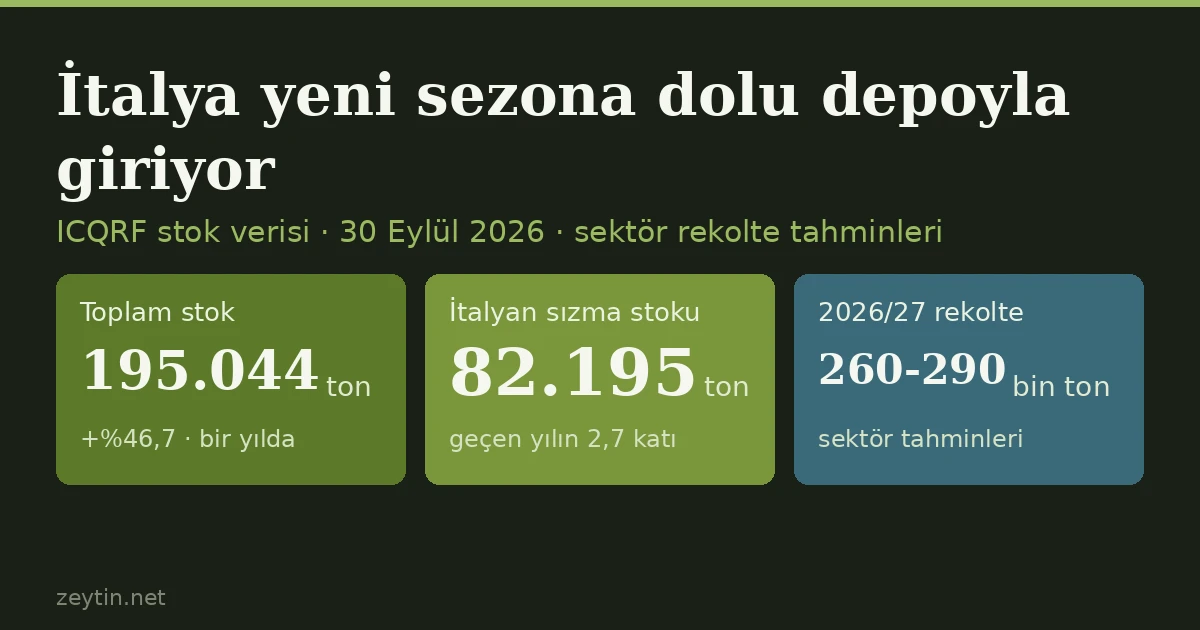
Italy enters the new season with full tanks: 195,000 tonnes in stock, a 260,000-290,000 tonne crop expected
ICQRF's Frantoio Italia register shows 195,044 tonnes of olive oil in Italian storage on 30 September 2026, up 46.7% in a year; Italian extra virgin stocks of 82,195 tonnes are 2.7 times last year's. Sector estimates put the 2026/27 crop at 260,000-290,000 tonnes, 11-20% below Ismea's 325,000. With stocks added, though, the supply of Italian oil is not shrinking: in the European Commission series Italian extra virgin fell from €9.26 to €4.37 a kilo in a year, and the gap with Spain narrowed from €5 to €1.
 Article
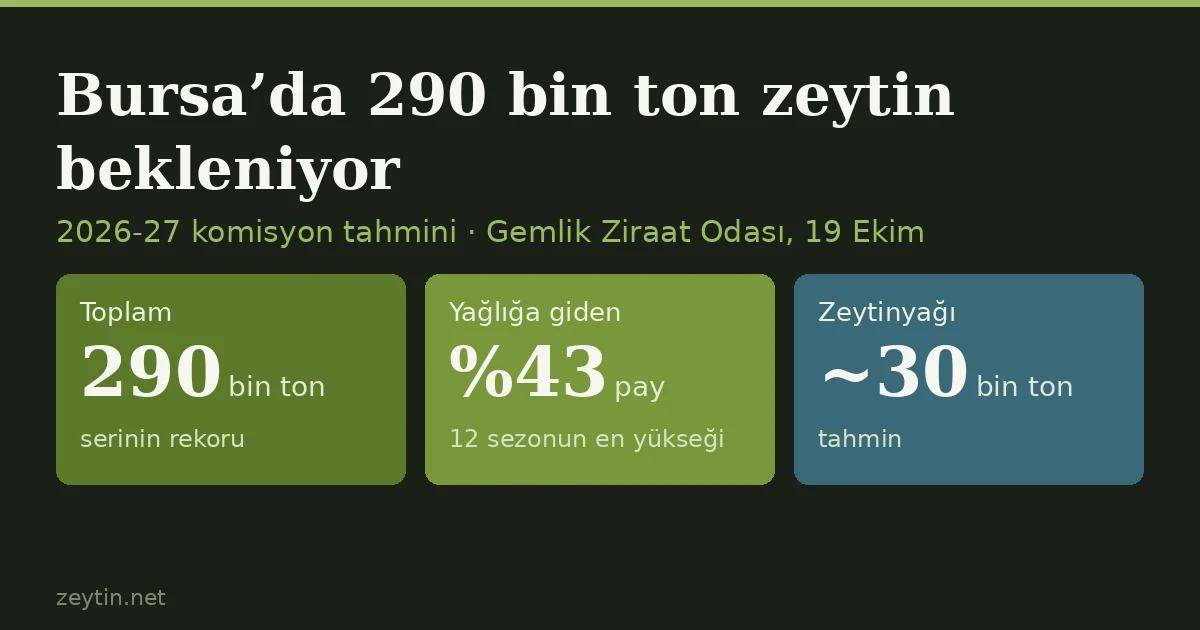
Bursa expects 290,000 tonnes of olives, with the biggest share going to oil in 12 seasons
According to a provincial commission estimate shared by the Gemlik Chamber of Agriculture on 19 October, Bursa expects 290,000 tonnes of olives this season: 165,000 tonnes of table olives, 125,000 tonnes of oil olives and about 30,000 tonnes of olive oil. The crop is a record for the series, and the 43 percent share going to oil is the highest in 12 seasons. Early-harvest olives are fetching 45-60 lira per kilo.
 Article
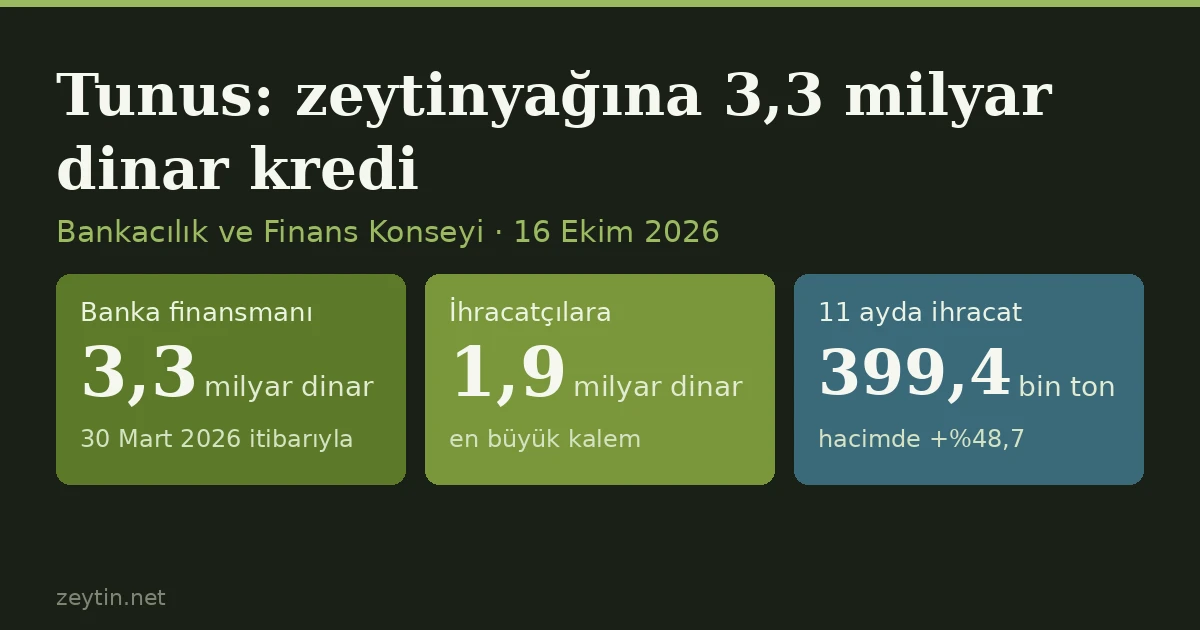
Tunisian banks lent 3.3 billion dinars to the olive oil season; the 2027 draft budget earmarks bulk export duties for a sector fund
According to Néji Ghandri, president of the Tunisian Banking and Financial Council, banks extended 3.2-3.3 billion dinars to the 2025/26 olive oil season by 30 March, up from 2.2 billion the season before; 1.9 billion went to exporters. Tunisia exported 399,400 tonnes in eleven months. The 2027 draft budget opens a 100-million-dinar credit line for small growers and earmarks 10 per cent of bulk export duty revenue for a sector fund; it is not a new tax.
 Article
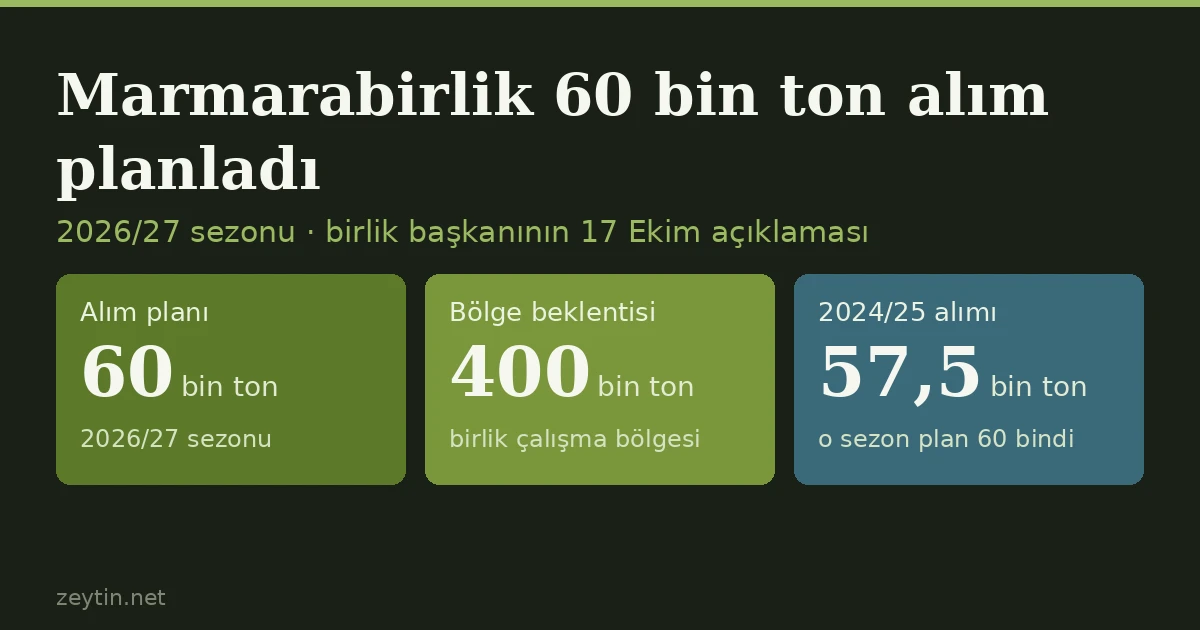
Marmarabirlik plans to buy 60,000 tonnes of olives: 15 per cent of the 400,000 tonnes expected in its region
According to a statement by chairman Ali Yıldız on 17 October, Marmarabirlik plans to buy about 60,000 tonnes of olives from growers this season, while its region expects 400,000 tonnes. The union set the same target in 2024/25 and closed that campaign at 57,500 tonnes. Crop declarations close on 23 October; the purchase price has not been announced.
 Article
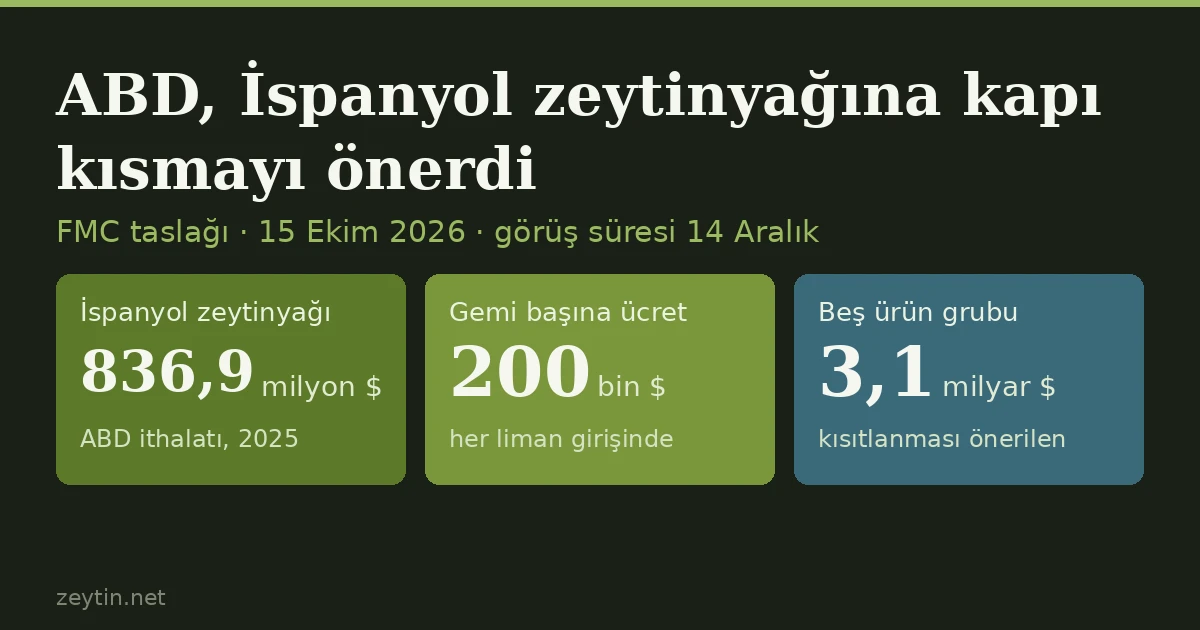
US proposes curbs on Spanish olive oil: $836.9 million of imports caught in a port dispute
The US Federal Maritime Commission published a proposed rule on 15 October in response to Spain turning away three US-flagged ships in 2024: a $200,000 fee per entry for Spanish-flagged vessels and import limits on five product groups. One of them is the oils and fats chapter; the US bought $836.9 million of Spanish olive oil in 2025. Any ship offloading covered goods, whatever its flag, could be held in port. Comments close on 14 December.
 Article
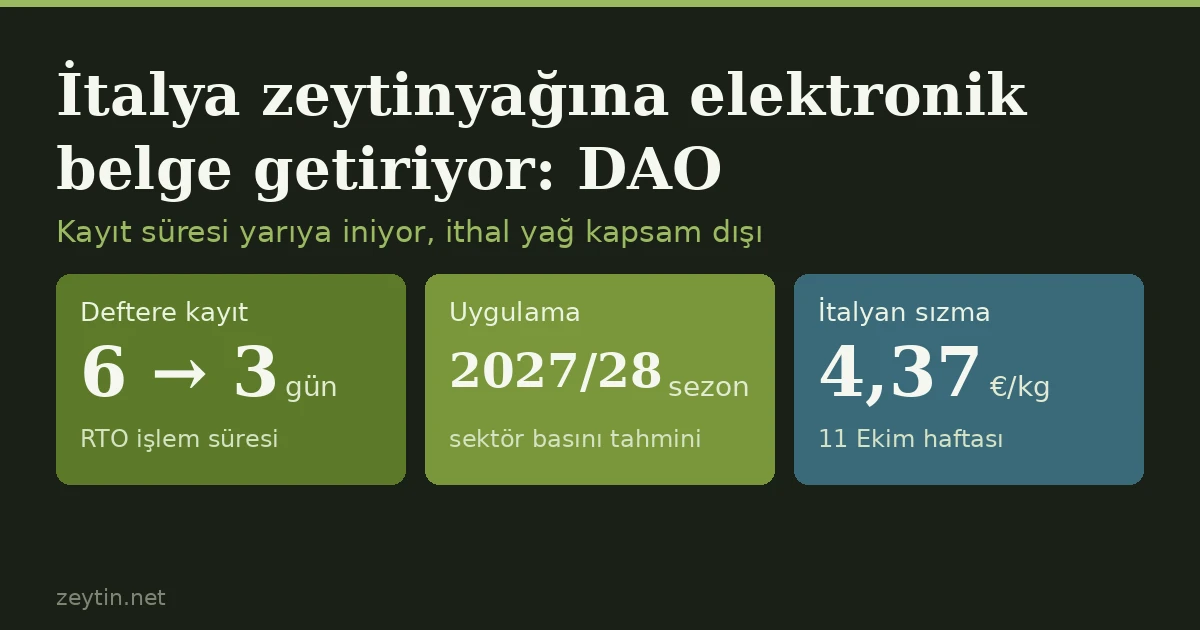
Italy to track olive oil with an electronic document: first positive response from the regions on the DAO, imported oil left out
A draft decree announced on 9 October by Italian agriculture minister Lollobrigida introduces the DAO, an electronic accompanying document that links olive and olive oil movements to the SIAN and RTO systems and cuts the register deadline from six days to three. According to the growers' committee, the state-regions conference gave a first positive response on 15 October. But the document only tracks domestic oil leaving a facility; oil from other EU states and third countries will keep entering with conventional paperwork. The trade press expects it to apply from the 2027/28 season.
 Article
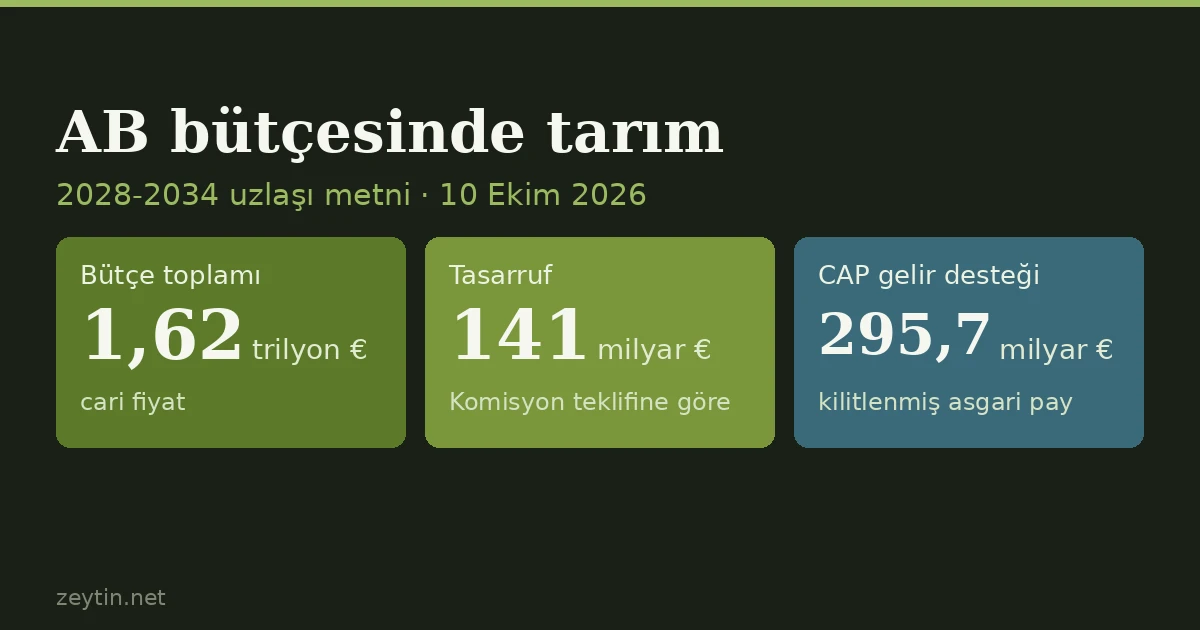
Agriculture in the EU budget bargain: allocations kept, the four big olive oil producers still object
Ireland, holding the Council presidency, circulated a revised compromise text for the 2028-2034 budget on 10 October: 1.62 trillion euros in current prices, savings of 141 billion euros (8%) against the Commission proposal, with agricultural and cohesion allocations retained. The objections have not stopped, because under the Commission proposal the income support of the Common Agricultural Policy is ring-fenced at 295.7 billion euros inside a single 865 billion euro fund, against 387.8 billion euros allocated to that policy for 2021-2027. All four of the Union's big olive oil producers sit in the group of 17 states resisting the cut.
 Article
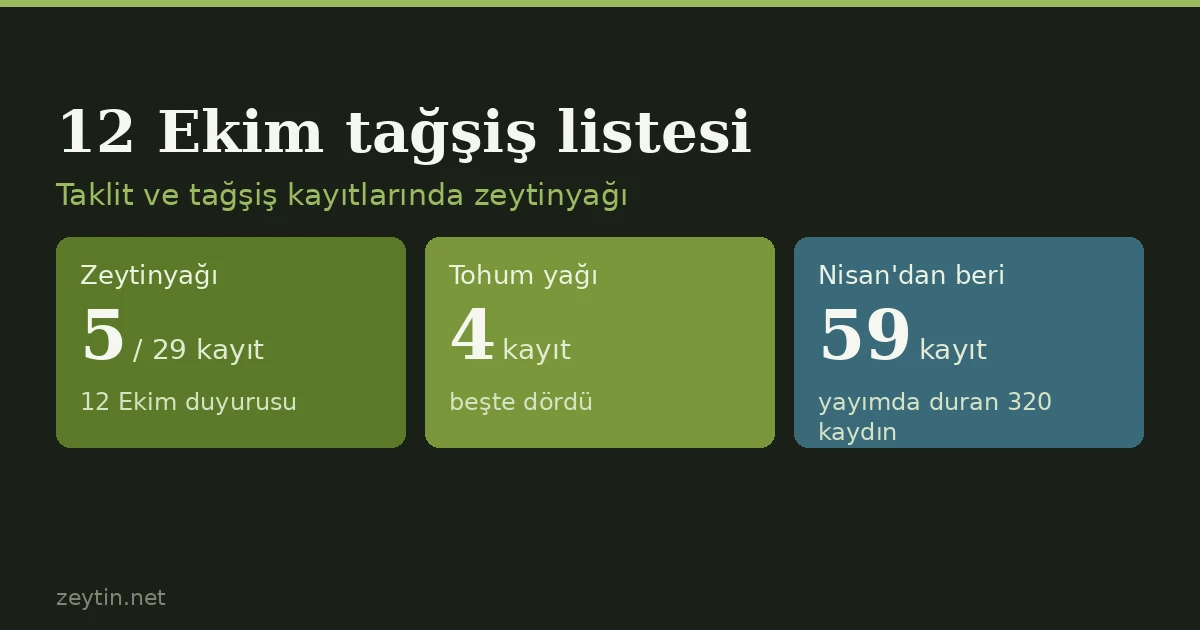
12 October adulteration list: five of 29 records are olive oil, four with seed oil
The ministry's 12 October 2026 notice added 29 records to Türkiye's counterfeit-and-adulteration list, five of them olive oil: four with seed oil blended in, one with lower-grade olive oil. Of the 320 records currently published, 59 are olive oil, and Manisa's count rose from one to three.
 Article
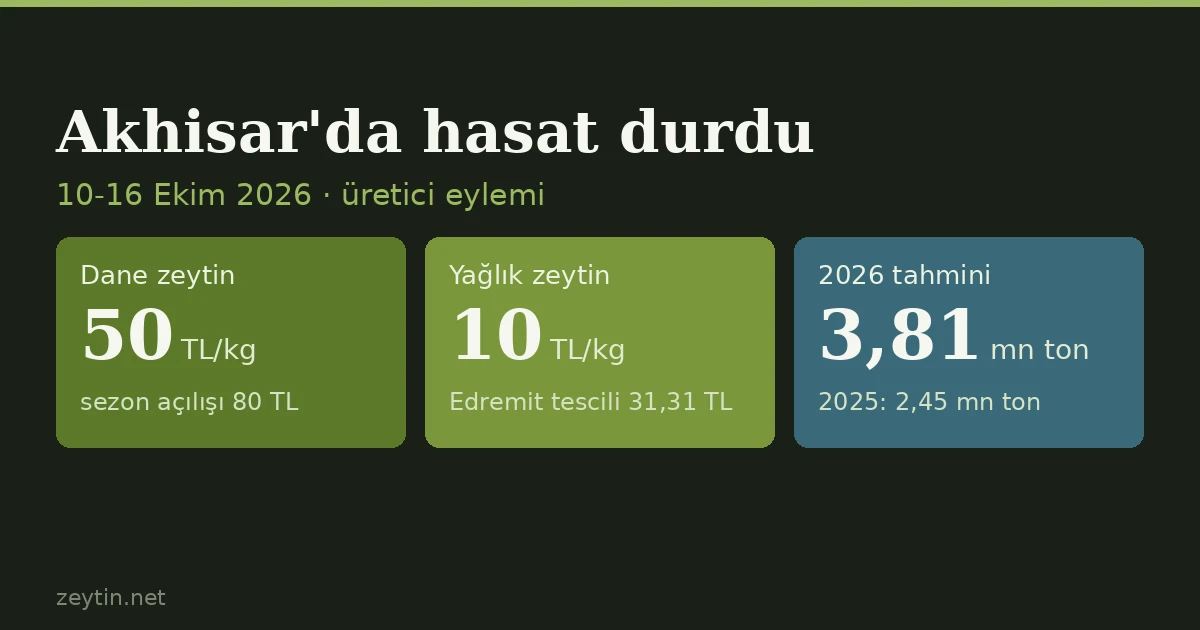
Harvest halted amid a record forecast: 50 lira for table olives in Akhisar, 10 for oil
Growers in Akhisar halted the harvest for a week on 10 October. Table olive prices that opened the season at 80 lira fell to 50, and oil olives to 10 — below last season's table olive floor. In the same days the official first estimate puts production at 3.8 million tonnes.
 Article
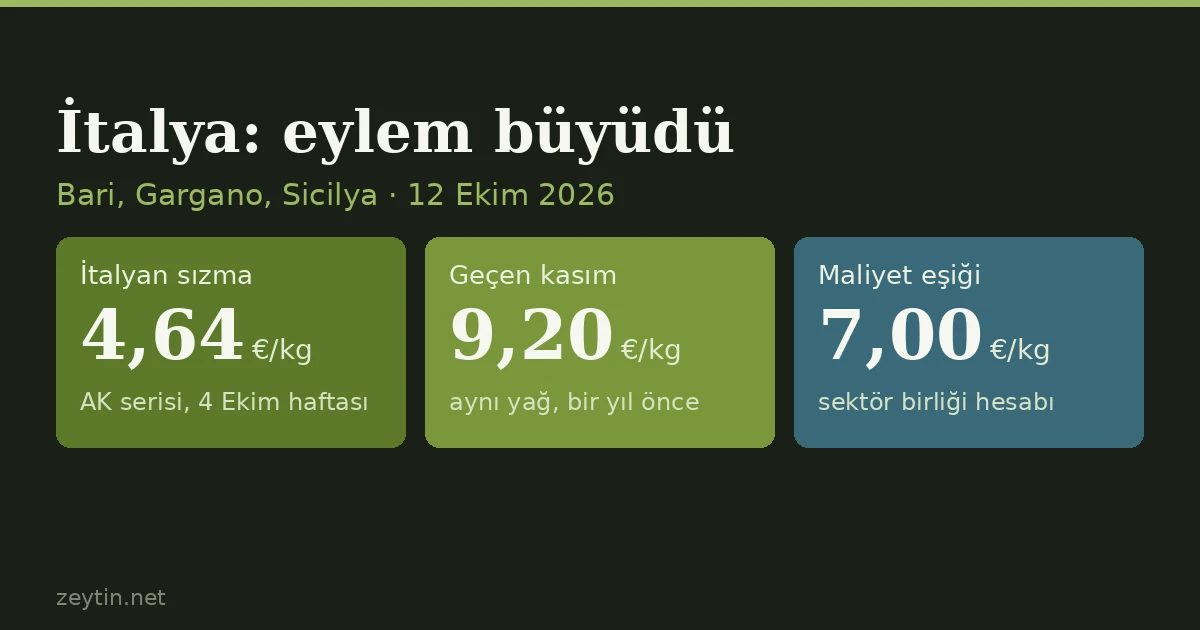
Italy's protest widens: thousands of growers in Bari, mills idle in Sicily, still no crisis status
The deadline given in Puglia expired without crisis status being granted: on 12 October thousands of growers gathered in front of the Bari prefecture, hundreds of tractors blocked roads on the Gargano, and harvesting and milling have been suspended since 5 October across nine municipalities in Sicily. Two of the four demands concern anti-fraud controls and an electronic transport document for olives. In the European Commission series, Italian extra virgin stood at 4.64 €/kg in the week of 4 October; the figure quoted in the field is 4 euros, against 9.20 € last November. The next threshold is 15 October.
 Article
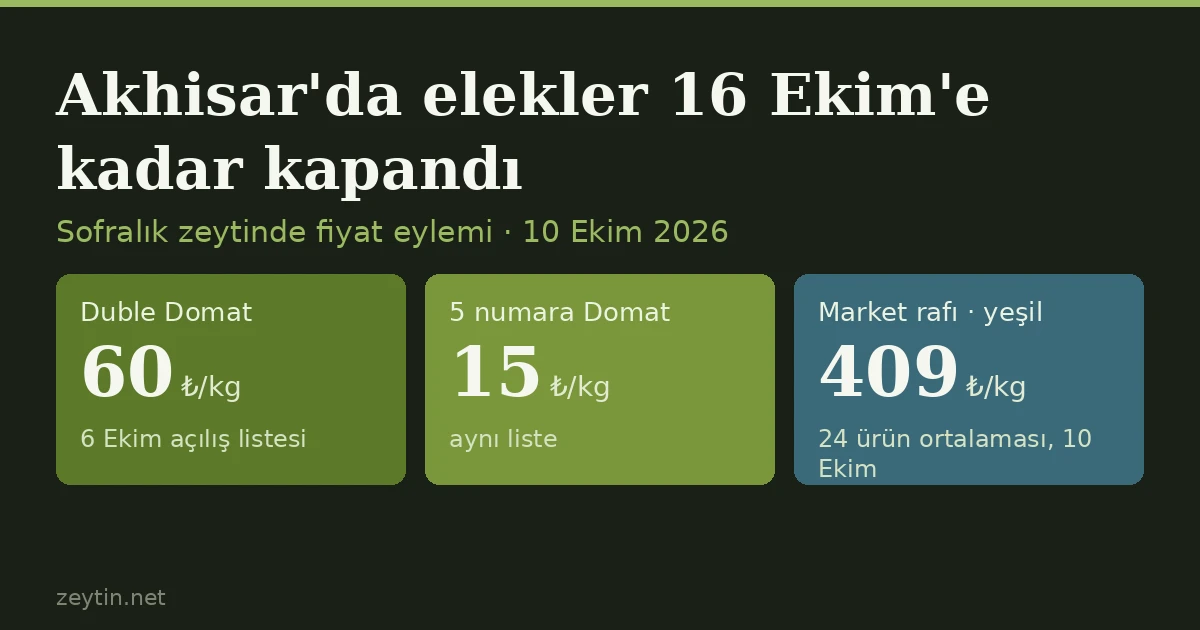
Sieves shut until 16 October in Akhisar: the table-olive price protest spreads to a second basin
In Akhisar's Zeytinliova neighbourhood, growers and commission agents have shut their sieves and halted harvesting and sales until Friday 16 October; purchases also stopped in Ballıca and Bünyaniosmaniye. In Ataeymir, in Aydın's Karacasu district, buying was suspended for three days from 8 October. Türkiye has no state floor price for table olives, and the cooperative union treated as the reference has not yet announced its 2026/27 purchase prices.
 Article
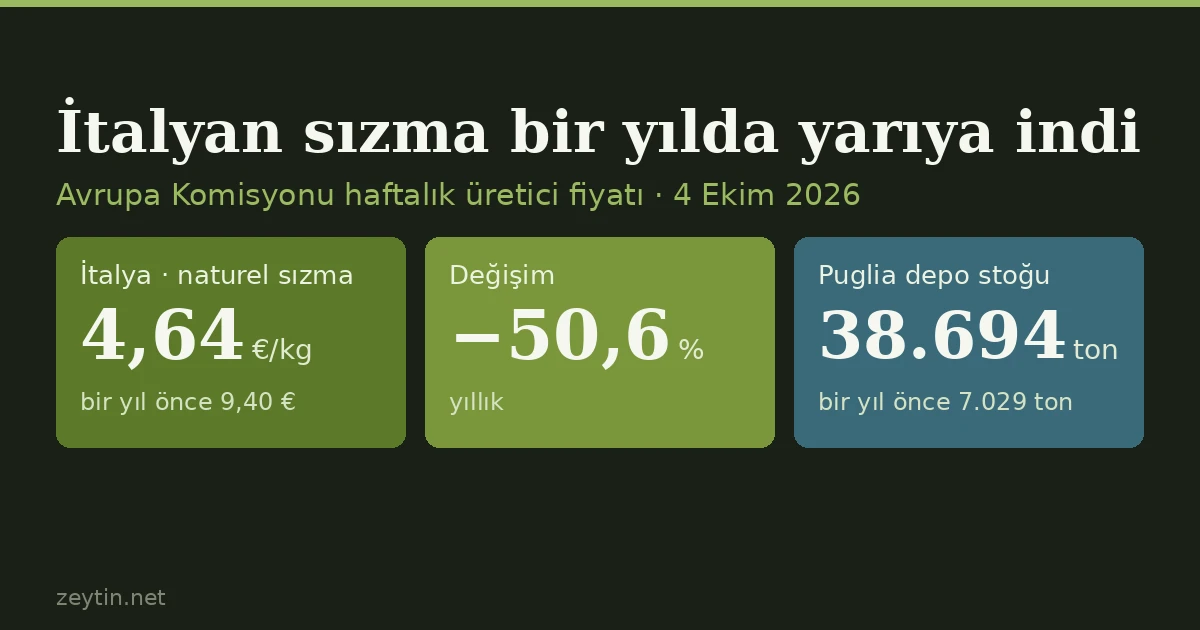
Italian extra virgin has halved in a year: growers in Puglia set a Monday noon deadline
According to the European Commission's weekly producer prices, Italian extra virgin olive oil fell to €4.64 a kilo in the week of 4 October; a year earlier, in the same week, it was €9.40. Growers in Puglia have taken to the streets in the opening days of the harvest, holding sit-ins in Corato and Bitonto and giving the government until noon on 12 October to respond. Italian extra virgin stored in the region's warehouses has risen fivefold in a year.
 Article
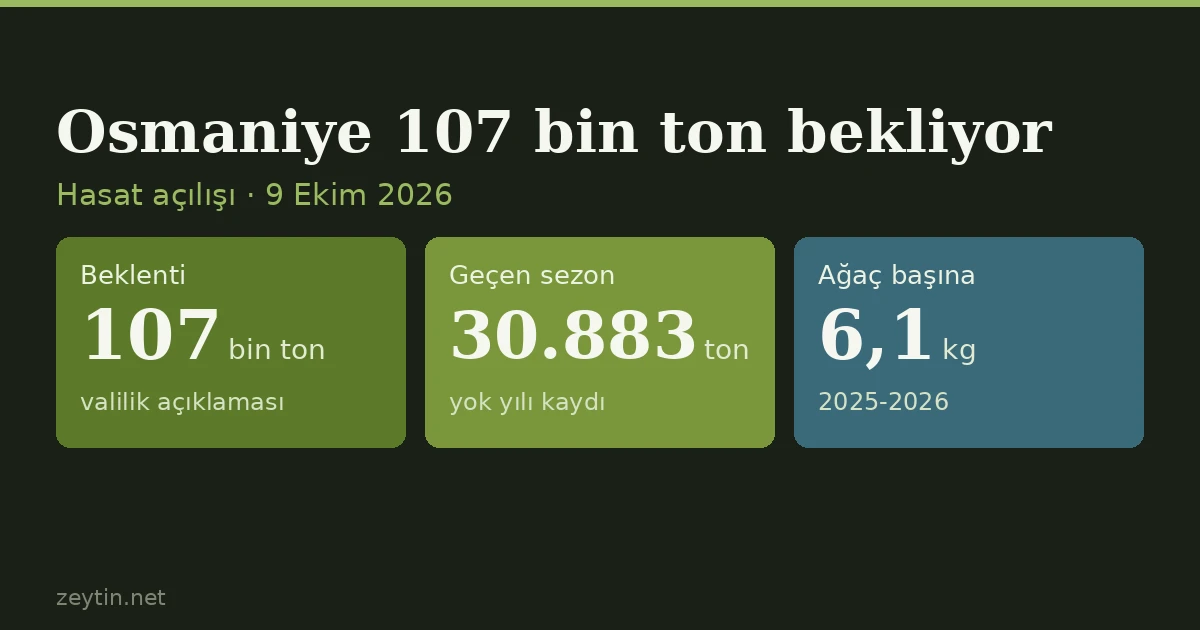
Osmaniye expects 107,000 tonnes: 3.5 times last season, in line with on-year averages
The governor's office in Osmaniye says the province's roughly 10 million olive trees are expected to yield more than 107,000 tonnes this year. That is 3.5 times last season — but 2025-2026 was an off year, and the forecast is consistent with on-year yields. Small discrepancies remain in tree counts and ranking.
 Article
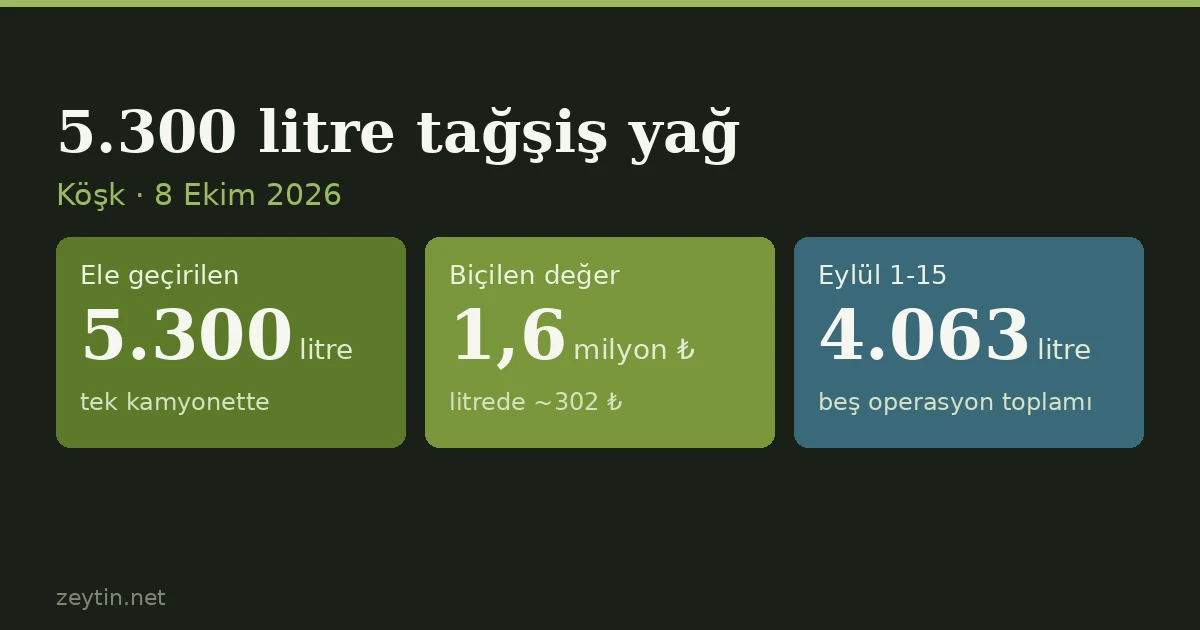
5,300 litres of adulterated oil in one van at Köşk — more than all of September
A van stopped on the Aydın-Denizli highway was found to be carrying 5,300 litres of counterfeit and adulterated olive oil, valued at 1.6 million lira; two people face proceedings. The single shipment exceeds the 4,063 litres seized across five operations in the province in the first half of September.
 Article
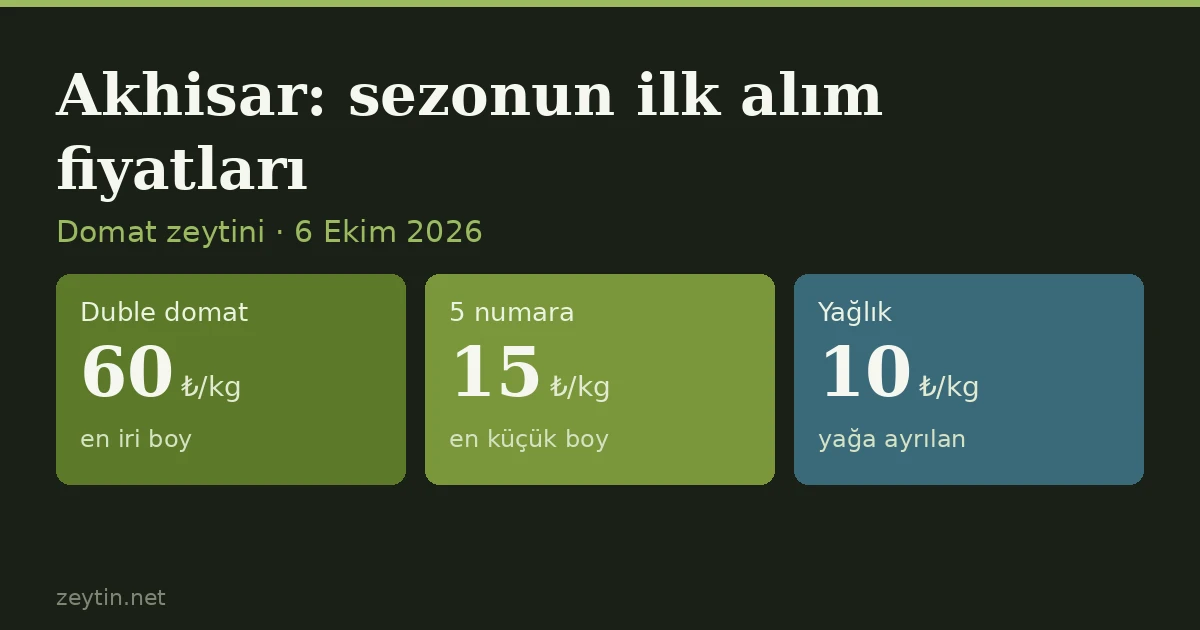
Opening prices in Akhisar: 60 lira for double Domat, 10 lira for milling olives
The season's first purchase prices for Domat olives have formed in Akhisar: 15 to 60 lira a kilo by size, and 10 lira for fruit sold for milling. The local chamber of agriculture says prices are below last year's and has called for a joint table. Farm input costs rose 27.6% over the same period.
 Article
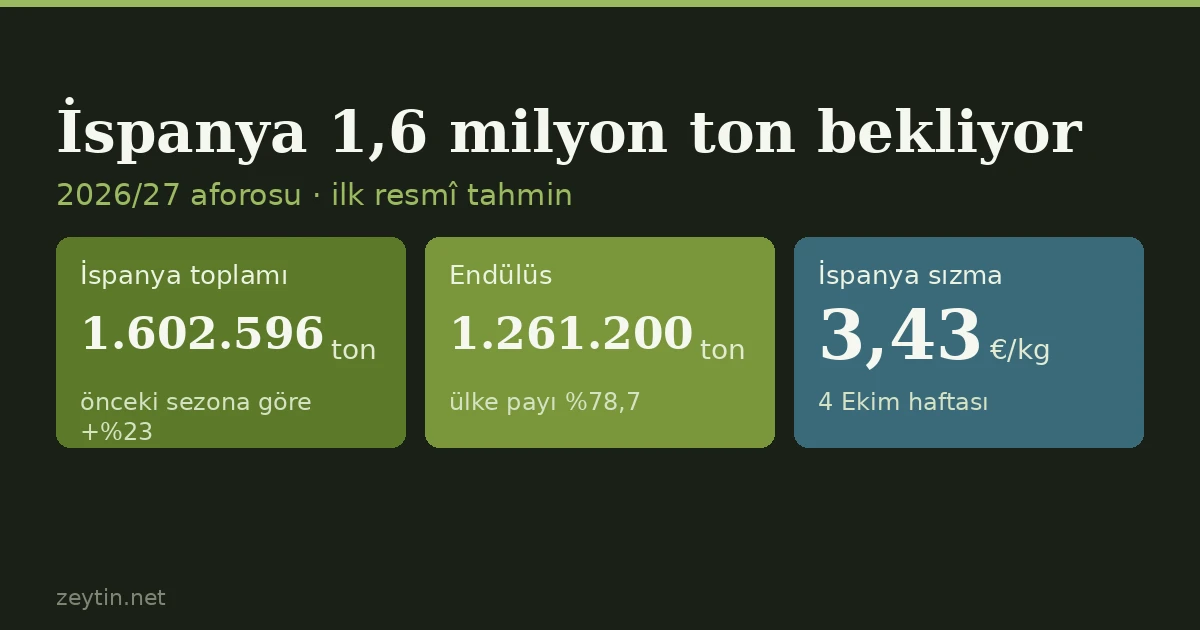
Spain's official estimate: 1.6 million tonnes, and prices have already fallen
Spain's agriculture ministry has published its first official 2026/27 crop estimate: 1,602,596 tonnes of olive oil, 23% above last season. Andalusia alone expects 1.26 million tonnes. Producer prices did not wait for the estimate — Spanish extra virgin has slipped to 3.43 euros a kilo.
 Article
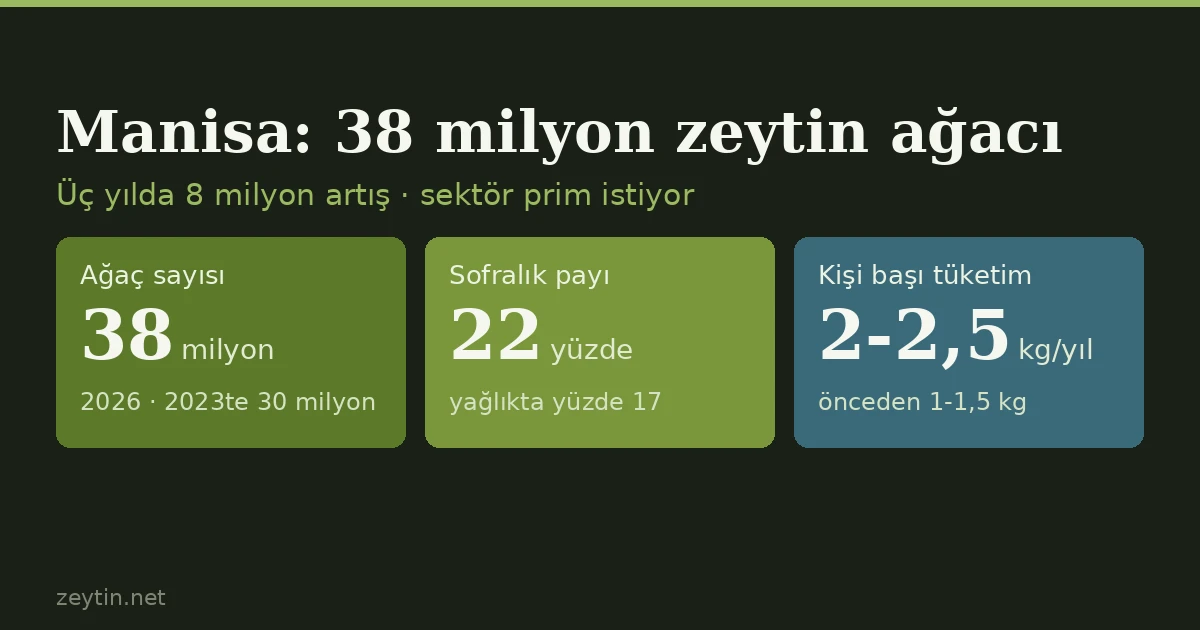
Manisa's olive trees reach 38 million: 8 million added in three years, sector asks for premium support
Manisa's olive tree count rose from 30 million in 2023 to 38 million in 2026. Data shared at a sector meeting hosted by the Manisa Commodity Exchange shows the province alone accounts for 17 percent of Turkey's oil-olive output and 22 percent of its table-olive output. The meeting also reported that annual per-capita olive oil consumption in Turkey has climbed from 1-1.5 kg to 2-2.5 kg. Exchange chairman Sadık Özkasap called for higher state support and premium incentives against the lower processing costs of Spain, Tunisia and Morocco.
 Article
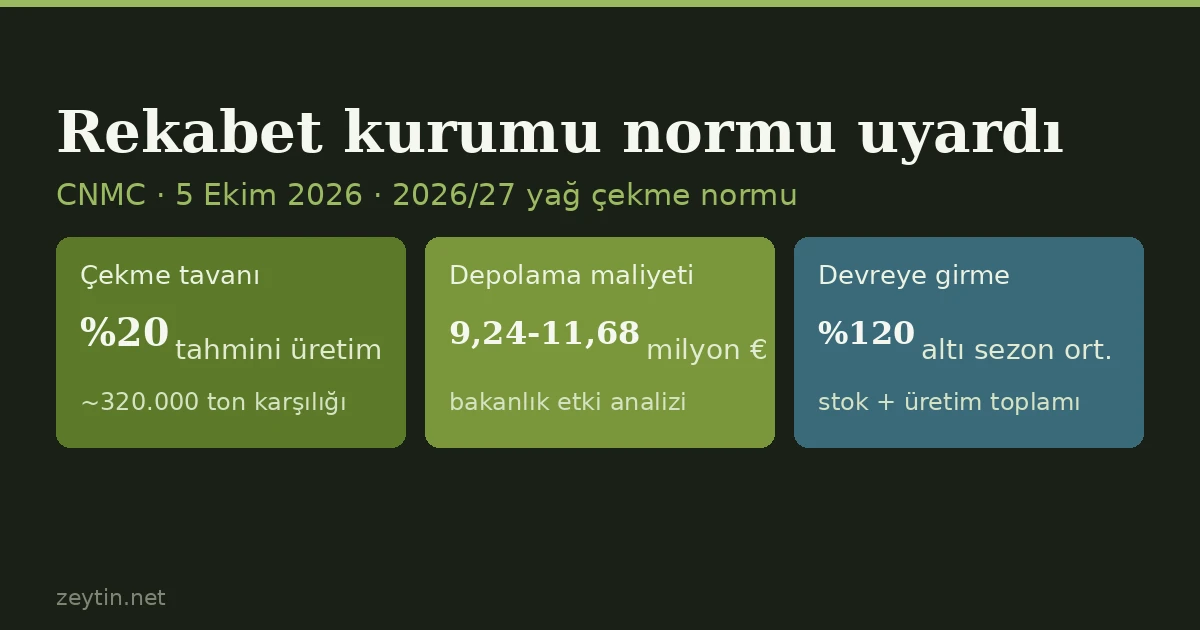
Spain's competition authority opposes the withdrawal rule: "very negative for competition and consumers"
On 5 October the CNMC published its report on the draft rule that would withdraw part of Spain's olive oil from the market in the event of oversupply in 2026/27. The authority says the measure would raise prices and narrow quality and variety. The ministry's own impact assessment puts storage costs at €9.24-11.68 million. The withdrawal cap is 20 percent of estimated production — up to 320,000 tons.
 Article
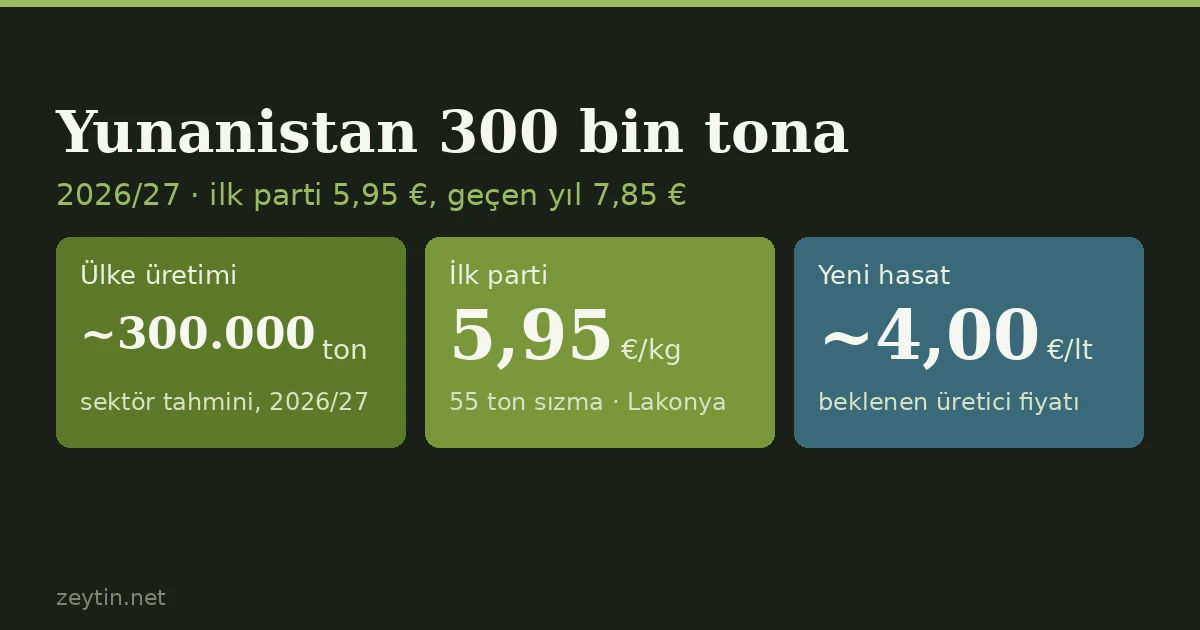
Greece heads for 300,000 tons: first lot sold at €5.95 after last year's €7.85
Greece expects its largest olive oil harvest since 2022/23 in 2026/27, with industry estimates near 300,000 tons. The season's first lot — 55 tons of extra virgin in Laconia — changed hands at €5.95 per kilo, down from €7.85 a year earlier. Carryover oil sells near €3.40 and new-crop producer prices are expected around €4. A simultaneous rebound across the three largest producers pushes down the world price Turkish exporters will meet.
 Article
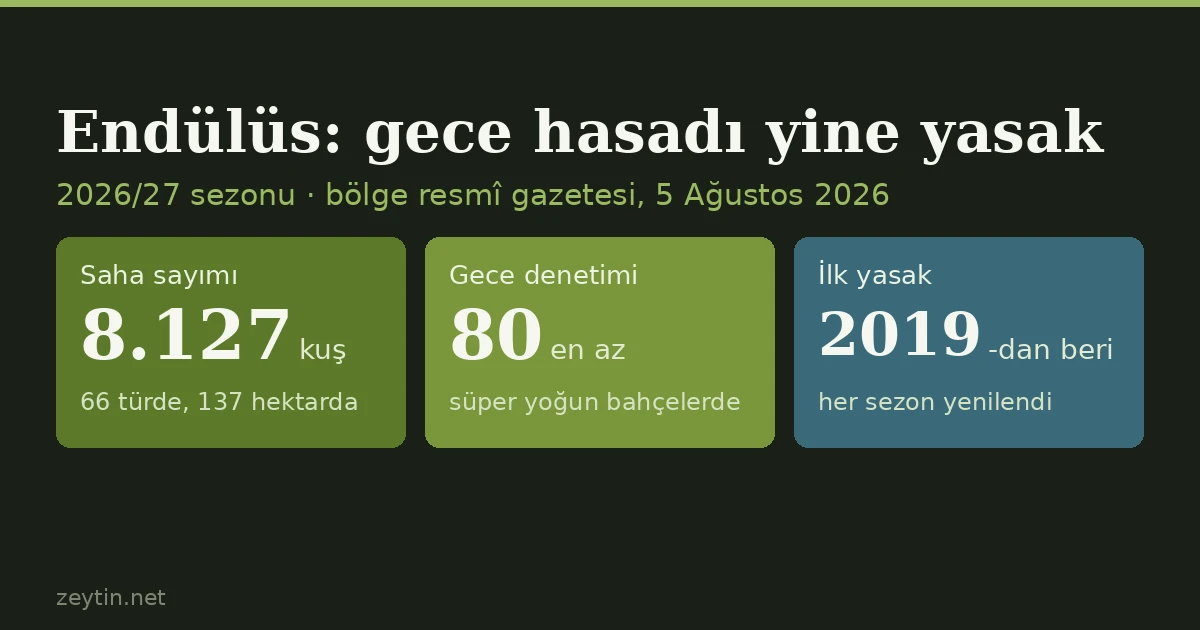
Andalusia bans night harvesting again for 2026/27: 8,127 birds counted on 137 hectares
Andalusia has again suspended night-time mechanical harvesting in super-intensive hedgerow olive groves for the 2026/27 season. The resolution is dated 30 July 2026, was published in the regional official gazette on 5 August and is valid for one year. The justification is field counting: 8,127 birds from 66 species on 137 hectares. The suspension was first introduced in 2019 and has been renewed every season since.
 Article
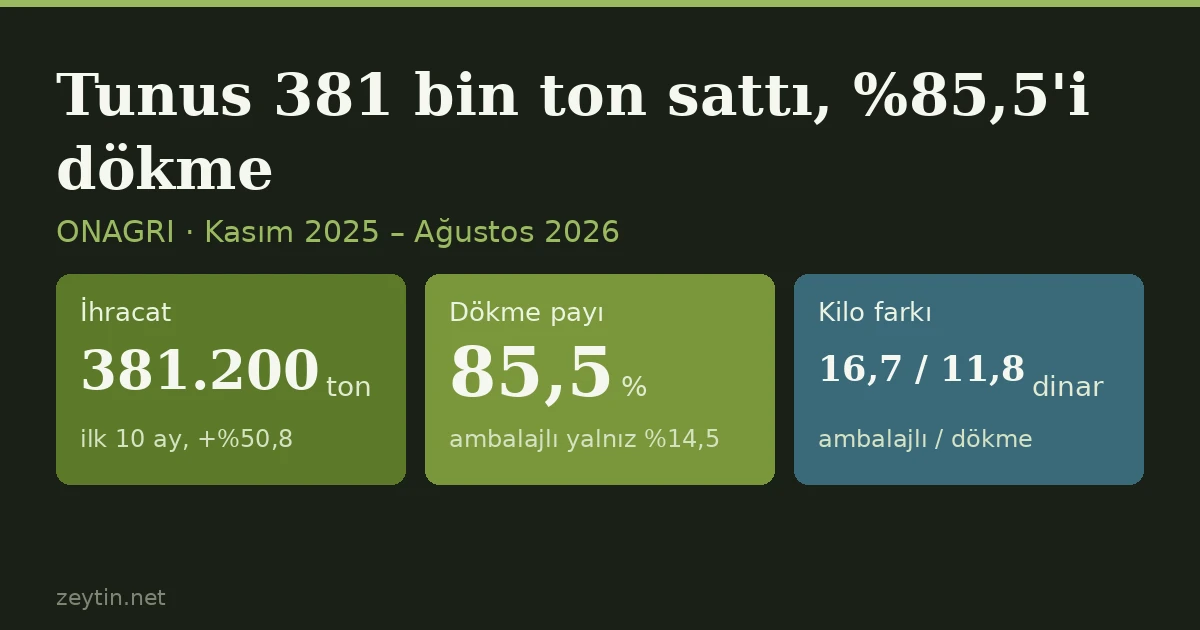
Tunisia sold 381,000 tonnes of olive oil in ten months: 85.5% in bulk, half of it to Spain and Italy
According to the National Observatory of Agriculture (ONAGRI), Tunisia exported 381,200 tonnes of olive oil in the first ten months of the 2025/26 season — volumes up 50.8% and receipts up 41.2% year on year. But 85.5% of it left the country in bulk, and more than half went to Spain and Italy. Packaged oil averaged 16.7 dinars per kilo against 11.8 for bulk. Production is set to fall 40% next season, which changes the bulk market Turkish exporters face.
 Article
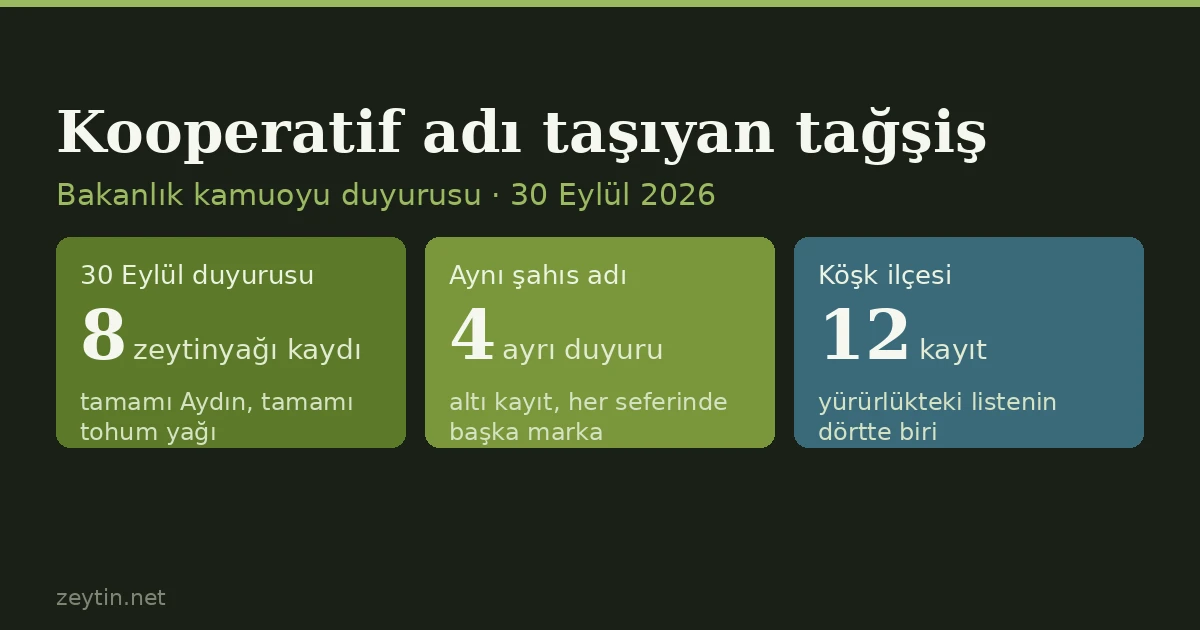
Co-op branding in the adulteration list: one name, four separate announcements
All eight olive oil entries in Turkey's 30 September 2026 food-fraud announcement come from a single province, Aydın, and all eight carry the same finding: seed oil blended into oil sold as extra virgin. The brand names tell a second story — three of them invoke a cooperative or a producers' union. Read as a time series, the live list shows one trader's name across four separate announcements, under a new brand each time.
 Article
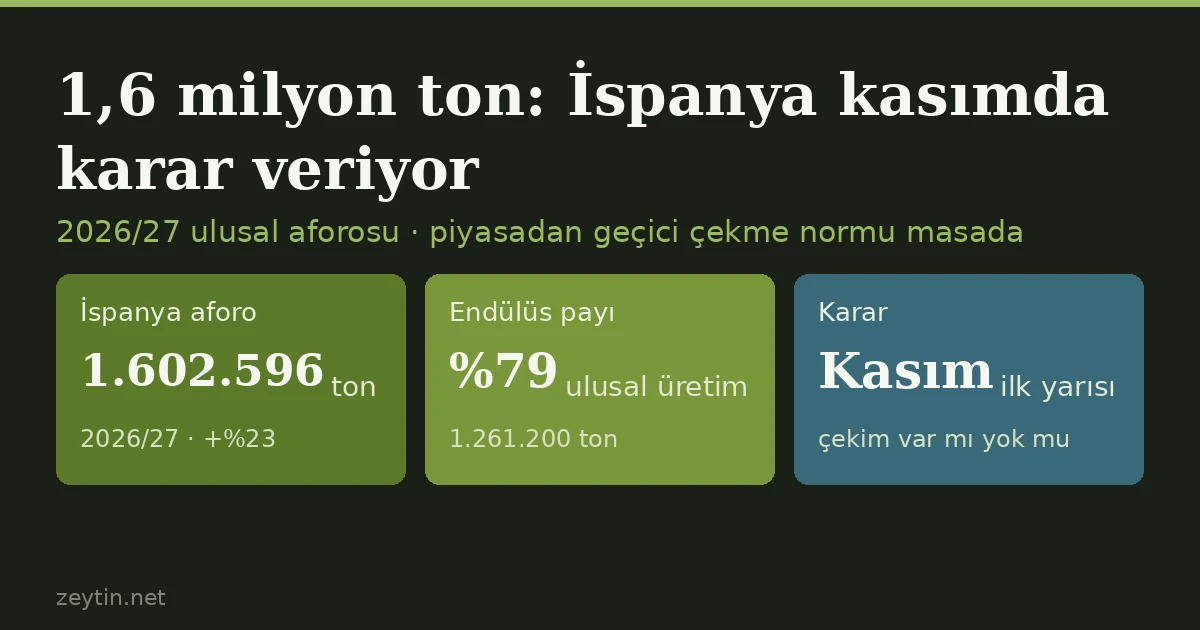
Spain decides in November: will part of a 1.6 million tonne crop be withdrawn from the market?
Spain's first national aforo for 2026/27 was presented in Jaén on 1 October: 1,602,596 tonnes of olive oil, 23% above last harvest. With carry-over stock, total availability approaches two million tonnes, and the Ministry of Agriculture will decide in the first half of November whether to activate a temporary withdrawal mechanism that has never been used. The ceiling on the world price Turkish exporters will face is being set here.
 Article
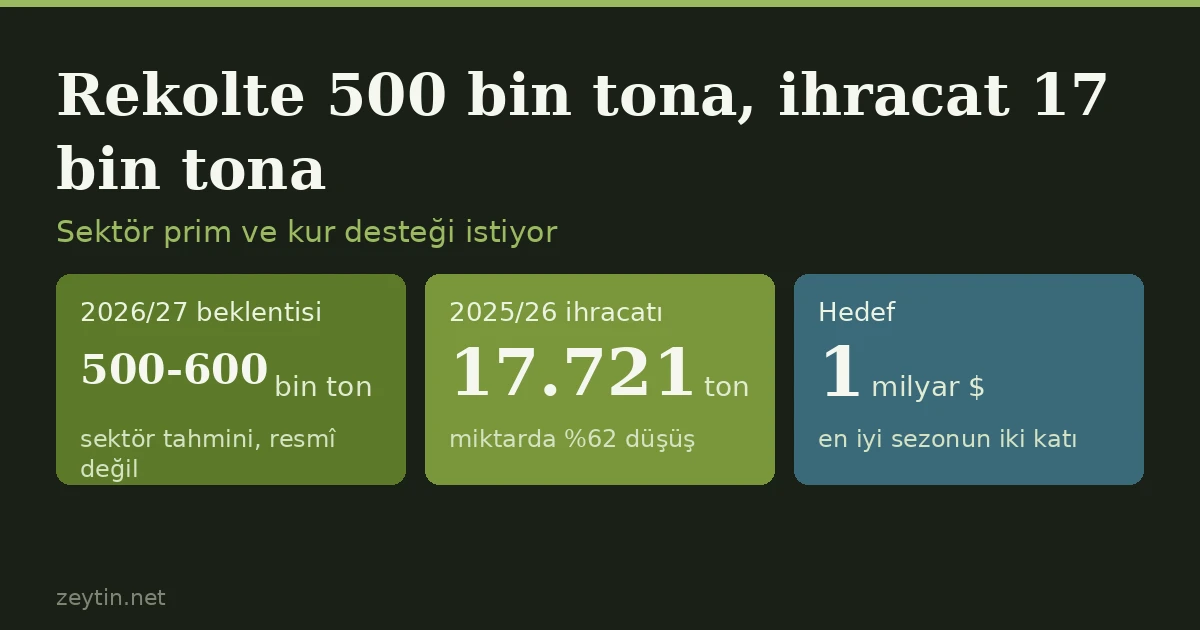
The crop is heading for 500,000 tonnes, exports fell to 17,000: the sector wants a premium and an exchange-rate mechanism
Industrialists and exporters meeting in Izmir put this season's olive oil crop at 500,000-600,000 tonnes. Last season Türkiye shipped 17,721 tonnes of olive oil: down 62% in volume and 59% in value. The crop is not the problem; selling the crop is.
 Article
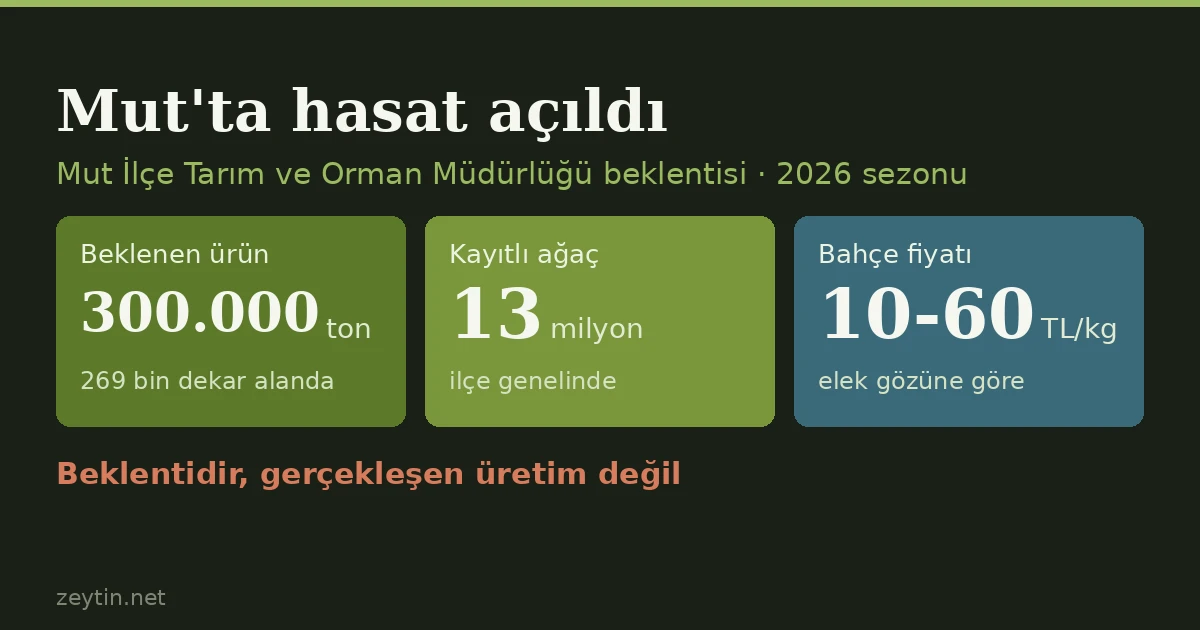
Harvest opens in Mut: 300,000 tonnes expected, orchard prices start at 10 lira
Mut's district agriculture directorate reports 300,000 tonnes expected from 269,000 decares, with orchard prices ranging from 10 to 60 lira by sieve size. Yield is high but growers are unhappy with prices. Set against our own Mersin figures the tonnage leaves an unresolved measurement gap, and we report it as such.
 Article
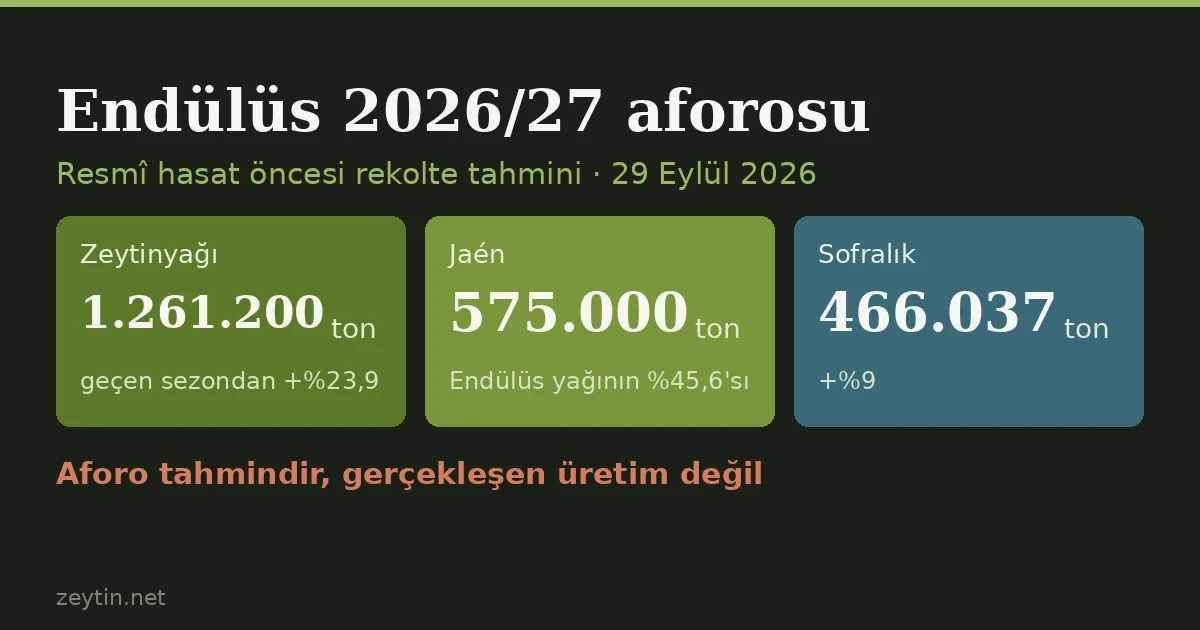
Andalusia finally puts a number on it: 1.26 million tonnes of olive oil, up 24%
Andalusia's agriculture ministry published its 2026/27 aforo on 29 September in Mengíbar: 1,261,200 tonnes of olive oil, 23.9% above last season and 44% above the five-year average. The heat warning growers raised in early September made it into the forecast's own reasoning. Four times Turkey's entire season output is entering an already soft price environment.
 Article
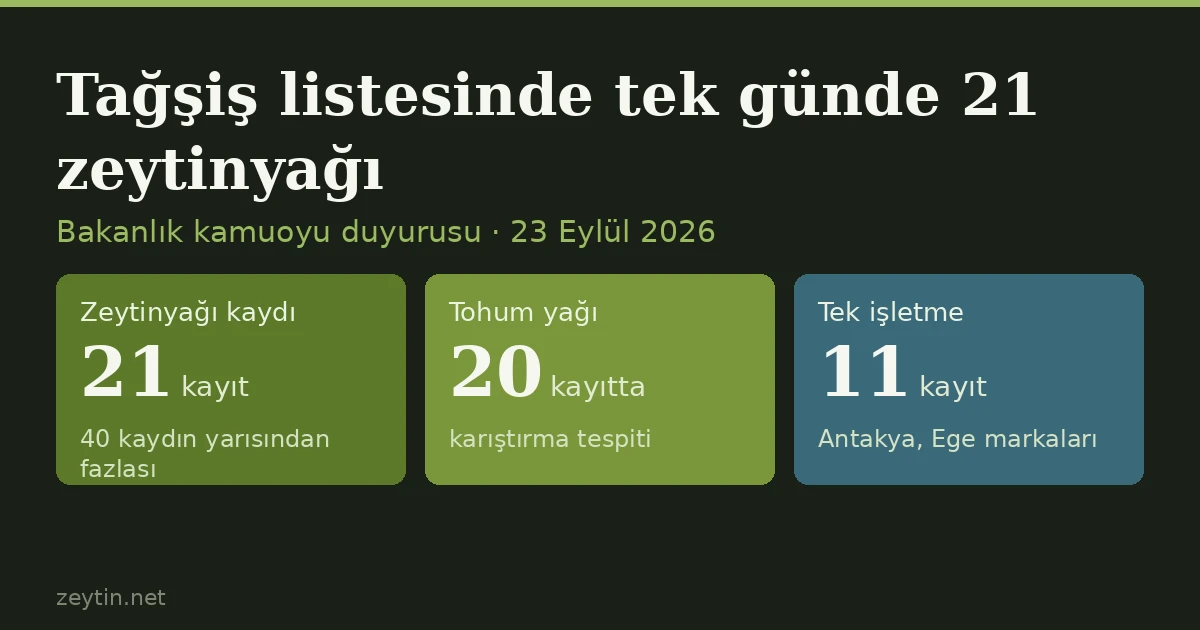
Twenty-one olive oils on the ministry's adulteration list in one day, eleven from a single Antakya business
Of the 40 records added to Turkey's counterfeit-and-adulteration list on 23 September 2026, 21 are olive oil, and 20 of those were found to contain seed oil. Eleven records belong to a single business registered in Antakya, marketing under Aegean origin names such as Ayvalık, Akçay-Altınoluk and Kazdağları. Sixteen of the containers were five litres.
 Article
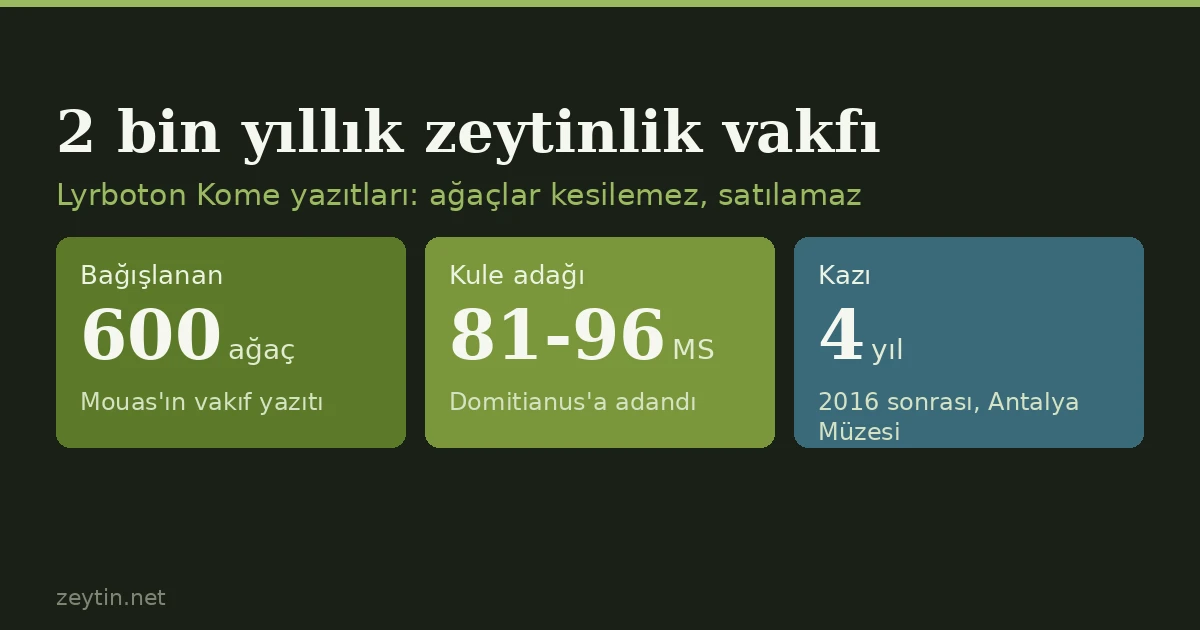
A 2,000-year-old olive grove endowment in Antalya: 600 trees, “never to be cut or sold”
The excavation results from Lyrboton Kome in Antalya have been presented. Inscriptions record a family endowing its farm and 600 olive trees in perpetuity, with an explicit clause: these trees can never be cut, sold or put to another use.
 Article
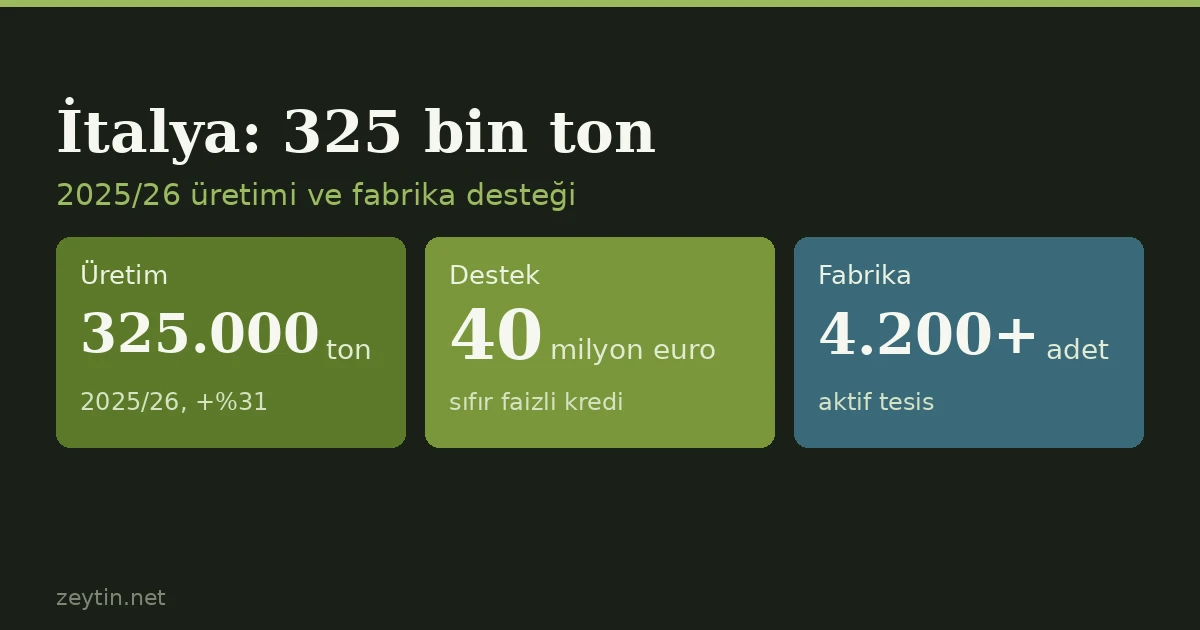
Italy is back at 325,000 tonnes yet is handing cash to its mills: a 40-million-euro zero-interest loan
Italy produced 325,000 tonnes of olive oil in the 2025/26 campaign, up 31%, according to Ismea's sector report. Yet even as output recovers, the state is pumping liquidity into mills: the 40-million-euro "Cambiale Frantoi Oleari" offers zero-interest loans of 3,500 to 50,000 euros. The five-year national olive plan aims to lift production by 25%.
 Article
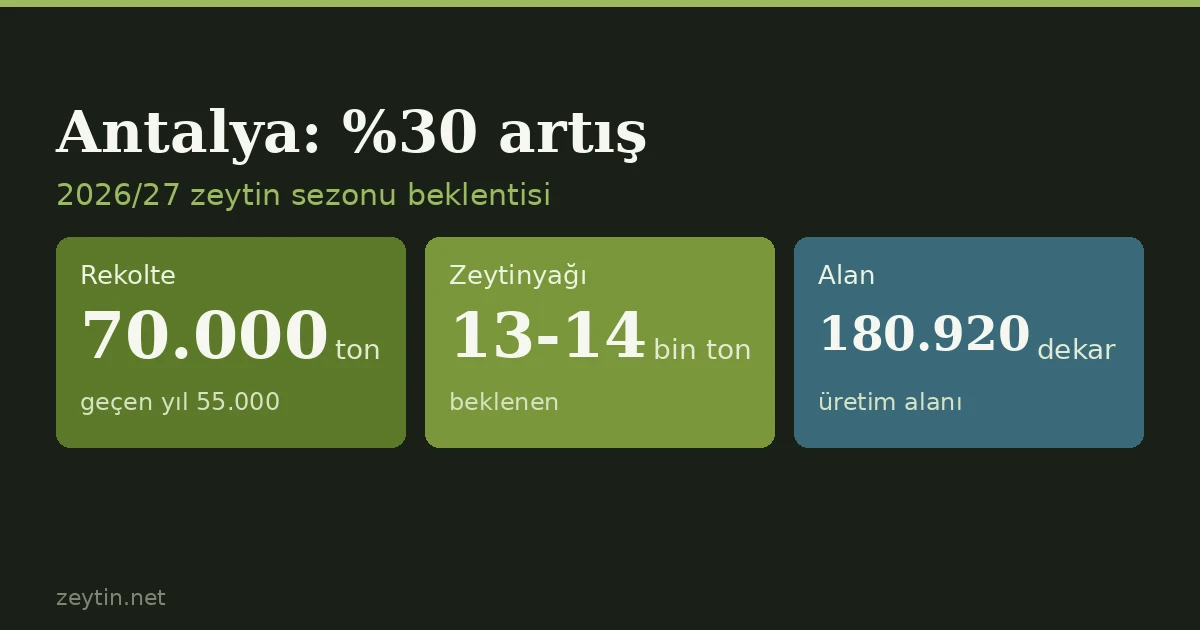
Antalya's crop is up 30%: of 70,000 tonnes of olives, 55,000-60,000 head for the mill
According to the Antalya Commodity Exchange, the province's olive crop is rising about 30% from some 55,000 tonnes last season to around 70,000 tonnes, with 13,000-14,000 tonnes of olive oil and 10,000-15,000 tonnes of brined fruit expected. Harvest opened on 15 September. There is movement on the registration front too: an EU application has been filed for the Tavşan Yüreği olive, and a geographical indication file is under way for the Beylik variety.
 Article
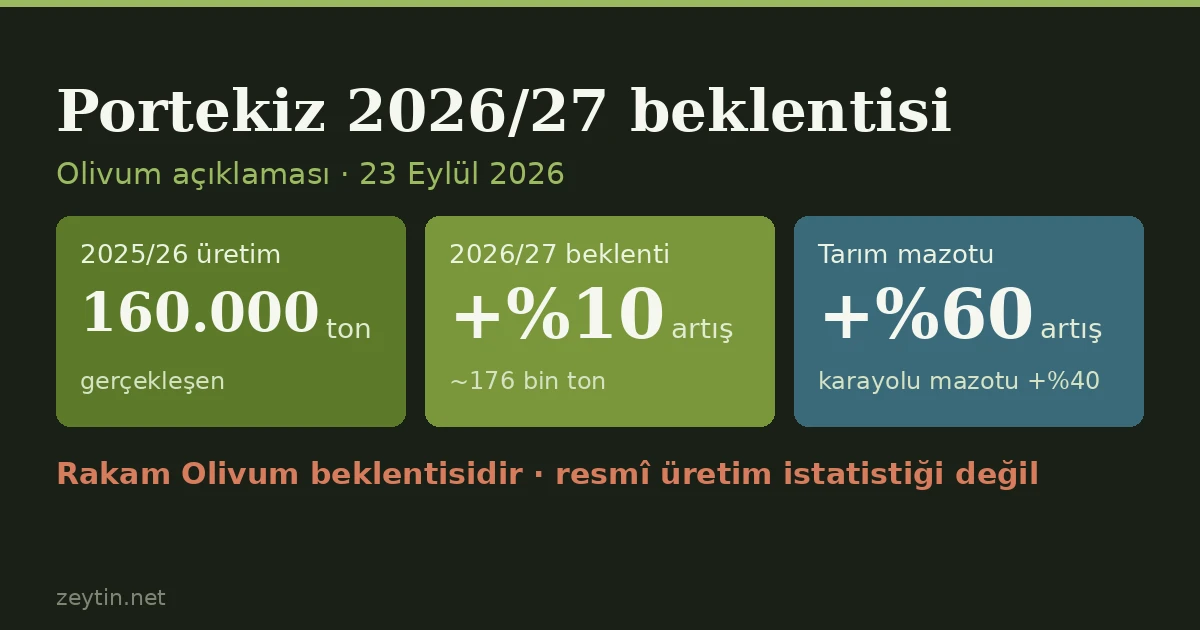
Portugal heads back to 177,000 tonnes: output up 10%, farm diesel up 60%
Portugal's olive association Olivum expects production to rise by about 10% in 2026/27 — a return from 160,000 tonnes to the 177,000 of two years ago. The same statement records a 60% rise in the price of agricultural diesel.
 Article
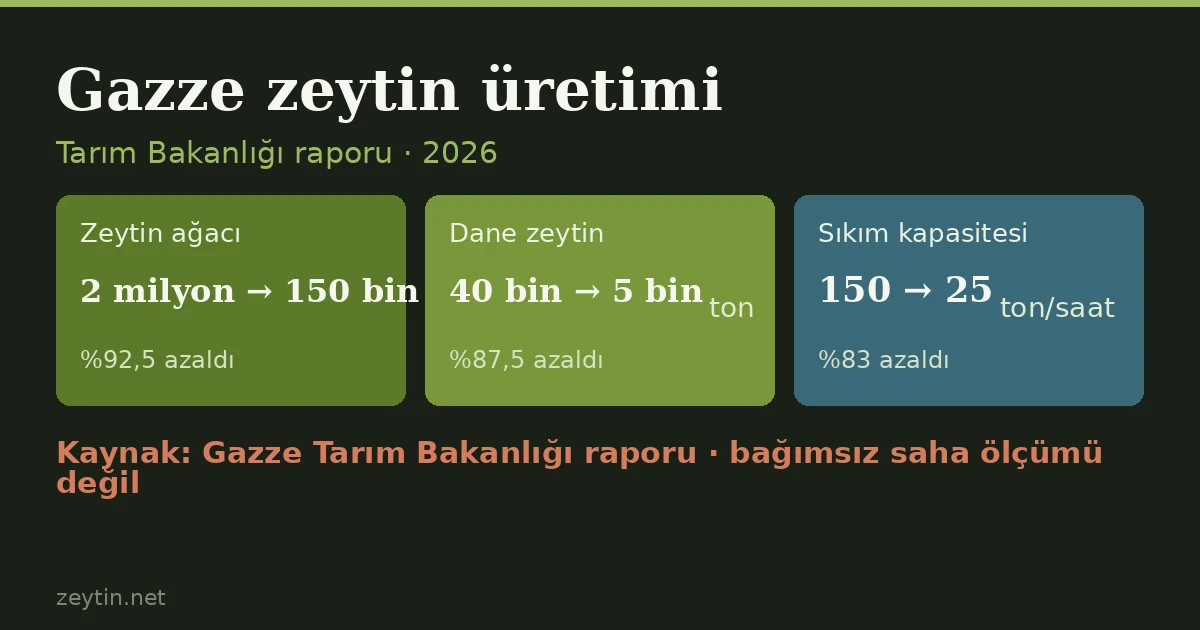
Gaza's olive report: 150,000 trees left of two million, production down 87.5%
According to a report from Gaza's Ministry of Agriculture, olive groves have shrunk from 50,000 dunums to 5,000 and the olive crop from 40,000 tonnes to 5,000. The loss is not confined to the grove: milling capacity has fallen from 150 tonnes an hour to 25, and the number of growers from 20,000 to 1,000.
 Article
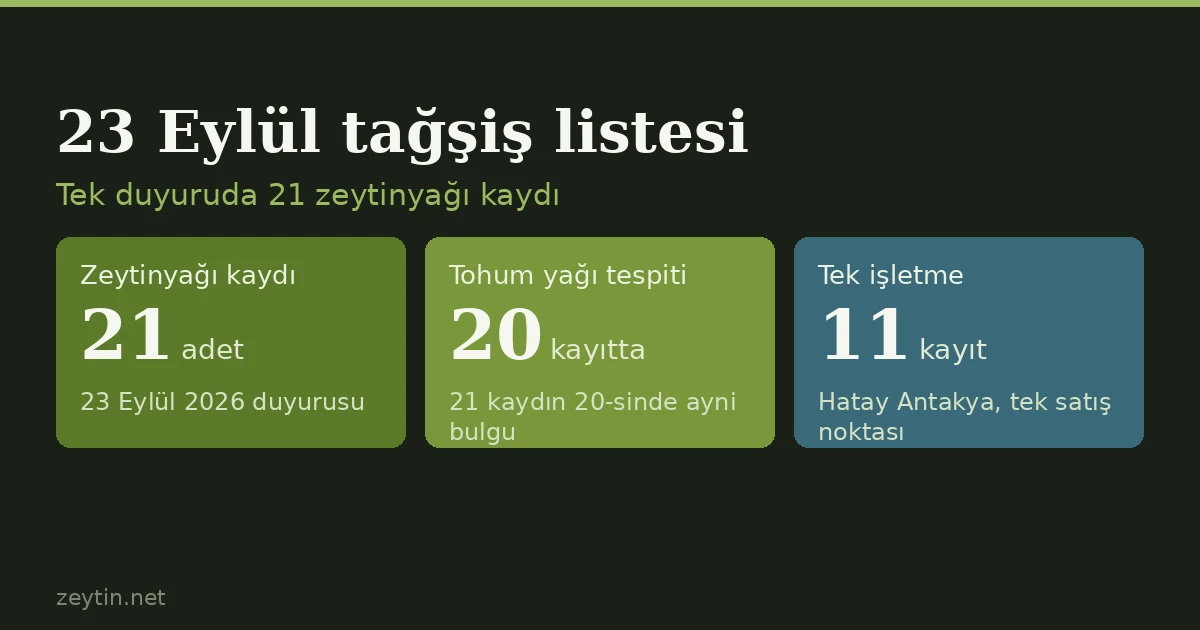
Turkey's 23 September fraud list: 21 olive oils, 11 from a single seller
Twenty-one olive oil entries joined Turkey's public food-fraud register on 23 September 2026 — two-thirds of what the other eleven announcements since April produced combined. In twenty of them the finding is identical: seed oil adulteration.
 Article
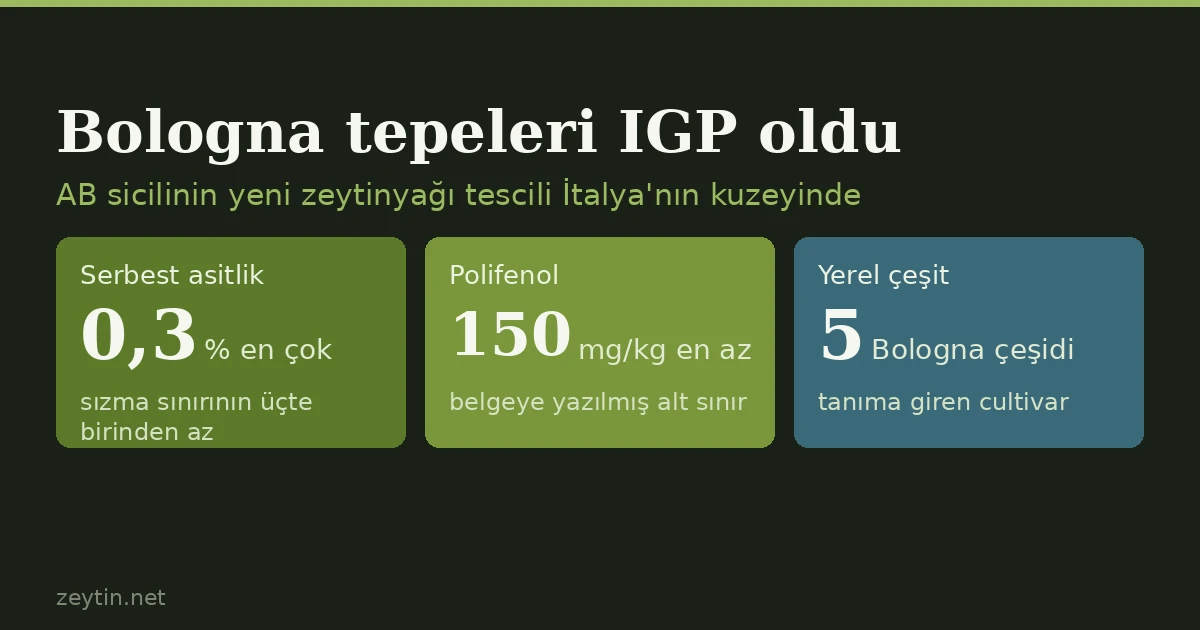
The EU's newest olive oil registration is in northern Italy: Olio dei Colli di Bologna gets PGI status
The European Commission has entered olive oil from the hills of Bologna into the Union register of geographical indications. The specification caps free acidity at 0.3 percent, well under a third of the legal limit for extra virgin, and writes five local Bolognese cultivars into the definition.
 Article
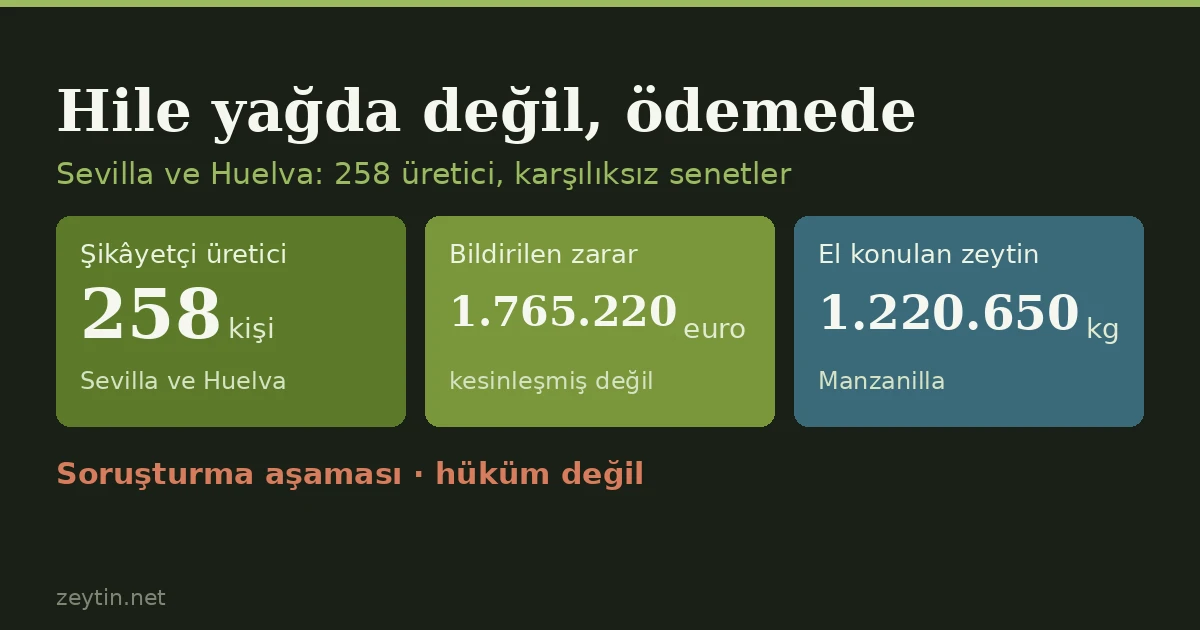
258 growers, €1.77 million: in Spain the fraud was not in the oil, it was in the payment
Spain's Guardia Civil has detained a table olive trader accused of defrauding 258 growers in Seville and Huelva of €1,765,220. The olives were real and the sales were real; the money never reached the producers. Investigators seized 1,220,650 kilos of Manzanilla olives.
 Article
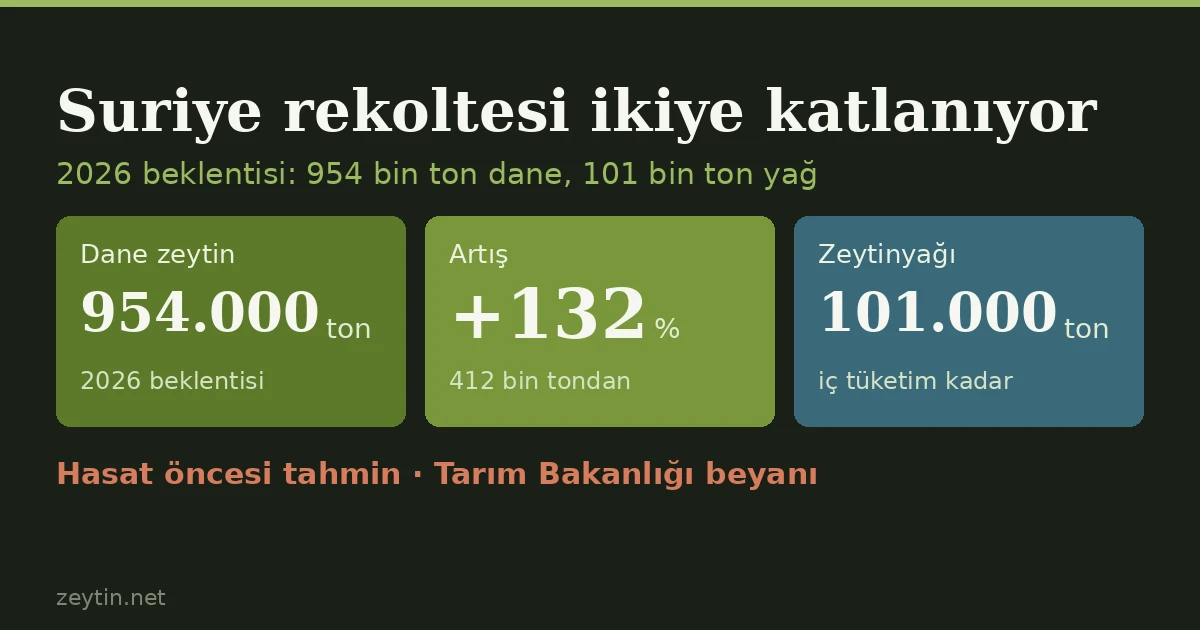
Syria's crop doubles to 954,000 tonnes — and the oil still only feeds itself
Syria's Ministry of Agriculture expects 954,000 tonnes of olives in 2026, up from 412,000 last season. The 101,000 tonnes of oil that implies barely covers domestic consumption — a doubled crop that still produces no export surplus.
 Article
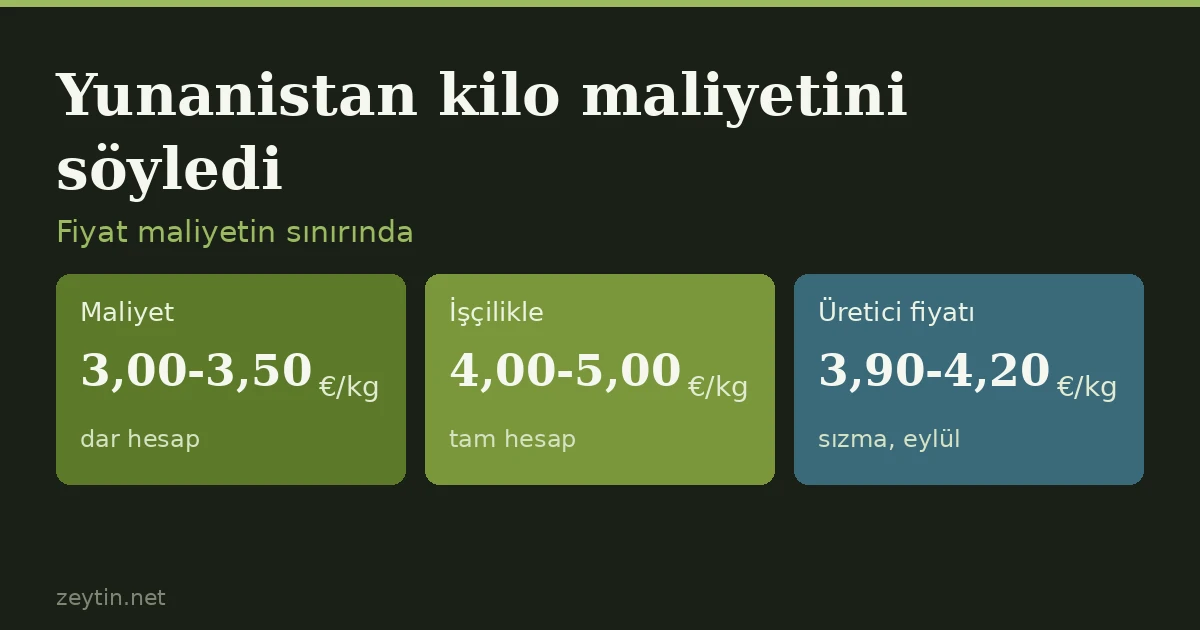
Greece finally puts a number on its cost: €3-3.5 a kilo, up to €5 with labour
For the first time Greece has put a per-kilo figure on its olive oil production cost: €3.00-3.50, rising to €4.00-5.00 once labour is fully counted. The producer price stands at €3.90-4.20, at or below that cost. Spain's €1.70-2.00 for the same item shows where the competitive gap actually sits. Greek output for 2026/27 is estimated at 280,000-330,000 tonnes.
 Article
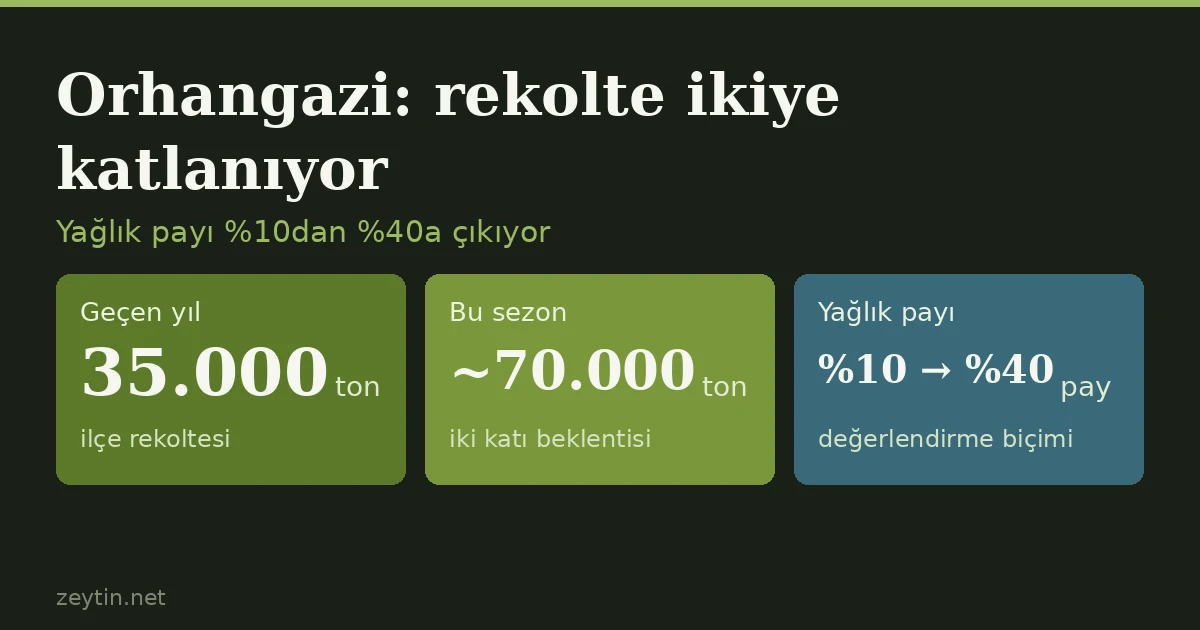
Orhangazi's crop is doubling: the oil olive share climbs from 10% to 40%
According to figures from the Orhangazi District Directorate of Agriculture and Forestry, last season's crop of roughly 35,000 tonnes could double this year. But in Türkiye's table olive heartland the real shift is in the split: the share pressed for oil is expected to rise from 10% to 40%. Mills are already in maintenance, and the grower's income now depends on fruit size.
 Article
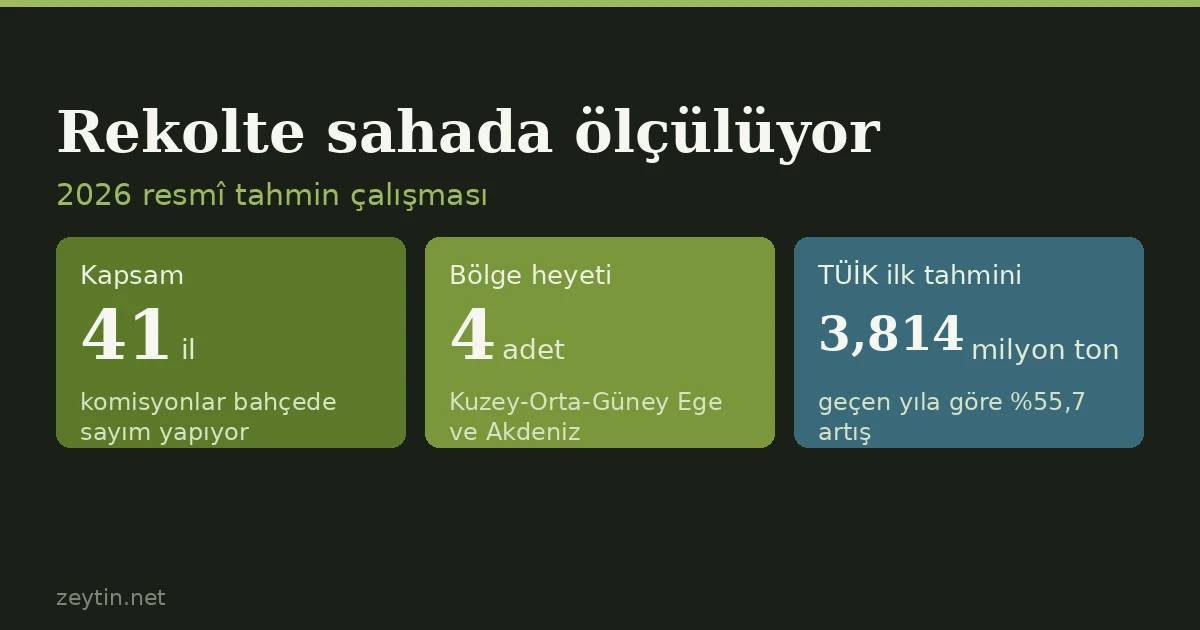
The official olive figure is measured in the grove: Türkiye's 2026 crop survey is under way
Türkiye's official olive crop figure is not produced at a desk. It comes from agricultural engineers counting fruit load tree by tree. A provincial crop estimation commission met in Denizli this week while field inspections continue in the districts. The national figure is assembled by an official delegation coordinated by the National Olive and Olive Oil Council across 41 provinces, and last season it was announced on 24 October.
 Article
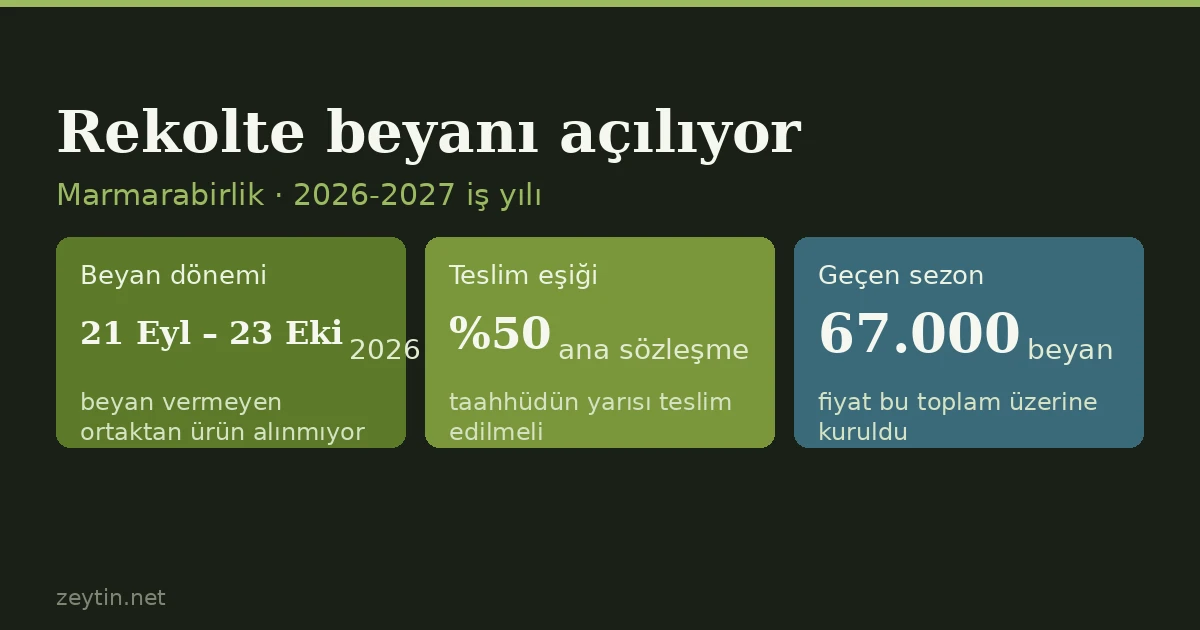
Marmarabirlik opens crop declarations on 21 September: no declaration, no purchase
Crop declarations for the 2026-27 business year open on 21 September and close on 23 October at cooperatives affiliated with Marmarabirlik, Türkiye's largest table olive cooperative union. Members who do not file cannot sell to the cooperative, and the declared figure is a binding commitment covering oil olives too. In Orhangazi some 300 members are close to expulsion under the union's fifty-percent delivery rule.
 Article
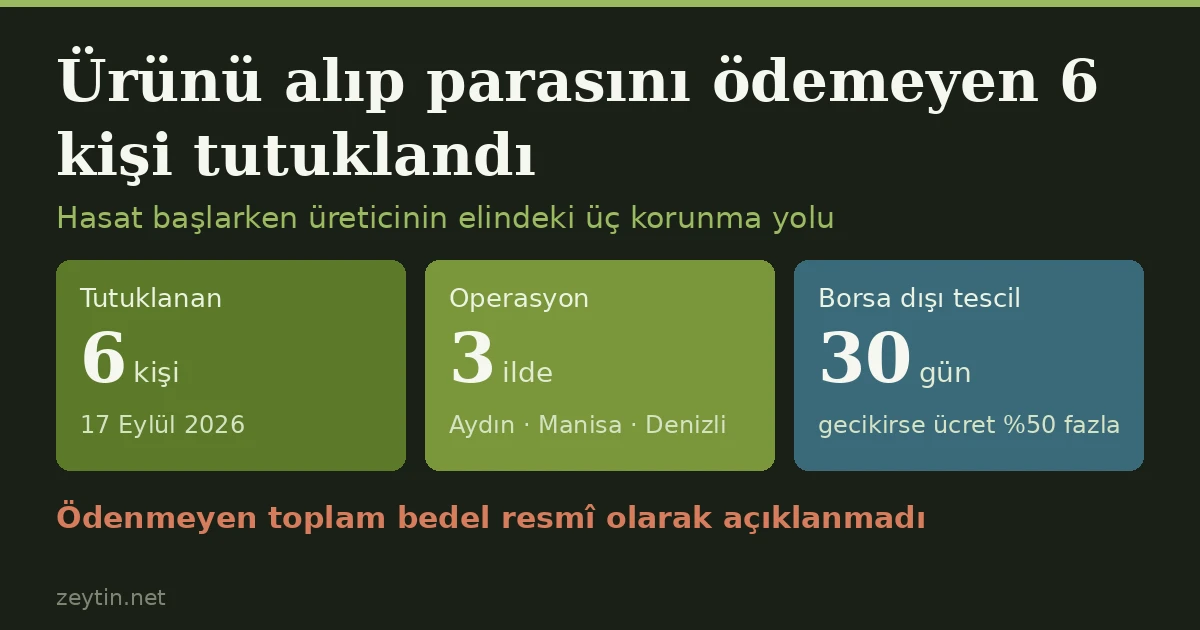
Six jailed for taking produce without paying: the grower's most fragile moment is the start of harvest
In Bozdoğan, Aydın, six people who bought olive oil, nuts and livestock from growers and failed to pay were caught in a simultaneous operation across three provinces on 15 September and jailed on 17 September. The method is a familiar one: the first purchase is paid in full, and once trust is established the large purchase is not. In the week harvest begins, growers have three concrete protections.
 Article
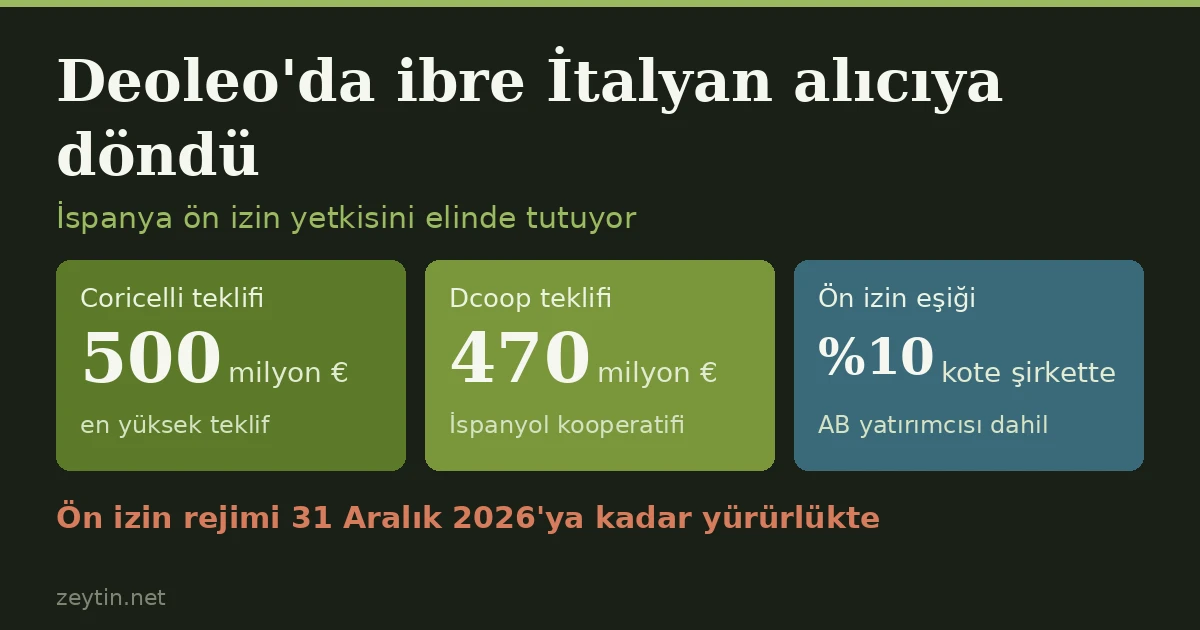
Spain steps back from vetoing Deoleo's sale: the door opens for Italy's Coricelli
Madrid's position on the sale of the world's largest olive oil bottler has shifted: in early September a Spanish buyer was preferred, and on 18 September Italy's Coricelli was reported to be seen as the best-positioned candidate. The government's lever is a foreign investment screening regime that covers EU investors too and runs to 31 December 2026. Because Deoleo is a major bulk buyer, the outcome matters to Turkish exporters.
 Article
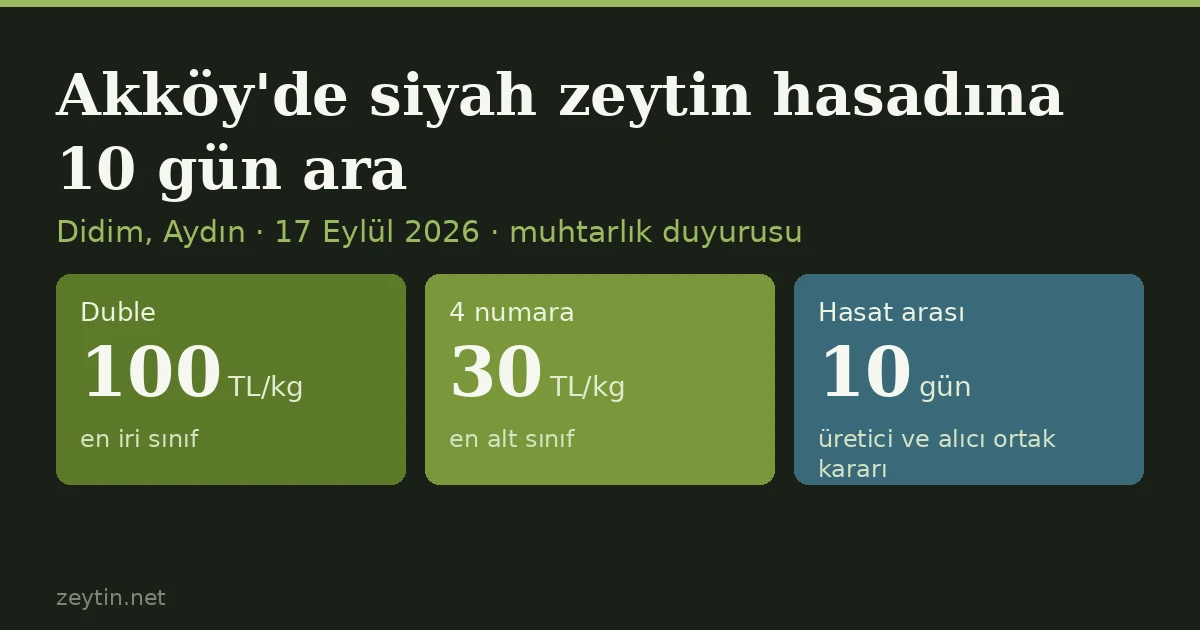
Black olive harvest paused for ten days in Akköy, Didim: a price ladder from 30 to 100 lira
In Akköy, a village in the Didim district of Aydın, growers and olive buyers have jointly agreed to suspend black olive harvesting and buying for ten days, saying announced prices do not cover costs. The price ladder published by the village headman's office runs from 100 lira a kilo for the largest grade down to 30 lira for the smallest. Growers say picking costs alone exceed the price on the lower grades.
 Article
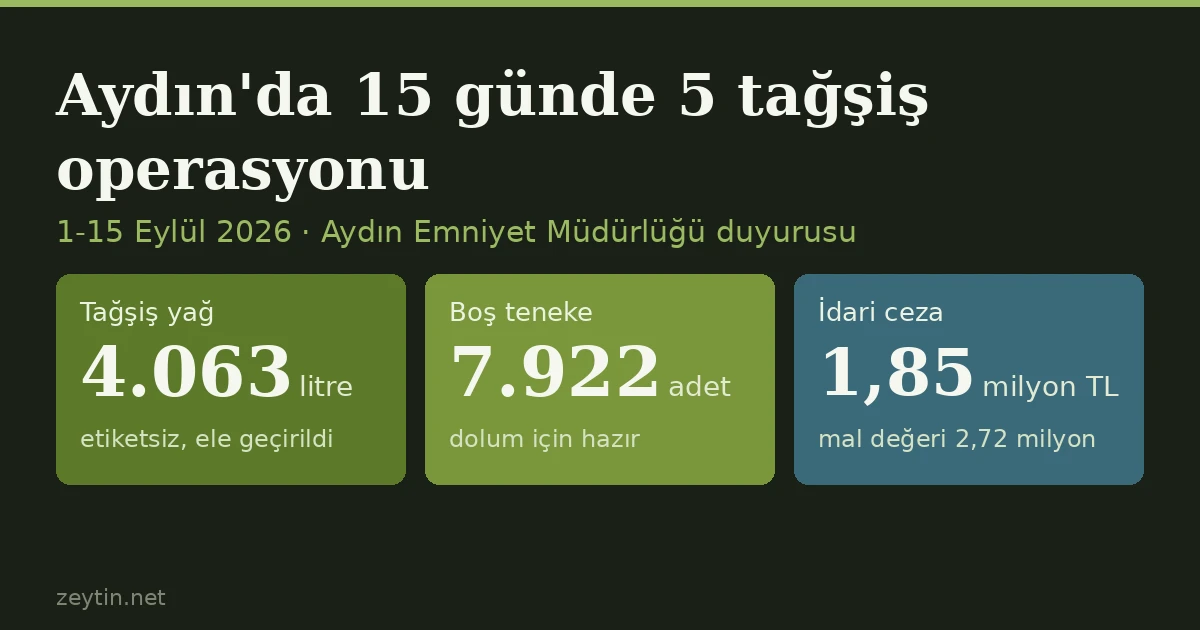
Five adulteration raids in 15 days in Aydın: 4,063 litres of oil, 7,922 empty tins
Police in Aydın say five operations between 1 and 15 September 2026 seized 4,063 litres of unlabelled adulterated oil and 7,922 empty tins. The goods were valued at about 2.72 million lira and the administrative fines totalled 1.85 million lira. The number of empty tins was nearly double the litres of oil seized.
 Article
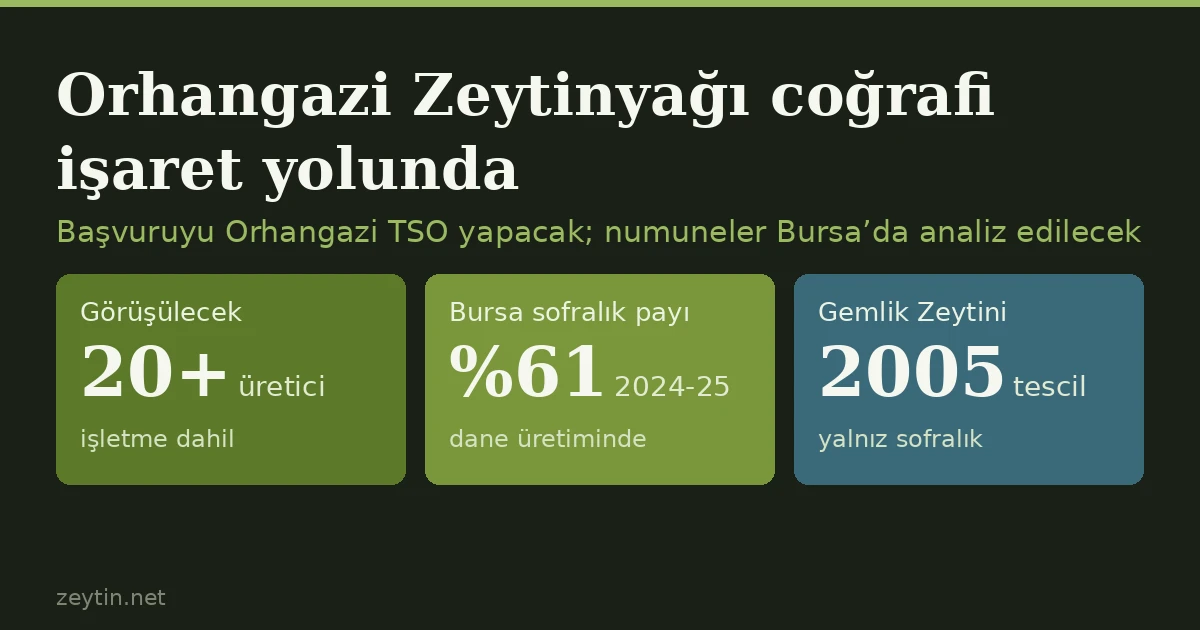
Orhangazi olive oil starts on the road to geographical indication, with samples to be tested for acidity and polyphenols
The Orhangazi Chamber of Commerce and Industry has begun preparing a geographical indication application for "Orhangazi Olive Oil". More than 20 producers will be consulted, samples tested in Bursa and the influence of the Lake İznik basin studied. The area's Gemlik Olive registration covers only table olives.
 Article
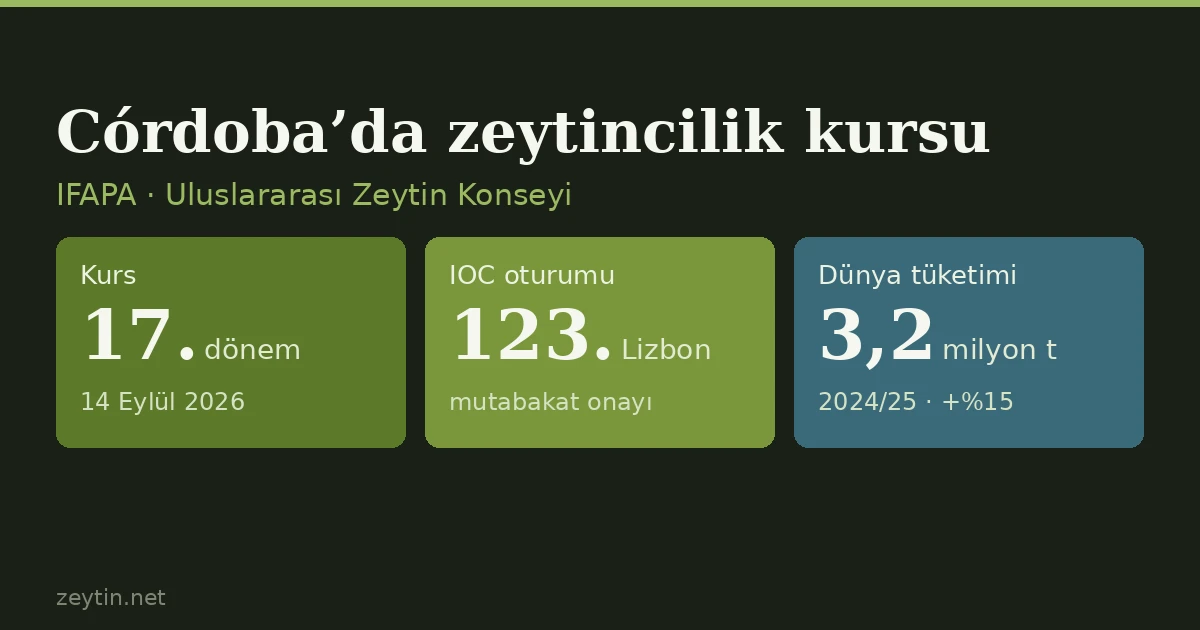
17th Advanced Course in Olive Growing opens in Córdoba as the IOC and IFAPA move towards genetic resources cooperation
Andalusia's Institute of Agricultural and Fisheries Research and Training (IFAPA) opened its 17th Advanced Specialisation Course in Olive Growing in Córdoba on 14 September, with the International Olive Council giving the opening lecture. The Council has approved signing a memorandum of understanding with IFAPA, which hosts one of the world's key olive germplasm collections.
 Article
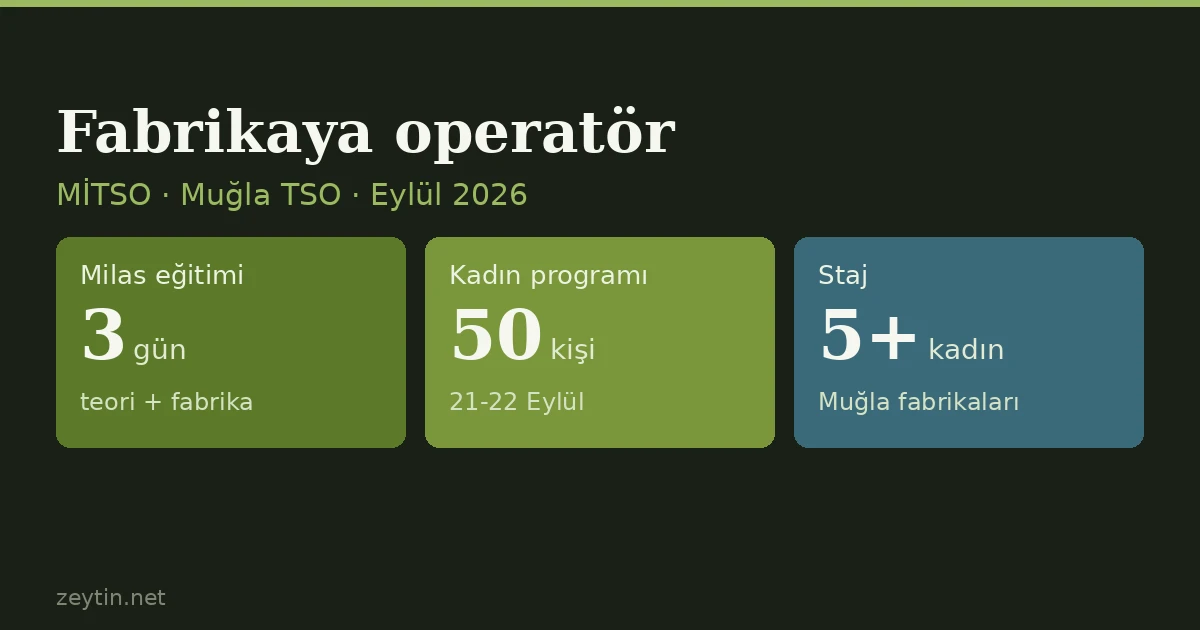
Skilled operators for olive mills: training ends in Milas, Muğla trains women operators
Ahead of the harvest, two training programmes in Muğla focus on operators, the most critical link in olive mills. A three-day operator course run by MİTSO, Milas Tariş and HAUS Makine has ended in Milas, and the Muğla Chamber of Commerce and Industry is launching a 50-place "Women's Hands in Industry" programme to train women as mill operators.
 Article
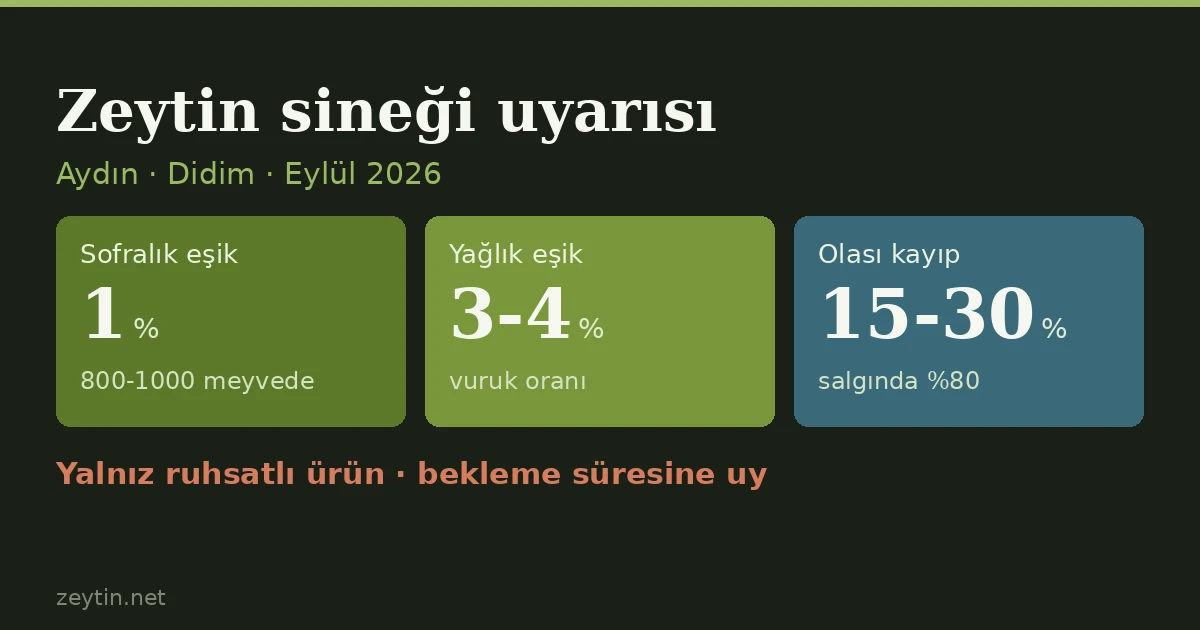
Olive fruit fly warning before harvest in Aydın: check groves, spray only above the threshold
The Didim District Directorate of Agriculture and Forestry, together with the Aydın Provincial Directorate, has warned growers about the olive fruit fly ahead of the harvest. Growers were asked to check groves regularly, monitor pest density and, if needed, act only with products licensed for olives and at the right time. Fly pressure rising in autumn cuts both yield and oil quality.
 Article
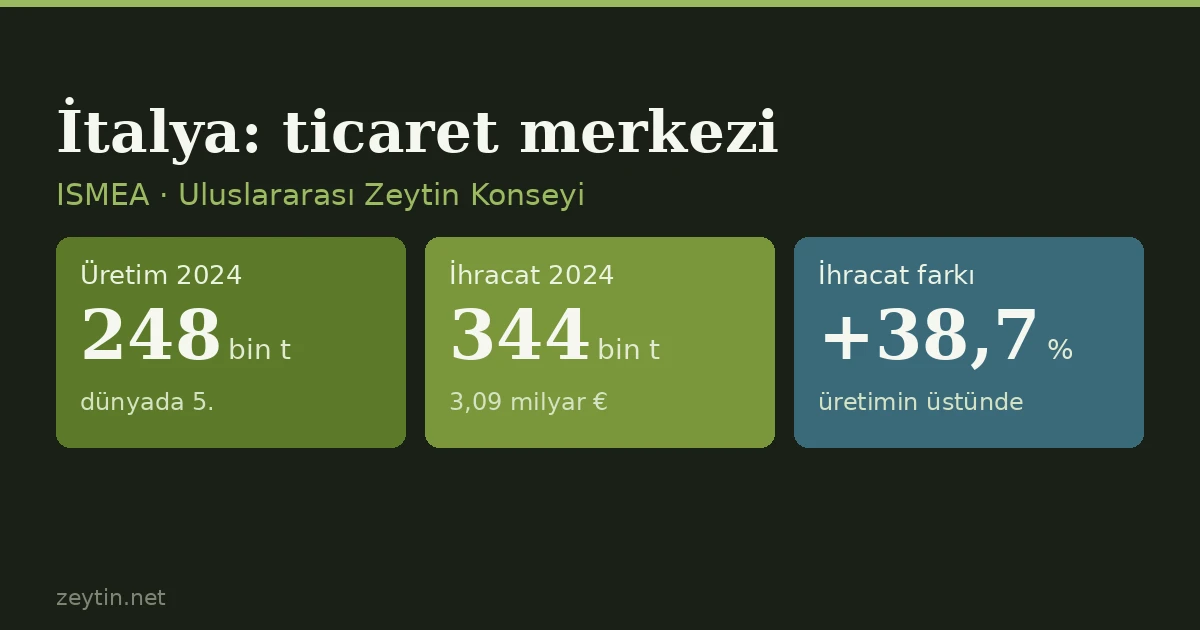
Italy from production giant to trade hub: it exports more olive oil than it produces
Italy produced 248,000 tonnes of olive oil in 2024 and slipped to fifth place worldwide, yet in the same year it exported 344,000 tonnes worth 3.09 billion euros. The country is now less a production giant than a trade hub that buys oil around the Mediterranean, blends it and sells it to the world.
 Article
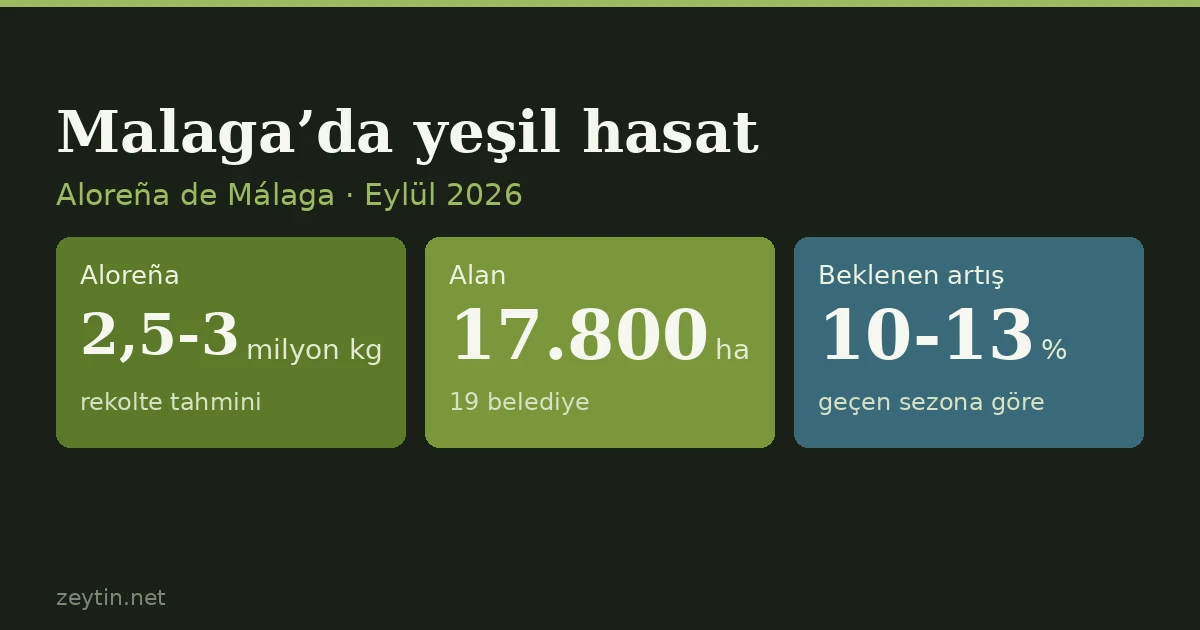
Green olive harvest begins in Málaga: 2.5 to 3 million kilos expected for Aloreña
Table olive harvesting has begun in Spain's Málaga province with better prospects after years of drought. The protected-origin Aloreña de Málaga is expected to yield 2.5 to 3 million kilos, and trees are heavily laden with Hojiblanca, which supplies more than 90 per cent of the province's table olives. September heat, however, is shrivelling fruit on rain-fed land.
 Article
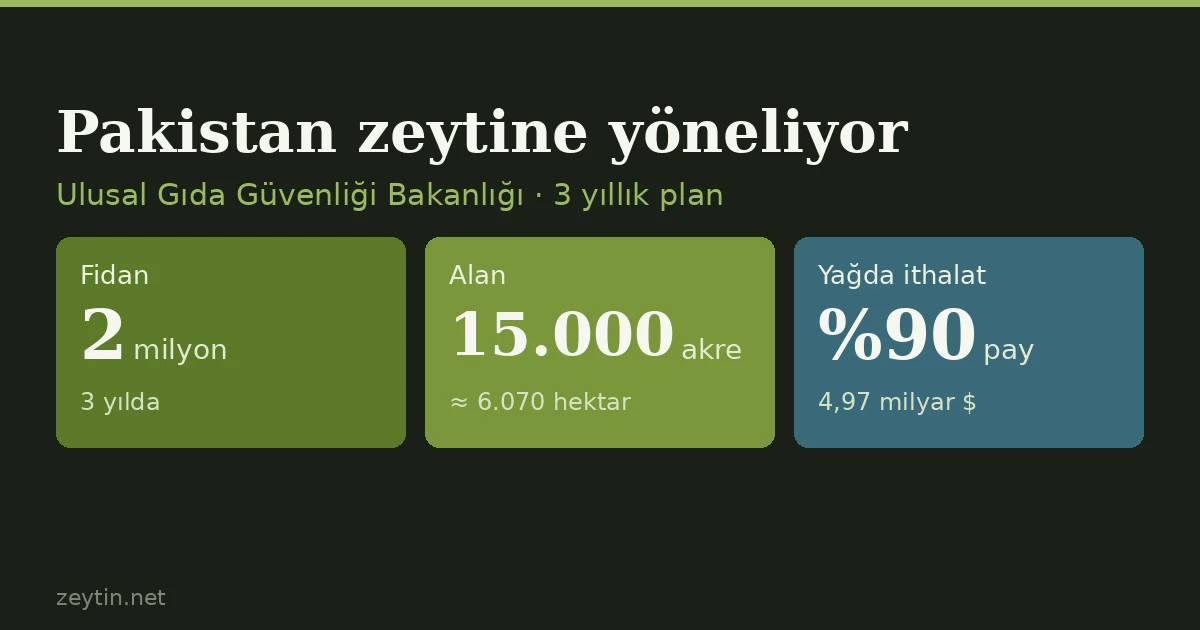
Pakistan to plant 2 million olive trees in three years to cut edible oil imports
Pakistan's Ministry of National Food Security and Research plans to establish olive groves on 15,000 acres (about 6,070 hectares) over three years and supply 2 million plants in that period. The country imports roughly 90 per cent of its edible oil; the import bill reached 4.97 billion dollars in 2024-25.
 Article
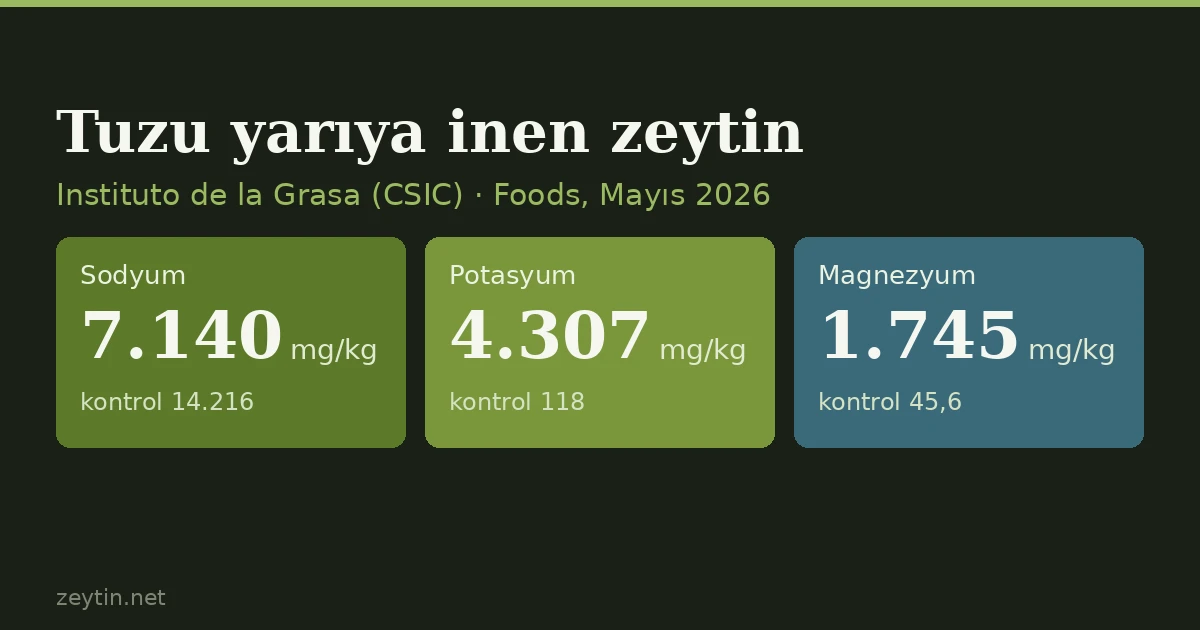
Table olives with half the salt: potassium, calcium and magnesium instead of sodium
Researchers at Spain's Instituto de la Grasa (CSIC) cut sodium in pimento-stuffed green Manzanilla olives from 14,216 mg to about 7,100 mg per kilogram. Potassium, calcium and magnesium salts added to the packing brine made the olives a source of these minerals.
 Article
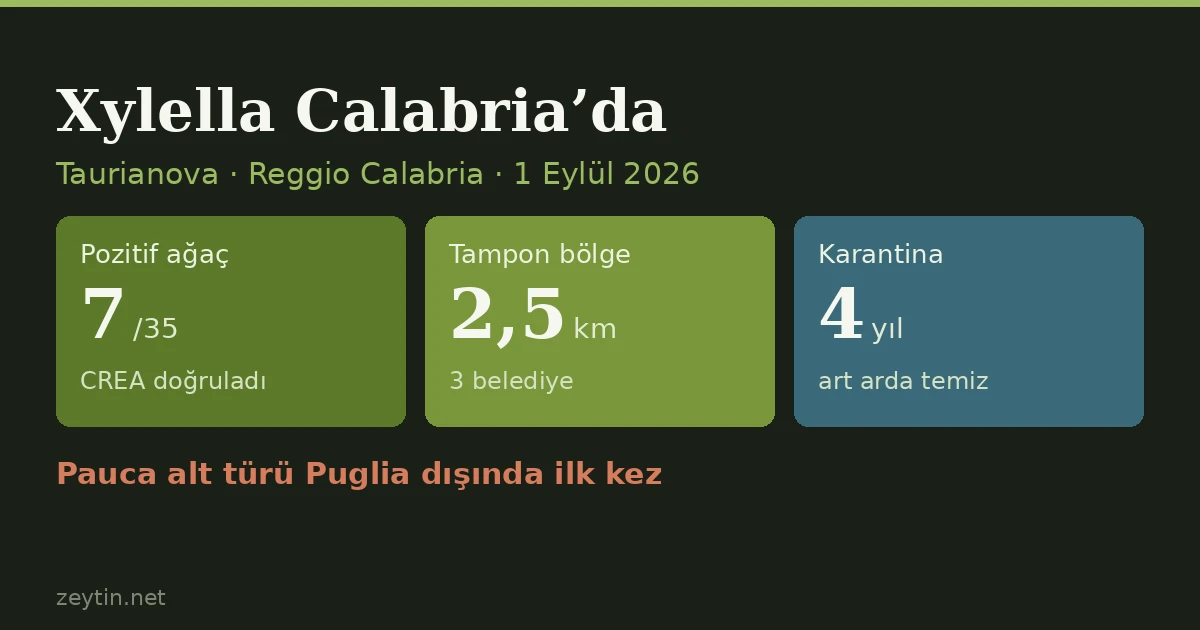
Xylella has left Puglia: seven olive trees test positive in Calabria
The pauca subspecies of Xylella fastidiosa, which dries out olive trees, had been confined to Puglia since 2013. In Taurianova, Calabria, 7 of 35 samples tested positive; the region issued a quarantine decree on 1 September with a 2.5 km buffer zone.
 Article
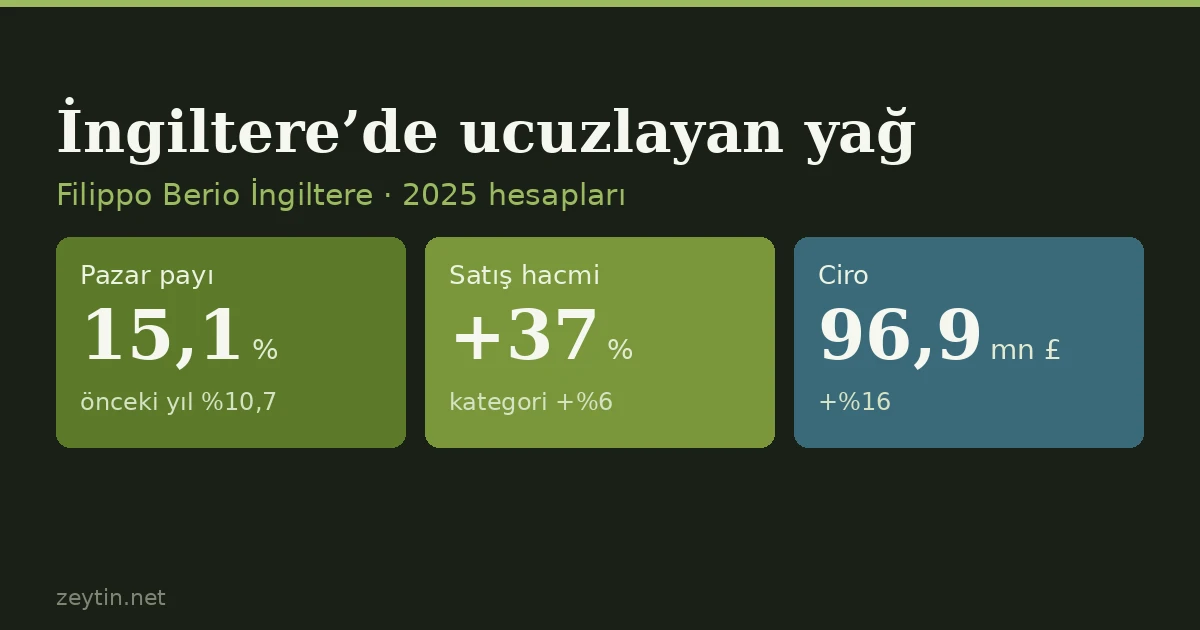
Olive oil got cheaper in the UK and Filippo Berio lifted its share to 15%
The 2025 accounts of Filippo Berio's UK company show how falling prices reached the shelf: volumes up 37%, revenue up 16%, market share from 10.7% to 15.1%. The category grew 6% and lower wholesale costs were passed on to shoppers.
 Article
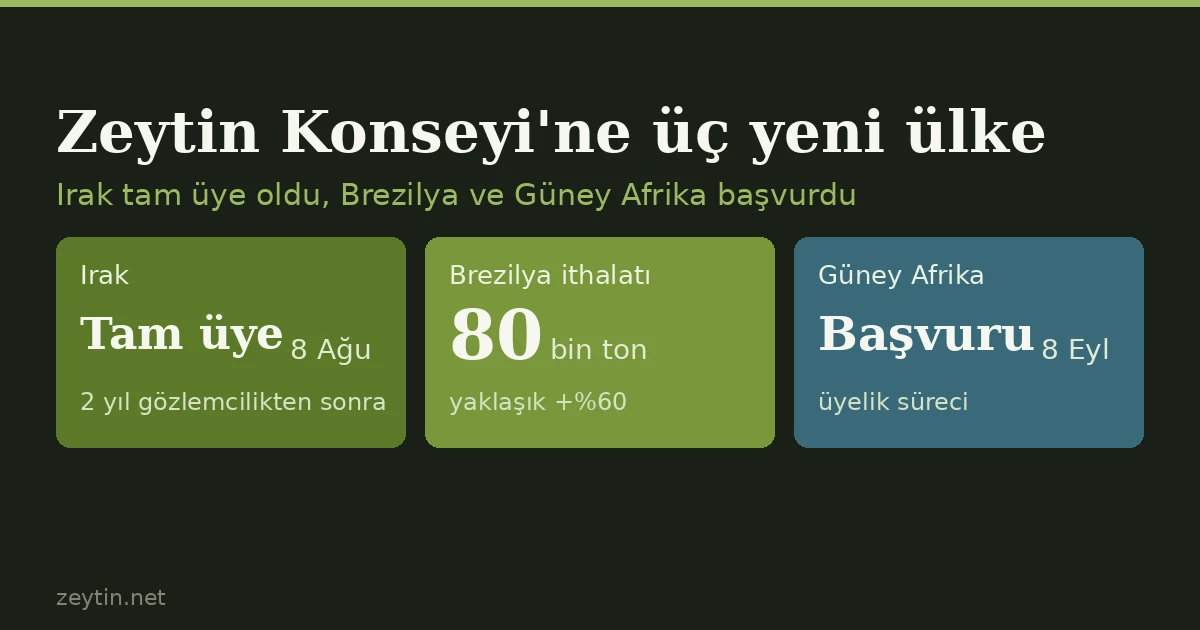
The International Olive Council grows: Iraq joins, Brazil and South Africa apply
The International Olive Council (IOC) saw three developments in a month: Iraq became a full member on 8 August, South Africa submitted its membership request on 8 September and Brazil on 9 September. The expansion reflects olive oil's shift towards production and consumption areas beyond the Mediterranean.
 Article
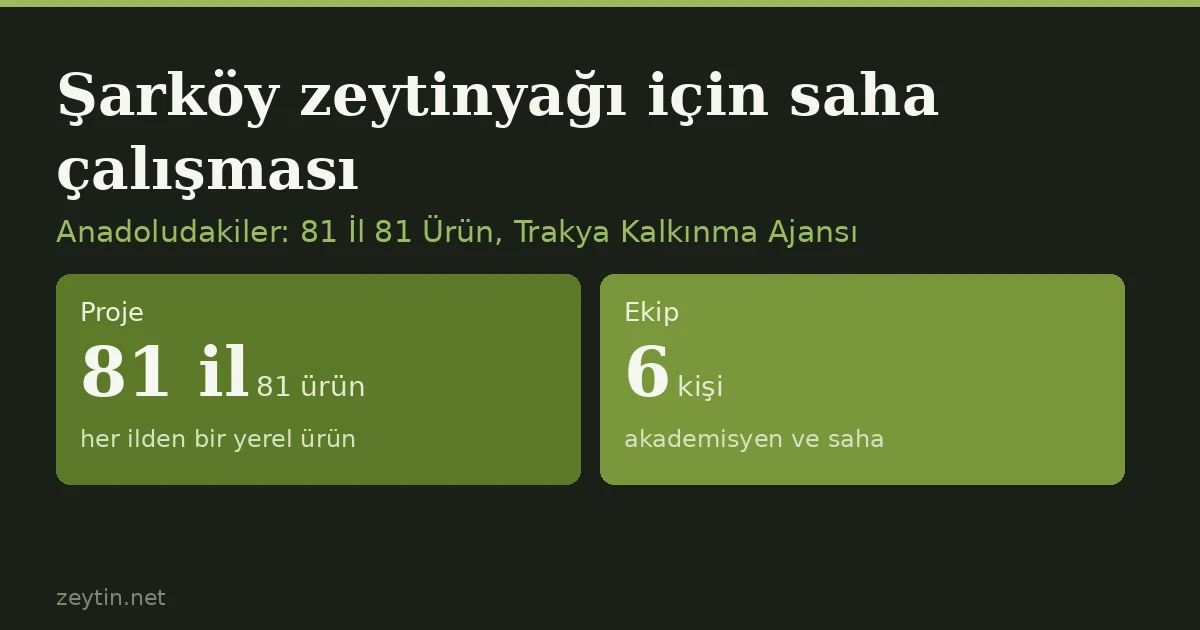
Field study for Şarköy olive oil: Tekirdağ's pick for "81 Provinces 81 Products"
Şarköy olive oil has been chosen as Tekirdağ's product in the "Anatolians: 81 Provinces 81 Products" programme coordinated by the Ministry of Industry and Technology. The Thrace Development Agency and Namık Kemal University surveyed growers and businesses to map the value chain. The goal is branding; there is no geographical indication registration yet.
 Article
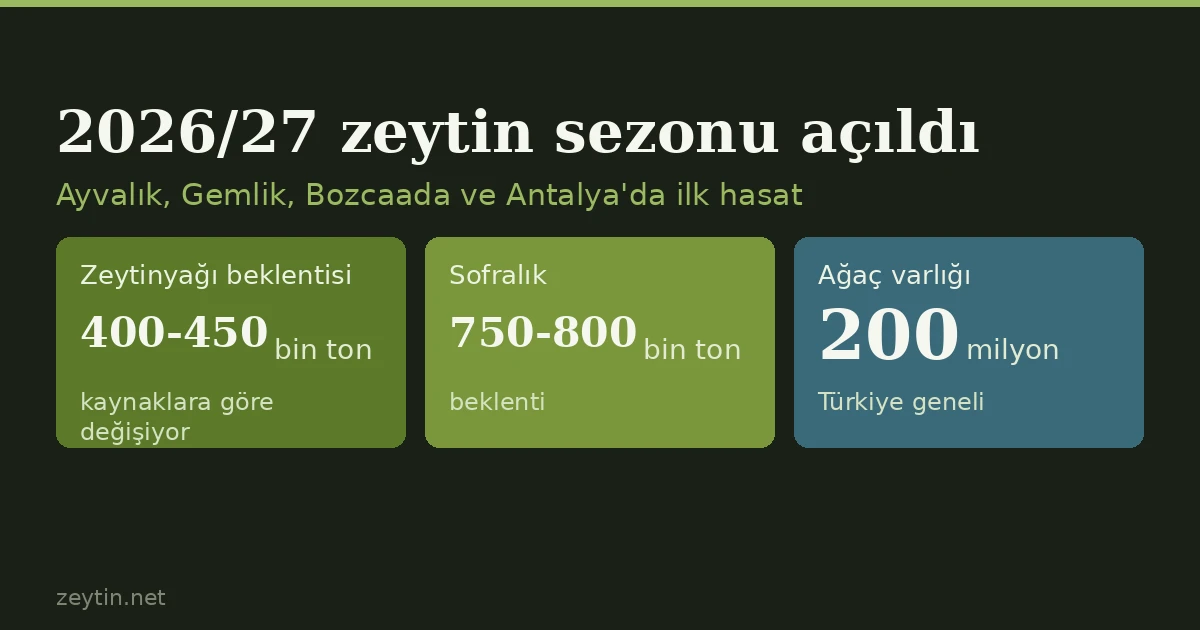
The 2026/27 season opens: first harvests in Ayvalık, Gemlik and Bozcaada
The new olive season opened with three events on 11-13 September. In Ayvalık, an on-year forecast of 400,000-450,000 tonnes of olive oil was voiced; in Gemlik the first olives were picked during the festival; and on Bozcaada the island's first olive oil was pressed with a portable system.
 Article
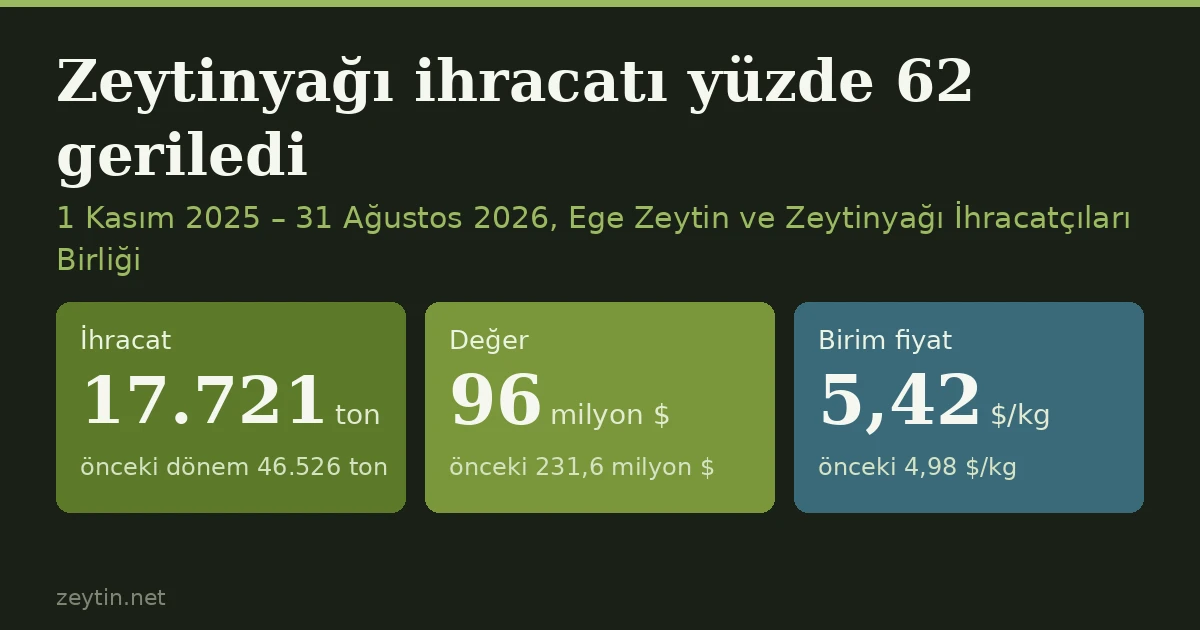
Olive oil exports still down 62% at the end of August: bulk loses 73%
According to the Aegean Olive and Olive Oil Exporters' Association, olive oil exports between 1 November 2025 and 31 August 2026 fell 62% in volume and 59% in value. Bulk sales lost 73%, the US market 70%. Table olives, by contrast, held their ground.
 Article
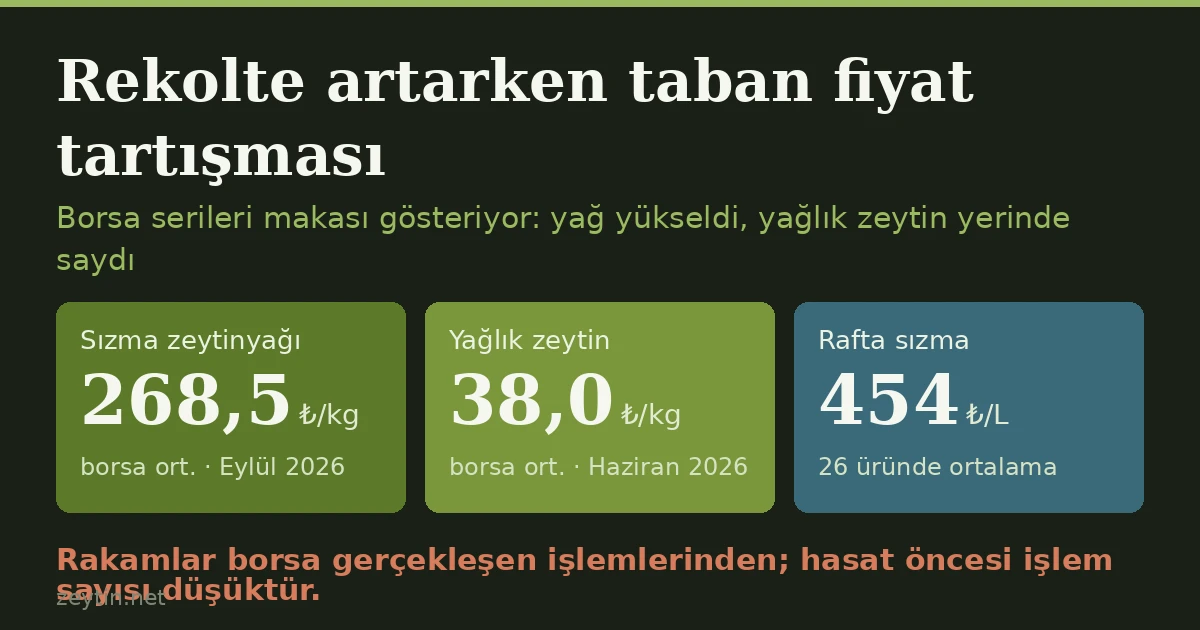
Crop forecast climbs as the minimum-price debate returns: what the exchange numbers say
With the 2026 harvest approaching, crop forecasts are up 40 percent in some provinces and growers want a floor price. Our exchange series shows why the dispute is really about olives, not oil.
 Article
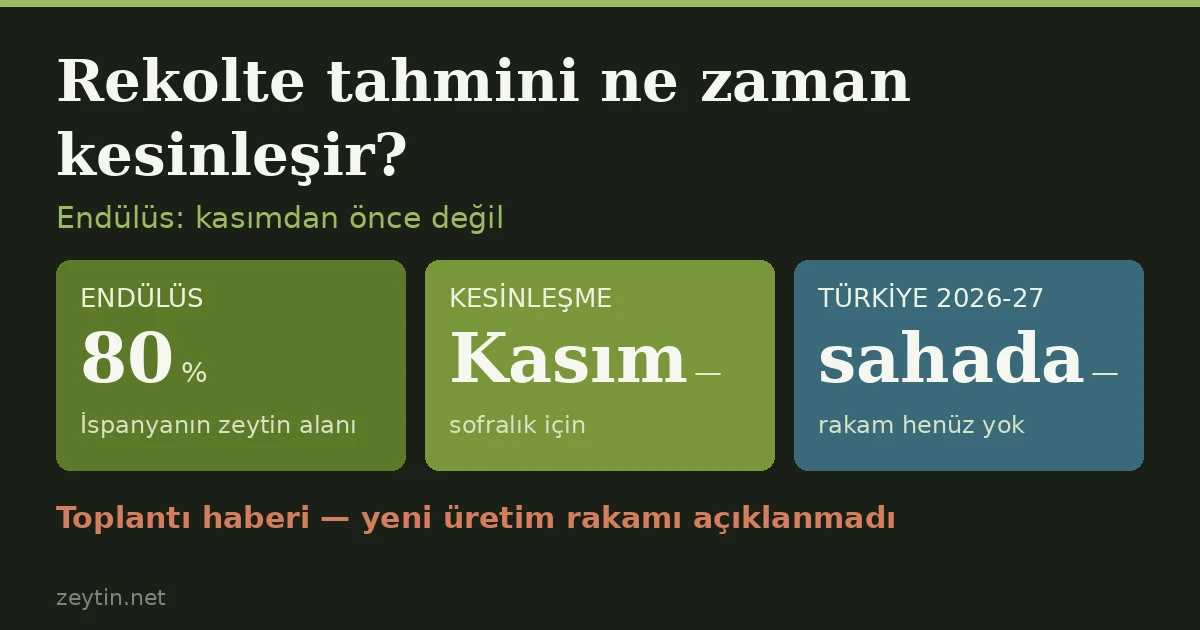
"Not definitive until November": Andalusian growers push back on the crop estimate
Andalusia's agriculture ministry called its first crop estimate "high production"; cooperatives and COAG in Seville objected: recent heat will affect the crop and the estimate is not definitive until November. Türkiye is making its 2026-27 estimate in the field the same week — the same caution applies here.
 Article
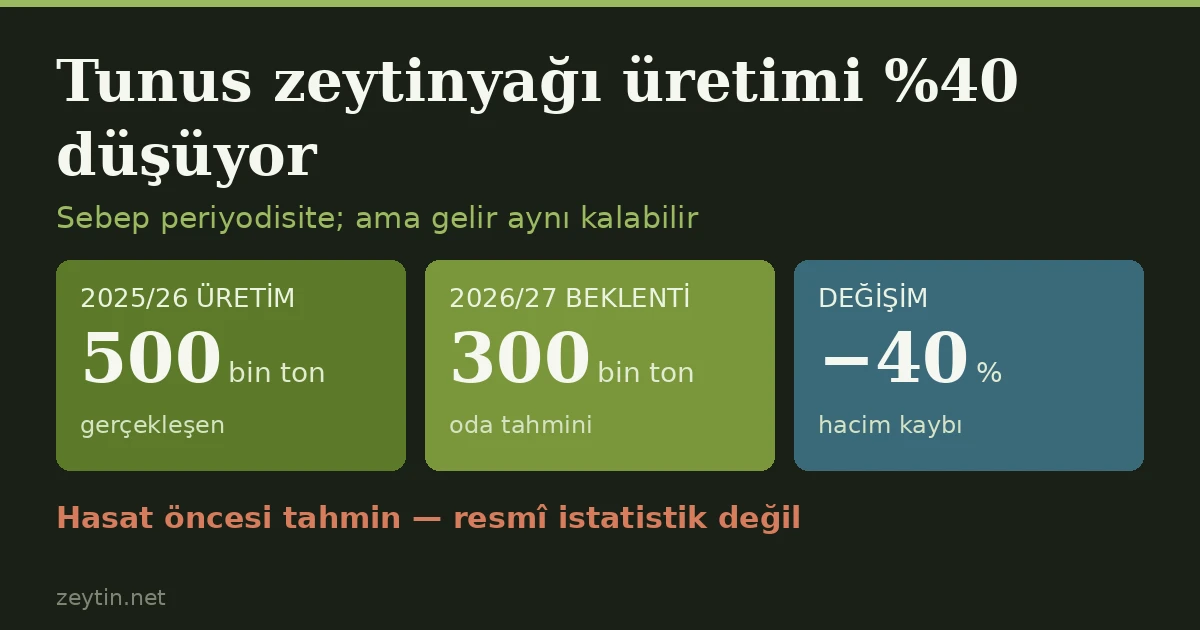
Tunisia's output falls from 500,000 to 300,000 tonnes — revenue may hold
Tunisia's National Chamber of Olive Producers expects olive oil output to fall from 500,000 to 300,000 tonnes in 2026/27, citing alternate bearing. Revenue is still expected to match last season because prices are higher. Türkiye's most direct bulk competitor is shrinking.
 Article
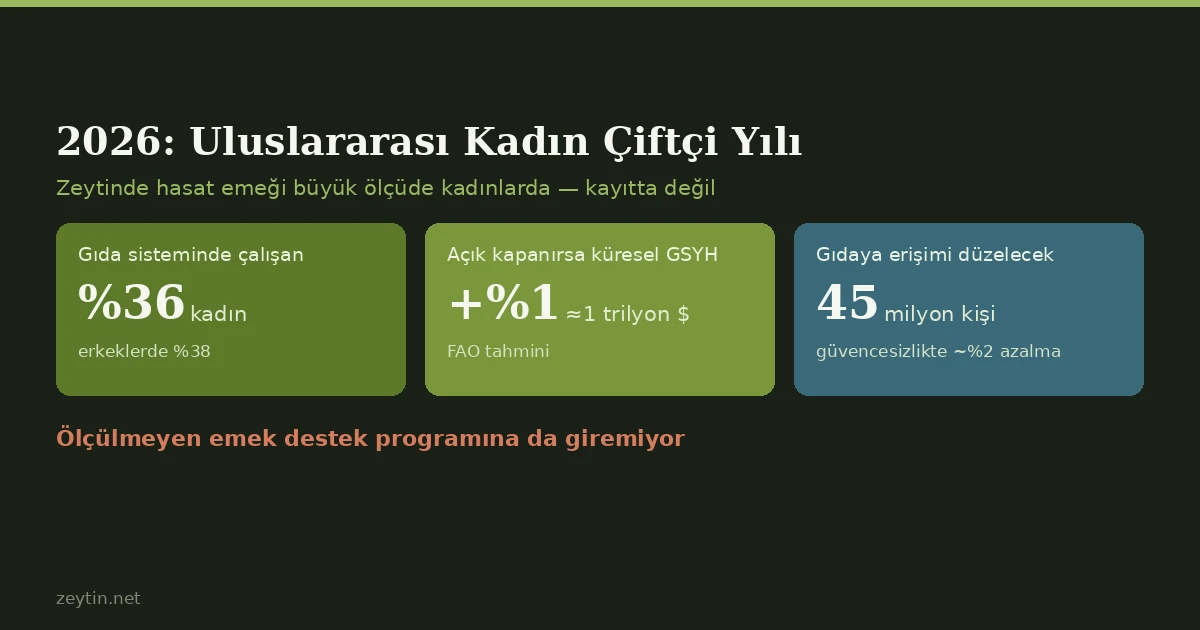
The UN names 2026 the Year of the Woman Farmer: in olives the labour is women's, the records are not
FAO reports that agrifood systems employ 36% of working women and 38% of working men; closing the gender gap would add 1% to global GDP (about $1 trillion) and improve food access for 45 million people. In olives, most harvest labour is women's — title deeds and decisions are not.
 Article
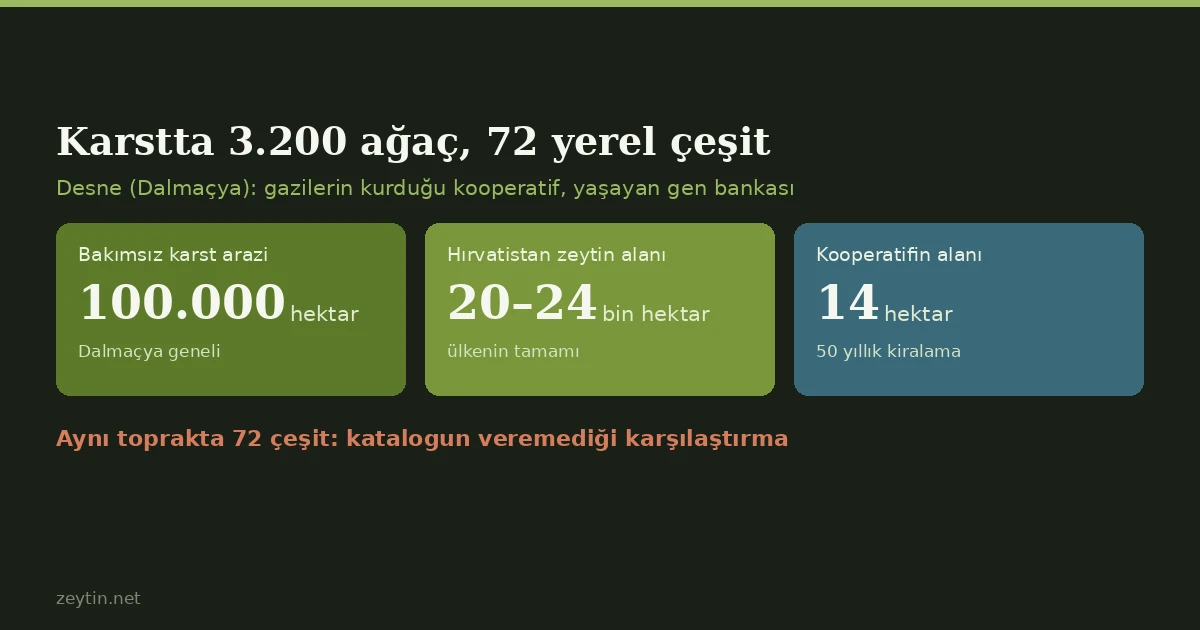
3,200 trees and 72 varieties on 14 hectares of stone: the cooperative turning Dalmatian karst into groves
Some 100,000 hectares of karst lie neglected in Dalmatia while all of Croatia has 20,000–24,000 hectares under olives. In Desne a veterans' cooperative has grown 3,200 trees of 72 native varieties on 14 hectares of rock — a grove that doubles as a natural laboratory for climate resilience.
 Article
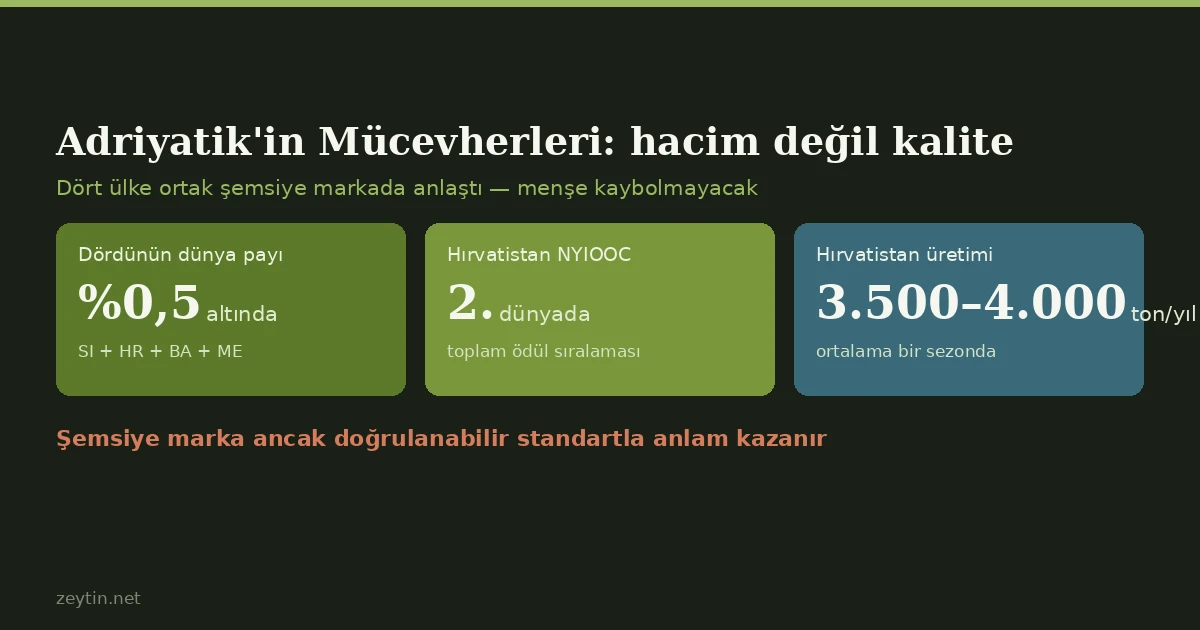
"Jewels of the Adriatic": four countries choose to compete on quality, not volume
Slovenia, Croatia, Bosnia and Herzegovina and Montenegro together produce under 0.5% of the world's olive oil — yet Croatia finished second worldwide at the NYIOOC. A panel in Mostar proposed a shared umbrella brand: origin stays, common rules are the condition.
 Article
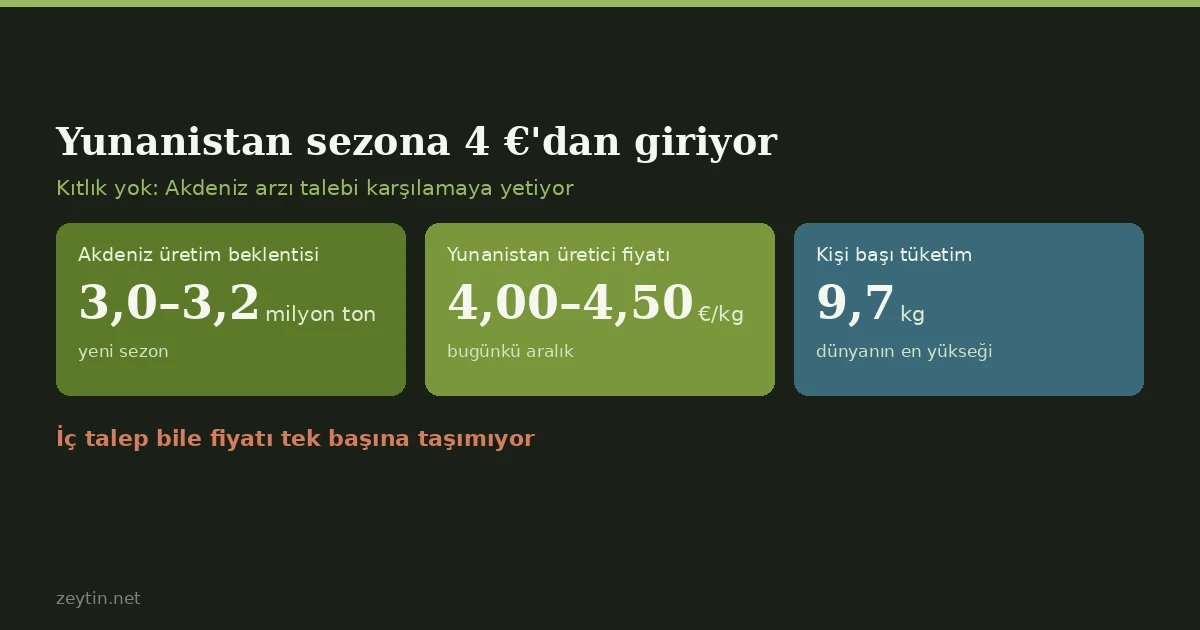
Greece opens the season at €4: no scarcity in the Mediterranean, but pressure on price
Manolis Giannoulis, president of the National Interprofessional Olive Oil Organization, expects the season to open at around €4 per kilogram. Mediterranean output is forecast at 3–3.2 million tonnes: no record, but enough to meet demand. The market is quiet, buyers are few, and costs plus North African imports keep the pressure on.
 Article
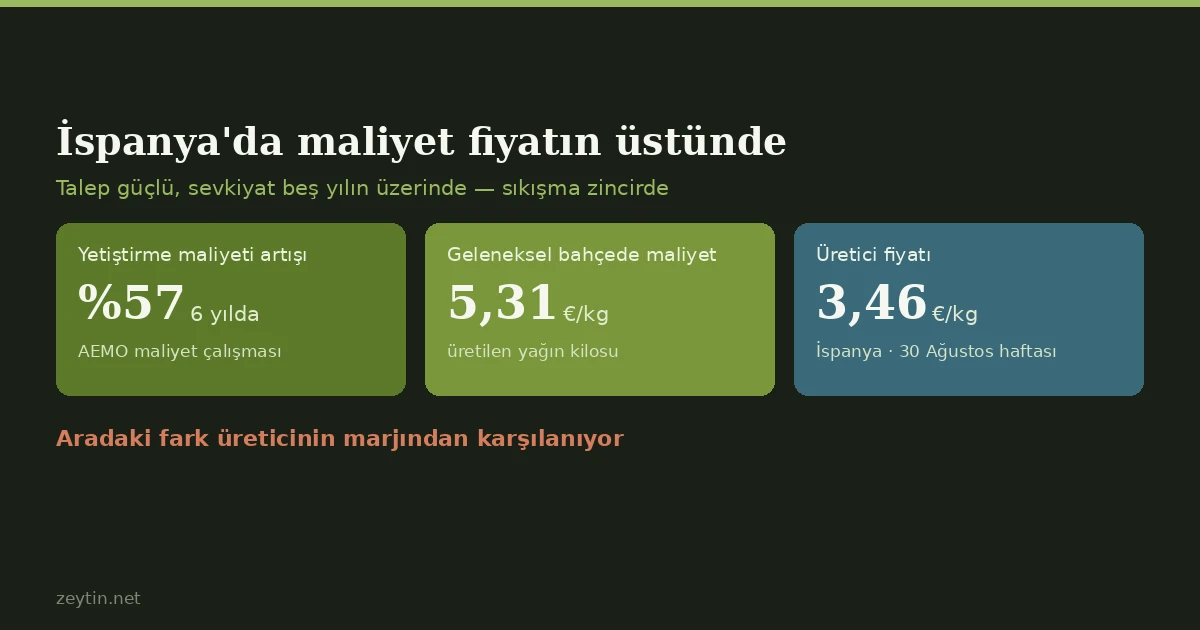
In Spain the cost sits above the price: €5.31 in a traditional grove, €3.46 at the gate
Olive cultivation costs have risen 57% in six years and reach €5.31 per kilogram in the most traditional groves, according to an AEMO study. The same week, Spain's producer price was €3.46. The Andalusian cooperative federation, with 342,000 members, is asking not for aid but for a change to the Food Chain Law.
 Article
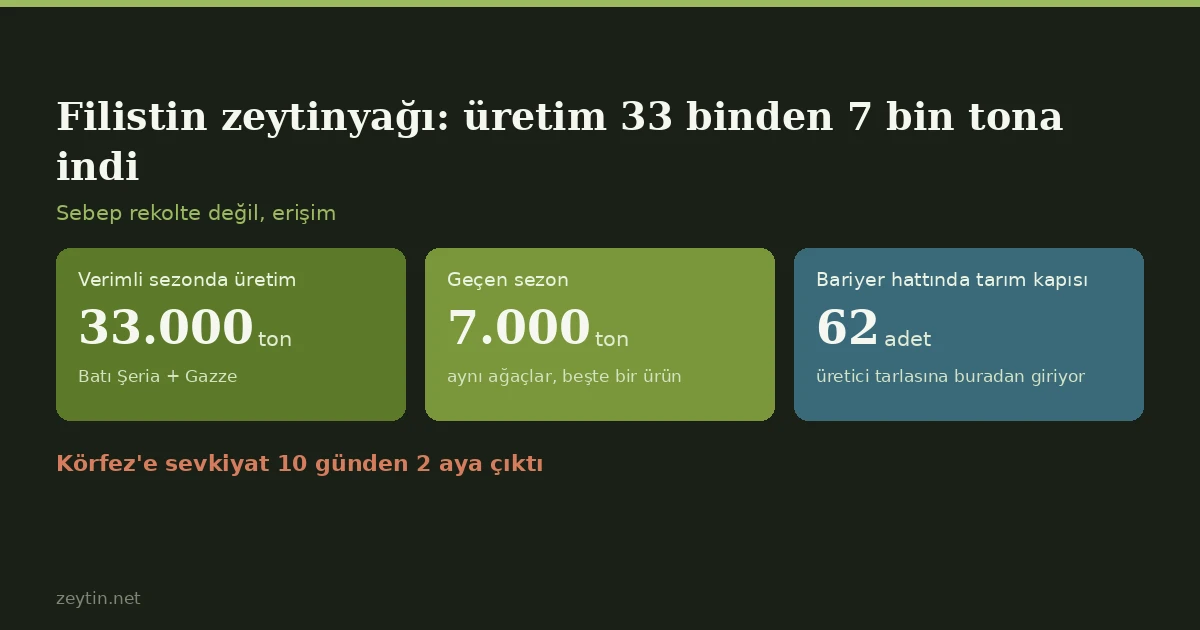
Palestinian olive oil: output down from 33,000 to 7,000 tonnes — the cause is access, not the crop
In a productive season Palestine yields 33,000 tonnes of olive oil; last season it produced 7,000. Seventy per cent of the groves sit in the northern West Bank, reached through 62 agricultural gates, and shipping times have gone from ten days to two months.
 Article
The world's largest bottler is for sale: a €500 million race for Deoleo
Deoleo, owner of Bertolli and Carbonell, holds 22% of global bottled olive oil sales. Italy's Coricelli leads at €500 million, Spain's Dcoop cooperative at €470 million. The Spanish government regards the company as nationally strategic. Because Deoleo is a major bulk buyer, the outcome matters to Turkish exporters too.
 Article
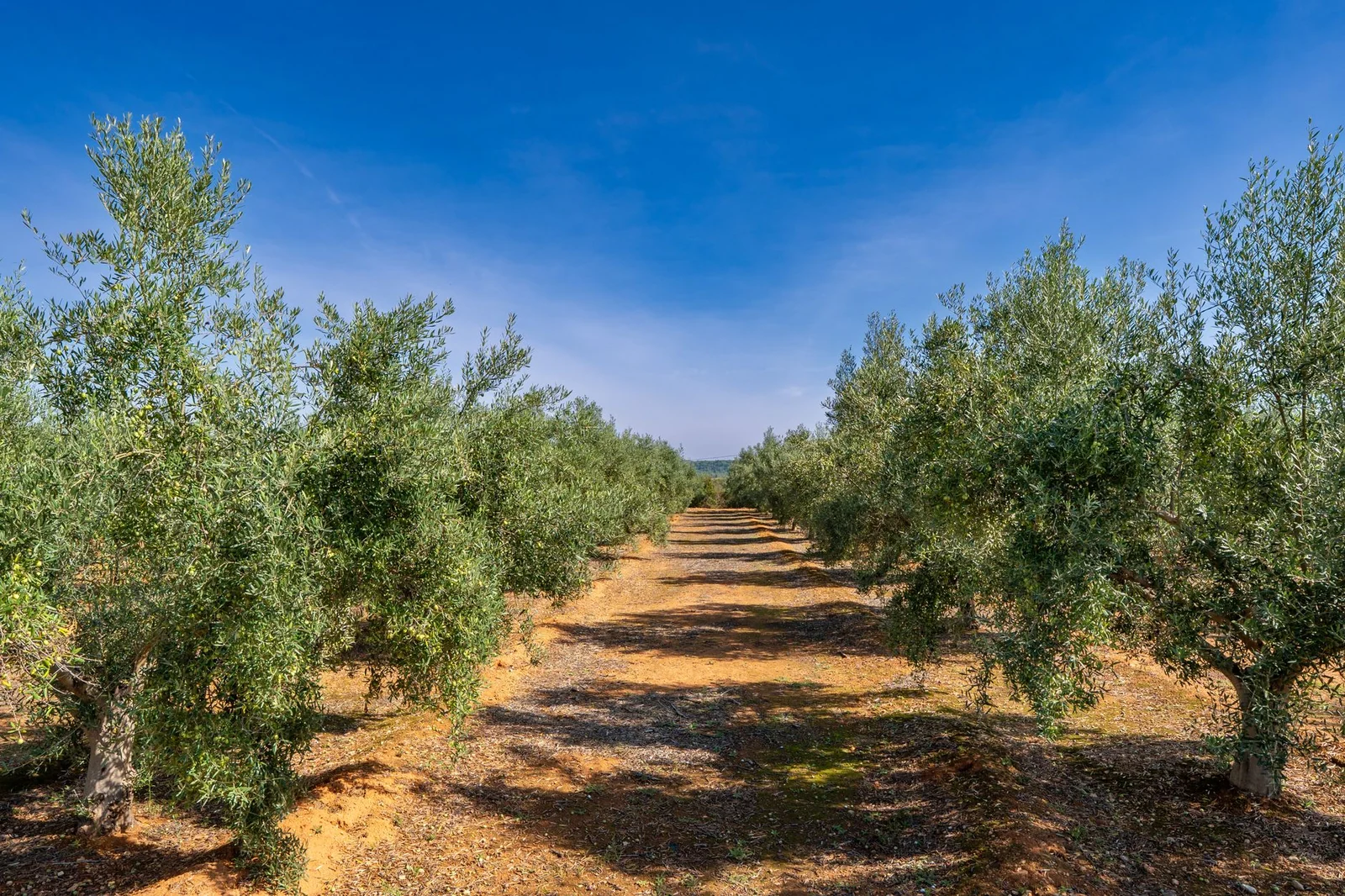
Andalusia moves against North African imports: 76% of what arrives is extra virgin
Andalusia's farm sector objects that more than 76% of the olive oil imported into the region in early 2026 was extra virgin. The regional minister has requested exceptional measures under Article 195 of the EU regulation. Türkiye could meet the same door.
 Article
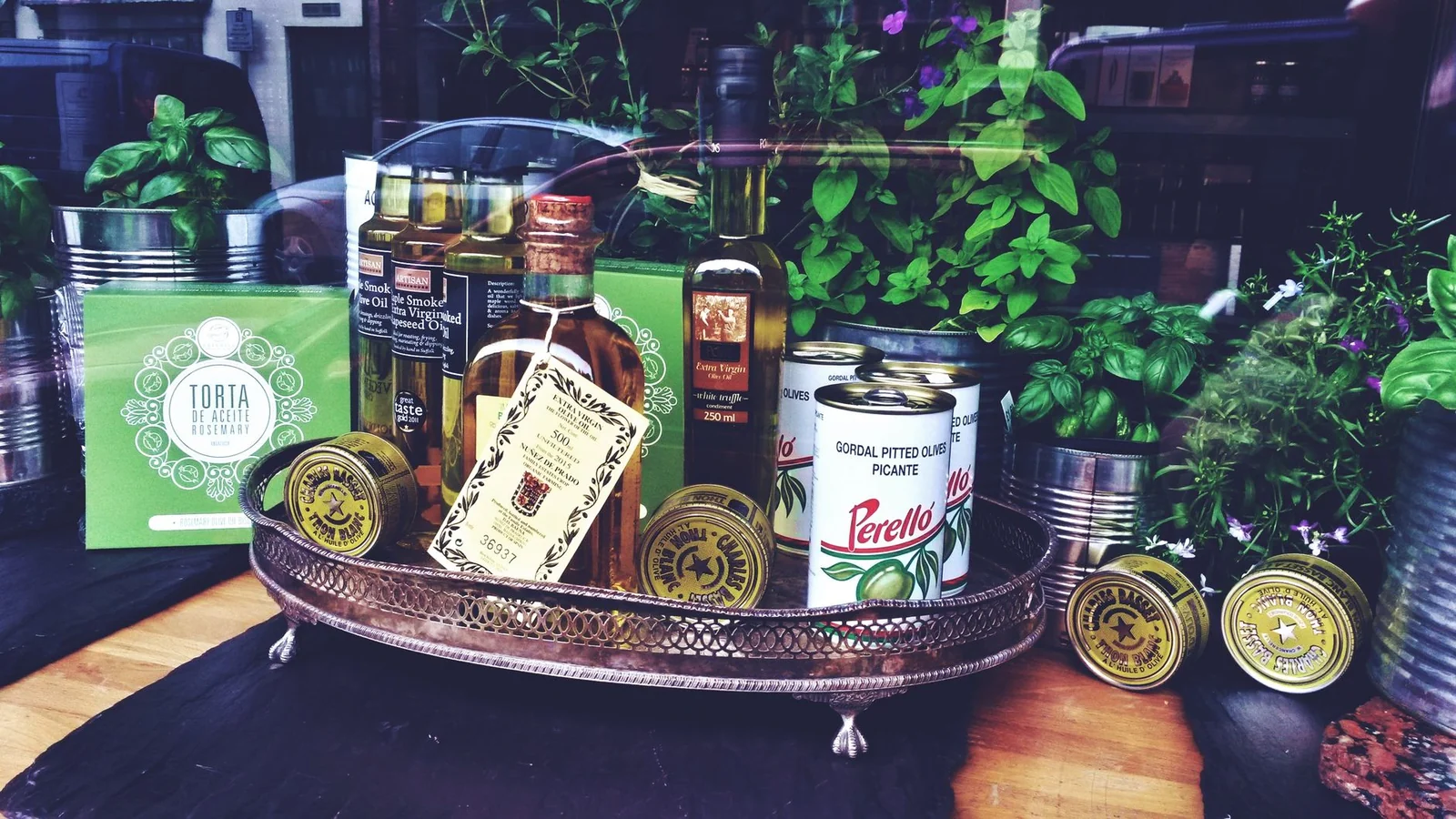
Adulterated olive oil costs more than the real thing: price is no longer a sign of authenticity
Diker, president of the Edremit Chamber of Agriculture, says adulterated oils sold online now exceed the wholesale price of genuine oil: wholesale starts at 240 lira, the fake sells above 300. Our exchange data complicates the picture — genuine extra virgin in Aydın is already 307.60 lira.
 Article
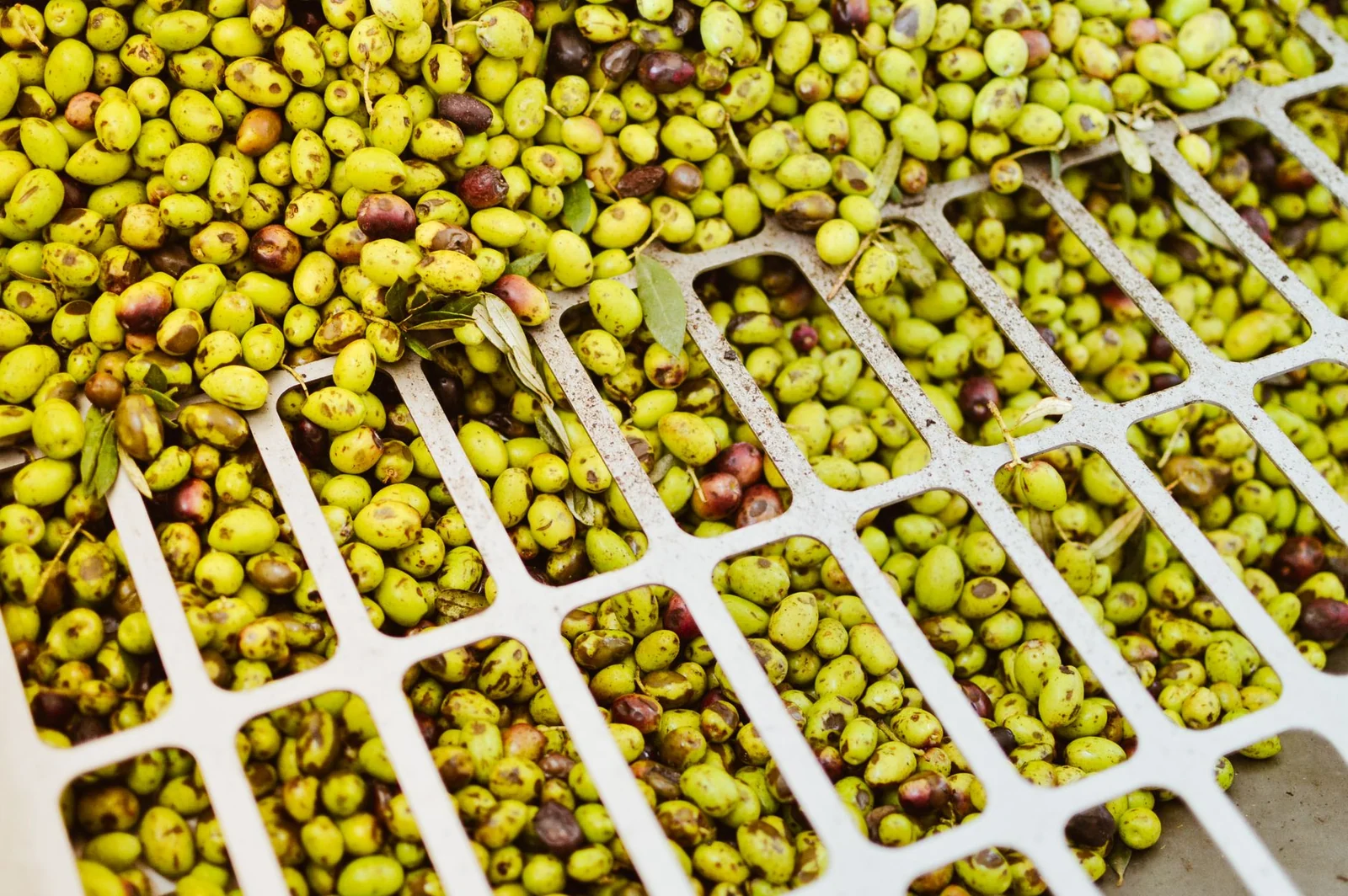
Algeria expects a record 150,000 tonnes: the Mediterranean supply map is shifting
Algeria's 2025/26 olive oil output is expected to exceed 150,000 tonnes — up 76% on the previous season and a third consecutive rise. With domestic consumption near 81,000 tonnes, an exportable surplus appears. In a season when Turkish exports fell 62% by value, that means new competition in the bulk market.
 Article
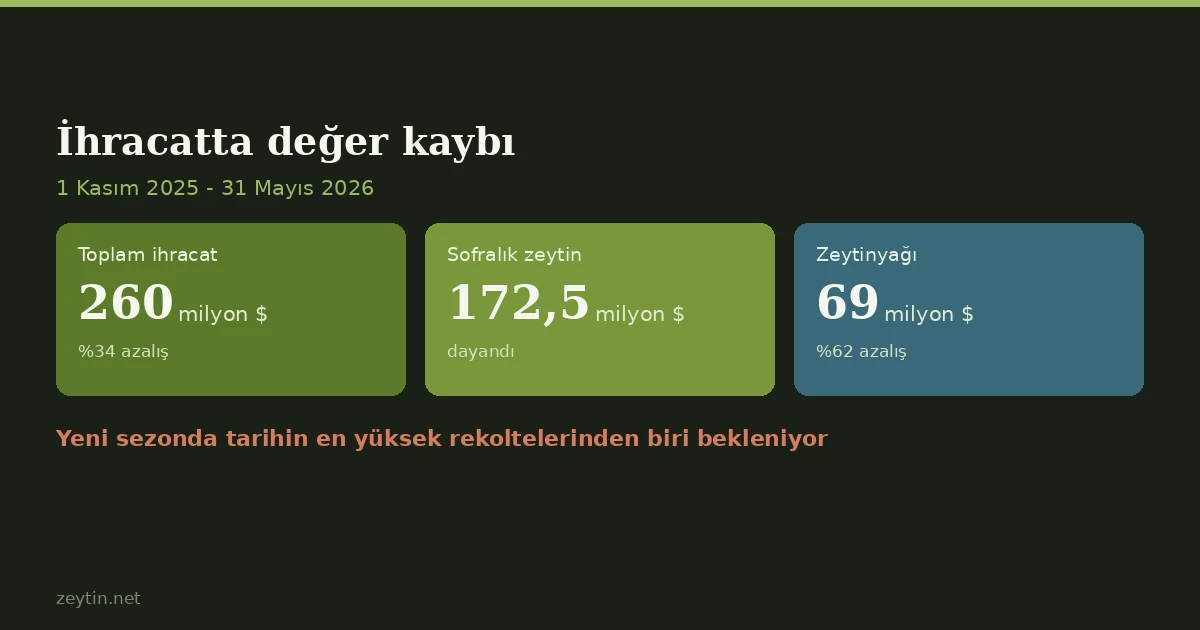
Olive oil exports down 62% by value as a record harvest is expected
Olive and olive oil exports fell 34% to $260 million between 1 November 2025 and 31 May 2026. Table olives held at $172.5 million while olive oil dropped to $69 million. The target is a return to $1 billion.
 Article
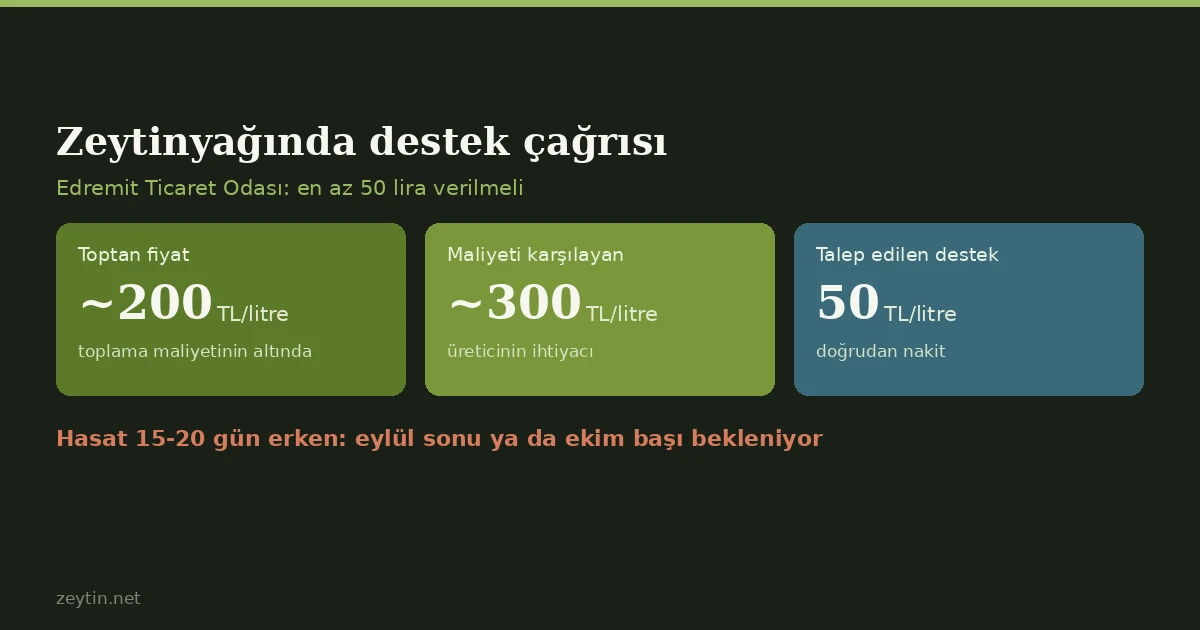
Edremit Chamber: olive oil needs at least 50 lira per litre in support
Chamber President Ahmet Çetin says the wholesale price has fallen to 200 lira, below the cost of picking. The level needed to cover costs is 300 lira. Harvest is expected 15-20 days early.
 Article
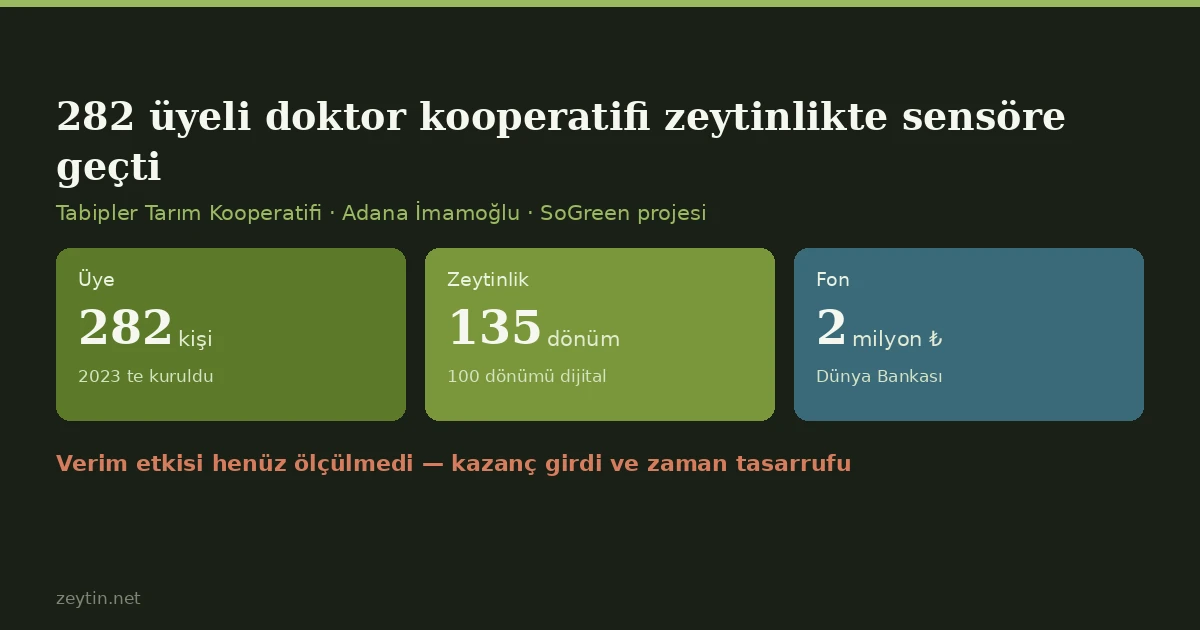
A 282-member doctors' cooperative puts sensors in the olive grove
A cooperative founded by doctors in Adana is monitoring water and fertiliser with buried sensors across 100 of its 135 dönüm of bearing olive grove, funded with 2 million lira.
 Article
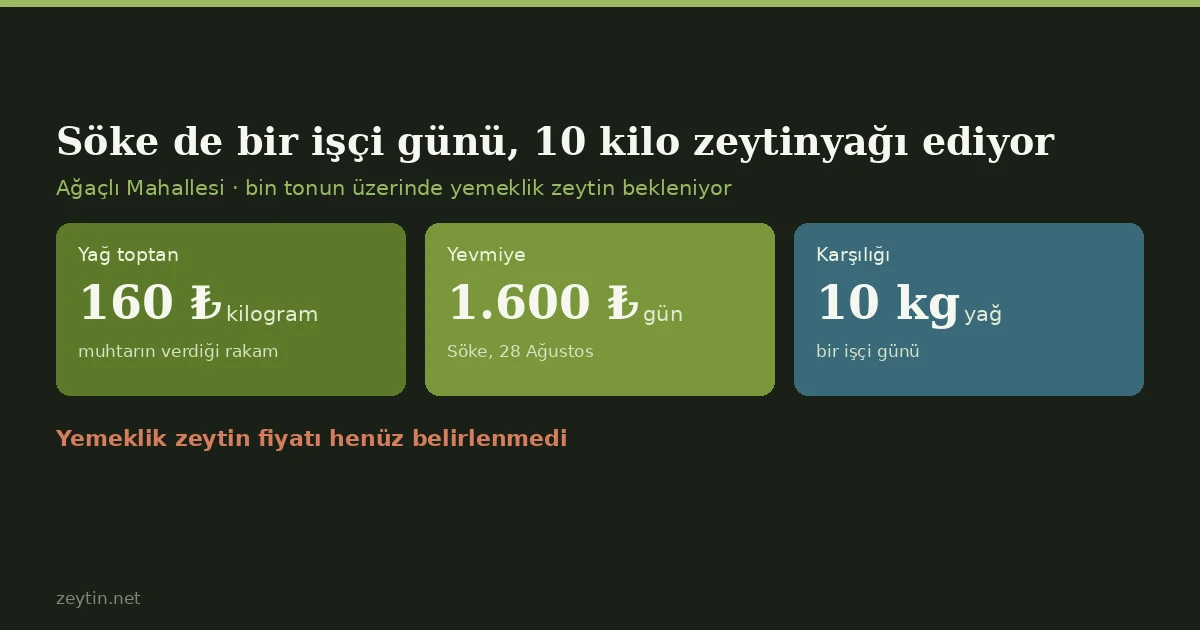
In Söke, one day's wage costs ten kilos of olive oil
Over 1,000 tonnes of table olives are expected in Söke's Ağaçlı. Two figures given by the headman sum up the season: oil at 160 lira wholesale, a day's wage at 1,600.
 Article
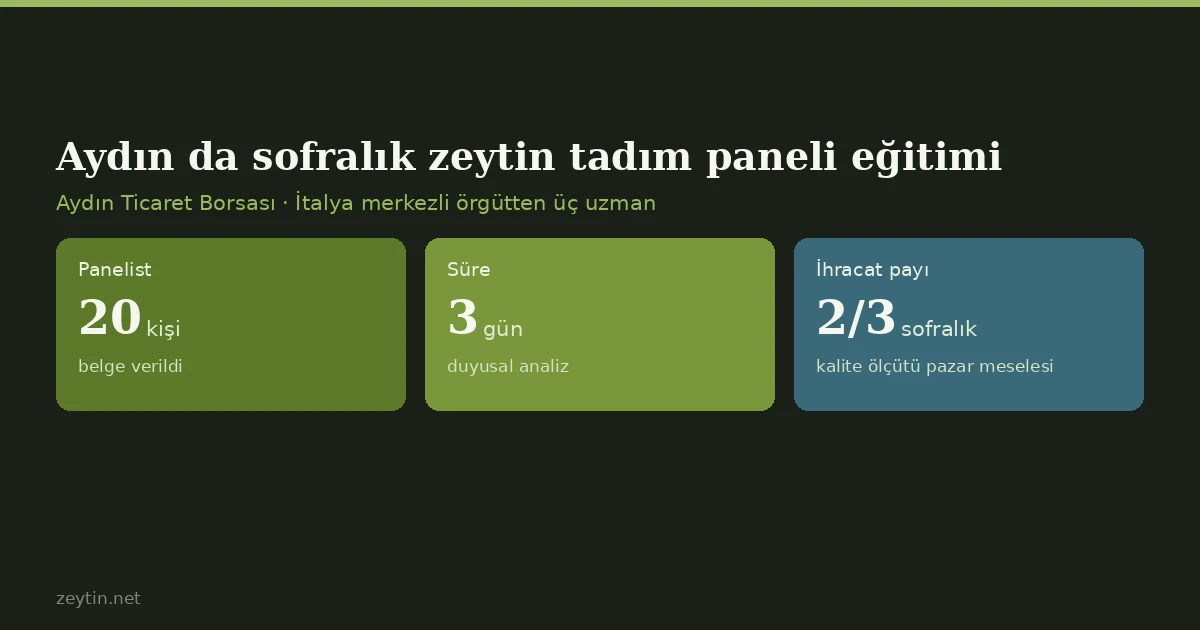
Table olive tasting panel training in Aydın
Aydın Commodity Exchange is extending its sensory analysis experience from olive oil to table olives, with 20 panellists trained over three days.
 Article
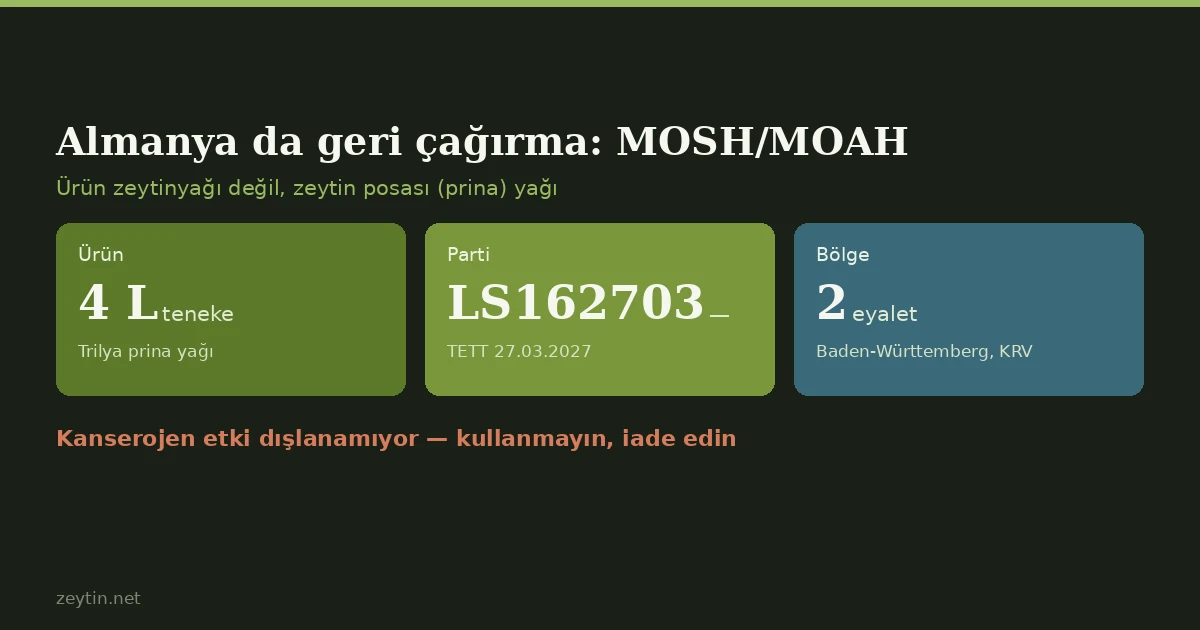
Recall in Germany: MOSH/MOAH in pomace oil — not olive oil
Germany's official food safety portal has recalled a 4-litre pomace oil sold in Turkish shops. The product is not olive oil but olive pomace oil; we explain the difference and what MOSH/MOAH are.
 Article
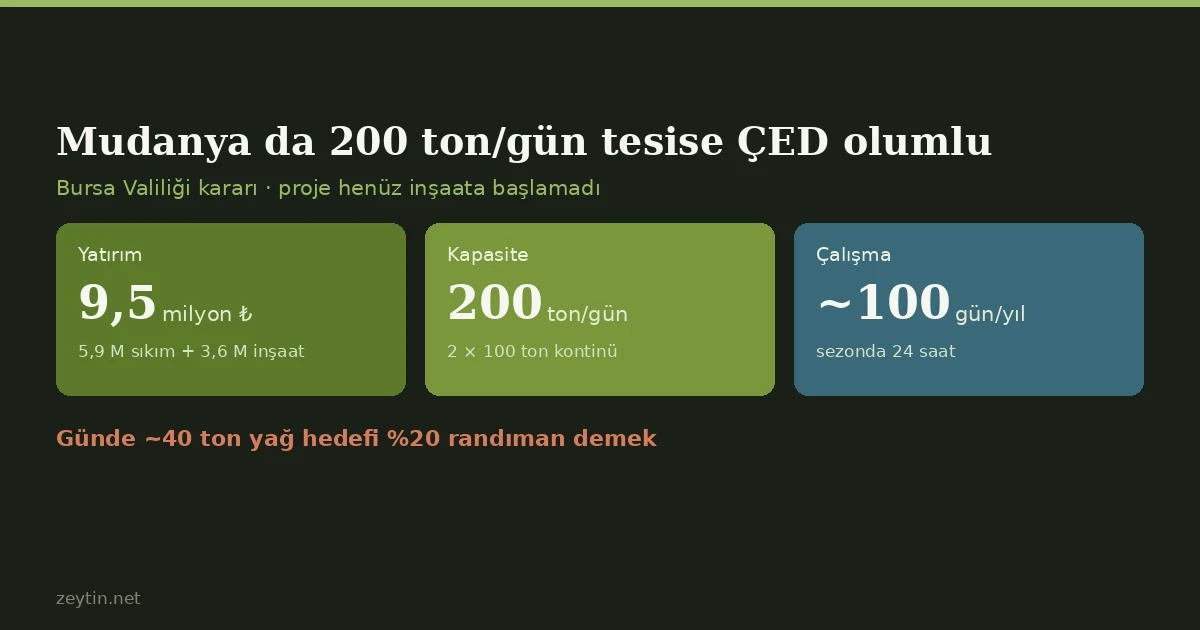
EIA approval for a 200 t/day olive oil plant in Mudanya
A 9.5 million lira olive oil plant planned in Mudanya, Bursa, has received a positive environmental impact decision: 200 tonnes of olives a day, around 100 operating days a season.
 Article
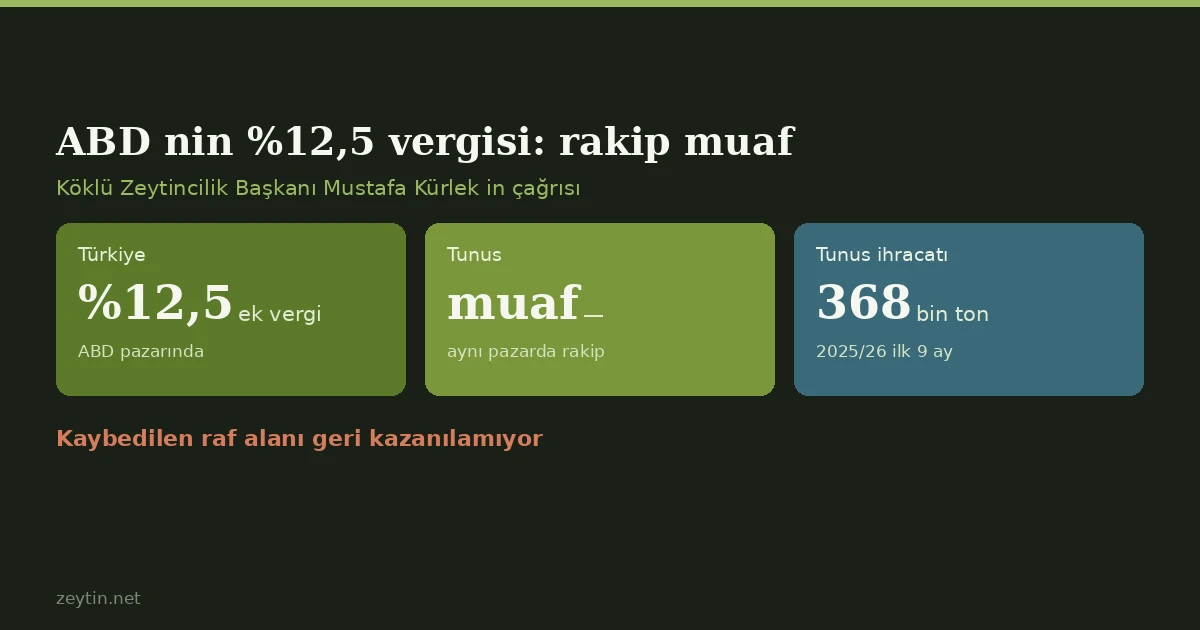
The 12.5% US tariff: the competitor is exempt, the Turkish exporter is not
Mustafa Kürlek notes the 12.5% additional US tariff on Turkish olive products is not applied to competitors such as Tunisia, and calls for DFİF and Eximbank measures.
 Article
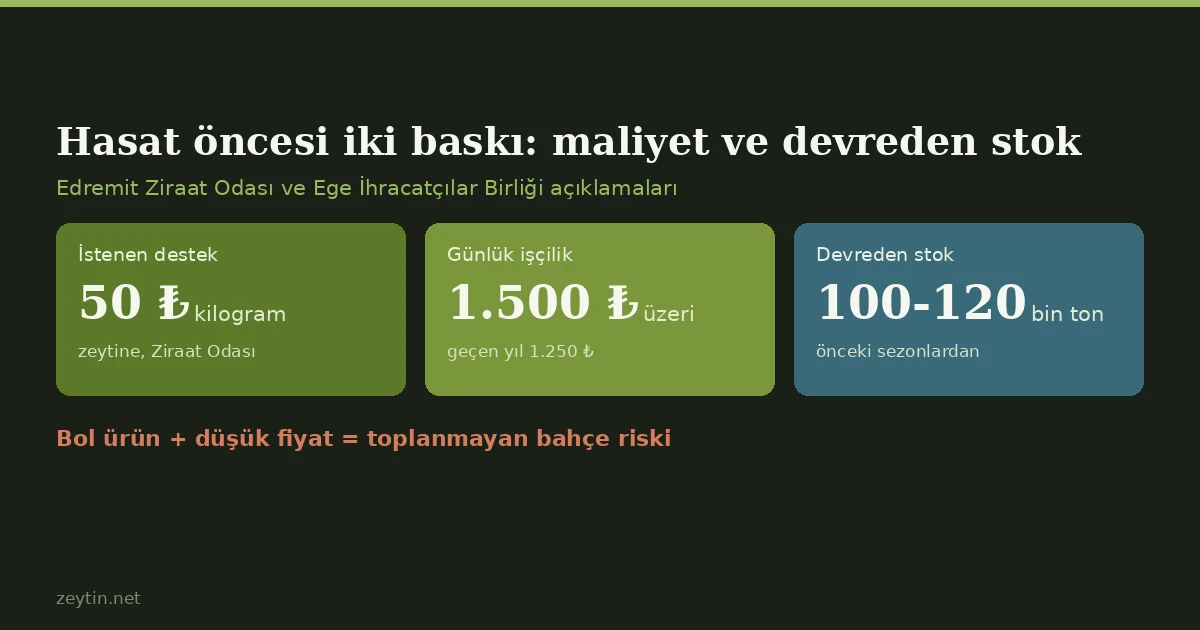
Two pressures before the harvest: costs and 100,000 tonnes carried over
The chamber of agriculture wants 50 lira per kilo; daily labour has passed 1,500 lira. Exporters report 100,000-120,000 tonnes carried over from previous seasons.
 Article
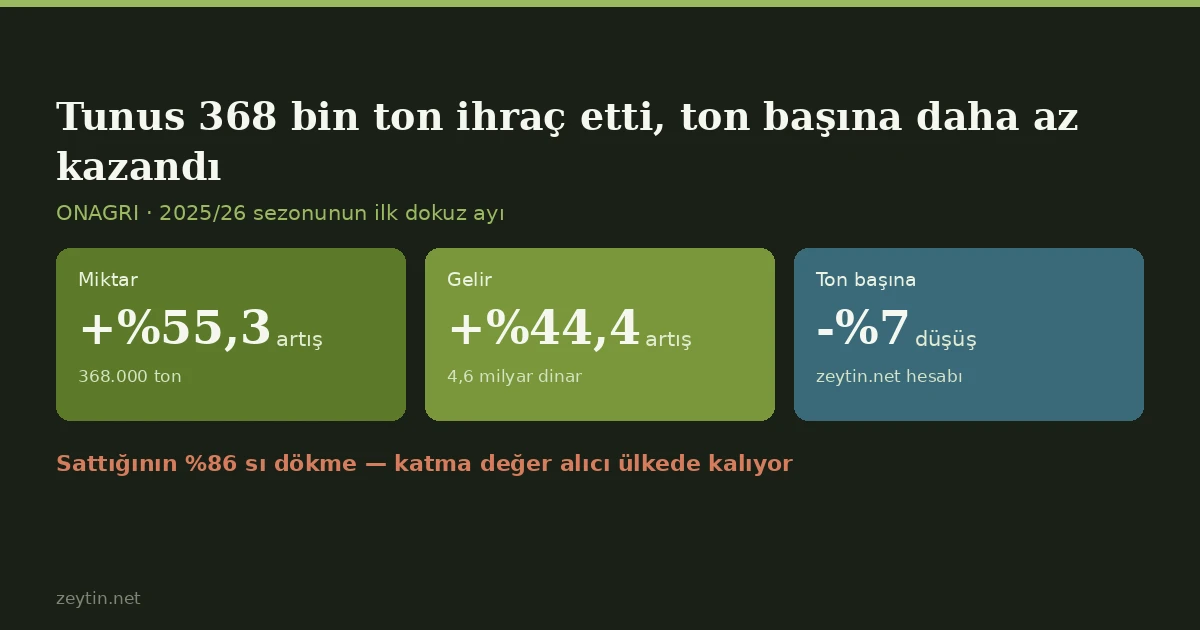
Tunisia exported 368,000 tonnes of olive oil — but earned less per tonne
Tunisia's agriculture observatory ONAGRI reports olive oil exports up 55.3% by volume and 44.4% by value in the first nine months of 2025/26. The gap between the two means about 7% less earned per tonne.
 Article
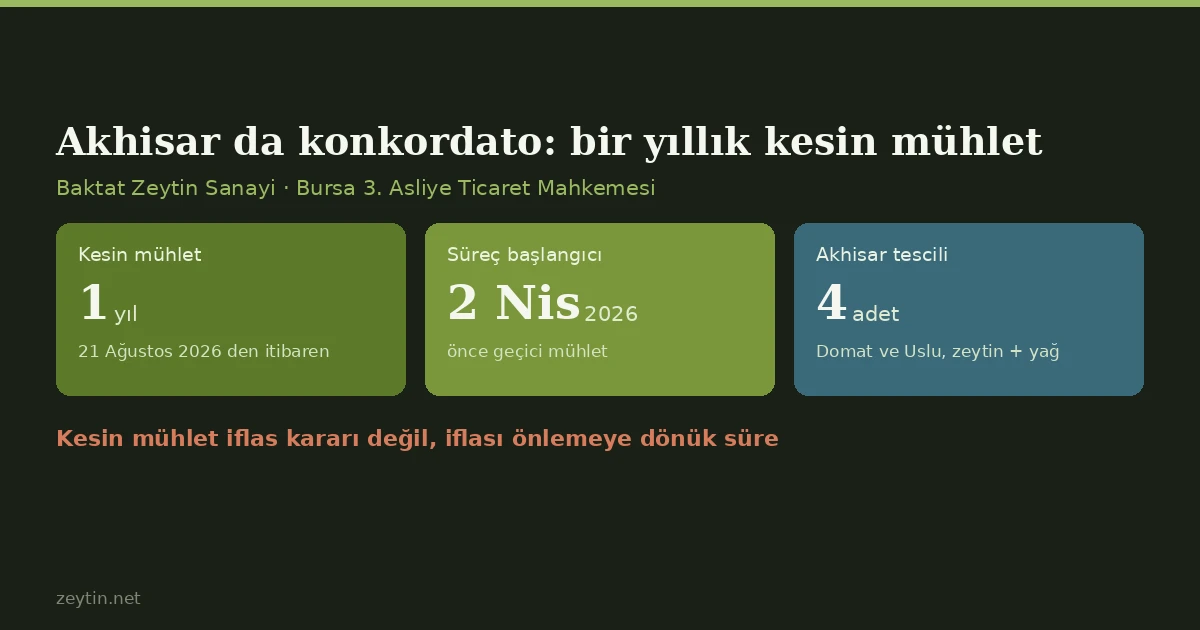
Concordat in Akhisar: a one-year moratorium for Baktat Zeytin
A Turkish commercial court has granted a one-year definitive moratorium to Baktat Zeytin, a table-olive processor in Akhisar. We set out what the ruling means and why it matters for the sector.