5,300 litres of adulterated oil in one van at Köşk — more than all of September
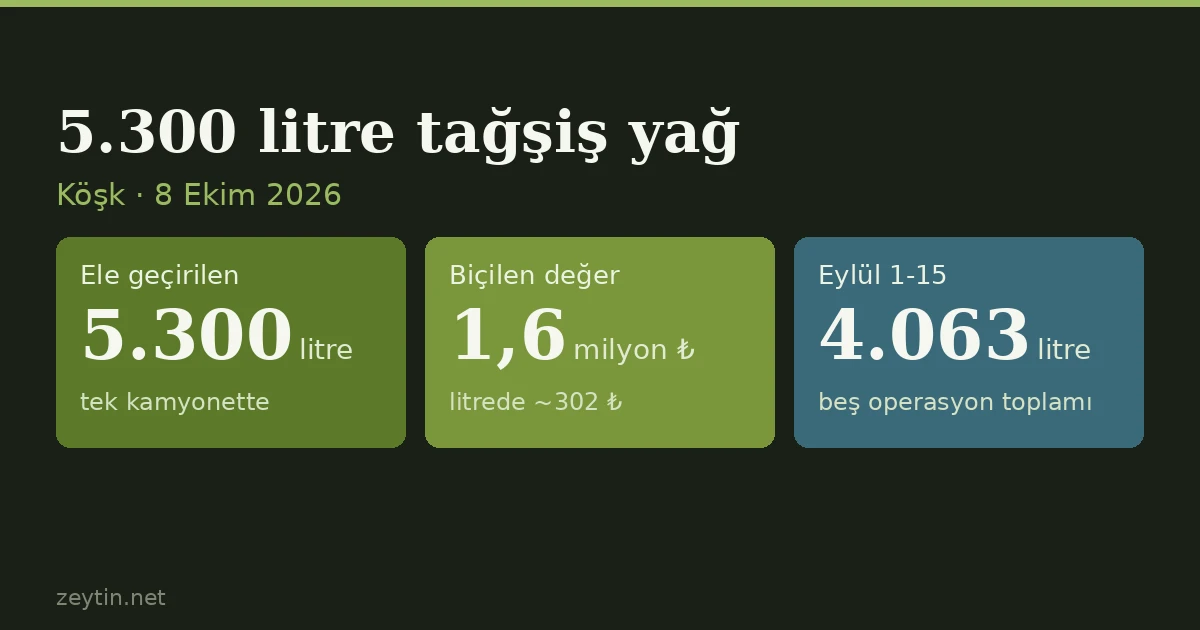
A van stopped on the Aydın-Denizli highway was found to be carrying 5,300 litres of counterfeit and adulterated olive oil, valued at 1.6 million lira; two people face proceedings. The single shipment exceeds the 4,063 litres seized across five operations in the province in the first half of September.
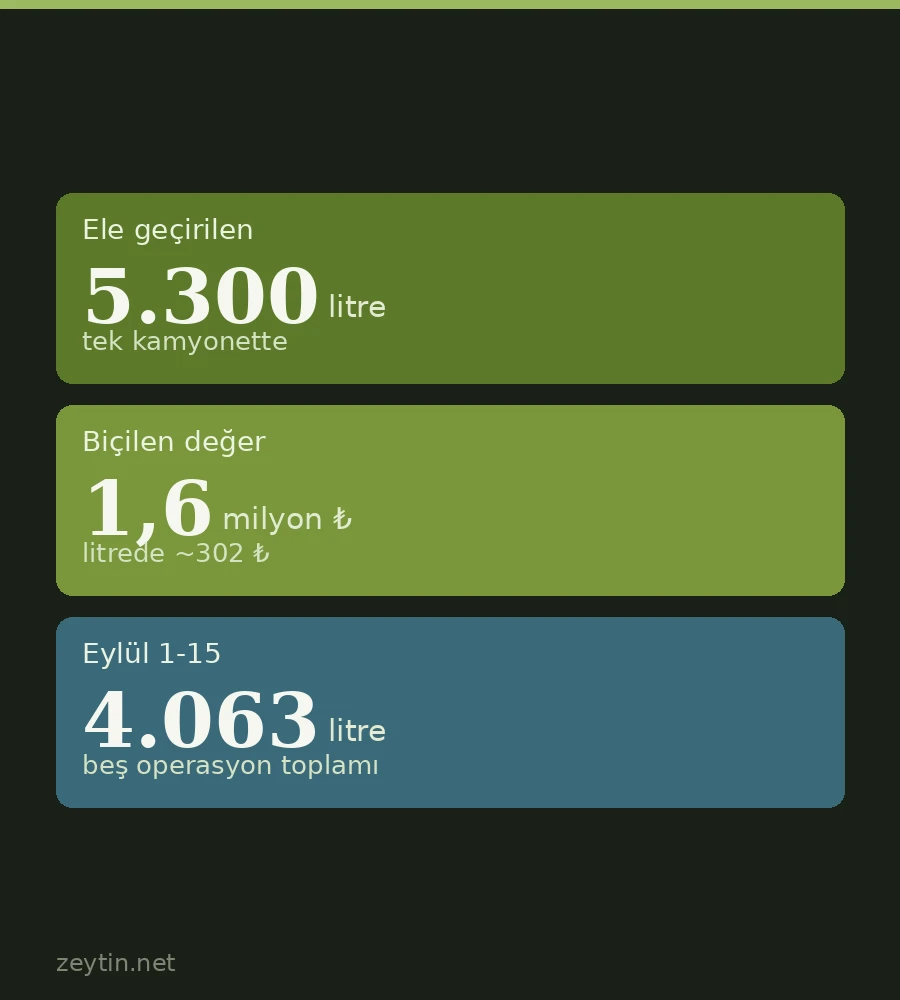
As the season's first pressings reach the market, a single vehicle in Aydın turned out to be carrying 5,300 litres of counterfeit and adulterated olive oil. According to the statement from the Aydın Provincial Gendarmerie Command, the operation took place on 8 October 2026 in the district of Köşk, on the Aydın-Denizli highway. A van used by the suspects was stopped and the entire load was seized.
The figures in the statement
| Item | Figure |
|---|---|
| Oil seized | 5,300 litres |
| Estimated market value | ₺1.6 million |
| People charged | 2 |
| Date of operation | 8 October 2026 |
The statement identifies the suspects only by their initials, M.O. (31) and K.Ş. (52); both face criminal and administrative proceedings. The investigation was carried out by teams from the Köşk District Gendarmerie Command, and the statement says the goods were intercepted before they could be distributed to the market.
What 302 lira a litre tells us
Dividing one figure in the statement by the other makes the economics of the trade visible: ₺1.6 million ÷ 5,300 litres is roughly 302 lira a litre. That is the value assigned by the authorities, not necessarily the price at which the oil would have been sold. It still gives a sense of scale. In this site's retail survey on 9 October, branded extra virgin olive oil was selling at between 392.95 and 599.95 lira a litre.
The more telling comparison is on the wholesale side. In Türkiye, extra virgin olive oil was registered on the Nazilli commodity exchange at 200.46 lira a kilogram on 8 October. Because olive oil weighs less than a kilogram per litre, that works out to roughly 184 lira a litre. In other words, the value assigned to the seized oil is about 1.6 times the wholesale price of genuine extra virgin recorded on the exchange in the same days. Part of that gap is explained by the authorities valuing the goods at retail level; the rest indicates the price band the adulterated oil was aiming to occupy.
It helps to picture the volume as well: 5,300 litres means 1,060 five-litre tins, or roughly 295 eighteen-litre canisters. That is not a household's or a small shop's stock. It is a consignment prepared for distribution.
The gap in between is the whole reason adulteration persists. A product thinned with cheap seed oil — or one that is another oil from start to finish — can be put together for a fraction of what genuine oil costs to produce, and if it finds a buyer at a price just below the supermarket shelf, every bit of that difference becomes profit. The extreme version of this appeared earlier in the year, in a case where adulterated oil was priced above the real thing. Price on its own is not a guarantee of anything.
One van, more than a whole fortnight
To see how large this quantity is, it helps to place it next to the previous tally from the same province. According to the Aydın Police Department, five separate operations conducted across the province between 1 and 15 September 2026 seized a combined 4,063 litres of unlabelled adulterated oil, along with 7,922 empty tins; we covered the details in our report on those raids. The single van stopped at Köşk was carrying roughly 1,200 litres more than that entire fortnight produced.
There are two ways to read the comparison. Either the scale of individual shipments is growing, or enforcement is beginning to reach larger consignments rather than retail-sized batches. Telling the two apart takes more than one news item: it requires watching the direction of the figures through the season.
Why Aydın keeps appearing
It is no accident that Aydın recurs in this kind of story. According to this site's provincial data, the province produced 439,278 tonnes of olives and 44,785 tonnes of olive oil in the 2025-2026 season, making it Türkiye's largest producer. The province has 22.4 million trees of bearing age, yielding 19.6 kilograms each, and of the fruit produced, 296,027 tonnes went to milling against 143,251 tonnes for the table. Aydın is not merely large; it is predominantly an oil-producing basin.
The place where raw material, milling capacity and bulk oil trading are most concentrated is also where adulteration hides most easily: in a basin where bulk movement is ordinary, a load with no traceability can travel without attracting attention. That the van was stopped on one of the basin's main exit routes, heading towards Denizli, also suggests the load was on its way out of the province.
"Counterfeit" and "adulterated" are not the same
The statement uses both words together, but in Turkish food law they are distinct. Adulteration means mixing in a substance that does not belong to the product, or otherwise degrading its composition — in olive oil, most often blending cheap seed oil into extra virgin. Counterfeiting means selling a product under another product's name, brand or packaging. A single shipment can involve both at once: seed-oil-thinned oil poured into the tins of a known brand is adulterated and counterfeit at the same time. We set out the methods, and what a buyer can actually check, in our guide to olive oil fraud and adulteration.
The particular risk of early season
The timing matters too. October is the in-between month, when the new crop has not yet fully loaded the market and the previous season's stock has run down. It is when the words "first pressing" carry a premium both on the shelf and in bulk sales, and when most buying is done in tins and canisters rather than retail bottles. In a period when unlabelled selling looks normal, an untraceable product is also harder to distinguish from a legitimate one.
This season has one further peculiarity: world supply is abundant. Spanish extra virgin olive oil fell to a producer price of €3.43/kg in the week of 4 October, and Spain expects 1.6 million tonnes in 2026/27. As the price of genuine oil falls, the margin left to adulteration should in theory narrow; that seized consignments are nonetheless getting larger suggests these loads were prepared before the season turned.
Lack of a label is a separate risk in its own right. An oil with no named producer, no batch number, no filling date and no analytical history leaves nothing to recall if something goes wrong — no batch to withdraw, no business to hold responsible, no record to examine.
What this is worth to a buyer
The practical test on the buyer's side is short. Avoid bulk oil that carries no label, no batch number and no filling date; and check whether the brand you buy has appeared on the lists of counterfeit and adulterated products that the Ministry of Agriculture and Forestry publishes regularly. The most recent list included 21 olive oil brands.
The administrative fine in the Köşk case and the outcome of the criminal process have not yet been announced. In the September tally that figure came to 1,846,000 lira, and a similar statement may follow for this file.
One rating per visitor; you can change yours at any time. Ratings are real reader votes — no seeded or default scores.
Related
 Article
Manisa's olive trees reach 38 million: 8 million added in three years, sector asks for premium support
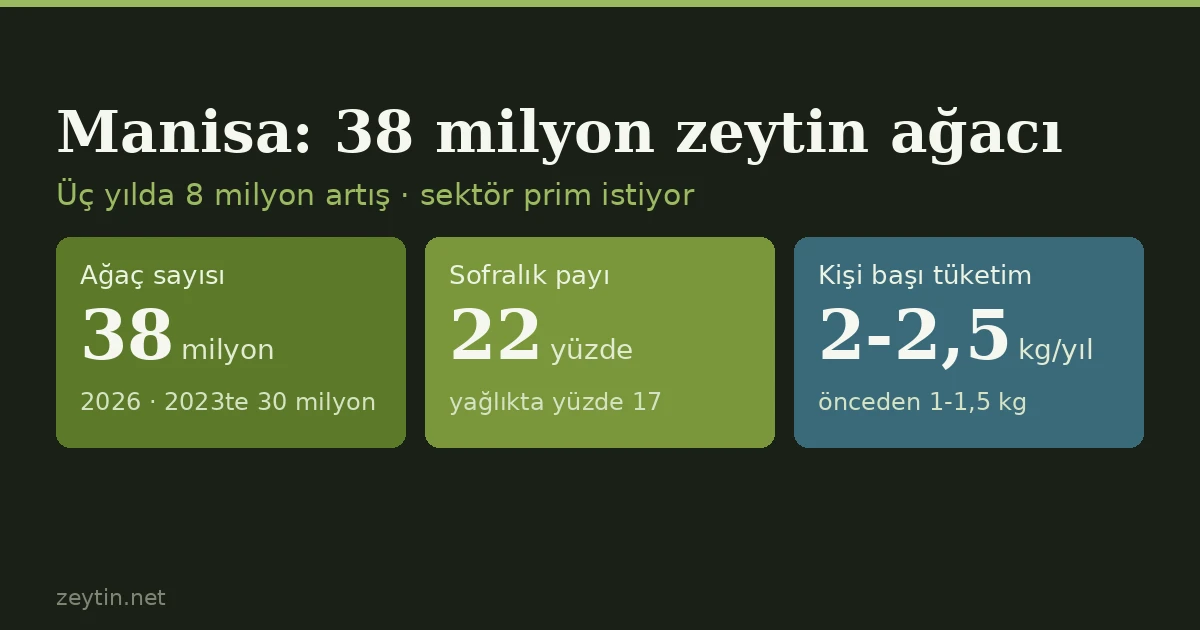
Manisa's olive tree count rose from 30 million in 2023 to 38 million in 2026. Data shared at a sector meeting hosted by the Manisa Commodity Exchange shows the province alone accounts for 17 percent of Turkey's oil-olive output and 22 percent of its table-olive output. The meeting also reported that annual per-capita olive oil consumption in Turkey has climbed from 1-1.5 kg to 2-2.5 kg. Exchange chairman Sadık Özkasap called for higher state support and premium incentives against the lower processing costs of Spain, Tunisia and Morocco.
Article
Manisa's olive trees reach 38 million: 8 million added in three years, sector asks for premium support
Manisa's olive tree count rose from 30 million in 2023 to 38 million in 2026. Data shared at a sector meeting hosted by the Manisa Commodity Exchange shows the province alone accounts for 17 percent of Turkey's oil-olive output and 22 percent of its table-olive output. The meeting also reported that annual per-capita olive oil consumption in Turkey has climbed from 1-1.5 kg to 2-2.5 kg. Exchange chairman Sadık Özkasap called for higher state support and premium incentives against the lower processing costs of Spain, Tunisia and Morocco.
 Article
The International Olive Council grows: Iraq joins, Brazil and South Africa apply
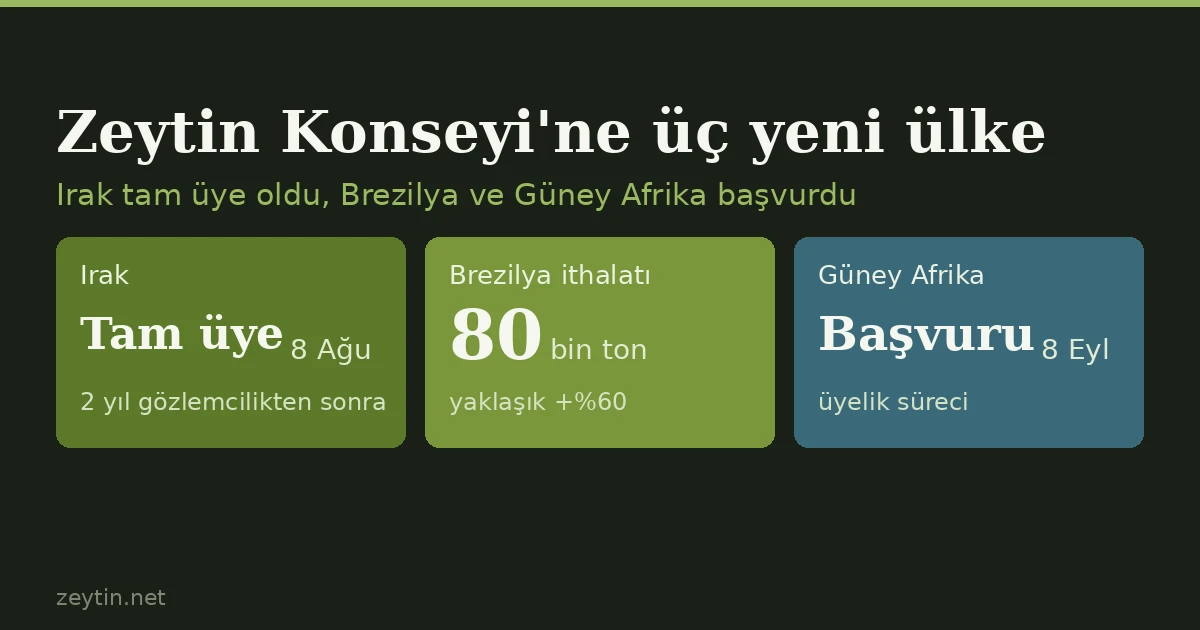
The International Olive Council (IOC) saw three developments in a month: Iraq became a full member on 8 August, South Africa submitted its membership request on 8 September and Brazil on 9 September. The expansion reflects olive oil's shift towards production and consumption areas beyond the Mediterranean.
Article
The International Olive Council grows: Iraq joins, Brazil and South Africa apply
The International Olive Council (IOC) saw three developments in a month: Iraq became a full member on 8 August, South Africa submitted its membership request on 8 September and Brazil on 9 September. The expansion reflects olive oil's shift towards production and consumption areas beyond the Mediterranean.
 Article
Olive oil exports down 62% by value as a record harvest is expected
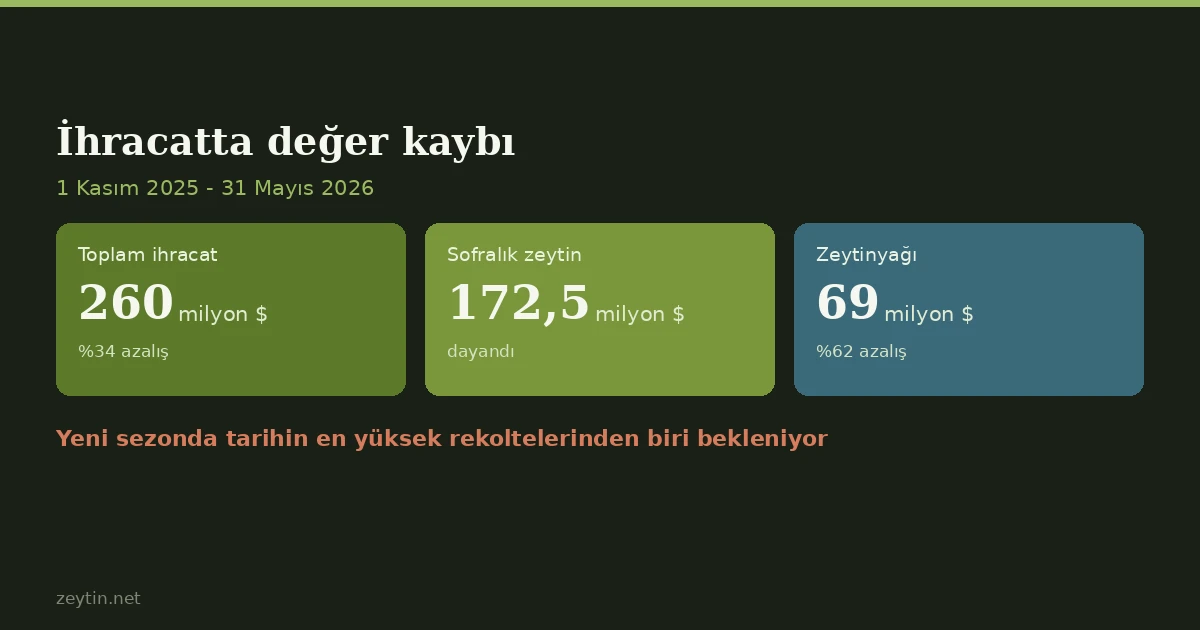
Olive and olive oil exports fell 34% to $260 million between 1 November 2025 and 31 May 2026. Table olives held at $172.5 million while olive oil dropped to $69 million. The target is a return to $1 billion.
Article
Olive oil exports down 62% by value as a record harvest is expected
Olive and olive oil exports fell 34% to $260 million between 1 November 2025 and 31 May 2026. Table olives held at $172.5 million while olive oil dropped to $69 million. The target is a return to $1 billion.
 Article
In Spain the cost sits above the price: €5.31 in a traditional grove, €3.46 at the gate
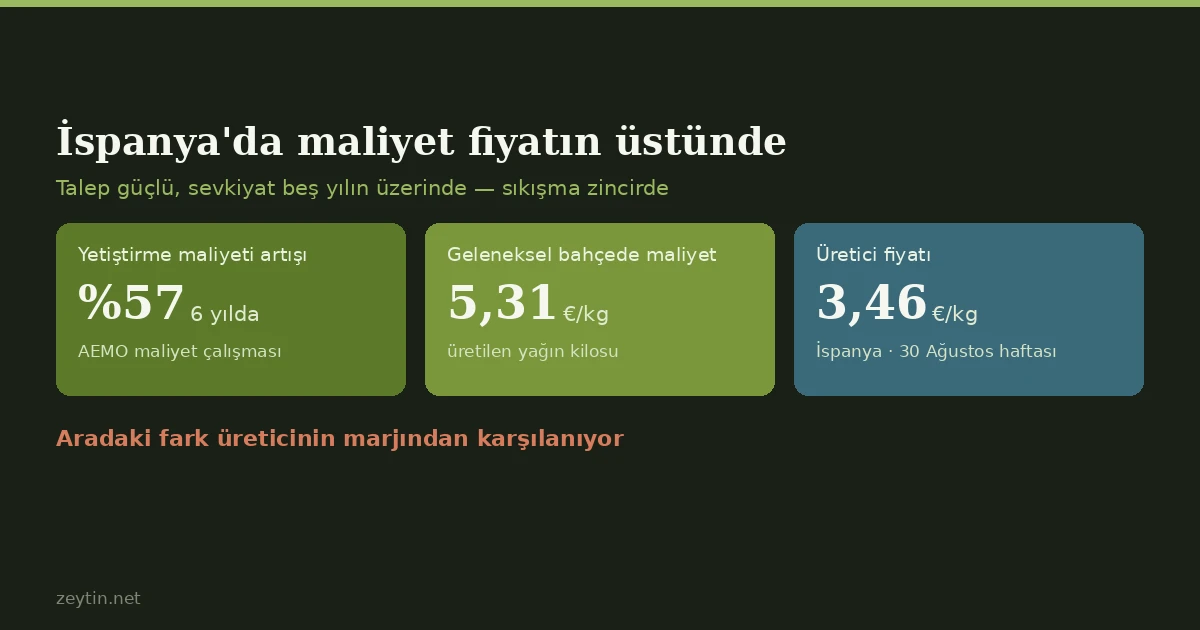
Olive cultivation costs have risen 57% in six years and reach €5.31 per kilogram in the most traditional groves, according to an AEMO study. The same week, Spain's producer price was €3.46. The Andalusian cooperative federation, with 342,000 members, is asking not for aid but for a change to the Food Chain Law.
Article
In Spain the cost sits above the price: €5.31 in a traditional grove, €3.46 at the gate
Olive cultivation costs have risen 57% in six years and reach €5.31 per kilogram in the most traditional groves, according to an AEMO study. The same week, Spain's producer price was €3.46. The Andalusian cooperative federation, with 342,000 members, is asking not for aid but for a change to the Food Chain Law.