Spain's official estimate: 1.6 million tonnes, and prices have already fallen
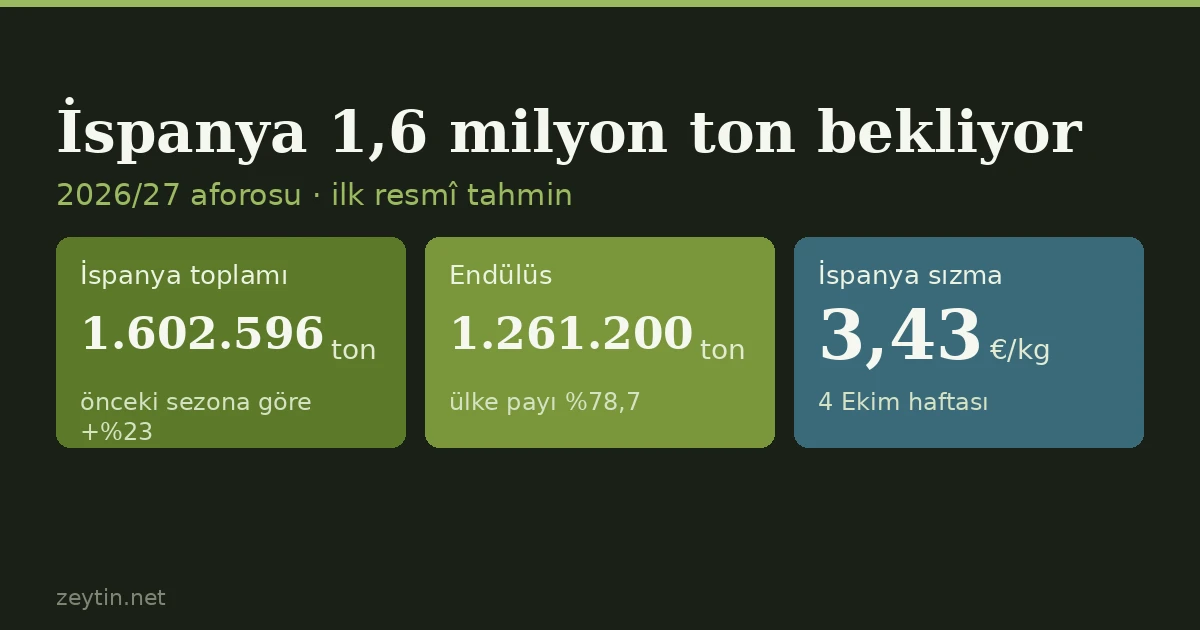
Spain's agriculture ministry has published its first official 2026/27 crop estimate: 1,602,596 tonnes of olive oil, 23% above last season. Andalusia alone expects 1.26 million tonnes. Producer prices did not wait for the estimate — Spanish extra virgin has slipped to 3.43 euros a kilo.
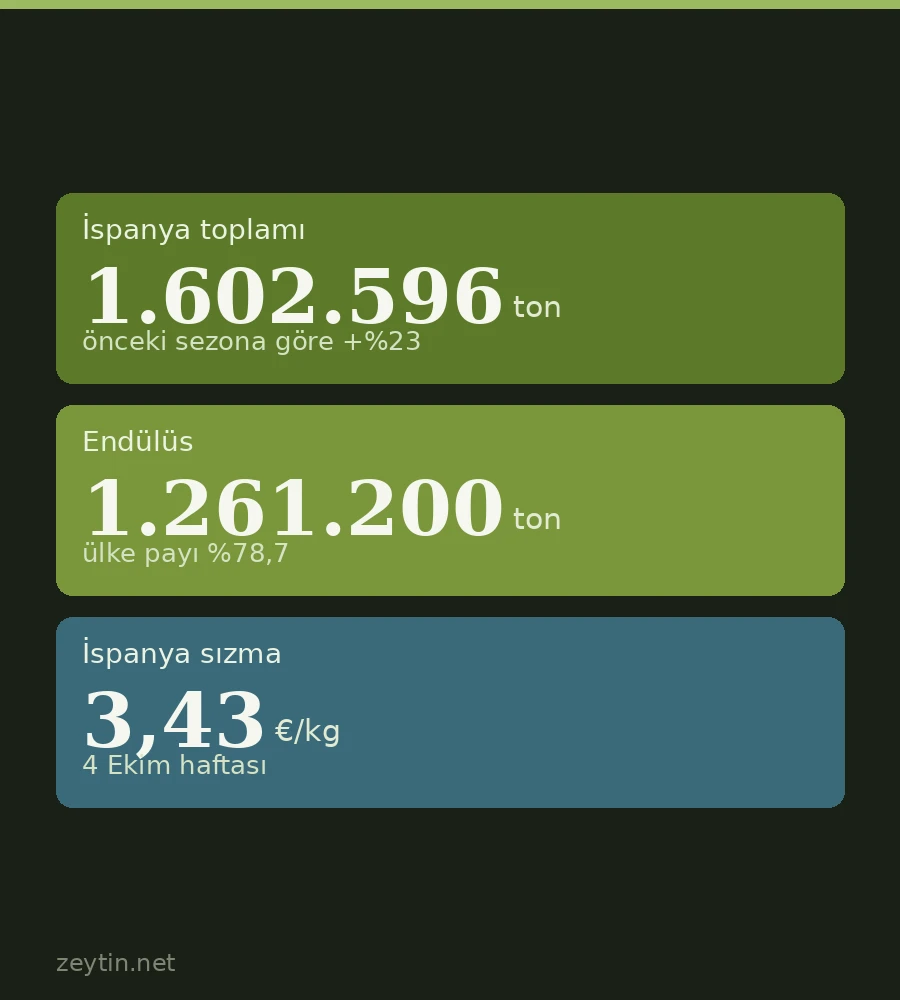
Spain's Ministry of Agriculture, Fisheries and Food published the first official estimate for the 2026/27 season — the survey Spaniards call the aforo — in Jaén on 1 October: 1,602,596 tonnes of olive oil, some 23% above the previous season. The ministry describes the crop, in its own words, as medium-high.
Scale helps to read that number. Türkiye's officially surveyed olive oil output for 2025/26 was 310,000 tonnes. Spain alone expects five times as much.
The estimate by region
| Region | Olive oil | Change |
|---|---|---|
| Andalusia | 1,261,200 t | up |
| Castilla-La Mancha | 152,555 t | +10% |
| Extremadura | 97,300 t | +24% |
| Catalonia | 30,344 t | −22% |
| Spain total | 1,602,596 t | +23% |
The line worth pausing on is Catalonia. National supply grows by roughly a fifth while that region contracts by almost a quarter. A big Spanish crop is not one uniform picture; it is the sum of regional movements that point in opposite directions.
Andalusia on its own accounts for 78.7% of national output. Talking about world olive oil supply is, in practice, talking about this one region.
Andalusia released its own survey a day earlier
The regional government announced its aforo on 29 September in Mengíbar, in the province of Jaén. According to Ramón Fernández-Pacheco, the regional minister for agriculture, fisheries, water and rural development, Andalusia will produce 1,261,200 tonnes of olive oil: 23.9% above the previous season and 44% above the average of the last five.
The provincial breakdown: Jaén 575,000 tonnes (45.6% of the regional total), Córdoba 339,700 tonnes, Seville 142,000 tonnes. Milling olives come to 6,849,200 tonnes, with a yield of around 20% in Jaén. Organic olive oil is forecast at 60,400 tonnes — 80.5% above last season, which makes it the sharpest rise in the whole survey. The steepest growth this year is not in ordinary oil but in the organic segment.
⚠ The two institutions do not agree on the percentage. The tonnage is identical in both (1,261,200), but the increase appears as 23.9% in the regional release and 29% in the ministry's regional table. The gap comes from which figure is taken as last season's actual output. This article works from the tonnage.
Table olives are growing too
The Andalusian survey puts table olives at 466,037 tonnes, a 9% increase on the previous season. Seville alone accounts for 320,000 tonnes, Córdoba for 70,066 and Málaga for 63,373.
For Türkiye this line matters as much as the oil. Spain is our most direct competitor in table olives, and Seville's volume is part of the pressure behind the opening prices formed in Akhisar this week.
Prices did not wait for the estimate
In the European Commission producer price series this site tracks, Spanish extra virgin stood at €3.43/kg in the week of 4 October, with Jaén at €3.42/kg. At the Italian end of the same series, the week of 27 September showed €4.75/kg, and €4.55/kg in Bari.
That spread — more than €1.30 a kilo between Europe's two largest producers — is the clearest sign that the market had already priced the aforo in. Where supply is abundant, price looks down; where it is short, price looks up. Greece opened its season under the same price pressure.
What it means for Türkiye
1. The floor for bulk export prices is set in Spain. The buyer facing a Turkish exporter is negotiating in a market that can see the largest supply on earth. Last season showed the result plainly: olive and olive oil exports came to 260 million dollars, down 62% in value.
2. A large crop does not rescue income by itself. The same equation runs in reverse in Tunisia, where output falls 40% while revenue is expected to hold because unit prices are higher. Türkiye's own sector expectation for 2026/27 is 500,000 to 600,000 tonnes — meaning our abundant year coincides with the largest supply in the world reaching the market at the same moment.
3. Not all of the Mediterranean is in surplus. Tunisia is heading down to 300,000 tonnes and Catalonia is contracting. The opposite-phase pattern still holds; the difference this season is that Spain sits on the large side of it.
When does the number become final?
An aforo is an estimate, not a count. It moves as milling advances and as yields become clear. Growers in Andalusia were already objecting to the first projections back in September: this figure is not settled until November. The ministry enters the same caveat, noting that the estimate will be revised according to the effect of a dry summer on rainfed groves and the weather of the coming weeks.
Türkiye's own official survey is in the field as well. Once the two numbers sit side by side in November, the price framework for the season will read far more clearly than it does today.
One rating per visitor; you can change yours at any time. Ratings are real reader votes — no seeded or default scores.
Related
 Article
Field study for Şarköy olive oil: Tekirdağ's pick for "81 Provinces 81 Products"
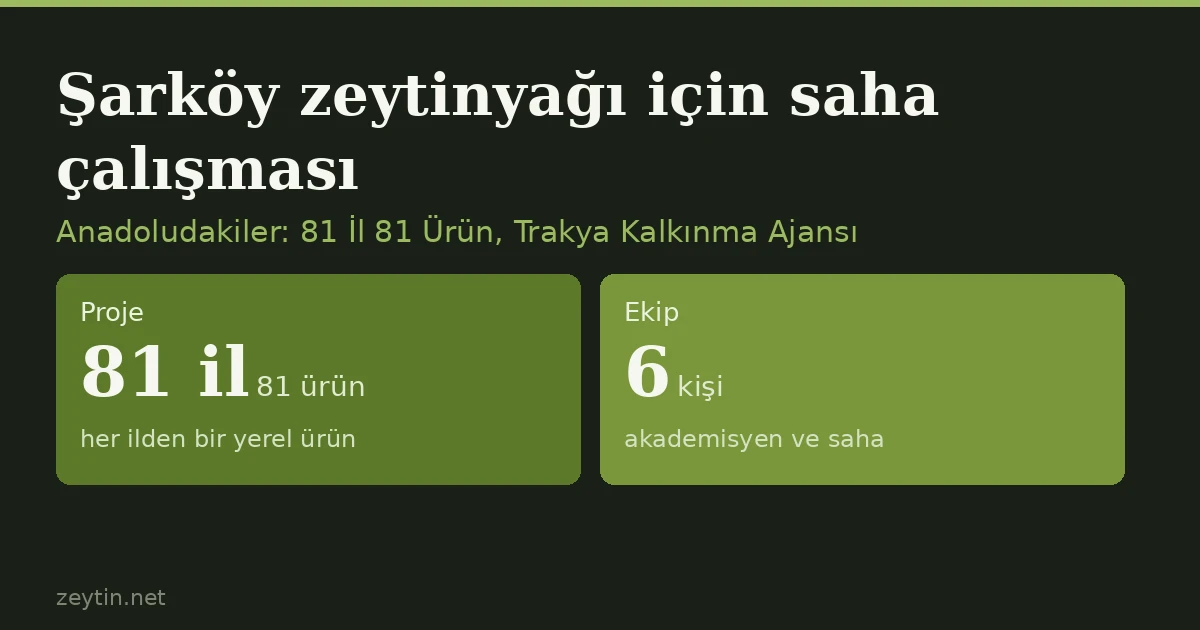
Şarköy olive oil has been chosen as Tekirdağ's product in the "Anatolians: 81 Provinces 81 Products" programme coordinated by the Ministry of Industry and Technology. The Thrace Development Agency and Namık Kemal University surveyed growers and businesses to map the value chain. The goal is branding; there is no geographical indication registration yet.
Article
Field study for Şarköy olive oil: Tekirdağ's pick for "81 Provinces 81 Products"
Şarköy olive oil has been chosen as Tekirdağ's product in the "Anatolians: 81 Provinces 81 Products" programme coordinated by the Ministry of Industry and Technology. The Thrace Development Agency and Namık Kemal University surveyed growers and businesses to map the value chain. The goal is branding; there is no geographical indication registration yet.
 Article
The UN names 2026 the Year of the Woman Farmer: in olives the labour is women's, the records are not
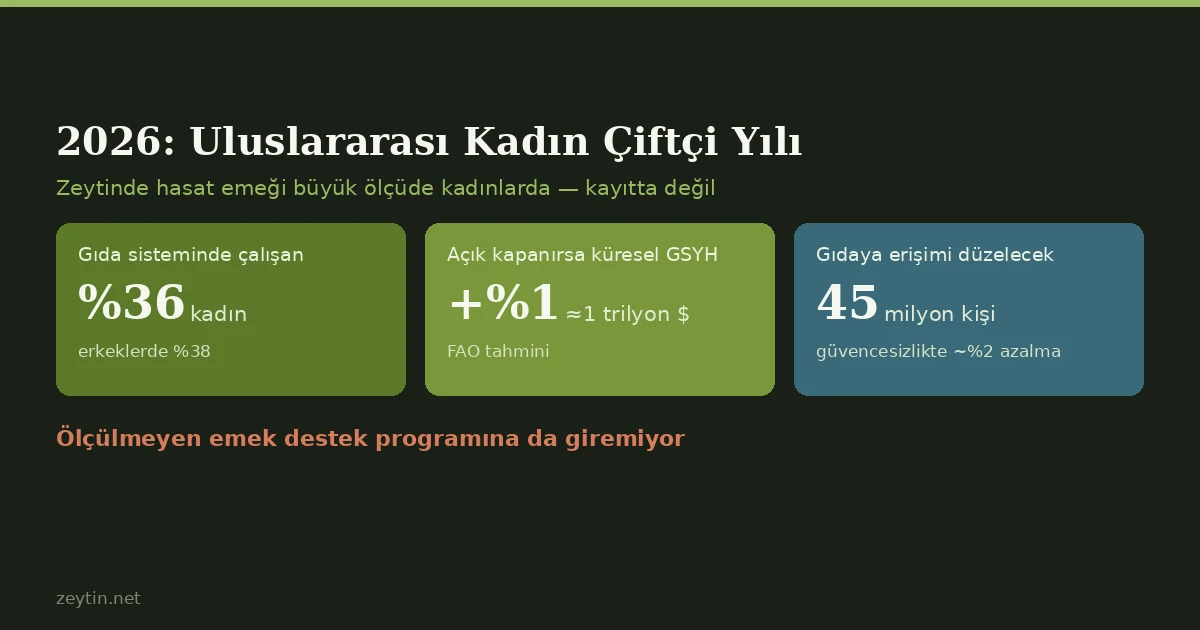
FAO reports that agrifood systems employ 36% of working women and 38% of working men; closing the gender gap would add 1% to global GDP (about $1 trillion) and improve food access for 45 million people. In olives, most harvest labour is women's — title deeds and decisions are not.
Article
The UN names 2026 the Year of the Woman Farmer: in olives the labour is women's, the records are not
FAO reports that agrifood systems employ 36% of working women and 38% of working men; closing the gender gap would add 1% to global GDP (about $1 trillion) and improve food access for 45 million people. In olives, most harvest labour is women's — title deeds and decisions are not.
 Article
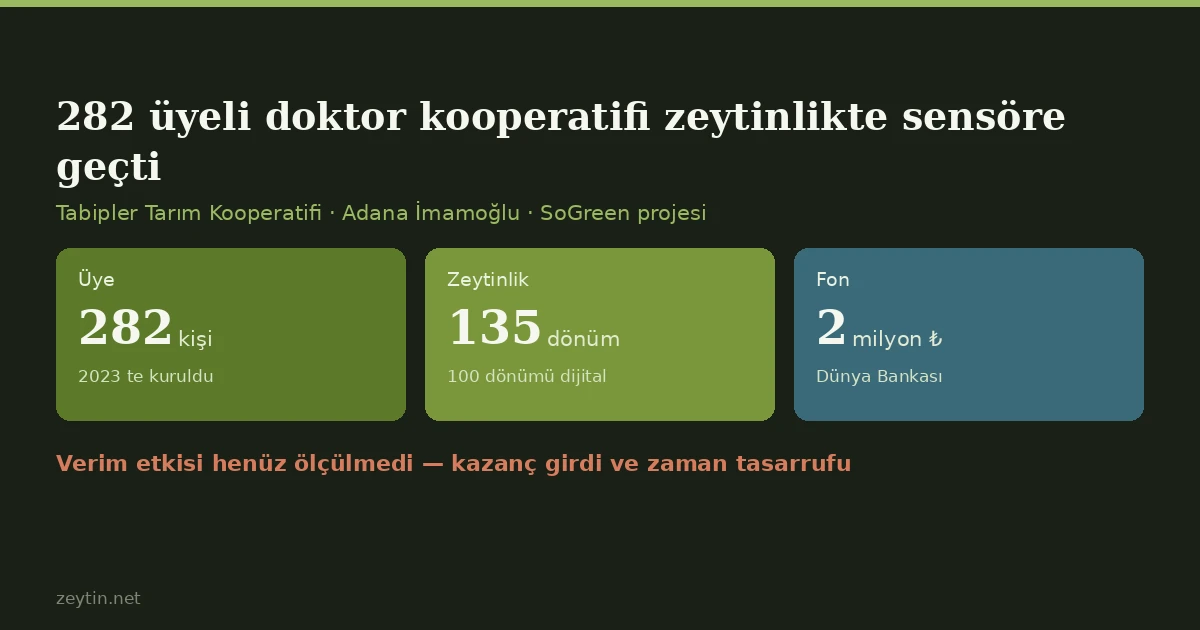
A 282-member doctors' cooperative puts sensors in the olive grove
A cooperative founded by doctors in Adana is monitoring water and fertiliser with buried sensors across 100 of its 135 dönüm of bearing olive grove, funded with 2 million lira.
Article
A 282-member doctors' cooperative puts sensors in the olive grove
A cooperative founded by doctors in Adana is monitoring water and fertiliser with buried sensors across 100 of its 135 dönüm of bearing olive grove, funded with 2 million lira.
 Article
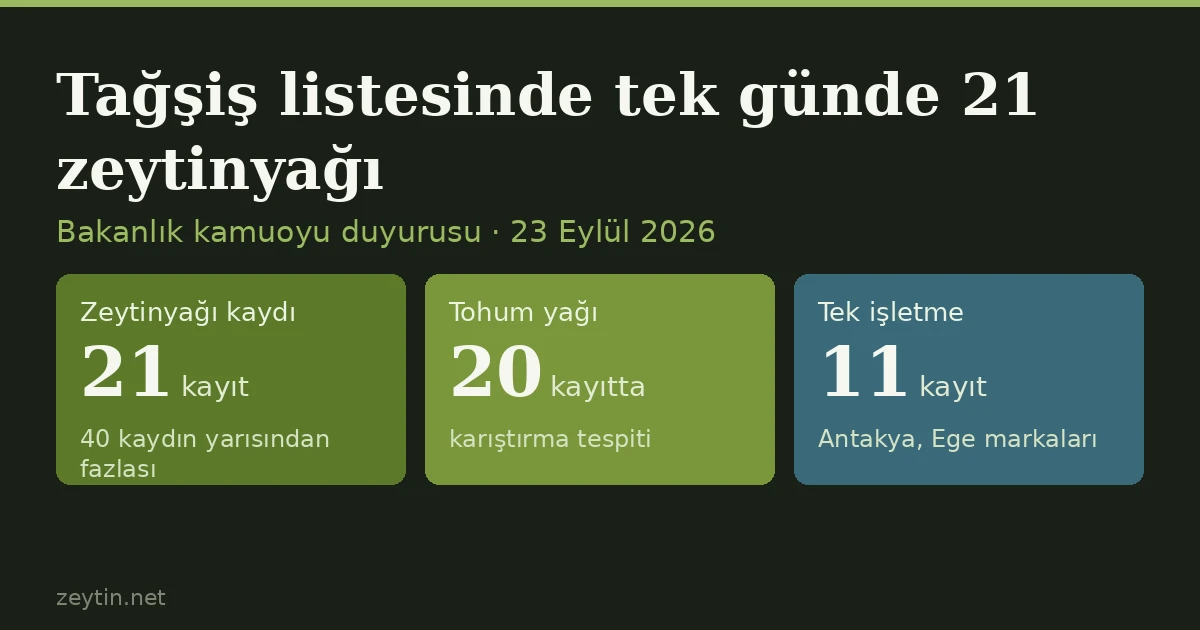
Twenty-one olive oils on the ministry's adulteration list in one day, eleven from a single Antakya business
Of the 40 records added to Turkey's counterfeit-and-adulteration list on 23 September 2026, 21 are olive oil, and 20 of those were found to contain seed oil. Eleven records belong to a single business registered in Antakya, marketing under Aegean origin names such as Ayvalık, Akçay-Altınoluk and Kazdağları. Sixteen of the containers were five litres.
Article
Twenty-one olive oils on the ministry's adulteration list in one day, eleven from a single Antakya business
Of the 40 records added to Turkey's counterfeit-and-adulteration list on 23 September 2026, 21 are olive oil, and 20 of those were found to contain seed oil. Eleven records belong to a single business registered in Antakya, marketing under Aegean origin names such as Ayvalık, Akçay-Altınoluk and Kazdağları. Sixteen of the containers were five litres.