Olive oil export support package approved: 50 cents for branded packs, 15 cents for bulk and contract-packed; the requested 1 dollar was cut
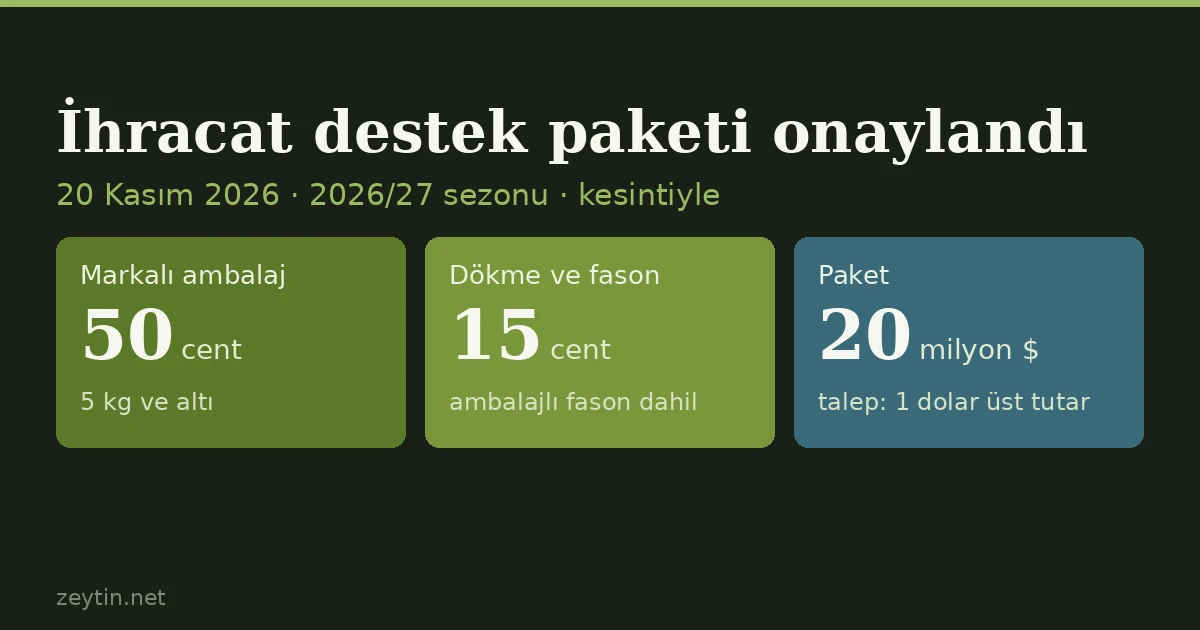
According to a 20 November 2026 report, the Ministry of Trade approved the 2026/27 olive oil export support package after a cut: 50 cents for branded packs of 5 kg and under, 15 cents for bulk and contract-packaged oil. The report says it was 'learned'; the unit, exchange rate, start date and official text are not given.
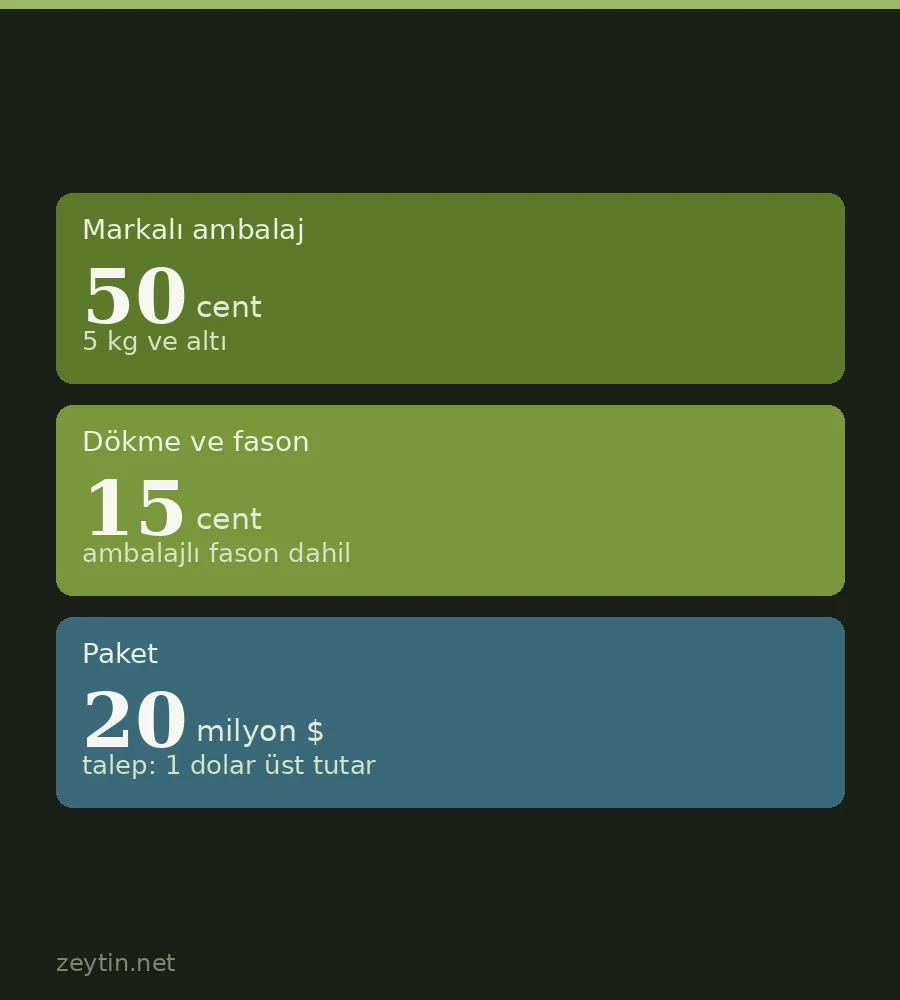
According to a report dated 20 November 2026, the olive oil export support package prepared for the 2026/27 season has been approved by the Ministry of Trade and included in the 2027 budget. The approval came in below the level requested: the earlier requested ceiling of 1 dollar was reduced to 50 cents for branded packaged products of 5 kilograms and under, and to 15 cents for bulk and contract-packaged exports. The report presents the information as something that "was learned"; at the time of writing we could find neither an announcement from the Ministry or the Official Gazette nor the same information in another source. Everything below rests on the report's account.
What the report says
| Item | What the report says |
|---|---|
| Season | 2026/27; an expected "historic crop" of about 600,000 tonnes |
| Branded packaging, 5 kg and under | 50 cents |
| Bulk and contract-packaged exports | 15 cents |
| Requested ceiling | 1 dollar; approved after a cut |
| Lira equivalent per tonne (in the report) | About 7,500 lira for small packs, about 25,000 lira for the other items |
| Size of the package | About 20 million dollars; export potential of 750 million dollars |
| Budget | 2027 budget, added to the budget line by presidential decree |
Do the numbers add up?
The report does not say which unit the "cent" amount applies to. The lira equivalents per tonne also appear to be in reverse order: although 50 cents is 3.3 times 15 cents, the report ties the small-pack item to the lower figure (7,500) and the bulk and contract-packaged item to the higher one (25,000). One assumption resolves this. If the amounts are per kilogram, 50 cents is 500 dollars per tonne and 15 cents is 150 dollars; at an exchange rate of roughly 50 lira these correspond to 25,000 and 7,500 lira. In other words, the lira figures suggest the order was written the wrong way round in the report. This is our own inference. The report gives neither the unit nor the exchange rate, so the text of the official decision is needed for a firm conclusion.
For scale: according to the exporters' union records that we reported earlier, exports in 2025/26 came to 17,721 tonnes and 96.0 million dollars, or 5,418 dollars per tonne. If the amounts are per kilogram, a 500-dollar subsidy is equivalent to about 9.2 percent of that per-tonne revenue and a 150-dollar subsidy to about 2.8 percent. The 20-million-dollar package in the report is about 2.7 percent of the 750-million-dollar potential; however, the report does not say which period or which products that potential covers, so we limit ourselves to noting that it is 7.8 times last season's revenue of 96 million dollars.
Why is support on the agenda?
The report frames the season around three pressures. The first is the crop: the National Olive and Olive Oil Council's expectation of 588,000 tonnes of olive oil is far above what the domestic market can absorb. The second is the market: Turkish exporters took a blow from the additional 12.5 percent US tariff, and we have previously reported that exports fell to 17,000 tonnes last season. The third is competition: the report says serious production is also expected in Spain, Italy and Tunisia, and Spain has moved to mandatory withdrawal. The support appears designed so that the surplus can leave the country quickly under these conditions.
What the exporters say
Emre Uygun, Chairman of the Aegean Olive and Olive Oil Exporters' Association, thanked the ministries of Trade, of Agriculture and Forestry, and of Treasury and Finance. According to Uygun, the support will make it possible to win back lost markets, and "a serious quantity of product needs to be exported abroad quickly"; in that way the sector will be "somewhat more relieved" by the middle of 2027. Uygun also noted that olive oil is among the sectors with few net exporters and rests on an export tradition of thousands of years, and said that at a time of difficult economic conditions the ministries chose olive oil as the sector to support. He added that the support will bring foreign-currency income to the country; this expectation is Uygun's own assessment and is not backed by figures in the report.
Is the producer side left out?
The association's Vice Chairman, Davut Er, said they were grateful for the support but argued that the support given on the exporter side should also be given on the producer side: "Producers too need direct support of at least 25,000 lira per tonne." Er added that they expect a support measure for producers from the Ministry of Agriculture and Forestry, and that it is being said that 40 to 50 percent of the crop in the Aydın region may be left on the trees. That last figure is a claim Er relayed, and we have not verified it. For the state of producer prices, Marmarabirlik's 2026/27 purchase list is a useful reference: the price for oil olives fell from 53 lira to 40 lira.
What the report does not say
- The start date and duration of the support, and any total amount or tonnage cap.
- The application conditions, and to whom and against which document payment will be made.
- The unit of the "cent" amount (kilogram, litre, item) and the exchange rate used in the calculation.
- The Ministry's own statement or a decree number.
- Any support decision for producers.
Why this matters
Throughout the season the debate has run through the producer price falling below cost. This report shows the search for a remedy taking concrete form on the export side: the crop is large, domestic demand is limited, and rivals abroad are arriving with full warehouses as well. Whether the support will lift prices depends on the implementation rules and on how much product is actually exported; we will update the article when the text is published.
One rating per visitor; you can change yours at any time. Ratings are real reader votes — no seeded or default scores.
Related
 Article
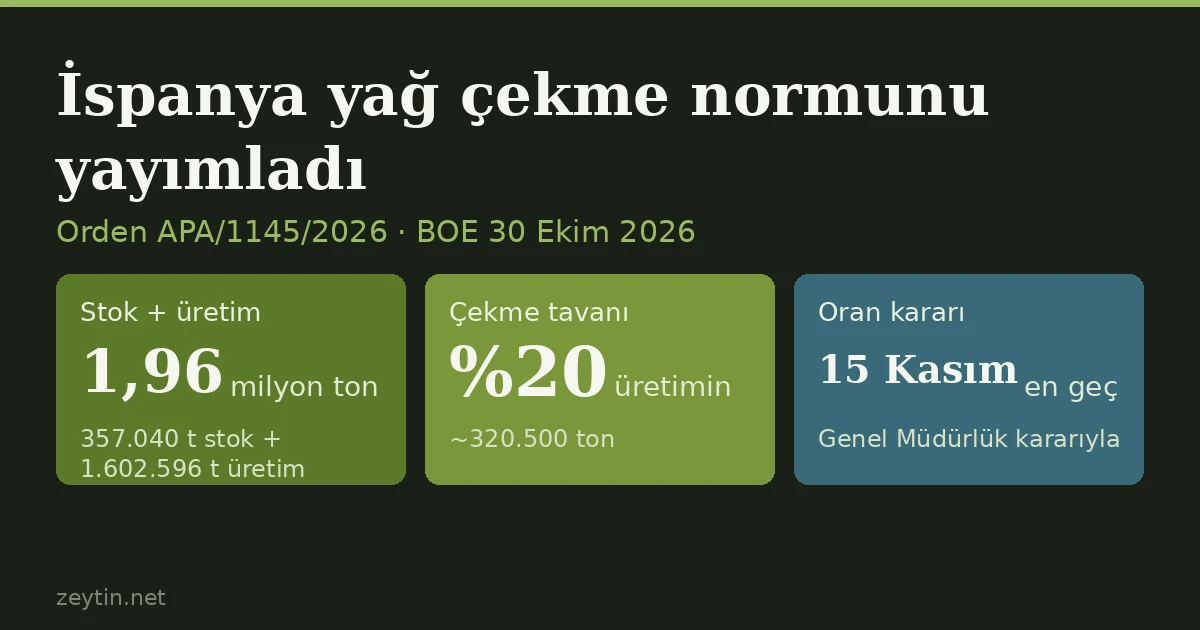
Spain publishes its olive oil withdrawal order: the percentage is due by 15 November, capped at 20% of the crop
Spain's Order APA/1145/2026 was published in the BOE on 30 October. A separate resolution due by 15 November will set the share mills must store, capped at 20% of estimated production. The season opened with 357,040 tonnes of stocks and a 1,602,596-tonne crop estimate.
 Article
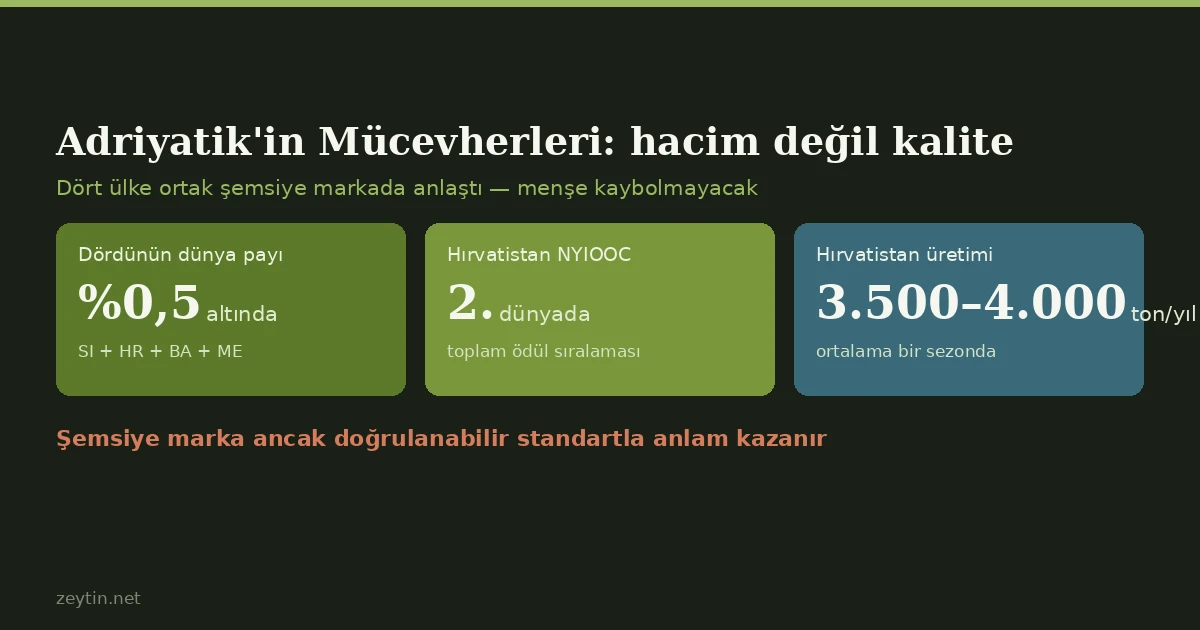
"Jewels of the Adriatic": four countries choose to compete on quality, not volume
Slovenia, Croatia, Bosnia and Herzegovina and Montenegro together produce under 0.5% of the world's olive oil — yet Croatia finished second worldwide at the NYIOOC. A panel in Mostar proposed a shared umbrella brand: origin stays, common rules are the condition.
 Article
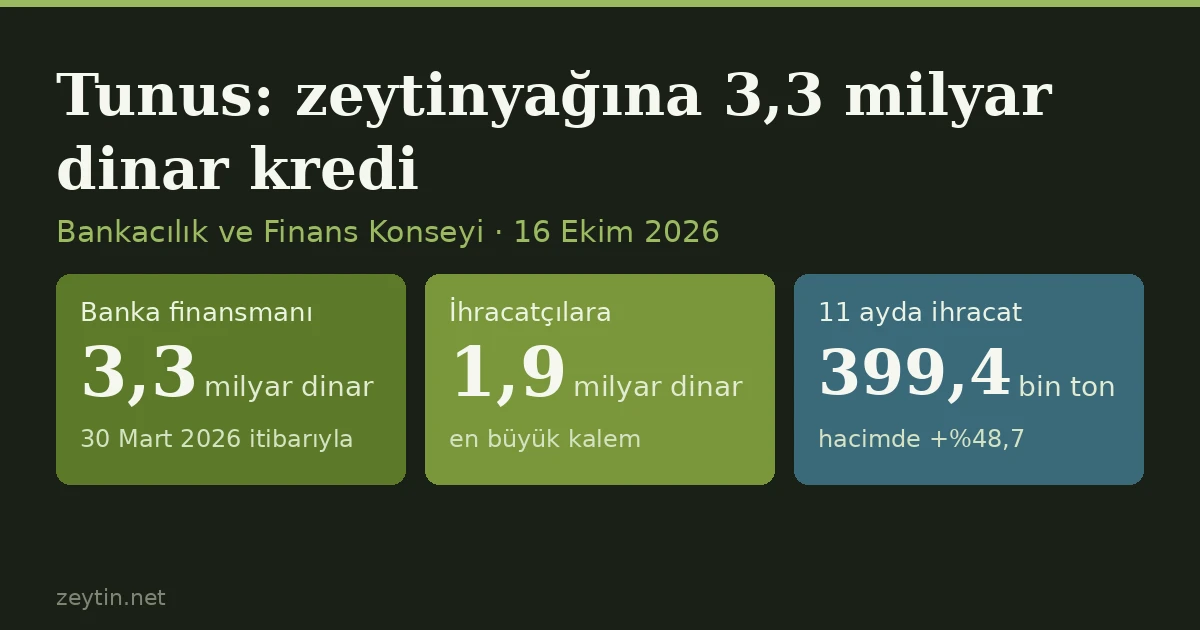
Tunisian banks lent 3.3 billion dinars to the olive oil season; the 2027 draft budget earmarks bulk export duties for a sector fund
According to Néji Ghandri, president of the Tunisian Banking and Financial Council, banks extended 3.2-3.3 billion dinars to the 2025/26 olive oil season by 30 March, up from 2.2 billion the season before; 1.9 billion went to exporters. Tunisia exported 399,400 tonnes in eleven months. The 2027 draft budget opens a 100-million-dinar credit line for small growers and earmarks 10 per cent of bulk export duty revenue for a sector fund; it is not a new tax.
 Article
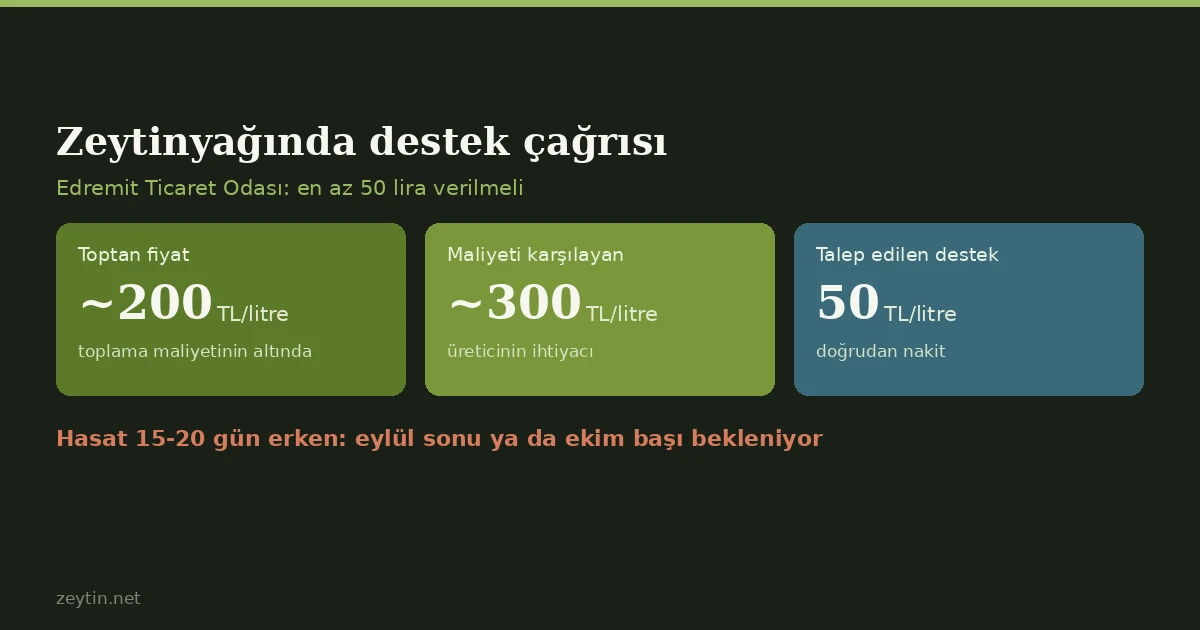
Edremit Chamber: olive oil needs at least 50 lira per litre in support
Chamber President Ahmet Çetin says the wholesale price has fallen to 200 lira, below the cost of picking. The level needed to cover costs is 300 lira. Harvest is expected 15-20 days early.