A demand for 50 lira per litre: what the numbers say
The Edremit Chamber of Commerce has called for at least 50 lira per litre in support for olive oil producers. We check the price claim behind that demand against registered exchange trades.
Ahmet Çetin, head of the Edremit Chamber of Commerce, has called for support of at least 50 lira per litre for olive oil producers. He also asked for per-litre cash support for exporters. In his view such support should not be seen as a one-sided burden on public finances: as informal trade shrinks, the system could pay for itself.
Behind the demand lies a price claim. Çetin says olive oil is selling wholesale at around 200 lira per litre, and that this does not cover production and harvest costs. He argues the price needs to reach 300 lira; below 200, picking and labour costs mean "the fruit stays on the tree".
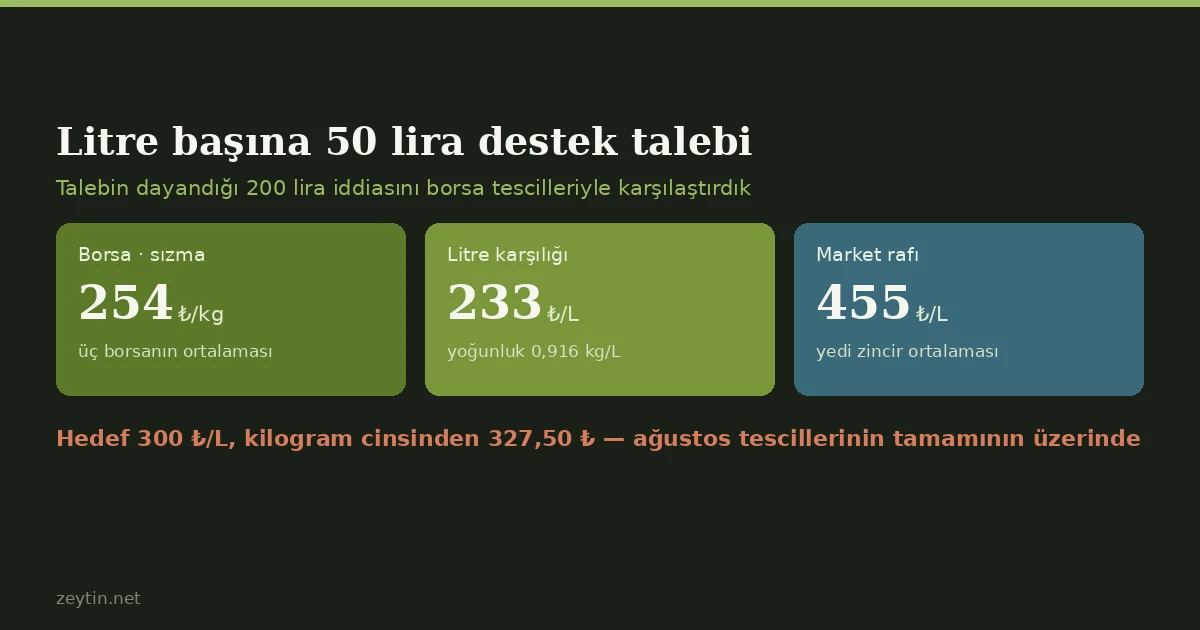
Do those figures match the registered trades?
We can test the claim against our own data. Trades registered at Turkish commodity exchanges are quoted per kilogram, while Çetin speaks in litres. With olive oil density at 0.916 kg/L, the two convert as follows:
| Exchange | Registered TRY/kg | Equivalent TRY/litre | Date |
|---|---|---|---|
| Aydın | 307.60 | 281.76 | 18.08.2026 |
| Edremit | 254.33 | 232.97 | 25.08.2026 |
| Nazilli | 201.09 | 184.20 | 19.08.2026 |
Two things stand out. First, "around 200 lira" is not a single Turkish price: converted to litres, the Nazilli trade works out at 184 lira and the Aydın one at 282 — a spread of roughly fifty per cent. Second, the 300 lira per litre Çetin sets as a target corresponds to 327.50 lira per kilogram, above every extra virgin trade registered on those three exchanges in August.
And on the shelf?
In the same week, extra virgin olive oil averaged 454.62 lira per litre across seven supermarket chains. Since the exchange average converts to 233 lira per litre, the shopper pays roughly twice what the producer receives. That gap covers milling, bottling, distribution and retail margin — which raises the question of which link in the chain any support would actually reach.
An early harvest
Çetin expects the 2026 harvest in the Gulf of Edremit to begin 15 to 20 days earlier than last year, in late September or early October, thanks to favourable weather and rested trees. This is an "on year", and he expects a strong crop in the region.
But a large crop is not good news by itself. What decides the season is whether the price a grower meets covers picking and labour. Abundant fruit combined with a low price can mean no harvest at all.
The export side
Çetin notes that olive oil trades internationally at around 3.5 to 4 euros per litre, and that a strong Turkish lira makes it harder for export revenue to cover costs. If forest fires in Europe affect production there, Turkish exports to that market could rise — but EU quotas and duties on Turkish products stand in the way.
His warning goes beyond growers: if cost pressure leads producers to skip the harvest, supply falls, quality production weakens, and the consumer is hurt most.
One rating per visitor; you can change yours at any time. Ratings are real reader votes — no seeded or default scores.
Related
 Article
Kilis: the structure is solved, the soil is not
Kilis is the one place in south-eastern Anatolia to have finished the institutional job: a union, an integrated plant, a geographical indication. Yet 100% of 49 soil samples are iron-deficient.
Article
Kilis: the structure is solved, the soil is not
Kilis is the one place in south-eastern Anatolia to have finished the institutional job: a union, an integrated plant, a geographical indication. Yet 100% of 49 soil samples are iron-deficient.
 Article
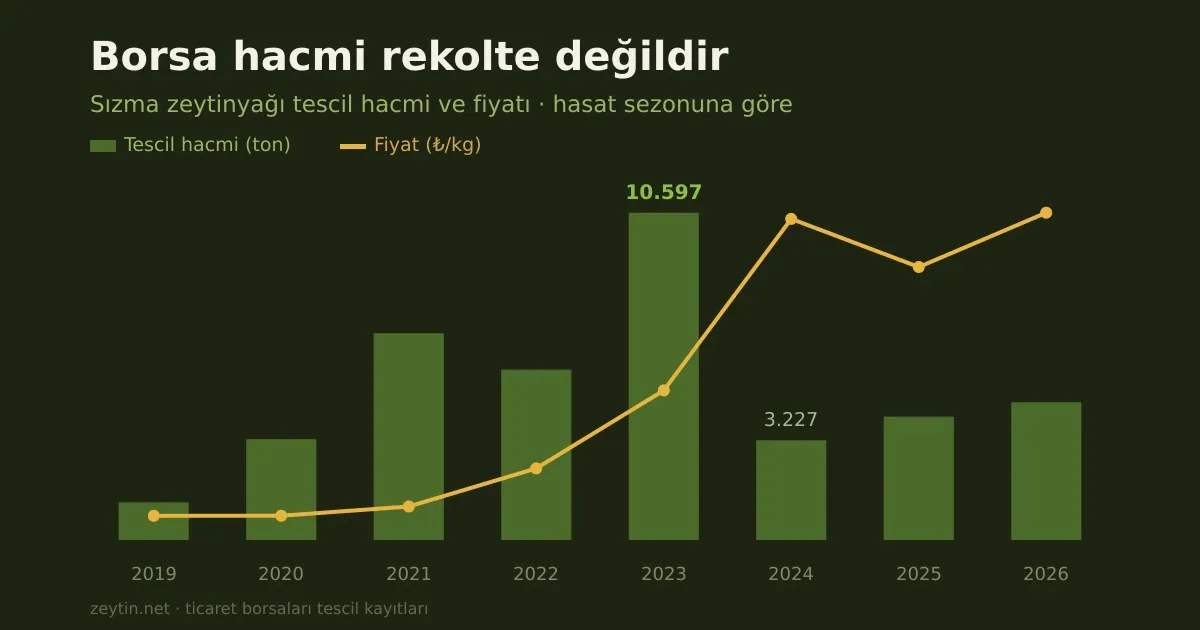
Exchange volume is not the harvest: what the 2023 record actually recorded
10,597 tonnes registered in 2023, down to 3,227 the next season. Harvest collapse or a change of channel? The data cannot tell them apart.
Article
Exchange volume is not the harvest: what the 2023 record actually recorded
10,597 tonnes registered in 2023, down to 3,227 the next season. Harvest collapse or a change of channel? The data cannot tell them apart.
 Article
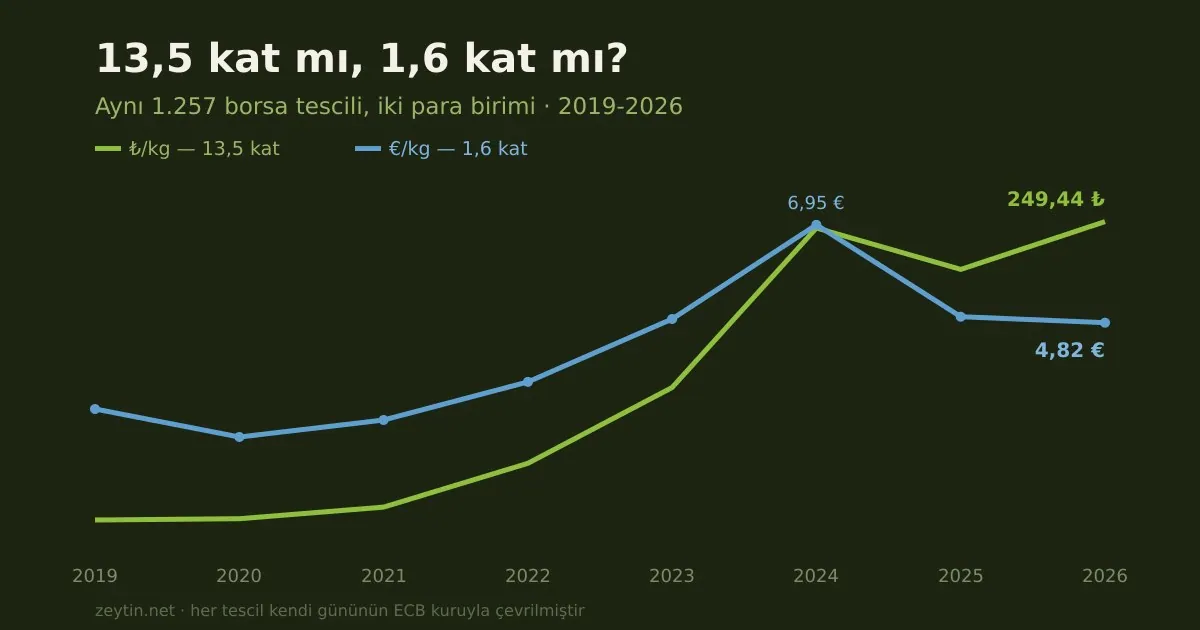
Did olive oil go up 13.5 times, or 1.6 times?
Up 13.5 times in lira, 1.6 times in euros. The same 1,257 registrations, each converted at its own day's ECB rate.
Article
Did olive oil go up 13.5 times, or 1.6 times?
Up 13.5 times in lira, 1.6 times in euros. The same 1,257 registrations, each converted at its own day's ECB rate.
 Article
Solar panels above the grove: energy without cutting trees?
In Spain, 5,150 solar modules were raised four metres above a working olive grove without removing a single tree. The height is set not by the trees but by a harvester that opens to 3.5 metres. A University of Córdoba model puts joint output at 789 kg of oil and 891 MWh per hectare.
Article
Solar panels above the grove: energy without cutting trees?
In Spain, 5,150 solar modules were raised four metres above a working olive grove without removing a single tree. The height is set not by the trees but by a harvester that opens to 3.5 metres. A University of Córdoba model puts joint output at 789 kg of oil and 891 MWh per hectare.