The nameless olives of southeast Anatolia: Mardin, Şırnak and the pollinator problem
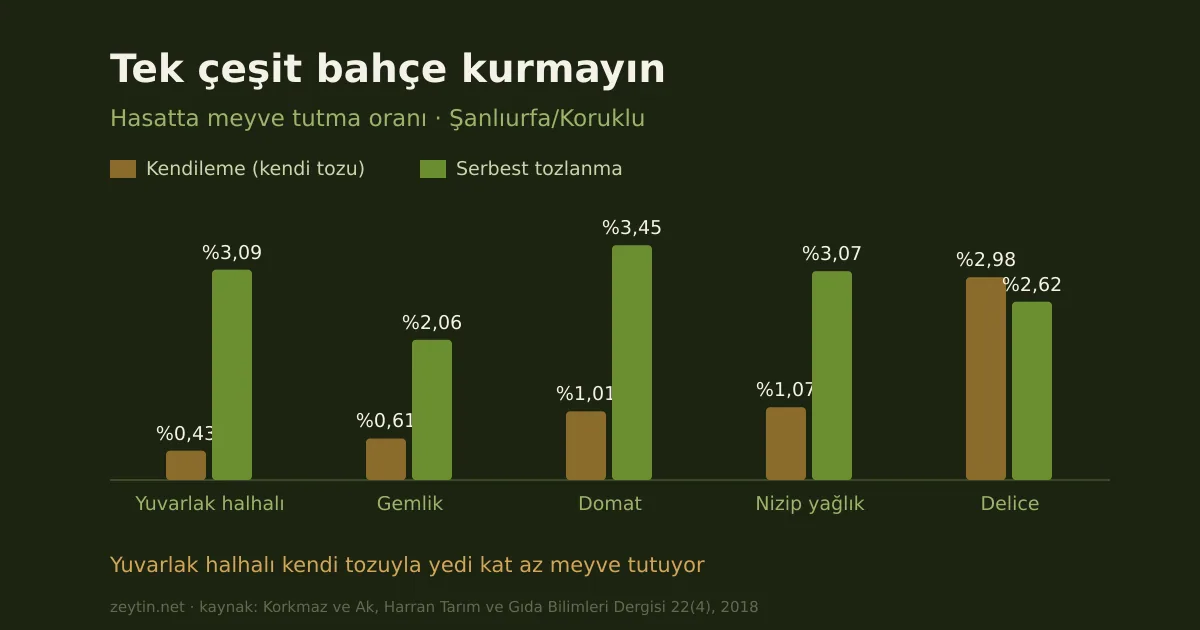
Kumçatı and Derik genotypes beat Ayvalık and Gemlik on flesh ratio. Yuvarlak halhalı sets only 0.43% of its flowers with its own pollen.
Say "olives" in Türkiye and people think of the Aegean and Marmara. But the eastern edge of the olive lies much further inland: Şanlıurfa, Mardin, Şırnak, Cizre. Olives are not new here — on the contrary, the region is one of the olive's centres of genetic diversity.
The trouble is that most of these trees have no name. They are not catalogued cultivars but genotypes, known by the village, stream or district they grow in. Two academic studies have measured what they actually are.
The nameless olives of the southeast
Sevgin and Caner (2020), of Şırnak University, collected olives from five locations and compared them with Ayvalık and Gemlik: Şırnak/Kumçatı, Şırnak/Kızılsu, Şırnak/Cizre, Mardin/Kızıltepe and Mardin/Derik.
| Genotype | 100 fruits (g) | Width (mm) | Length (mm) | Flesh (%) |
|---|---|---|---|---|
| Gemlik (standard) | 537.35 | 18.00 | 22.57 | 85.36 |
| Ayvalık (standard) | 498.44 | 18.85 | 23.09 | 85.38 |
| Kızıltepe (Mardin) | 372.19 | 17.63 | 22.56 | 84.02 |
| Kızılsu (Şırnak) | 354.71 | 15.72 | 24.16 | 81.74 |
| Derik (Mardin) | 338.45 | 16.36 | 22.10 | 87.46 |
| Cizre (Şırnak) | 326.21 | 15.92 | 21.74 | 85.76 |
| Kumçatı (Şırnak) | 324.93 | 16.31 | 21.49 | 88.06 |
Source: Sevgin and Caner (2020). "Flesh" is the share of the fruit remaining once the stone is removed.
The table says two things.
First, southeastern genotypes have smaller fruit. A hundred Kızıltepe olives weigh 372 g; a hundred Gemlik, 537. Since fruit size translates directly into price for table olives, that is a serious disadvantage.
Second — and this is the more interesting part — the ranking reverses on flesh ratio. Kumçatı at 88.06% and Derik at 87.46% beat both Ayvalık (85.38%) and Gemlik (85.36%). The fruit is small, but so is the stone; the edible share is higher.
The study's own recommendation is that Kızıltepe, pomologically the closest to the standards, be developed as a table olive.
On the oil side: phenols
Oil was extracted mechanically from the same genotypes and analysed.
| Genotype | Total phenols (mg/kg) | Peroxide (meq/kg) | Iodine value |
|---|---|---|---|
| Ayvalık (standard) | 374.33 | 10.93 | 80.20 |
| Gemlik (standard) | 359.67 | 11.43 | 81.40 |
| Derik (Mardin) | 292.33 | 12.36 | 81.00 |
| Cizre (Şırnak) | 247.66 | 18.53 | 88.40 |
| Kumçatı (Şırnak) | 232.66 | 12.70 | 84.20 |
| Kızılsu (Şırnak) | 228.00 | 11.13 | 87.90 |
| Kızıltepe (Mardin) | 153.00 | 16.53 | 89.36 |
Phenols govern an olive oil's bitterness, pungency and shelf life. Commercial extra virgin oils typically run 30-400 mg/kg; all of these genotypes fall inside that range.
Derik comes closest to the standards at 292.33 mg/kg. Kızıltepe's 153 mg/kg is low — meaning the most promising genotype for the table is the weakest for oil. A clean illustration of why one tree rarely serves both purposes.
The peroxide values should be read carefully: peroxide is not a varietal trait but a measure of oxidation. Harvest timing, the delay between crushing and pressing, and storage conditions all move it directly. Cizre's 18.53 may say less about the genotype than about how the sample reached the laboratory.
The study's own conclusion is unambiguous: the region's genotypes need DNA-level analysis, their relationship to standard cultivars established, and use in breeding programmes. At present we have fruit measurements but no identity.
Şanlıurfa: don't plant a single-variety grove
The second study answers a more practical question. Korkmaz and Ak (2018) measured self-fertility in five cultivars in a grove planted in 1990 at the GAP Agricultural Research Institute's station in Koruklu.
Self-fertility is whether a cultivar can set fruit with its own pollen. If it cannot, the grove needs another cultivar — a pollinator — planted alongside. Otherwise the tree flowers and sets nothing.
| Cultivar | Index | Status | Self-pollinated fruit set | Open-pollinated fruit set |
|---|---|---|---|---|
| Delice (wild) | 1.13 | Self-fertile | 2.98% | 2.62% |
| Nizip yağlık | 0.34 | Self-fertile | 1.07% | 3.07% |
| Domat | 0.29 | Partially fertile | 1.01% | 3.45% |
| Gemlik | 0.29 | Partially fertile | 0.61% | 2.06% |
| Yuvarlak halhalı | 0.14 | Self-infertile | 0.43% | 3.09% |
Source: Korkmaz and Ak (2018). Index 0.00-0.15 self-infertile · 0.15-0.30 partially self-fertile · 0.30-1.00 self-fertile. Fruit set is measured in November as a percentage of flowers opened.
The striking row is Yuvarlak halhalı: 0.43% with its own pollen, 3.09% under open pollination. A sevenfold difference. One of the region's common cultivars barely yields if planted alone.
Gemlik shows more than a threefold gap too (0.61% against 2.06%). It counts as "partially self-fertile", but a grove without pollinators will plainly lose yield.
Delice — the unbudded wild olive — is the one exception: practically no difference between self and open pollination.
What it means in practice
The rule in the literature is simple: about 10% of the trees in a grove should be a pollinator cultivar. Even cultivars classed as self-fertile are reported to yield better with cross pollination.
So a grove laid out as "all Gemlik, keep it simple" saves at planting and loses yield every year afterwards. Payback on an olive grove already runs 8 to 15 years; planting without pollinators lengthens it.
One caution comes from the study itself: these indices hold for the ecology of Şanlıurfa, and where the cultivars share one grove. Self-fertility varies year to year and even country to country — Moraiolo was found self-infertile in Italy and self-fertile in India. Light, temperature and the weather during flowering all change the result.
Why it matters
The weight of Turkish olive growing sits in the Aegean. But:
- The southeast is one of the olive's centres of genetic diversity — it holds genotypes that never entered the standard catalogue.
- Some of those genotypes beat the standard cultivars on flesh ratio.
- The region's own cultivars — Kilis yağlık, Nizip yağlık, Halhalı — have not even been trialled in Mardin and Şırnak; that is the study's first recommendation.
- Local genotypes adapted to heat and drought may carry an answer to the climate question that Aegean cultivars do not have.
We have measurements but no identity. Without a name, a genotype cannot be registered as a geographical indication, marketed, or used in breeding.
Summary
- Southeastern genotypes have smaller fruit than the standards but a higher flesh ratio (Kumçatı 88.06%, Derik 87.46%).
- The most promising table genotype is Kızıltepe — which also has the lowest oil phenols (153 mg/kg).
- Closest to the standards for oil is Derik (292.33 mg/kg phenols).
- In Şanlıurfa, Yuvarlak halhalı is self-infertile: 0.43% fruit set with its own pollen against 3.09% open-pollinated.
- Gemlik and Domat are partially self-fertile; yield falls in a grove without pollinators.
- The practical rule: 10% of the grove should be a pollinator cultivar.
- What the region's genotypes need: DNA analysis and breeding work. At present they are nameless.
Sources
t; Sevgin, N. and Caner, S. (2020). The Determination of Fruit and Oil Properties of Some Olives Which are Cultivated in Mardin and Şırnak. Turkish Journal of Agricultural and Natural Sciences, 7(1): 54-59. doi:10.30910/turkjans.679908
t; Korkmaz, Ş. and Ak, B.E. (2018). Determination of self-fertility status of some olive cultivars grown in GAP Region. Harran Journal of Agricultural and Food Science, 22(4): 471-477. doi:10.29050/harranziraat.414662
Related reading: Olive varieties · Caliber economics · Twenty trees per decare, or 250?
One rating per visitor; you can change yours at any time. Ratings are real reader votes — no seeded or default scores.
Related
 Article
The profitability problem in olive oil exports
Turkey sold to the US at $3,492 a tonne while the world average was $4,235 - the furthest supplier and the cheapest. The EU tariff wall, the Tunisia comparison, and the method none of 17 exporters knew.
Article
The profitability problem in olive oil exports
Turkey sold to the US at $3,492 a tonne while the world average was $4,235 - the furthest supplier and the cheapest. The EU tariff wall, the Tunisia comparison, and the method none of 17 exporters knew.
 Article
How to read olive oil exchange prices
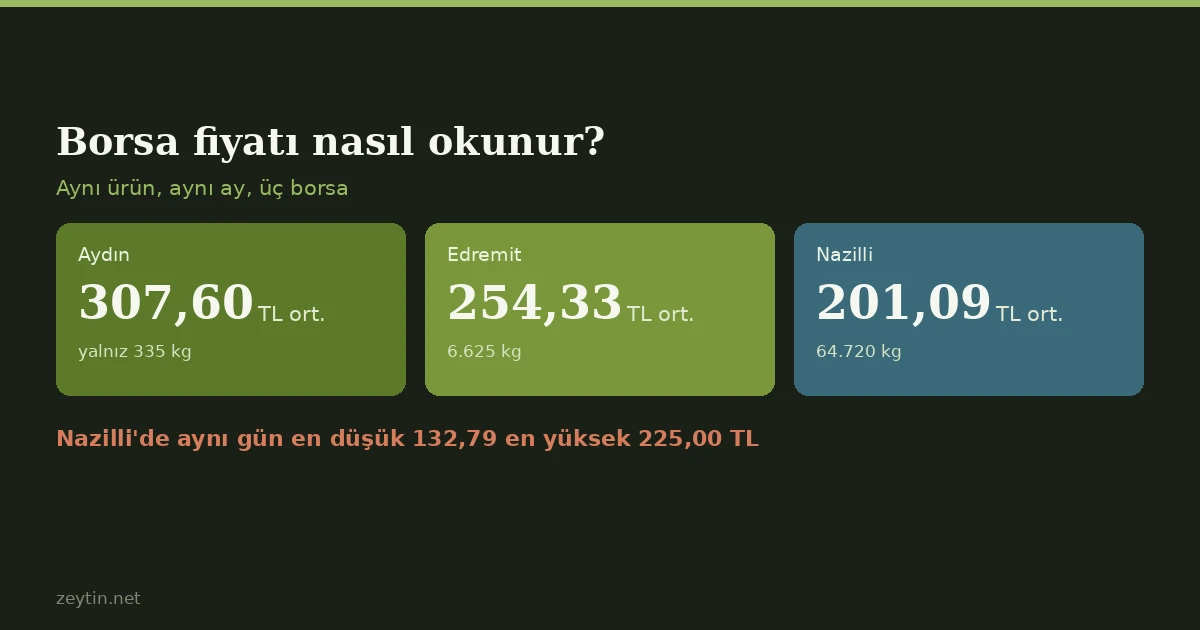
Three exchanges, three averages for the same product: 201, 254 and 308 lira. In Nazilli, trades from 132.79 to 225.00 in a single day. What an exchange price measures, and why date and volume matter more than the average.
Article
How to read olive oil exchange prices
Three exchanges, three averages for the same product: 201, 254 and 308 lira. In Nazilli, trades from 132.79 to 225.00 in a single day. What an exchange price measures, and why date and volume matter more than the average.
 Article
Structural problems of Turkish olive growing
157 million trees but 5% of world output: low yield, old trees, harvest mechanisation, missing data, the support gap and informality.
Article
Structural problems of Turkish olive growing
157 million trees but 5% of world output: low yield, old trees, harvest mechanisation, missing data, the support gap and informality.
 Article
From olive to oil: the price gap, 2019-2026
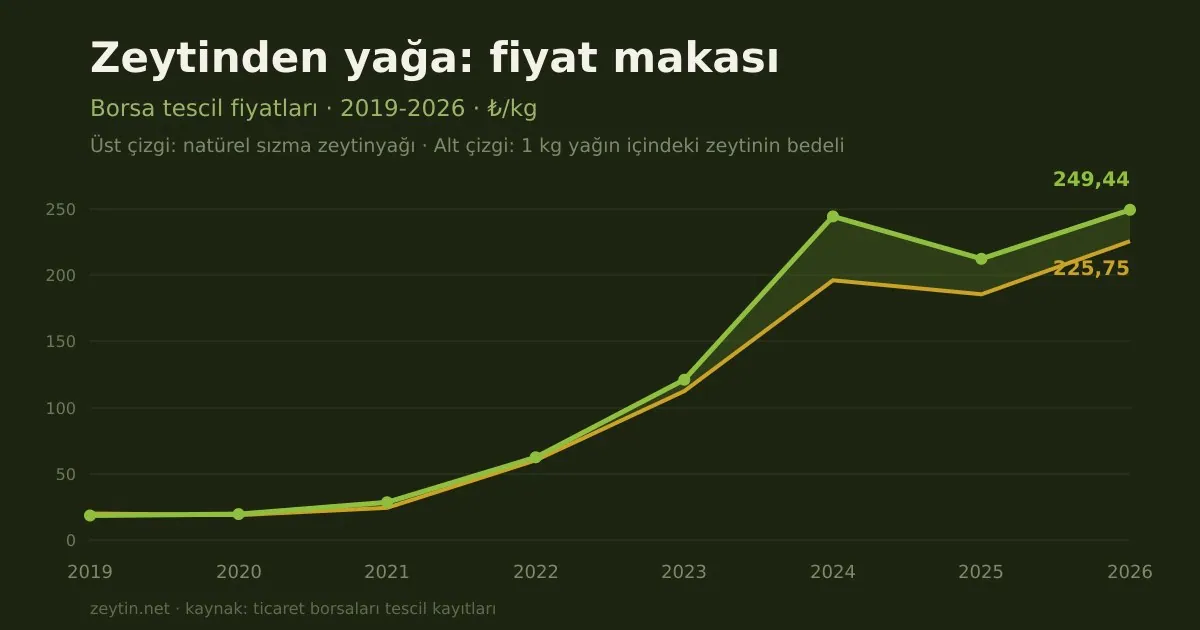
The gap between a kilo of olives and a kilo of oil, measured from exchange registrations. Why it widens, and who gains.
Article
From olive to oil: the price gap, 2019-2026
The gap between a kilo of olives and a kilo of oil, measured from exchange registrations. Why it widens, and who gains.