Kiraz olive: characteristics, oil content and growing areas
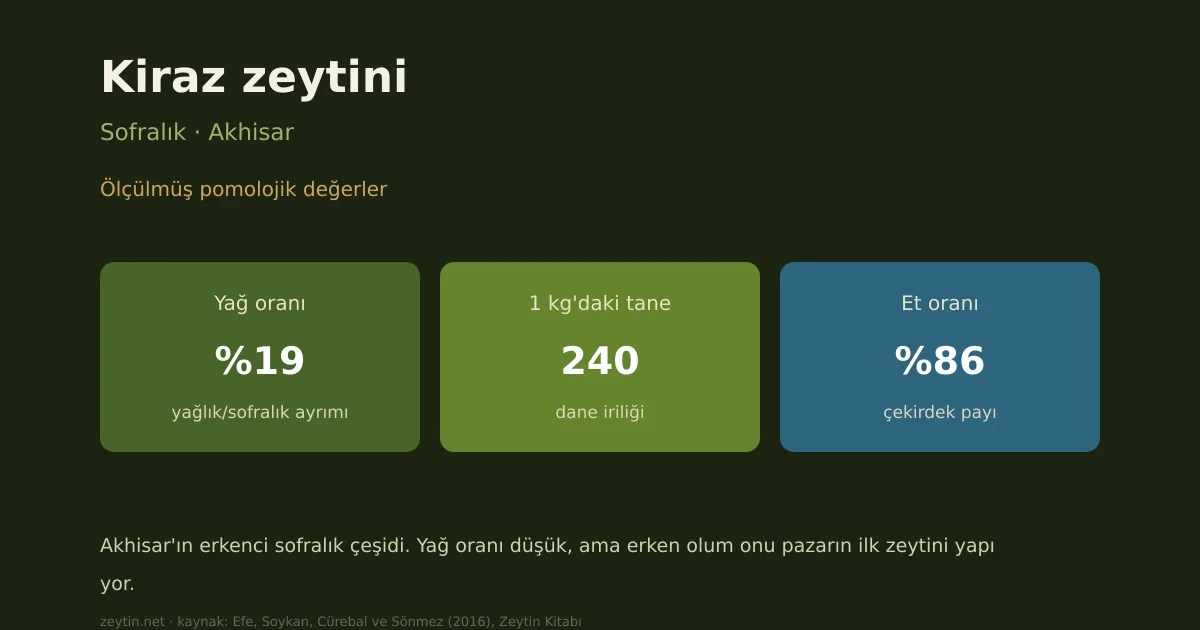
Akhisar's early table variety. Low in oil, but early maturity makes it the season's first olive to market.
Kiraz ("cherry") takes its name from the shape of its fruit and belongs to Akhisar. Its distinguishing trait is earliness: green maturity begins in late August, while most varieties on the list wait for October.
Kiraz in numbers
| Oil content | 19% |
| Fruits per kilo | 240 |
| Flesh ratio | 86% |
| Use | Table |
| Main areas | Akhisar |
Source: Efe, Soykan, Cürebal and Sönmez (2016), Zeytin Kitabı. Fields the source leaves blank are shown as "—"; nothing has been estimated.
When does it flower and ripen?
| Flowering | 20 May – 9 June |
| Fruit set | 25 May – 14 June |
Source: Olive Integrated Pest Management Technical Instruction, TAGEM. Dates shift with region and year; flowering is later at higher altitude.
Where it stands among measured cultivars
Its position on each axis is shown live in the comparison strip on this page, against every cultivar with a published figure. For the full ranking — and how that ranking is built — see olive variety rankings.
In short
Kiraz is an early table variety; its 19% oil is low on the list, but flesh ratio is 86%. Earliness is a commercial advantage: the season's first olives meet the least competition.
Earliness is also risk management — the harvest skips part of the olive fruit fly's peak. For the fly's calendar, see olive fruit fly control.
Measured characteristics
| Property | Value | Source |
|---|---|---|
| Fruit length | 24 mm | Zeytin Kitabı (Efe vd. 2016) |
| Fruit width | 20 mm | Zeytin Kitabı (Efe vd. 2016) |
| Flesh ratio | %86 | Zeytin Kitabı (Efe vd. 2016) |
| Fruits per kilogram | 240 | Zeytin Kitabı (Efe vd. 2016) |
| Oil content | %19 | Zeytin Kitabı (Efe vd. 2016) |
Where it stands among measured varieties
Zeytin Kitabı — Efe, Soykan, Cürebal, Sönmez (2016), Kitabevi Yay. s.37-80
Zeytin Kitabı — Efe, Soykan, Cürebal, Sönmez (2016), Kitabevi Yay. s.37-80
Zeytin Kitabı — Efe, Soykan, Cürebal, Sönmez (2016), Kitabevi Yay. s.37-80
Zeytin Kitabı — Efe, Soykan, Cürebal, Sönmez (2016), Kitabevi Yay. s.37-80
Zeytin Kitabı — Efe, Soykan, Cürebal, Sönmez (2016), Kitabevi Yay. s.37-80
Values are those published on each variety's own page; the comparison covers only varieties with a measured figure, so it is a comparison of what is known — not of every Turkish variety. See the full ranking and how it is built →
One rating per visitor; you can change yours at any time. Ratings are real reader votes — no seeded or default scores.
Related
 Article
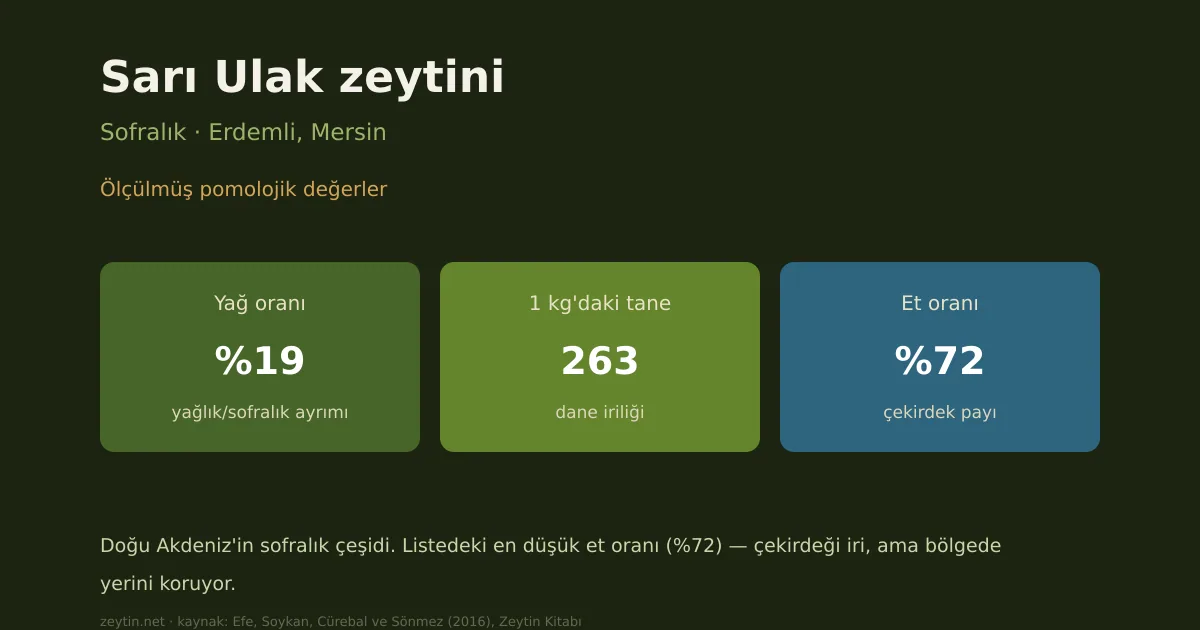
Sarı Ulak olive: characteristics, oil content and growing areas
The eastern Mediterranean's table variety. The lowest flesh ratio on the list (72%) — a large stone, yet it holds its ground.
Article
Sarı Ulak olive: characteristics, oil content and growing areas
The eastern Mediterranean's table variety. The lowest flesh ratio on the list (72%) — a large stone, yet it holds its ground.
 Article
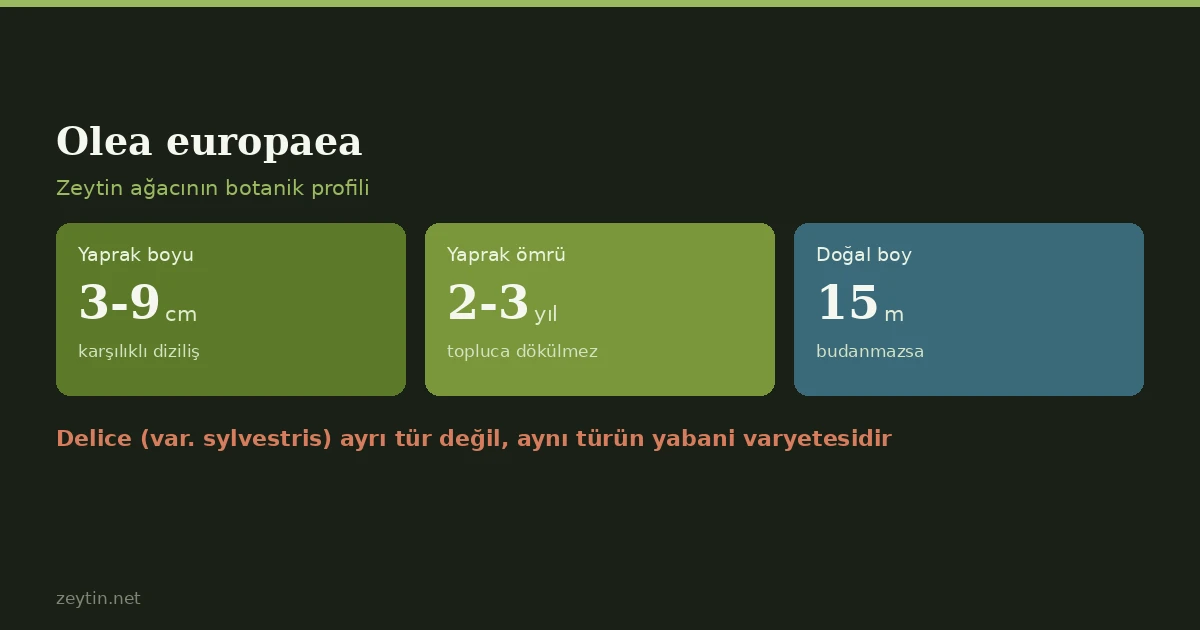
Olea europaea: the botany of the olive tree
The olive's scientific name and classification, why its leaves are silver, its floral structure, the layers of its fruit, its root system and lifespan — and how the wild oleaster relates to the orchard olive.
Article
Olea europaea: the botany of the olive tree
The olive's scientific name and classification, why its leaves are silver, its floral structure, the layers of its fruit, its root system and lifespan — and how the wild oleaster relates to the orchard olive.
 Article
Patos olive
Patos is a recorded variety of the Black Sea. Described in the source.
Article
Patos olive
Patos is a recorded variety of the Black Sea. Described in the source.
 Article
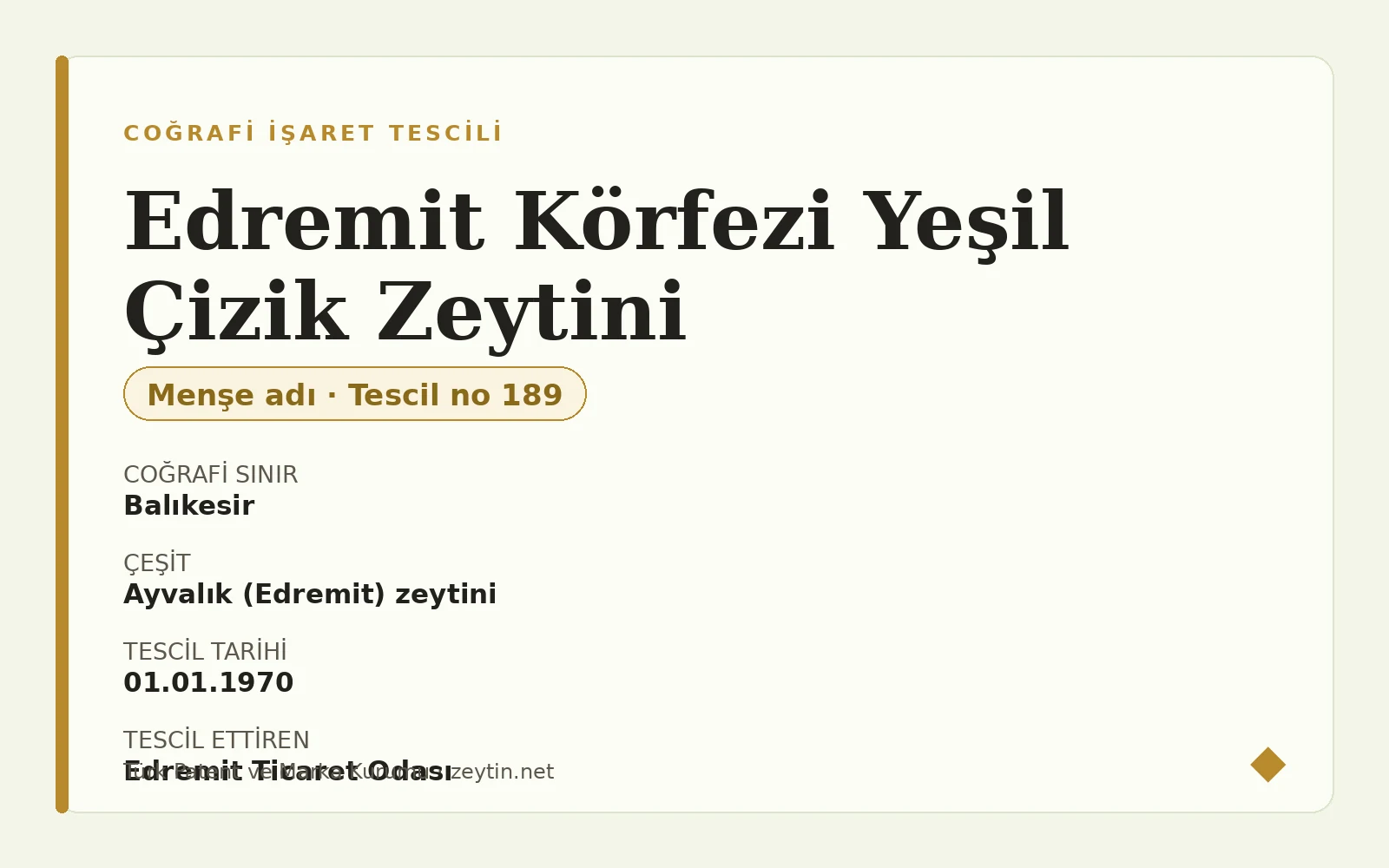
Edremit Gulf Green Scored Olive: a registration that defines altitude and slope
Registered in 2014. The certificate draws the boundary topographically as well as administratively: 50-250 m altitude, 5-6% slope. Debittering is entirely natural.
Article
Edremit Gulf Green Scored Olive: a registration that defines altitude and slope
Registered in 2014. The certificate draws the boundary topographically as well as administratively: 50-250 m altitude, 5-6% slope. Debittering is entirely natural.