Sarı Ulak olive: characteristics, oil content and growing areas
The eastern Mediterranean's table variety. The lowest flesh ratio on the list (72%) — a large stone, yet it holds its ground.
Sarı Ulak is the table variety of the Mersin and Adana area. It has the lowest flesh ratio on the list (72%) — a large stone — and still holds its place in the eastern Mediterranean.
Sarı Ulak in numbers
| Oil content | 19% |
| Fruits per kilo | 263 |
| Flesh ratio | 72% |
| Use | Table |
| Main areas | Erdemli, Mersin |
Source: Efe, Soykan, Cürebal and Sönmez (2016), Zeytin Kitabı. Fields the source leaves blank are shown as "—"; nothing has been estimated.
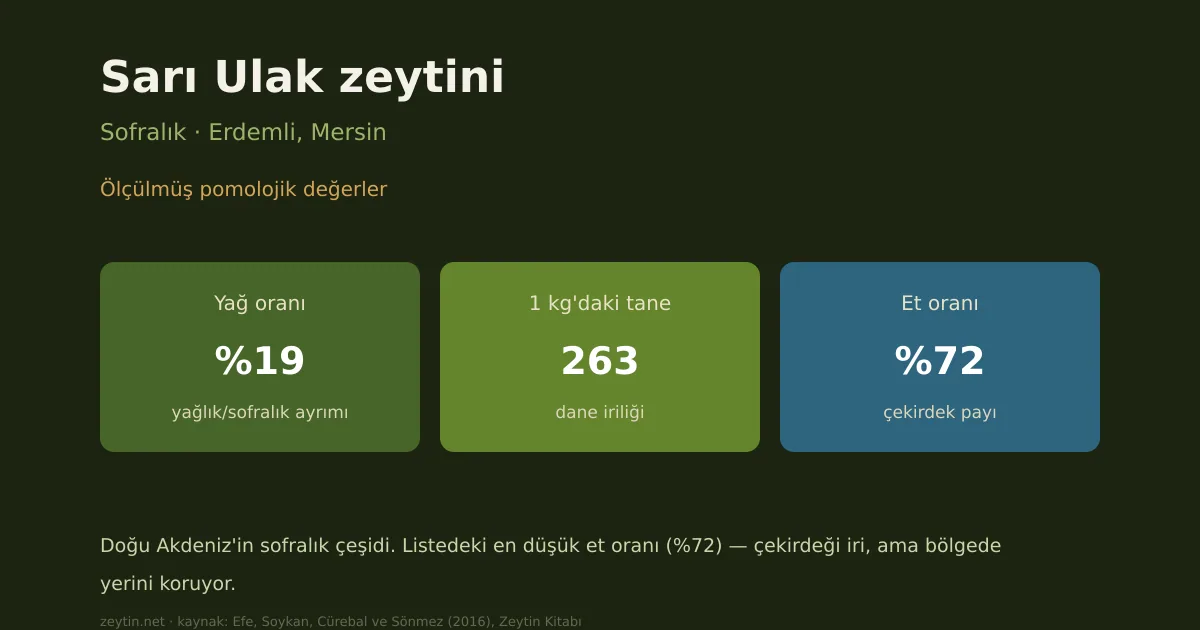
The eastern Mediterranean's table variety
Sarı Ulak is grown mainly for the table around Adana and Mersin, with Erdemli as its centre.
Under Tarsus conditions, open-pollinated Sarı Ulak fruit averaged 4.90 g, 18.18 mm wide and 23.85 mm long. Fruit and stone weights were measured at 3.77 g / 1.06 g.
That last pair explains the 72% flesh ratio in the table: the stone makes up roughly a quarter of the fruit. For most other varieties on the list the figure sits between 11% and 19%. Sarı Ulak's stone weighs twice Gemlik's (0.53 g).
So why is it still grown?
Because flesh ratio is not the only criterion. Sarı Ulak suits the region's conditions and is embedded in local brining tradition. Genetically it shows only about 50% similarity to the Domat–Gemlik–Kilis Yağlık–Nizip Yağlık–Manzanilla group, placing it on a relatively separate branch of Türkiye's variety pool — a distinctness worth conserving.
Take care when using it as a pollinator: pollinating Domat with Sarı Ulak dropped Domat's fruit weight from 5.51 g to 3.26 g.
In short
Sarı Ulak is a table variety with a large stone but a firm regional footing. Its relative genetic distance from Türkiye's main variety pool makes it valuable for diversity. Choose it as a pollinator with care: it reduces fruit size in large-fruited varieties.
Registered names built on this variety
The registration covers the product of a defined area — not this variety wherever it is grown.
- Tarsus Sarıulak Zeytini designation of origin · reg. no 345
- Tarsus Sarıulak Zeytinyağı designation of origin · reg. no 767
Where it stands among measured varieties
çeşit sayfası
çeşit sayfası
Zeytin Kitabı — Efe, Soykan, Cürebal, Sönmez (2016), Kitabevi Yay. s.37-80
Zeytin Kitabı — Efe, Soykan, Cürebal, Sönmez (2016), Kitabevi Yay. s.37-80
çeşit sayfası
Values are those published on each variety's own page; the comparison covers only varieties with a measured figure, so it is a comparison of what is known — not of every Turkish variety. See the full ranking and how it is built →
One rating per visitor; you can change yours at any time. Ratings are real reader votes — no seeded or default scores.
Related
 Article
Where do olives grow in Türkiye, and where don't they?
What limits the olive is frost, not a provincial border. Where it grows in Türkiye, with cold thresholds and altitude limits.
Article
Where do olives grow in Türkiye, and where don't they?
What limits the olive is frost, not a provincial border. Where it grows in Türkiye, with cold thresholds and altitude limits.
 Article
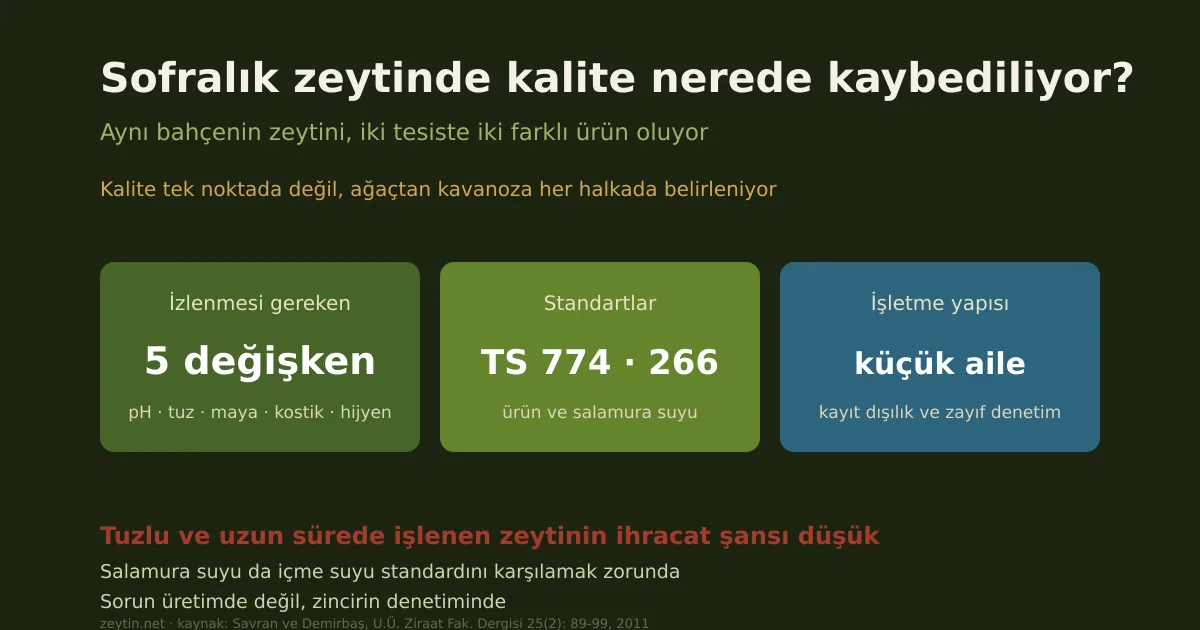
Where is quality lost in table olives?
Variety choice, harvest technique, fermentation control, sterilisation and the pre-packing check are each a separate point of loss. The structural problem is scale and inspection.
Article
Where is quality lost in table olives?
Variety choice, harvest technique, fermentation control, sterilisation and the pre-packing check are each a separate point of loss. The structural problem is scale and inspection.
 Article
Patos olive
Patos is a recorded variety of the Black Sea. Described in the source.
Article
Patos olive
Patos is a recorded variety of the Black Sea. Described in the source.
 Article
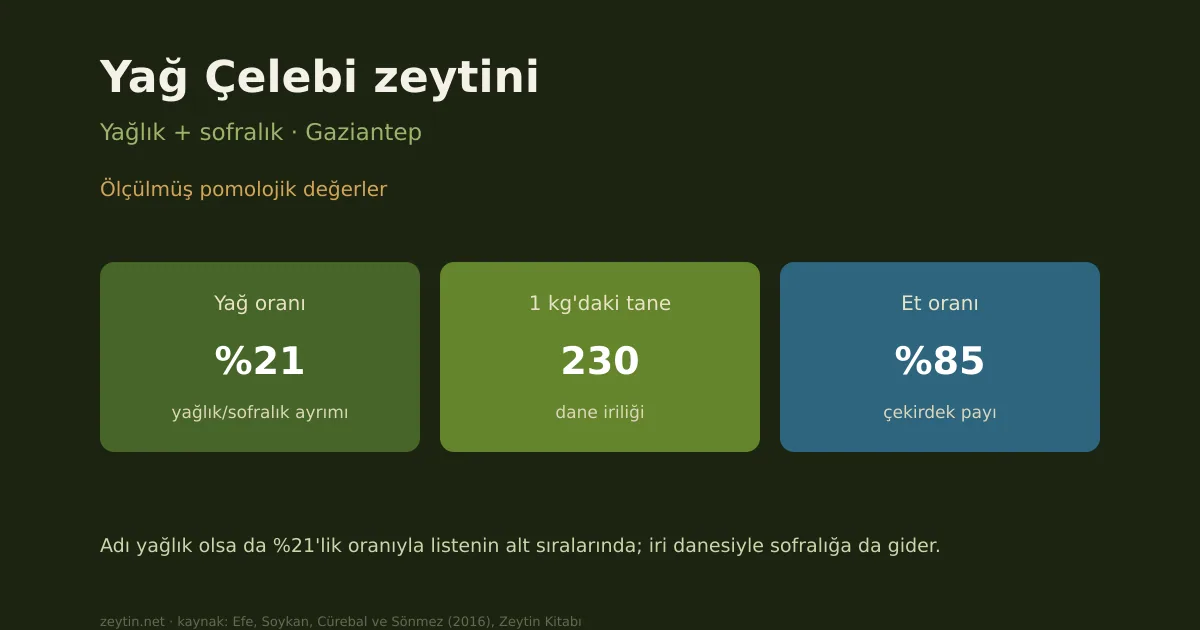
Yağ Çelebi olive: characteristics, oil content and growing areas
Despite the name, its 21% oil puts it low on the list; its large fruit also serves the table.
Article
Yağ Çelebi olive: characteristics, oil content and growing areas
Despite the name, its 21% oil puts it low on the list; its large fruit also serves the table.