Aydın Memecik Olive: grafted on wild rootstock, a tree that yields for a century
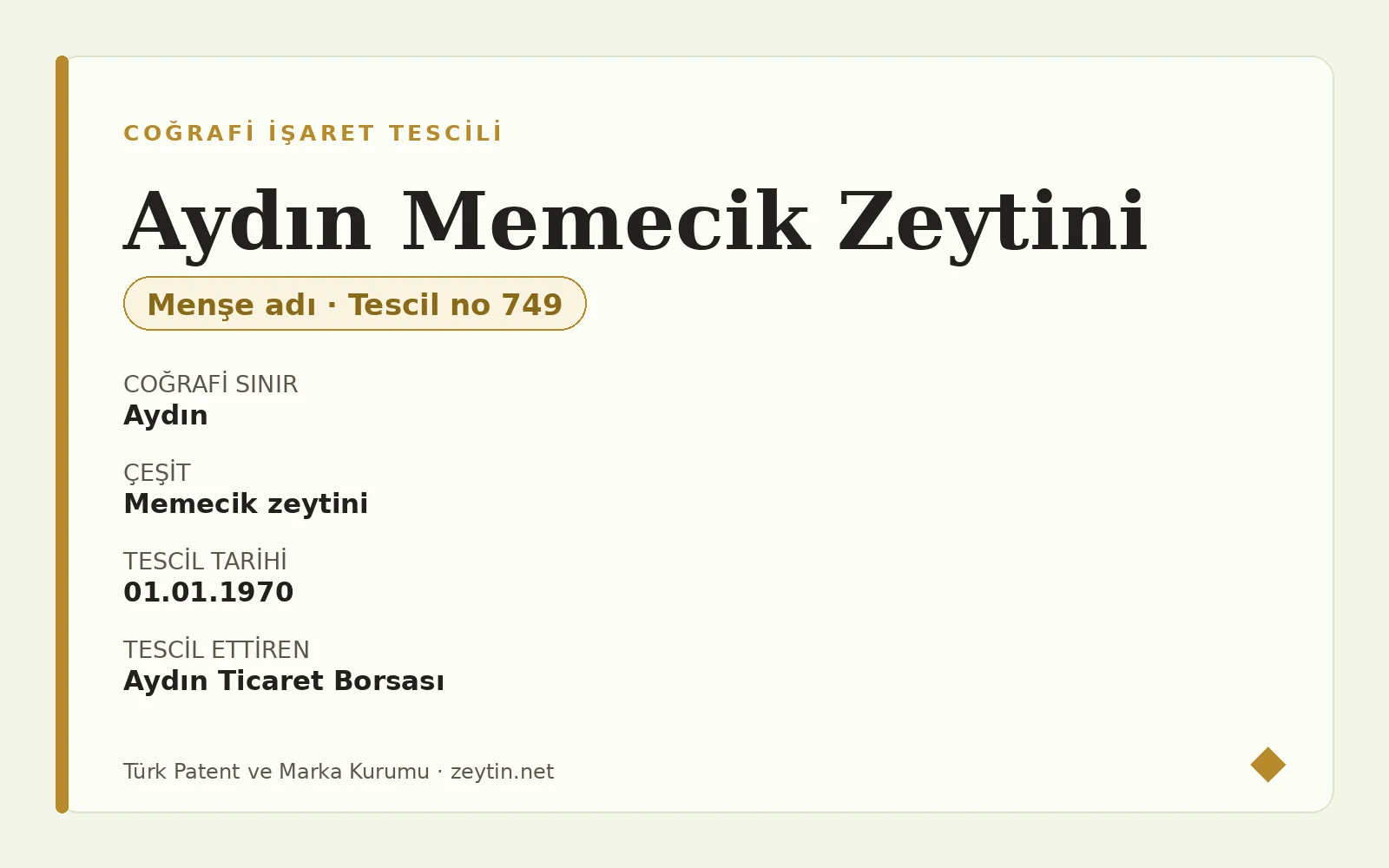
Registered in 2021. The certificate ties the cultivar's key trait to longevity: grafted on wild rootstock, Memecik yields economically for 80-100 years and can then be rejuvenated.
Memecik is the most widespread olive cultivar in the Aegean. What the certificate foregrounds is not yield but longevity: grafted onto wild rootstock, Memecik trees yield economically for 80-100 years, after which rejuvenation pruning can bring them back into production.
The record
| Registration no | 749 |
| Registration date | 07.05.2021 |
| Protection from | 16.07.2019 |
| Type | Designation of origin |
| Registered by | Aydın Commodity Exchange |
| Area | The province of Aydın |
| Cultivar | Memecik |
The measured fruit
| Criterion | Value |
|---|---|
| Fruit weight | 4.78 g |
| Flesh-to-stone ratio | 7.53 |
| Oil content | 24.50% |
| Fruits per kilogram | 200 on average |
| Fruit index (length/width) | 1.4 – 1.5 |
A flesh-to-stone ratio of 7.53 is high — it is why the cultivar serves both for oil and for brining.
Where it grows
Widespread through the Greater and Lesser Menderes valleys. It generally grows on sloping, hillside and mountainous ground and is drought-tolerant — the two facts belong together: unirrigable hillside land is no obstacle for Memecik.
The trunk is dark grey and fissured. It is moderately susceptible to the olive fly, which the certificate does not conceal.
Harvest by intended use
Because Memecik serves both oil and brine, harvest maturity depends on the intended use, and the criterion is fruit colour — the maturity index:
- Fruit destined for green brining is picked once it reaches a yellowish green
- Fruit for oil is left to a later maturity
We weighed up whether early harvest is expensive or valuable elsewhere.
The oil registration of the same cultivar
The Aydın Commodity Exchange also registered the cultivar's oil separately: Aydın Memecik Olive Oil (no 535, designation of origin). Together they are an example of the table and oil lines of one cultivar being protected separately.
In short
Aydın Memecik Olive is the registration, within the province of Aydın, of the Aegean's most widespread cultivar. What the certificate adds is five measured values and the cultivar's longevity — close to a century of yield on wild rootstock, followed by rejuvenation.
The cultivar behind it, measured
The registration is granted to a place, but the cultivar the definition rests on has measurable values:
| Property | Value |
|---|---|
| 1 kg’daki tane sayısı | 210 |
| Et oranı | %88 |
| Et / çekirdek oranı | 5,86 |
| Et/çekirdek oranı | 6,7 |
| Yağ oranı | %25-28 |
| Toplam fenol | 296-407 mg CAE/kg |
| α-tokoferol | 219-324 mg/kg |
| Olgunlaşma | Kasım ortası - aralık ortası |
| Kendine verimlilik | Kısmi |
| Soğuğa dayanım | Orta |
| Kullanım | Yağlık; yeşil ve siyah sofralık olarak da tüketilir |
| Ağaç | yarı dik, kuvvetli |
Oil content reaches 28% at the top of its range — on its own enough to justify pressing. The cultivar is partially self-fertile; pollinators are used to secure yield. A flesh-to-stone ratio of 5.86 is the basic measure of how much of a table olive is actually eaten.
Its place in Aydın's olive production
| Item | Value |
|---|---|
| Fruit production | 478,484 t |
| — for oil | 380,008 t |
| — for the table | 98,476 t |
| Olive oil production | 57,577 t |
| Trees | 22,772 thousand |
| Yield per tree | 21.0 kg |
79% of the province's fruit goes to oil — so this table-olive registration defines a niche outside the main flow.
How much difference does "harvest by intended use" make?
The document leaves harvest ripeness to the intended use: yellowish-green for brining, riper for oil. The numerical consequence of that choice has been measured.
Yemişçioğlu and colleagues (2016) examined oils from Memecik and Erkence olives harvested at different ripeness levels. Two findings emerged:
1. Total polyphenol falls logarithmically as ripening advances (P<0.05). The decline is not linear — the loss early on is steeper than the loss at advanced ripeness. Delaying harvest by a week costs more at the start of the season than at the end.
2. There is a significant relationship between total polyphenol and the bitterness index (K225) (P<0.01), expressible as a logarithmic equation. Bitterness is therefore not a subjective impression but the direct counterpart of a measurable phenol content.
Together these explain why the document gives no single harvest date:
- If brining is the aim, green fruit picked early is high in phenols, and in brine that bitterness is something to be removed. More phenol means longer, more laborious debittering.
- If oil is the aim, the same phenol is something to be preserved; it carries both the bitter-pungent character and the shelf life.
The same fruit, the same compound, two opposite goals. Giving a colour criterion rather than a date is therefore a technical necessity.
Memecik's particular place in this discussion: in cultivar comparisons it is counted among those with the highest total phenol content. What is an advantage for oil means extra work in table processing.
The oil's composition supports the profile: oleic acid has been measured at 73.37-75.64% and palmitic acid at 11.45-13.84% in Memecik oils.
We covered the phenolic compounds themselves in oleocanthal and polyphenols, and the ripeness measure in the ripeness index.
Further sources
- Yemişçioğlu, F., Özdikicierler, O., Çapar, S. & Gümüşkesen, A.S. (2016). The effect of ripeness degree on total polyphenol content and bitterness index of virgin olive oil in Memecik and Erkence olive cultivars. Gıda, 41(6), 381-386.
One rating per visitor; you can change yours at any time. Ratings are real reader votes — no seeded or default scores.
Related
 Article
Olive varieties: seventeen Turkish varieties in numbers
Gemlik, Ayvalık, Memecik, Domat and the rest: Türkiye's olive varieties with oil content, fruit size, flesh ratio, region and ripening calendar.
 Article
Gölvala olive
Gölvala is a recorded variety of the Black Sea. No measured pomological data published.
 Article
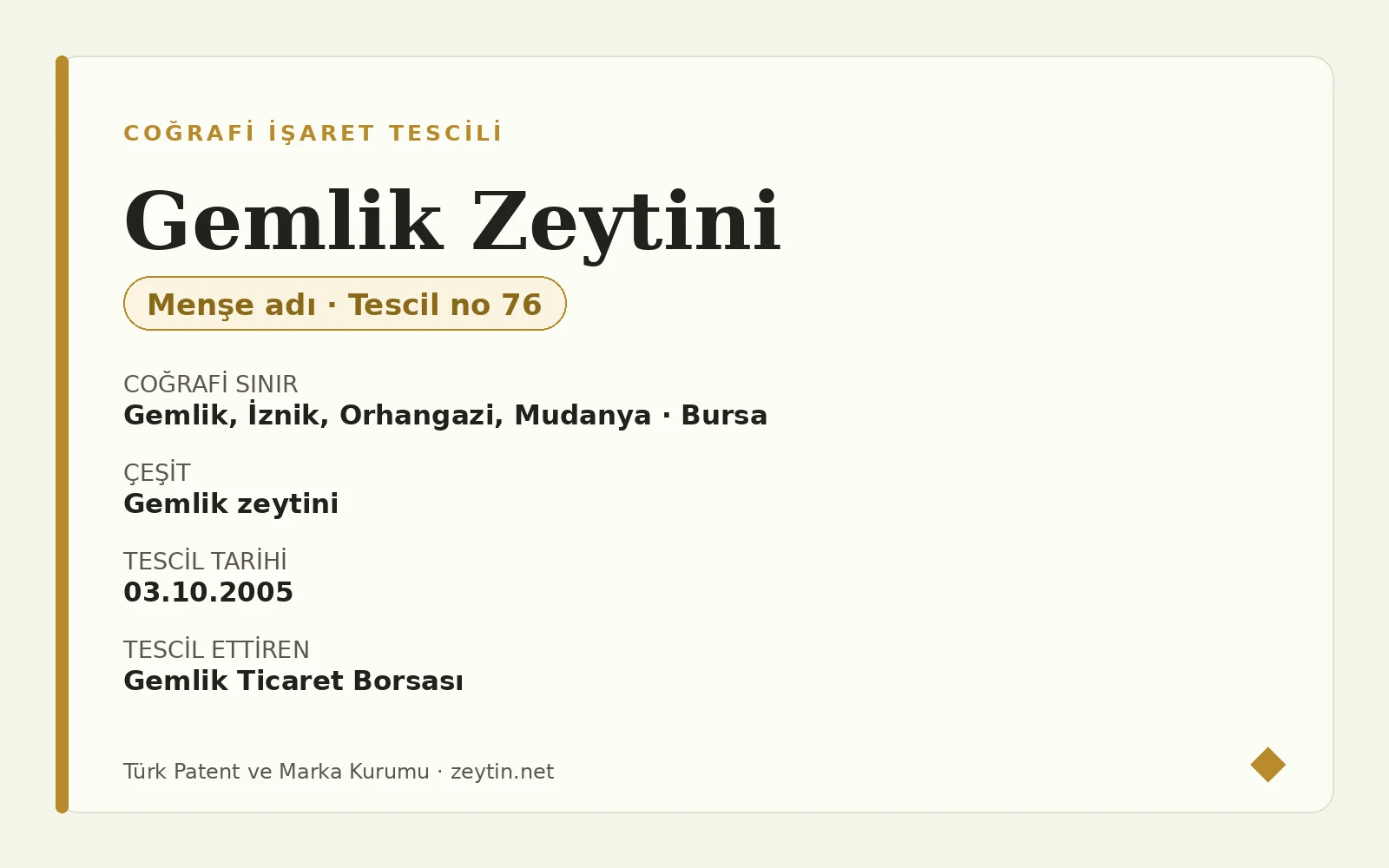
The Gemlik Olive designation of origin: what the certificate says
Turkey's first registered olive (2005, no 76). The certificate defines four districts, three cultivars, four curing methods and seven size grades — all of them binding.
 Article
Which is Turkey's best-quality olive?
Quality criteria and measured values for Turkey's main olive varieties — fruit weight, oil content and intended use.