When to harvest olives: deciding with the maturity index
Harvest timing is set by the maturity index, not the calendar. The 0-7 colour scale, how to calculate it from 100 fruits, early versus late harvest compared, and ripening times by variety.
There is no calendar answer to "when are olives harvested?" The right moment shifts by weeks according to place and variety, and changes completely depending on whether you are picking for oil or for the table. The measure used is not the calendar but the colour of the fruit.
The short answer
In Türkiye the olive harvest generally runs from early October to early January. Within that window:
- Green table olives come first: late September to early October, while the fruit is still fully green.
- Early oil harvest falls in October, as the fruit turns from green to pink.
- Ripe oil harvest falls in November, once the fruit has turned purple-black.
- Black table olives come last: late November to December, at full black.
Region matters too. The same variety ripens weeks earlier on the Mediterranean coast than around the Sea of Marmara.
The measure: the maturity index
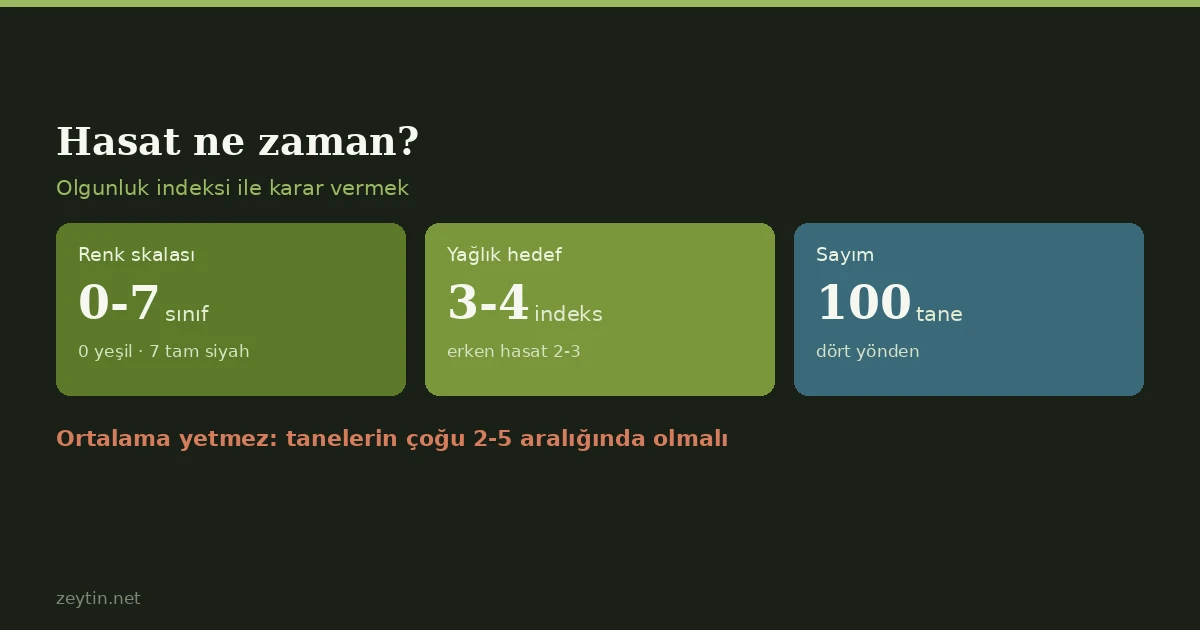
Harvest timing is set using the maturity index developed in Jaén, Spain and adopted internationally. It classifies skin and flesh colour from 0 to 7:
| Class | Appearance |
|---|---|
| 0 | Deep green skin |
| 1 | Yellow-green skin |
| 2 | Reddish spots on less than half the surface |
| 3 | More than half the surface reddish or purple |
| 4 | Skin black, flesh entirely white |
| 5 | Skin black, less than half the flesh purple |
| 6 | Skin black, flesh purple but not to the stone |
| 7 | Skin black, flesh purple all the way to the stone |
Broadly: 1–2 is green ripening, 3–4 pink, 5–7 black.
How the index is calculated
A representative sample is taken — 100 fruits collected from all four sides of the tree and from different heights. They are sorted into the eight classes, each class count is multiplied by its class number, and the total divided by 100.
Example: of 100 fruits, 10 fall in class 1, 40 in class 2, 35 in class 3 and 15 in class 4.
(10×1 + 40×2 + 35×3 + 15×4) ÷ 100 = (10 + 80 + 105 + 60) ÷ 100 = 2.55
The target range for an oil harvest is usually 3–4. The grove in this example is slightly early; another week would help.
The average is not the whole story. Distribution matters as well: most fruit should sit between 2 and 5, without large numbers at the 0–1 or 6–7 extremes. A grove averaging 3.5 because half is green and half overripe is not the same as a uniform one.
Early or late?
This is a quality-versus-quantity trade, and both sides of it are real.
| Early (MI 2–3) | Late (MI 5–6) | |
|---|---|---|
| Oil yield | Low | High |
| Polyphenols | High | Low |
| Bitterness / pungency | Pronounced | Soft |
| Green, grassy aroma | Strong | Weak |
| Shelf life | Long | Short |
| Fruit fly risk | Low | High |
Harvest early and you take less oil from the tree, but the oil you take is more phenolic, more aromatic and more stable. Harvest late and oil per kilo rises while bitterness, pungency and keeping quality fall.
Bitterness and a peppery catch in the throat are not faults but signs of phenolic content — see oleocanthal and polyphenols.
To see how yield shifts with harvest timing in your own grove, use the yield calculator.
The cost of waiting
Delaying the harvest does more than lower oil quality; it brings two concrete risks.
Olive fruit fly. Ripening fruit becomes more suitable for the fly, and every week the crop hangs raises the risk of infestation. See olive fruit fly control.
Free acidity. Fruit that has fallen, been bruised or kept waiting develops higher acidity — the threshold that defines the extra virgin grade. See what acidity means in olive oil.
A late harvest also reduces next year's crop. While fruit hangs it continues drawing on the tree's resources, weakening flower bud formation for the following season and deepening alternate bearing.
Ripening by variety
Ripening time is a fixed characteristic of the variety. Some of those recorded on this site:
For a grower with several varieties, this table means the harvest is run in sequence, not in one pass. Picking Erkence and Memecik on the same day means picking one too early and the other too late.
Why table harvest is different
For table olives the measure is not oil but texture and size.
Green table olives are picked once the fruit has reached full size but before colour change begins (MI 0–1). Left later, the flesh softens and breaks up in brine.
Black table olives are the reverse: picked after colour change is complete (MI 5–7). Picked early, they fail to wrinkle, do not take salt properly and taste flat.
Table harvest must also be done by hand. Fruit that has fallen or been struck cannot be used; bruises darken in brine. Harvesting methods acceptable for oil fruit are not usable for the table.
Frequently asked
Which month is the olive harvest? October to December in Türkiye, extending to late September for green table olives and into late December for black.
Can fallen olives be collected? For oil, yes, but they must be processed separately. Acidity rises quickly in fruit left on the ground, and blending it into good fruit can downgrade the whole batch.
How quickly must the harvest be processed? Harvested fruit left waiting heats and ferments. The rule is to mill on the day of picking; fruit left in sacks is the main source of the fusty defect.
Does harvest timing affect alternate bearing? Not directly, but it helps. An early harvest leaves the tree more time to form next year's flower buds and softens the on-off cycle.
One rating per visitor; you can change yours at any time. Ratings are real reader votes — no seeded or default scores.
Related
 Article
How are olives harvested? What five picking methods cost the tree and the oil
Hand picking, poles, combs, trunk shakers and straddle harvesters each charge a different bill — to the fruit, to the tree and to the acidity of the oil. Which method suits which grove, and what goes wrong on harvest day.
Article
How are olives harvested? What five picking methods cost the tree and the oil
Hand picking, poles, combs, trunk shakers and straddle harvesters each charge a different bill — to the fruit, to the tree and to the acidity of the oil. Which method suits which grove, and what goes wrong on harvest day.
 Article
Cold-hardy olive varieties: Gemlik, Ayvalık and the other candidates in the data
In our variety data, Gemlik, Ayvalık, Coratina, Picual and Hojiblanca are recorded with high cold adaptation or hardiness; Kalamata, Leccino, Memecik and Domat are medium, Frantoio moderately sensitive and Saurani low. But variety alone is not enough: tree age, the duration of the cold and the site of the grove also decide.
Article
Cold-hardy olive varieties: Gemlik, Ayvalık and the other candidates in the data
In our variety data, Gemlik, Ayvalık, Coratina, Picual and Hojiblanca are recorded with high cold adaptation or hardiness; Kalamata, Leccino, Memecik and Domat are medium, Frantoio moderately sensitive and Saurani low. But variety alone is not enough: tree age, the duration of the cold and the site of the grove also decide.
 Article
Where does an olive sapling come from? From cutting to laboratory
Most table olive varieties will not root, and those that do are clones of one another — defenceless against disease. Tissue culture reports up to 85% success in vitro, but zeatin is expensive.
Article
Where does an olive sapling come from? From cutting to laboratory
Most table olive varieties will not root, and those that do are clones of one another — defenceless against disease. Tissue culture reports up to 85% success in vitro, but zeatin is expensive.
 Article
How to Grow an Olive Tree
Soil, climate, watering, pruning and patience. A basic care guide for anyone planting an olive tree.
Article
How to Grow an Olive Tree
Soil, climate, watering, pruning and patience. A basic care guide for anyone planting an olive tree.