How are olives harvested? What five picking methods cost the tree and the oil
Hand picking, poles, combs, trunk shakers and straddle harvesters each charge a different bill — to the fruit, to the tree and to the acidity of the oil. Which method suits which grove, and what goes wrong on harvest day.

The olive harvest looks like a single decision made once a year: when to start. But how the fruit is taken off the tree matters as much as when. The picking method settles three things at once — the quality of this year's oil, the crop the tree will carry next year, and the cost of the job.
This article goes through five methods and says who each one suits. When to harvest is a separate decision, covered in the maturity index.
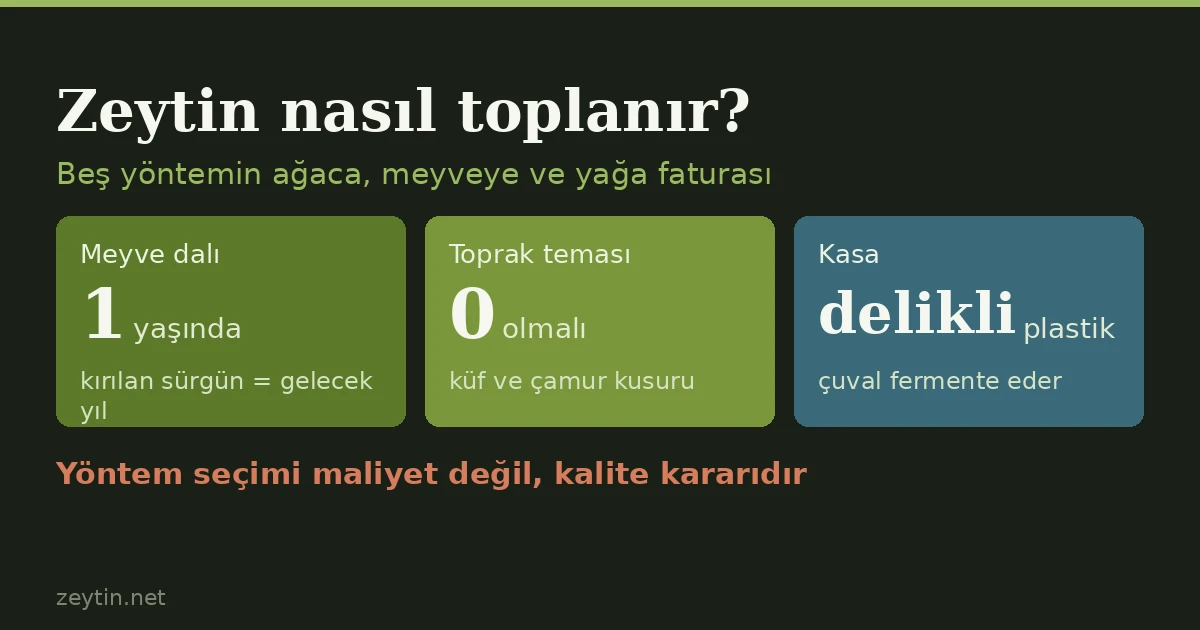
The decision is charged to two different ledgers
Every harvesting method writes into two accounts at once.
This year's ledger: the integrity of the fruit. The moment an olive is bruised, its own enzymes begin working and the free fatty acidity of the oil rises. Fruit that comes off the branch undamaged and fruit that hits the ground do not produce the same oil. The difference shows up both in the laboratory and on the tasting table.
Next year's ledger: the shoots. Olives are borne on one-year-old shoots. The thin branch broken this year is where next year's fruit would have sat. Rough harvesting deepens alternate bearing — the on-year, off-year cycle.
1. Hand picking
Stripping the fruit from the branch by hand. This does the least damage to both tree and fruit, and it is also the most expensive, because it is pure labour.
For table olives it is often the only option. A harvest that bruises the fruit comes back as spotting and softening in the brine — problems we covered in quality problems in table olives.
The drawback is not only cost but speed. In a large grove, as the harvest stretches out, the fruit picked first starts waiting.
2. Beating with poles
The most widespread and cheapest method in Türkiye, and the one that costs the tree most. A long pole is used to strike the branches and knock the fruit down.
It does three separate kinds of damage:
- The fruit is bruised. Olives that fall under impact are raw material that raises acidity.
- One-year-old shoots break. Next year's fruiting wood goes with them.
- Bark is wounded. An open wound is an entry point for disease and pests.
With oil olives going straight to the mill, poles partly hide their cost. With table olives they cannot.
3. Hand combs and powered combs
Combs with plastic or carbon teeth strip the fruit without breaking the branch. In a battery-powered or pneumatic comb the tooth assembly vibrates, raising the work rate to several times that of hand picking.
For small and medium groves this is today the most balanced option: clearly less damage than poles, clearly faster than hands. It also suits sloping ground where machinery cannot work.
The detail to get right is tooth spacing. Chosen without regard to variety and fruit size, it either leaves fruit on the tree or tears shoots off.
4. Trunk shakers
A tractor-mounted clamp grips the trunk and vibrates it; the fruit comes down all at once. In a large grove this is the method that cuts labour most.
It has conditions:
- The tree must be single-trunked and thick enough for the clamp to grip. Traditional multi-stemmed groves do not qualify.
- The ground must be flat enough for a tractor to turn comfortably.
- If the clamp is wrongly adjusted the bark is stripped, which is permanent damage.
Converting a traditional grove into one a shaker can work is a shaping job spread over years, and it has to be thought through together with pruning decisions.
5. Straddle harvesters
Similar to a grape harvester, the machine passes over the tree row and picks continuously. It works only in super-high-density (hedgerow) plantings, where trees are close, low and pruned into a wall.
Its unit cost is the lowest of any method, but it is not a harvesting decision — it is a grove establishment decision. It cannot be applied to an existing traditional planting.
Which grove takes which method?
| Method | Suits | Real cost |
|---|---|---|
| Hand picking | Table olives, small groves | Labour |
| Beating with poles | — | The tree and next year |
| Hand / powered comb | Small–medium, sloping ground | Equipment + moderate labour |
| Trunk shaker | Single-trunk, flat, large grove | Investment + bark risk |
| Straddle harvester | Super-high-density hedgerow | Grove must be built for it |
What goes on the ground matters as much as the method
Whatever method is used, the fruit must not touch the soil. Olives that land on bare ground carry moisture, mould and an earthy smell into the oil, appearing at tasting as the "muddy sediment" and "musty-humid" defects.
That is what the nets or sheets spread under the tree are for. Raising the edges of the sheet keeps fruit from escaping. Olives already lying on the ground for a few days should be collected separately and pressed separately; the moment they are mixed into good fruit they pull the whole batch down.
The hours after picking
Harvest quality keeps falling after the fruit leaves the tree.
⚠ Do not use sacks. Olives piled in a sack heat up and begin to ferment. Perforated plastic crates let air through, and the crate should be shallow enough not to crush the fruit.
⚠ Do not let it wait. For fruit destined for the mill, every day that passes comes back as acidity. What to check at the mill is covered in what to check when having olives pressed.
⚠ Do not pile wet fruit. Olives picked after rain deteriorate faster even in a crate.
The job does not end with the harvest
Once picking is done the tree's needs change: wounds, shoot balance and the fertilising calendar all differ according to how it was harvested. A grove that has been through a rough harvest needs more care the following year. Olive tree care after harvest covers that part.
In short: choosing a method looks like a cost decision, but it is a quality and continuity decision. The cheapness of the pole shows up in this year's accounts; the bill is written on next year's shoots.
One rating per visitor; you can change yours at any time. Ratings are real reader votes — no seeded or default scores.
Related
 Article
Olive Pruning: Why, When and How
Why olives are pruned, when to do it, formative and production pruning, rejuvenation and high-density systems.
Article
Olive Pruning: Why, When and How
Why olives are pruned, when to do it, formative and production pruning, rejuvenation and high-density systems.
 Article
Pollination and pollinator varieties in olive
98% of olive flowers drop. Whether the remaining 1-2% holds depends on having a pollinator in the grove. Gemlik is only partially self-fertile: in a single-variety grove harvest falls to a third.
Article
Pollination and pollinator varieties in olive
98% of olive flowers drop. Whether the remaining 1-2% holds depends on having a pollinator in the grove. Gemlik is only partially self-fertile: in a single-variety grove harvest falls to a third.
 Article
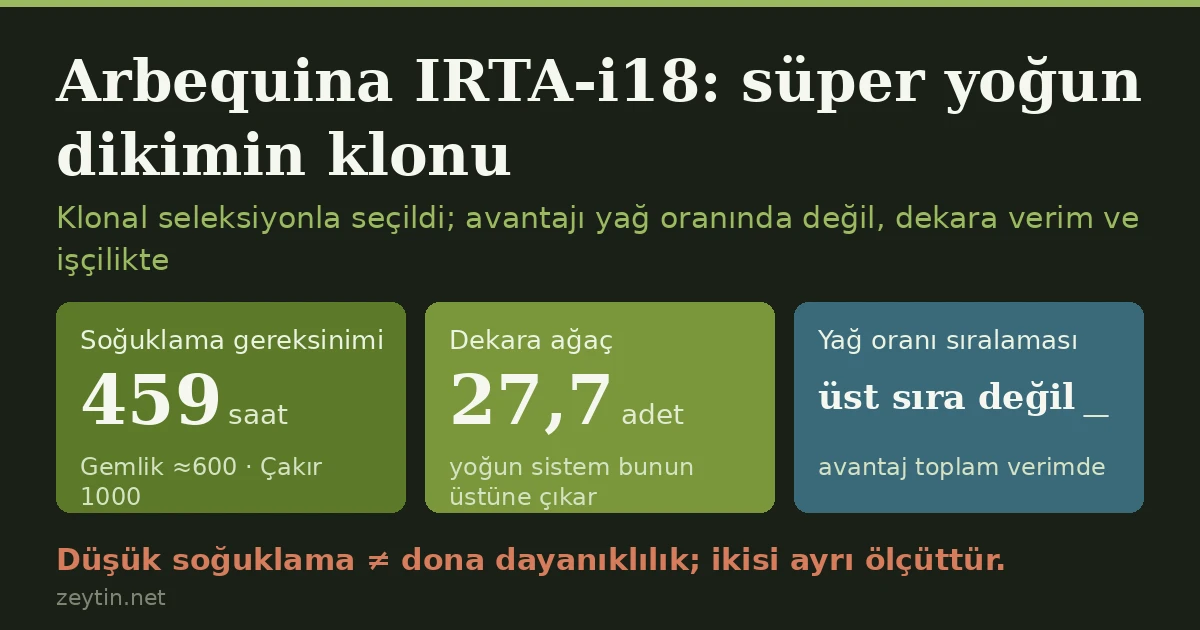
Arbequina IRTA-i18: the clone behind super-high-density olive groves
IRTA-i18, developed from Arbequina by clonal selection, was chosen for super-high-density groves. What early bearing, mechanical harvest and a low 459-hour chilling requirement actually mean.
Article
Arbequina IRTA-i18: the clone behind super-high-density olive groves
IRTA-i18, developed from Arbequina by clonal selection, was chosen for super-high-density groves. What early bearing, mechanical harvest and a low 459-hour chilling requirement actually mean.
 Article
Grafting Olives: Changing Cultivar and Improving Wild Trees
When grafting is needed, taking scion wood, bud and cleft methods, topworking and aftercare.
Article
Grafting Olives: Changing Cultivar and Improving Wild Trees
When grafting is needed, taking scion wood, bud and cleft methods, topworking and aftercare.