What does crop insurance cover for olives, and what does it cost?
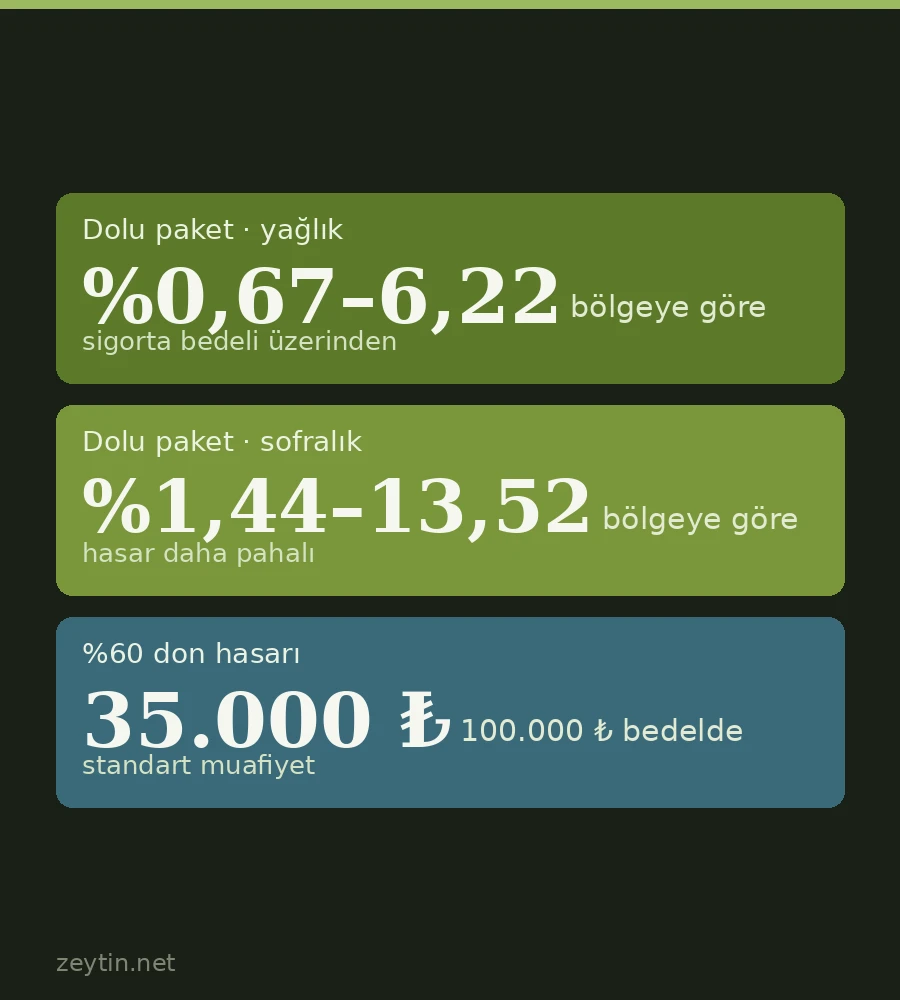
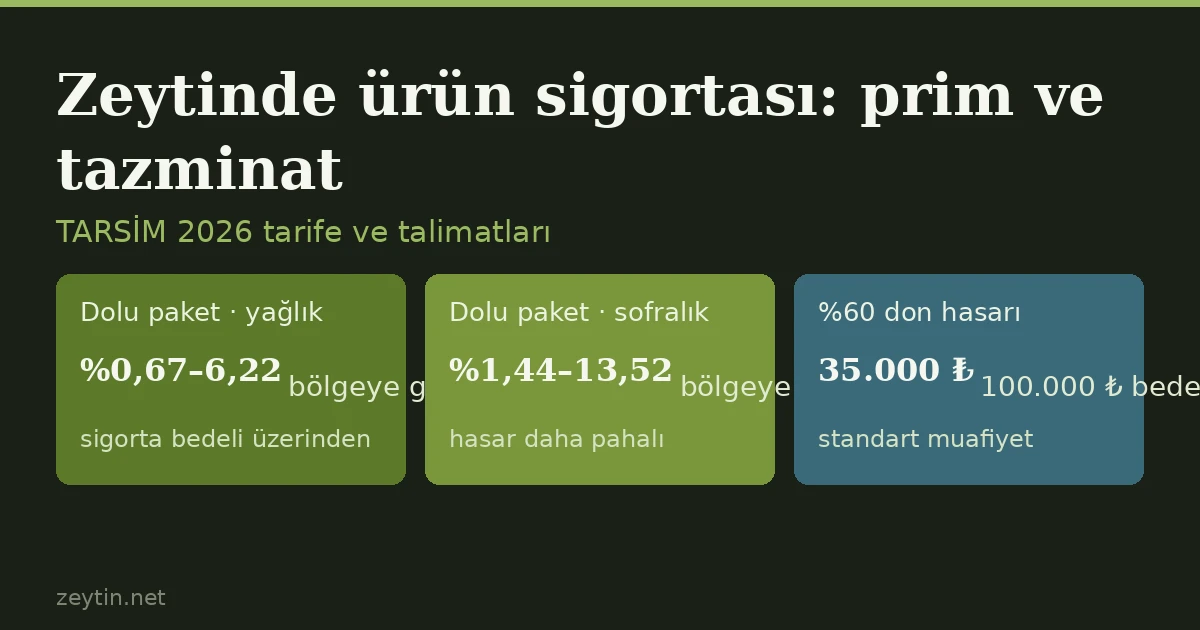
Olives can be insured twice: for the crop and for the tree. Under TARSİM's 2026 tariff the hail package runs from 0.67% to 6.22% for oil olives and 1.44% to 13.52% for table olives, while frost cover sits on its own tariff and is optional. What a claim pays is set by the deductible and coinsurance: 60% frost damage on the standard option pays 35% of the sum insured.
A hailstorm can take an olive season in ten minutes; a frost can take it in one night. Olives are among the crops covered by Turkey's state-supported agricultural insurance scheme, and they can be insured twice over — once for the fruit and once for the tree itself. This article sets out what is actually covered, how the premium is calculated and how a claim is settled, based on the 2026 tariff and instructions published by the Turkish Agricultural Insurance Pool (TARSİM).
The scheme rests on Law No. 5363 on Agricultural Insurance. The risks, crops and premium-support rates to be covered are set each year by presidential decree, and a policy can only be written for parcels registered in the record systems designated by the Ministry. An unregistered grove cannot be insured.
Two separate policies: crop and tree
Crop insurance protects the season's fruit. For olives the standard cover is the "hail package", and frost is added to the policy optionally.
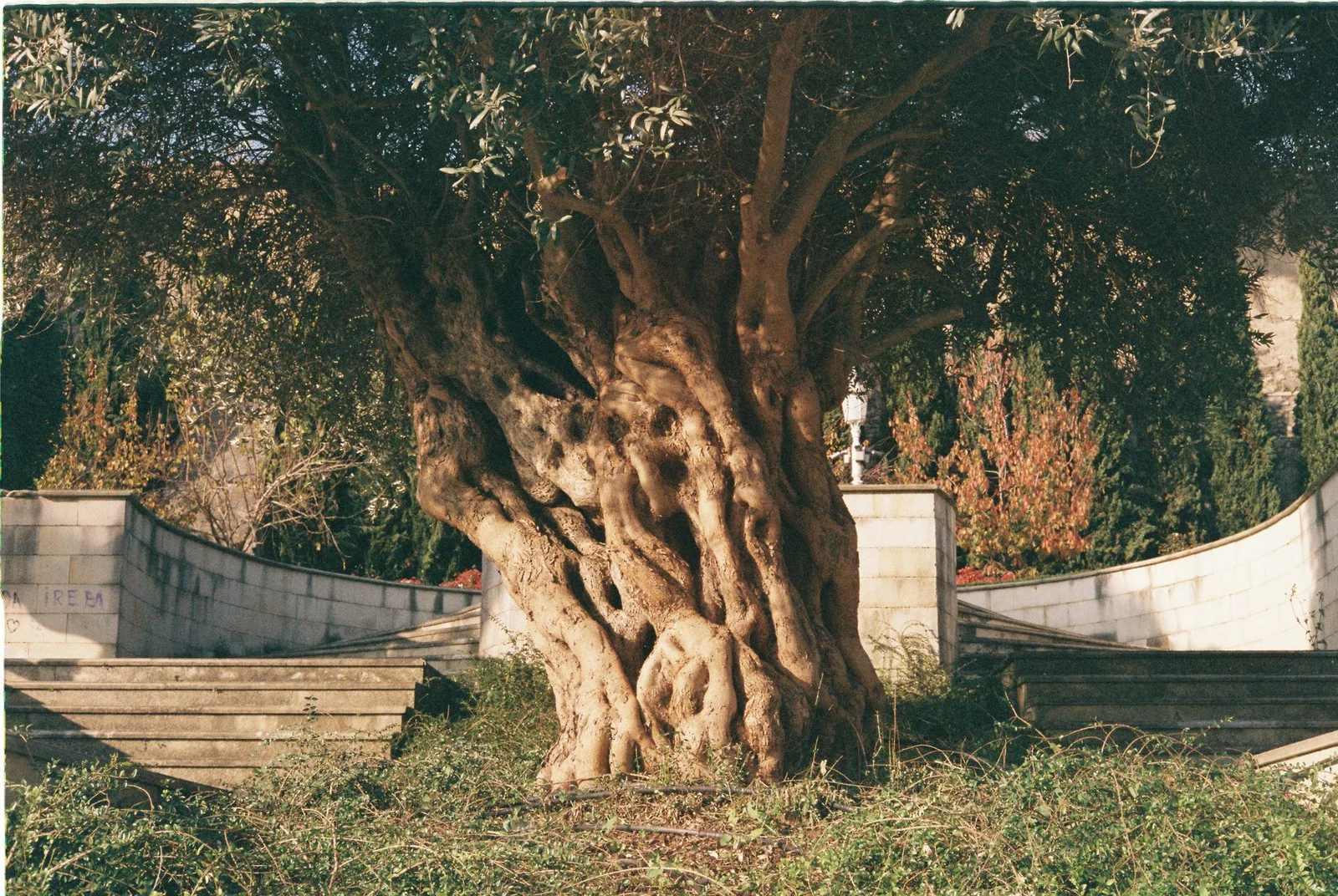
Tree and sapling insurance protects the tree rather than the crop, and its list of perils is longer: fire, storm, tornado, vehicle impact, earthquake, landslide, flood and inundation, snow load, hail, and damage by wild animals (wild boar and deer).
One detail in the tree policy deserves attention. Under the tariff, the sum insured for fruit trees is based on three times the tree's yield. A tree is therefore valued not at one season's crop but at three — a reasonable approach, given how many years a replacement sapling needs before it bears.
How the premium is calculated
The logic is simple: premium = sum insured × tariff rate. The rate is read from a table according to the crop's sensitivity class and the geographical hazard zone of the parcel. Zones run from A to Z, A being the lowest risk.
| Crop | Sensitivity class | Zone A | Zone Z |
|---|---|---|---|
| Olive (oil) | 33 | 0.67% | 6.22% |
| Olive (table) | 153 | 1.44% | 13.52% |
The gap between the two rows is not arbitrary. In table olives, hail does not merely reduce yield — it bruises the fruit and pushes it out of its commercial grade, and because caliber and appearance translate directly into price, the monetary loss is larger. The tariff prices that at close to double the rate.
Frost cover carries its own tariff, over a shorter run of zones (A–M).
| Crop | Sensitivity class | Zone A | Zone M |
|---|---|---|---|
| Olive (oil) | 95 | 0.42% | 5.41% |
| Olive (table) | 18 | 0.64% | 8.30% |
Tree insurance rates are far smaller, because the total loss of a tree is a rare event. For the olive tree the 2026 tariff gives fire at 0.6%; storm and vehicle impact at 0.05%; landslide 0.06%; tornado 0.02%; earthquake and flood 0.01% each; snow load 0.1%; hail 0.005%; wild boar damage 0.1%; deer damage 0.02%.
Snow load carries an altitude multiplier: a factor of 1 at 0–750 m, 2 at 751–1,000 m, 3 at 1,001–1,250 m and 4 above 1,251 m. Where a risk inspection is carried out on a tree policy, an additional premium of 0%, 20% or 40% applies according to the risk category assigned; a fourth category is not insurable.
The producer does not pay all of this. Part of the premium is met by state premium support, at a rate set annually by presidential decree — so the current rate should be checked when the policy is written.
Settlement: deductible and coinsurance
This is where the scheme is most often misread. The assessed loss ratio is not paid out directly. Under the tariff the deductible is first subtracted from the loss ratio, and a coinsurance share of what remains stays with the insured.
For frost on olives there are three options:
| Option | Deductible | Coinsurance |
|---|---|---|
| Standard | 10% | 30% |
| Option 1 | 10% | 20% |
| Option 2 | 10% | 10% |
A number makes it clearer. Take a parcel insured for 100,000 lira on the standard option, with frost damage assessed at 60%: the 10% deductible comes off the loss ratio, leaving 50%, and 30% coinsurance applies to what remains — so the claim pays 35,000 lira. The same loss on Option 2 pays 45,000 lira, but the premium is higher. The tariff adds one constraint here: state premium support for the optional deductible choices can never exceed what would be calculated for the standard option. The extra protection is paid for by the producer.
Tree policies work differently. For hail, storm, tornado, fire, earthquake, landslide, flood, vehicle impact and snow load the deductible is 0% and coinsurance 20%. For frost on saplings, a 10% deductible and 20% coinsurance apply.
The declared yield: understating hurts as much as overstating
The yield declared on the policy sets the ceiling on any claim, and the tariff cuts both ways:
- If the declared yield is below the actual yield, the Pool is liable only up to the declared figure. Understating to save premium means being underpaid on a claim.
- If the declared yield is above the actual yield, the claim is calculated on the actual yield determined by the loss adjuster, and the premium difference arising from the excess declaration is refundable under stated conditions. Overstating does not enlarge a claim; it only ties up cash.
If, despite the damage, the yield obtained turns out to be higher than the figure declared, no claim arises at all. The declaration should therefore be made with the grove's on-year or off-year position in view.
What if the harvest runs late?
A common situation in olives: the last harvest date on the policy arrives and, because of weather or labour, picking is not finished. The tariff leaves a door open. For citrus and olives, the policy term can be extended by up to 30 days beyond the last harvest date stated, subject to a risk assessment and against an additional premium of 50%. That additional premium is calculated on the hail package premium and the frost tariff premium; storm and tornado cover falls outside the extension. The request must be made at least 15 days before the policy expires.
There is one further limit that matters: damage arising from the adverse physiological effect of harvesting late is excluded. The policy covers hail and frost, not the cost of a delayed harvest. We covered when to open the harvest in the maturity index article.
When the policy has to be written
For crop insurance, the final acceptance dates and crop sensitivity classes are announced by the Agricultural Insurance Pool, which also holds the authority to change them. The practical consequence: a policy cannot be written once the risk is already visible. Frost cover has to be arranged before winter closes in and hail cover before the harvest; we also set out the signs of frost damage and what to do afterwards separately.
Hazard zone lists and current tariff tables are published on TARSİM's own site, and the administrative unit used for the policy — village or neighbourhood — is taken from the National Address Database. The zone that sets the premium is therefore fixed by the parcel's registered address, not by what the producer states.
Sources
- Turkish Agricultural Insurance Pool (TARSİM), State-Supported Crop Insurance Tariff and Instructions — 2026: sum insured and yield (arts. 2.1–2.2), deductible and coinsurance (art. 2.3, Tables 3–5), extension of the policy term (art. 4), premium rates and altitude factors (art. 5, Tables 6–8), hail and frost tariff tables, Annex 9 tree/sapling tariff table.
- Legal basis: Law No. 5363 on Agricultural Insurance, art. 12.
One rating per visitor; you can change yours at any time. Ratings are real reader votes — no seeded or default scores.
Related
 Article
When does the olive harvest begin?
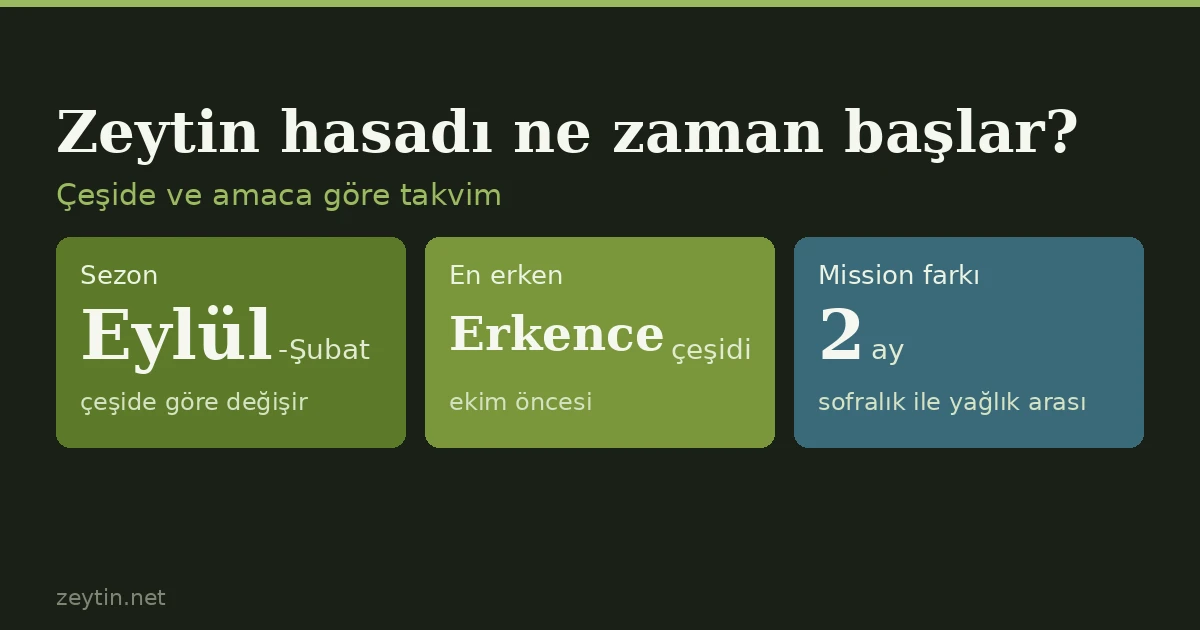
The harvest starts in late September and runs into February. Erkence is earliest, Memecik hangs into mid-December, and Mission's table and oil harvests are two months apart.
Article
When does the olive harvest begin?
The harvest starts in late September and runs into February. Erkence is earliest, Memecik hangs into mid-December, and Mission's table and oil harvests are two months apart.
 Article
Frost damage in olive trees: signs, risk factors and what to do after a frost
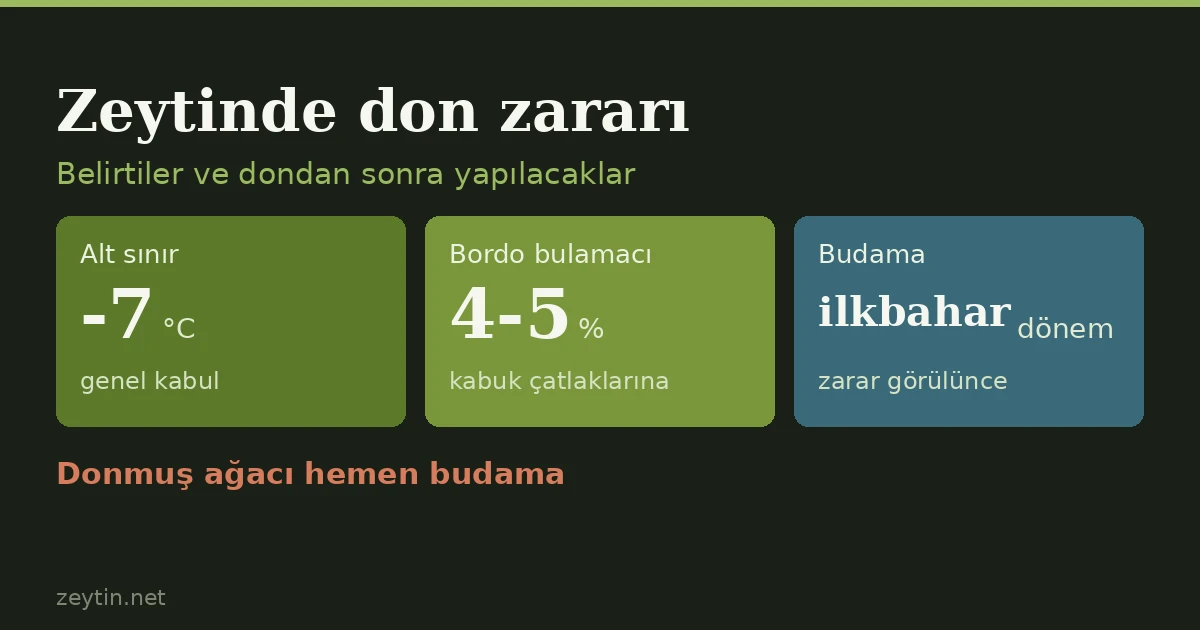
The generally accepted lower limit for olives is around -7 °C, but damage does not depend on the thermometer alone: how long the cold lasts, sudden drops, humidity, tree age and nutrition all matter. Here are the signs of frost damage on leaves, shoots, bark and fruit, ways to reduce the risk and which job to do when after a frost.
Article
Frost damage in olive trees: signs, risk factors and what to do after a frost
The generally accepted lower limit for olives is around -7 °C, but damage does not depend on the thermometer alone: how long the cold lasts, sudden drops, humidity, tree age and nutrition all matter. Here are the signs of frost damage on leaves, shoots, bark and fruit, ways to reduce the risk and which job to do when after a frost.
 Article
Grafting Olives: Changing Cultivar and Improving Wild Trees
When grafting is needed, taking scion wood, bud and cleft methods, topworking and aftercare.
Article
Grafting Olives: Changing Cultivar and Improving Wild Trees
When grafting is needed, taking scion wood, bud and cleft methods, topworking and aftercare.
 Article
Pollination and pollinator varieties in olive
98% of olive flowers drop. Whether the remaining 1-2% holds depends on having a pollinator in the grove. Gemlik is only partially self-fertile: in a single-variety grove harvest falls to a third.
Article
Pollination and pollinator varieties in olive
98% of olive flowers drop. Whether the remaining 1-2% holds depends on having a pollinator in the grove. Gemlik is only partially self-fertile: in a single-variety grove harvest falls to a third.