Milas Oil-Cured Olive: the one table-olive registration with measurements
Five of the six registrations are olive oils. This is the one table olive, and its certificate gives fruit dimensions, flesh-to-stone ratio and flesh firmness in figures.
There is an imbalance among the olive's geographical indications: almost all of them are oils. Milas Oil-Cured Olive is the one registered example from the table side — and in terms of measurement its certificate can be compared directly with the data on our cultivar pages.
The record
| Registration no | 446 |
| Registration date | 21.11.2019 |
| Type | Designation of origin |
| Area | The Milas district of Muğla |
| Cultivar | Memecik |
| Class | Natural brine · whole olive · scored |
What the product is
Ripe olives are debittered in brine and then covered with olive oil of at most 1% free acidity. The "oil-cured" in the name comes from this: the oil is not used to make it but to keep it.
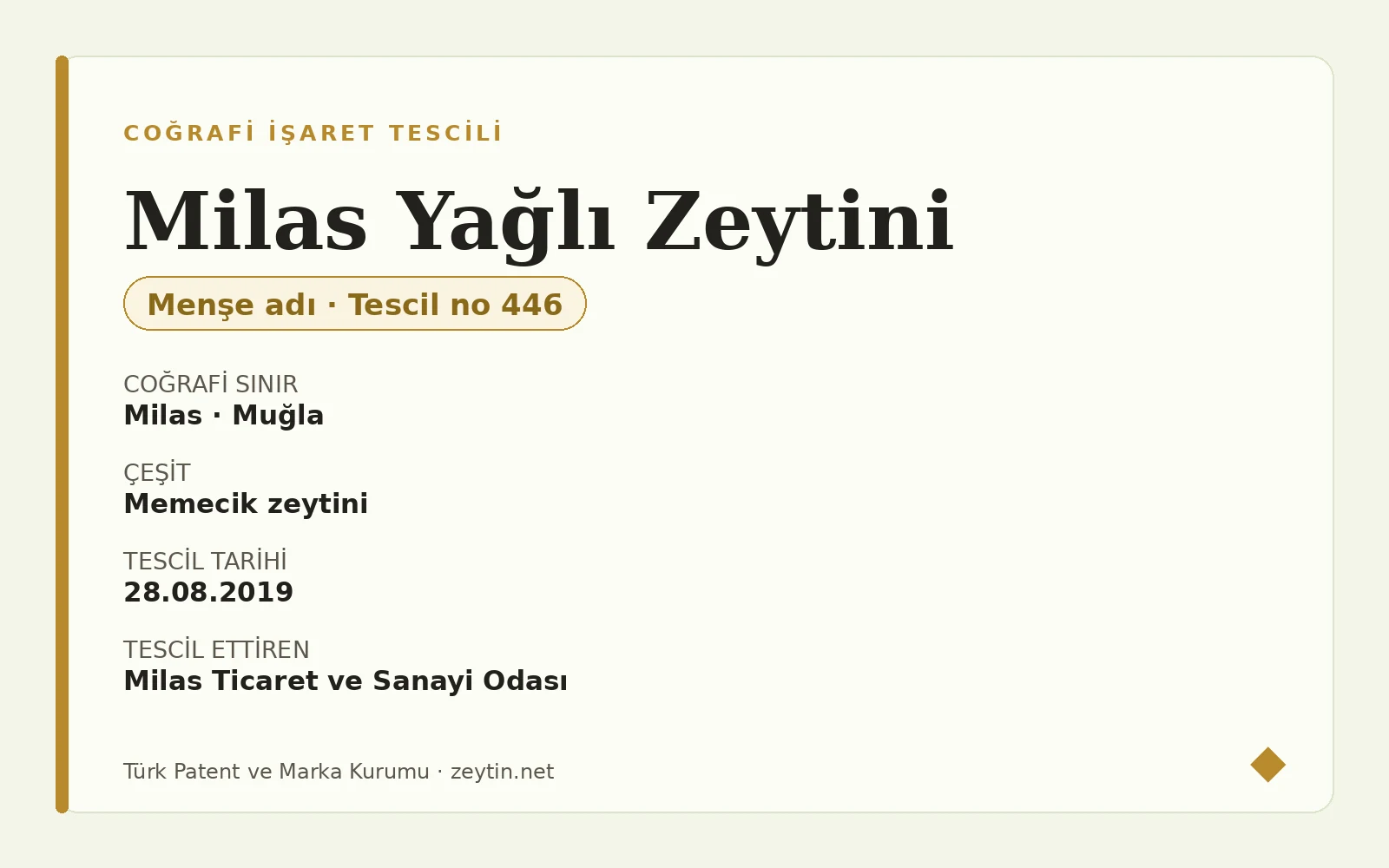
The certificate presents this as a preservation technique: covering the fruit completely with generous oil protects the product's aroma and freshness over time.
Under the Turkish Food Codex the product falls in the turning/pink olive class. We covered that classification in types of table olive.
Measured characteristics
This table is what sets the certificate apart — measurement at this level of detail is rare in a table-olive registration:
| Measurement | Value |
|---|---|
| Fruits per kilogram | 170 – 200 |
| Calibre class | 2XL and 3XL |
| Fruit width | 18.04 ± 1.22 mm |
| Fruit length | 24.72 ± 1.69 mm |
| Stone width | 8.37 ± 0.52 mm |
| Stone length | 16.51 ± 1.58 mm |
| Weight of 10 fruits | 56.00 ± 1.06 g |
| Weight of 10 stones | 8.28 ± 0.20 g |
| Flesh-to-stone ratio | 5.76 ± 0.03 |
| Flesh firmness | 449.4 ± 186 g |
A few notes:
170-200 fruits/kg means a large olive — about 5 to 5.9 g each. For comparison, Gemlik table calibres mostly sit between 200 and 350 fruits per kilogram.
A flesh-to-stone ratio of 5.76 is high for a table olive, and directly comparable with the measurements on our cultivar pages.
The ±186 g spread in firmness is striking, and the certificate does not hide it: "the olives are not of uniform firmness." Separation of flesh from stone is rated moderately difficult in sensory assessment.
Taste and aroma
The dominant tastes are saltiness, bitterness and acidity.
Fruitiness is moderate and citrus-leaning: aromas of bitter orange, orange, mandarin and lemon predominate.
The certificate also sets a defect threshold — abnormal fermentation defects (putrid, zapateria, butyric) and other defects (musty-rancid, soapy, winey, earthy, metallic, cooking effect) must remain at a value of 1.0 in sensory analysis.
Why it turns out this way in Milas
The certificate gives two reasons:
Soil. Milas soil is heavily calcareous, with clay-sand structures alongside alluvium.
Dry farming. Memecik shows pronounced alternate bearing. Until it ripens on the branch the fruit is fed by rainfall alone and needs no irrigation. In the certificate's words, "because it sees little water its quality is high" — limited water yields a moderate but distinct fruity aroma.
For the oil side of the same cultivar: Milas Olive Oil.
In short
Milas Oil-Cured Olive is the only table product among the six registrations. Its certificate defines a table olive in a detail rarely seen: calibre, dimensions, flesh-to-stone ratio and firmness — each with its standard deviation.
The criteria the document binds
The registration does not only protect a name; it defines the product numerically:
| Criterion | Value in the document |
|---|---|
| Total phenolic content | 100 mg/kg |
That the document sets a floor for total phenolic content is notable — most registrations never define phenol levels, although bitterness, pungency and shelf-life behaviour largely depend on them.
Inspection. Members: Milas Ticaret ve Sanayi Odası, Milas İlçe Tarım ve Orman Müdürlüğü, Muğla Sıtkı Koçman Üniversitesi, Milas Meslek Yüksekokulu. Results are reported under Industrial Property Law no. 6769 and submitted to the Turkish Patent and Trademark Office.
The cultivar behind it, measured
The registration is granted to a place, but the cultivar the definition rests on has measurable values:
| Property | Value |
|---|---|
| 1 kg’daki tane sayısı | 210 |
| Et oranı | %88 |
| Et / çekirdek oranı | 5,86 |
| Et/çekirdek oranı | 6,7 |
| Yağ oranı | %25-28 |
| Toplam fenol | 296-407 mg CAE/kg |
| α-tokoferol | 219-324 mg/kg |
| Olgunlaşma | Kasım ortası - aralık ortası |
| Kendine verimlilik | Kısmi |
| Soğuğa dayanım | Orta |
| Kullanım | Yağlık; yeşil ve siyah sofralık olarak da tüketilir |
| Ağaç | yarı dik, kuvvetli |
Oil content reaches 28% at the top of its range — on its own enough to justify pressing. The cultivar is partially self-fertile; pollinators are used to secure yield. A flesh-to-stone ratio of 5.86 is the basic measure of how much of a table olive is actually eaten.
Its place in Muğla's olive production
| Item | Value |
|---|---|
| Fruit production | 174,376 t |
| — for oil | 162,632 t |
| — for the table | 11,744 t |
| Olive oil production | 32,142 t |
| Trees | 14,844 thousand |
| Yield per tree | 11.7 kg |
93% of the province's fruit goes to oil. An oil-based registration matches how the province actually produces.
One rating per visitor; you can change yours at any time. Ratings are real reader votes — no seeded or default scores.
Related
 Article
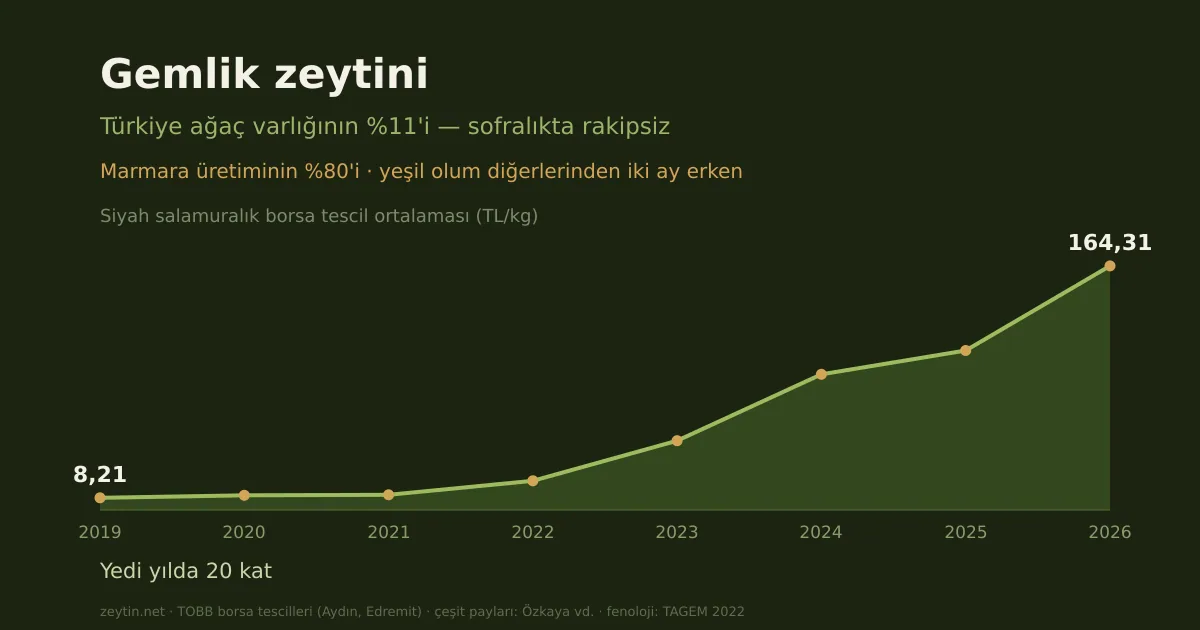
The Gemlik olive: small fruit, six times the flesh
Turkey s only olive cultivar with a geographical indication: 3.7 g fruit, a 6.4 flesh-to-pit ratio, 29-30% oil. Self-fertility measurements, chilling requirement, and why it is still picked by hand.
Article
The Gemlik olive: small fruit, six times the flesh
Turkey s only olive cultivar with a geographical indication: 3.7 g fruit, a 6.4 flesh-to-pit ratio, 29-30% oil. Self-fertility measurements, chilling requirement, and why it is still picked by hand.
 Article
Olives and Olive Oil: Frequently Asked Questions
Does the fridge test work, what separates extra virgin from riviera, can you fry with olive oil? The 18 most common questions, answered briefly.
Article
Olives and Olive Oil: Frequently Asked Questions
Does the fridge test work, what separates extra virgin from riviera, can you fry with olive oil? The 18 most common questions, answered briefly.
 Article
How long does an olive tree live?
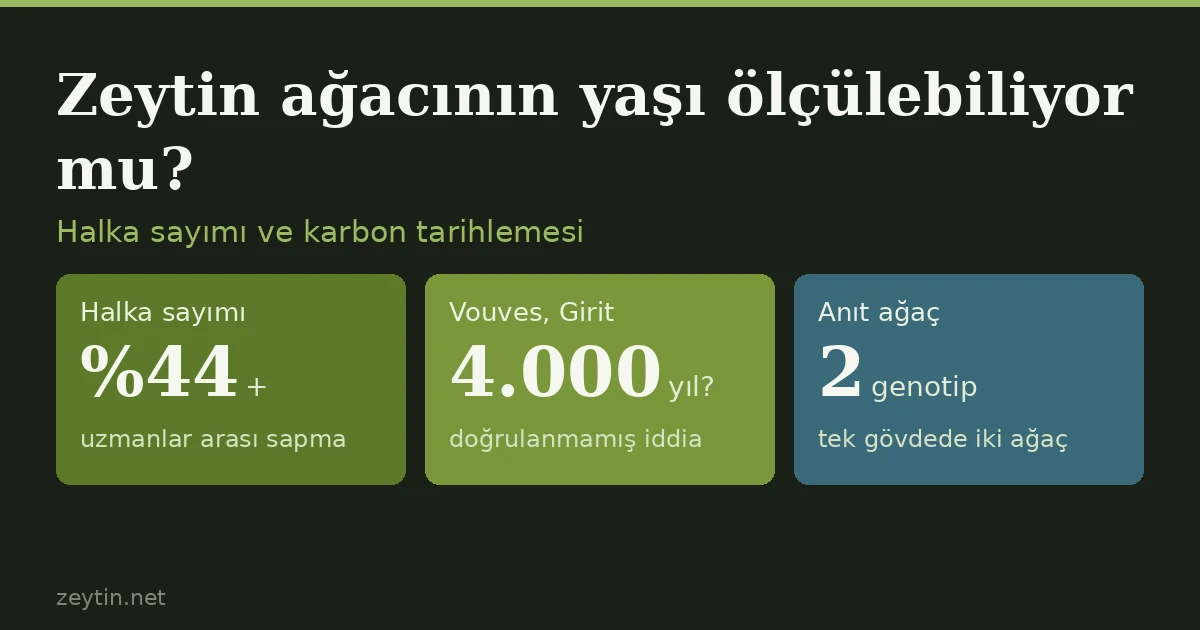
There are plenty of "thousand-year-old olive" signs and almost no measurements. Counting annual rings does not work on olive: when ten experts in five laboratories were given the same samples, their ring counts differed by more than 44%. Radiocarbon dating carries its own trap. So does the tree have a real age limit — and what does it mean that Crete's famous monumental olive turns out to consist of two different genotypes?
Article
How long does an olive tree live?
There are plenty of "thousand-year-old olive" signs and almost no measurements. Counting annual rings does not work on olive: when ten experts in five laboratories were given the same samples, their ring counts differed by more than 44%. Radiocarbon dating carries its own trap. So does the tree have a real age limit — and what does it mean that Crete's famous monumental olive turns out to consist of two different genotypes?
 Article
Which provinces in Turkey grow no olives?
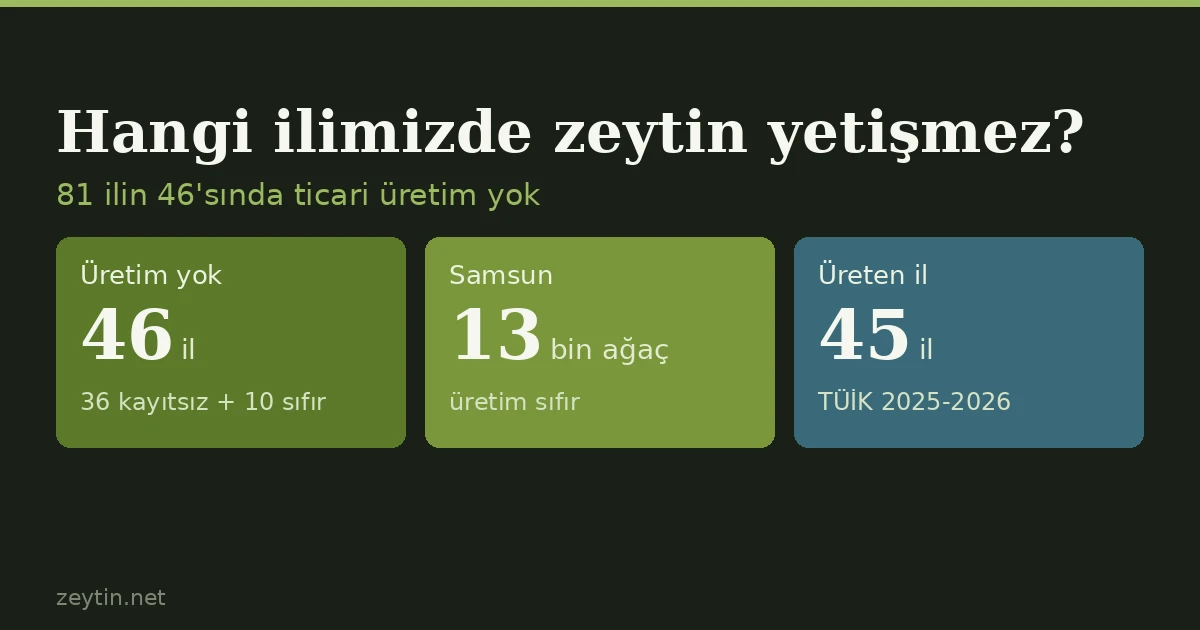
Forty-six of Turkey's 81 provinces have no commercial olive production: 36 absent from the statistics, ten reporting zero. Samsun has 13,000 trees and no crop.
Article
Which provinces in Turkey grow no olives?
Forty-six of Turkey's 81 provinces have no commercial olive production: 36 absent from the statistics, ten reporting zero. Samsun has 13,000 trees and no crop.