How long does an olive tree live?
There are plenty of "thousand-year-old olive" signs and almost no measurements. Counting annual rings does not work on olive: when ten experts in five laboratories were given the same samples, their ring counts differed by more than 44%. Radiocarbon dating carries its own trap. So does the tree have a real age limit — and what does it mean that Crete's famous monumental olive turns out to consist of two different genotypes?
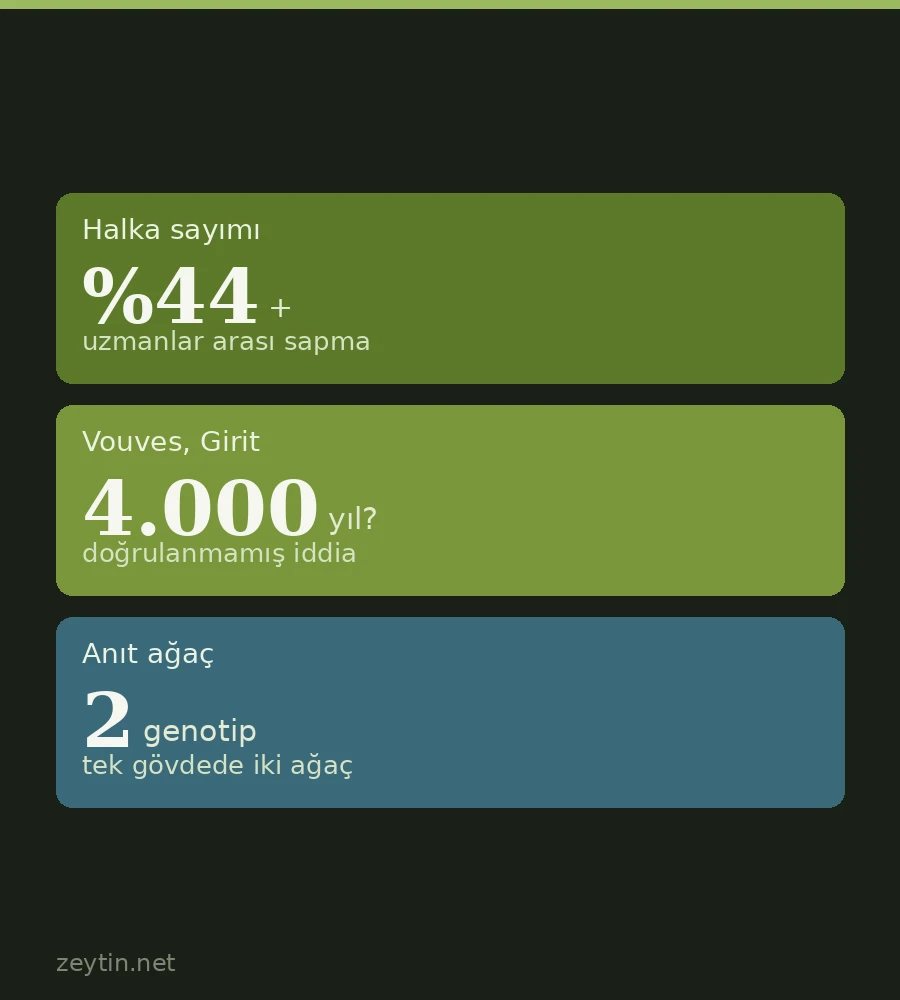
The short answer is nobody knows — and that is not a gap in the literature but a problem with the act of measuring. There is no practical, reliable way to determine the age of an olive tree. Every "1,000-year-old" or "2,000-year-old" figure in circulation is an estimate, and most are rough extrapolations from trunk circumference.
There are things we do know, however, and they lead to a better version of the question.
Counting rings does not work on olive
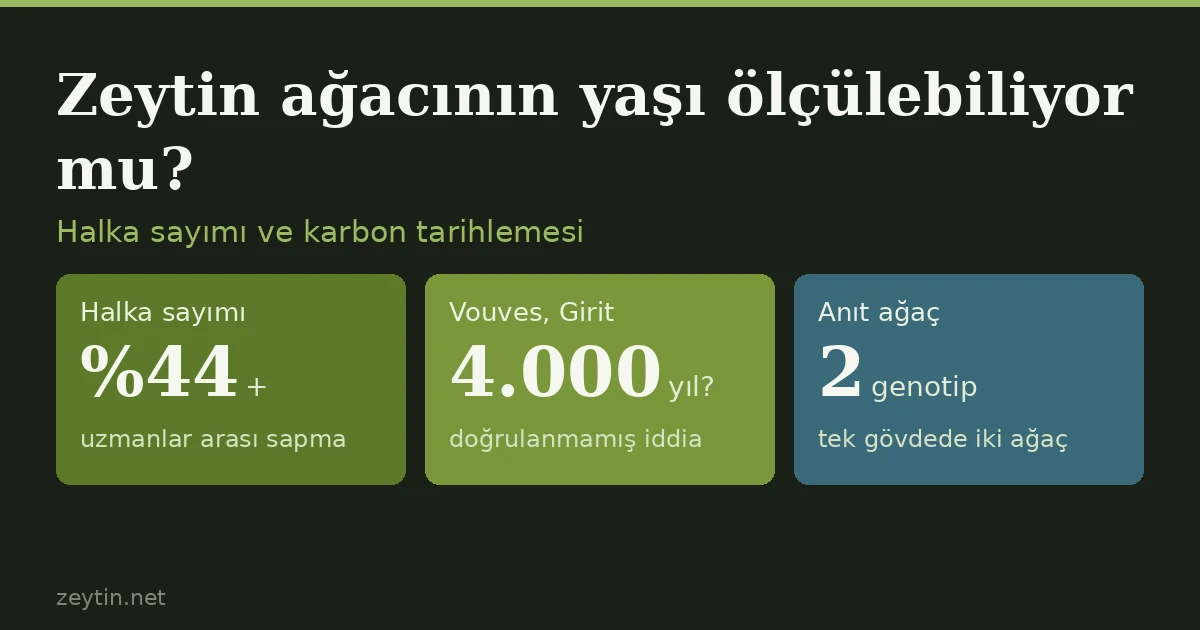
The method that comes to mind first for tree age is counting annual rings in a cross-section. On olive, that method collapses. A study by Cherubini and colleagues, published in PLoS ONE in 2013, tested this directly with samples from olive trees growing on Santorini: the same samples were given to ten experts in five different tree-ring laboratories, and the ring counts they arrived at differed by more than 44%.
The study lists the reasons:
- Intra-annual density fluctuations. Olive wood densifies and loosens more than once within a single year, and those fluctuations look like rings.
- Unclear ring boundaries. The structure of the boundary varies from tree to tree, and even from place to place within one cross-section.
- Sectoral cambial activity. In olive, the cambium is active not around the whole circumference but in shifting sectors of it. The consequence: ring sequences counted along two different radii of the same cross-section do not agree.
Olive, in other words, is not a tree that writes one ring per year the way pine or oak does. We dealt with this behaviour of the wood separately in the properties of olive wood.
Radiocarbon does not rescue it either
If rings fail, radiocarbon is the fallback. On olive it is squeezed from two directions.
First, the trunks of old olives go hollow: the tree's oldest wood decays and disappears over time. The centre you would want to date is no longer there. When we visited the monumental trees of Edremit we noted that all four were hollow — the trunk of the Kavaktarla olive, reckoned the oldest of them, measures 7.20 metres in circumference, and the 1,100 years given for its age is an estimate, not a measurement.
Second, the date of the outer wood can mislead. A study published in Scientific Reports in 2018 questioned the assumption that the outermost part of olive wood is contemporaneous with the tree's final growth year: dating that outer wood can yield a result corresponding to a point some 40 to 50 years earlier than the moment the tree actually died.
Crete's famous tree is really two trees
The Vouves tree in Crete, presented as the world's oldest producing olive, is usually described as "more than 4,000 years old." The genetic study published in Plants in 2021 does not confirm that figure — nor does it set out any method for how the age was calculated; it simply relays the number as an existing assumption.
What the same study did find is far more interesting: the tree is not one plant but two genotypes. The upper part, the scion, shows a relationship with the Greek cultivar Mastoidis of roughly the order of half-siblings, while the trunk below groups together with wild olive (oleaster) samples. The monument, in other words, is a tree grafted onto a wild rootstock.
That blurs the question of age. Which is the one growing old, the rootstock or the scion? Grafting does not reset a tree's age to zero, but the tissue above and the tissue below are not the same age either. In rooting cuttings and wild rootstock we described how those two layers carry separate histories.
The tree does not die; the trunk is replaced
The secret of the olive's longevity is not the durability of its trunk but its capacity for renewal from the base. New shoots emerge from dormant buds at the root collar; even when the main trunk rots and collapses, the tree rebuilds itself from those shoots. The same mechanism operates after frost, fire or felling.
The consequence is this: the trunk of an old olive is usually younger than the tree itself. Biologically, what stands there is less a single individual than a clonal continuity maintained by the same root system. "This tree is a thousand years old" means, at its most defensible, "this root has been here for a thousand years."
The general structure of the tree and this renewal behaviour are covered in Olea europaea, the botany of the olive tree, and the domestication story of the species in where olives came from.
Why estimating age from trunk circumference stays crude
The common field method is to measure trunk circumference and divide by an annual thickening rate. The logic is simple, and that is where the problem sits: in olive, the annual rate of thickening is not constant.
The same variety thickens noticeably faster in an irrigated grove than its counterpart in a rainfed one. Pruning regime, canopy load, soil depth and harvest method also shift that rate from year to year. Using a single coefficient therefore means measuring two trees grown under different conditions with the same ruler.
Two further things make a circumference reading larger than the wood warrants. The first is hollowing: as the inside of the trunk decays and empties, the remaining shell of wood and bark spreads outward, so circumference grows while wood mass does not. The second is trunk fusion: several shoots rising from the base merge over the years into what looks like one broad trunk. On such a tree, the circumference you measure describes not the years of one trunk but the sum of several shoots.
For these reasons, ages derived from circumference tend to be biased upward. The measurement itself is valuable — trunk circumference is the basic record in monumental-tree inventories — but it should be read with a wide margin of error when converted into years.
How long does a potted olive live?
In a pot, lifespan is determined less by the biology of the species than by the volume of the container. When root volume is restricted the tree stays small, but that does not make it short-lived; as long as the soil is renewed, roots are pruned and the plant is kept from freezing, a potted olive lives for decades. What actually kills these trees in practice is not age but root rot in winter wet and years-old exhausted potting mix. We gathered the care items in caring for an olive tree in a pot.
The lifespan that matters in practice: the economic one
For a grower, "how long does it live" gives way to "how long does it produce," and that has a clearer answer:
- A sapling begins bearing in its third to fifth year.
- The yield plateau usually arrives after the tenth year.
- A well-tended tree can stay in production for centuries; groves well over a hundred years old are still harvested in the Aegean and the southeast.
- Declining yield usually comes not from age but from delayed pruning, tired soil or lack of water. Rejuvenation pruning can return an old tree to production — we described the method in the pruning article.
The decision to renew a grove is a separate calculation: pulling out an olive grove is a ten-year decision, because new planting cannot match the old grove's yield for that long. We set out that arithmetic with figures in felling an olive grove.
And if we insist on a number
The honest range is this: as long as it is cared for, an olive tree can keep producing for centuries, and the upper limit of that has never been measured. Figures of a thousand years and beyond are estimates; some are reasonable, some are for the tourists. If you see an age on a sign, there is only one question worth asking: what was that number measured with? If the answer is ring counting, the 44% spread above is worth remembering.
If you are curious about the tree's journey through history, the history of the olive tree and the olive tree pages offer a wider frame.
One rating per visitor; you can change yours at any time. Ratings are real reader votes — no seeded or default scores.
Related
 Article
Table Olives: Types, Curing and How to Choose
From green to black, cracked to dry-cured: how table olives are made, chosen and kept.
Article
Table Olives: Types, Curing and How to Choose
From green to black, cracked to dry-cured: how table olives are made, chosen and kept.
 Article
The Olive Harvest: When and How
Early harvest or late? The timing of picking directly determines the oil's acidity, polyphenols and yield.
Article
The Olive Harvest: When and How
Early harvest or late? The timing of picking directly determines the oil's acidity, polyphenols and yield.
 Article
Akhisar Uslu Olive: the measured specification of a black table olive
Registered in 2010 as a designation of origin. The certificate defines the Uslu cultivar in figures — and corrects a published error: the flesh ratio is 85.17%.
Article
Akhisar Uslu Olive: the measured specification of a black table olive
Registered in 2010 as a designation of origin. The certificate defines the Uslu cultivar in figures — and corrects a published error: the flesh ratio is 85.17%.
 Article
Sarı Ulak olive: characteristics, oil content and growing areas
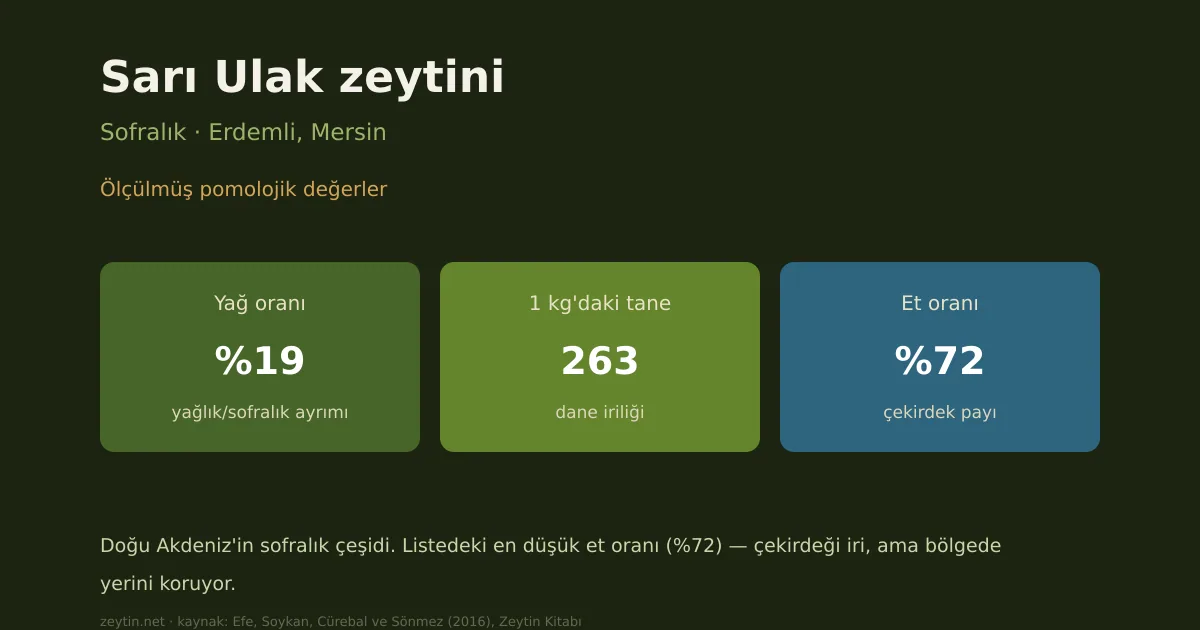
The eastern Mediterranean's table variety. The lowest flesh ratio on the list (72%) — a large stone, yet it holds its ground.
Article
Sarı Ulak olive: characteristics, oil content and growing areas
The eastern Mediterranean's table variety. The lowest flesh ratio on the list (72%) — a large stone, yet it holds its ground.