Muğla Commodity Exchange proposes a nationwide olive oil promotion campaign to TOBB: aim is to lift domestic consumption, roadmap requested by Hisarcıklıoğlu
The Muğla Commodity Exchange proposed to TOBB President Rifat Hisarcıklıoğlu a nationwide promotion effort to lift domestic consumption of olive oil, whose export prices remain low. The report says he received it positively and asked for a roadmap; the budget, timetable and format are not given.
After completing their chamber and exchange elections, the heads of Muğla's chambers of commerce and commodity exchange paid a visit to Rifat Hisarcıklıoğlu, President of the Union of Chambers and Commodity Exchanges of Türkiye (TOBB). According to reports dated 19 November 2026, the part of the meeting that concerns the olive sector was a proposal from the Muğla Commodity Exchange: a nationwide "Olive Oil Promotion Campaign" to raise domestic consumption of olive oil, whose export prices remain at low levels.
What the report says
| Item | What the report says |
|---|---|
| Who made the proposal | Hurşit Öztürk, Chairman of the Board, and Uğur Özen, Assembly Chairman, of the Muğla Commodity Exchange |
| Addressed to | TOBB President Rifat Hisarcıklıoğlu |
| Content of the proposal | A nationwide olive oil promotion effort; wider use of olive oil among citizens, starting with public institutions |
| Reasoning | Export prices staying low; olive oil consumption in Türkiye being quite low |
| TOBB's response | The proposal was received positively; a roadmap was requested so the project can start as soon as possible |
| Organisations at the visit | Chambers of commerce and industry of Muğla, Milas and Fethiye; chambers of commerce of Marmaris and Bodrum; the Muğla Commodity Exchange |
What exactly is being proposed?
The Muğla Commodity Exchange leaders stressed that olive growers should not suffer losses and must be able to market their crop. They said that, under current conditions, one of the most important steps is to increase Türkiye's low olive oil consumption. In the wording of the report, public institutions are the first address of this effort, so wider use of olive oil by the institutions themselves is counted among the targets. How a campaign would be run, who would pay for it and when it would begin are not in the report.
What the consumption figures show
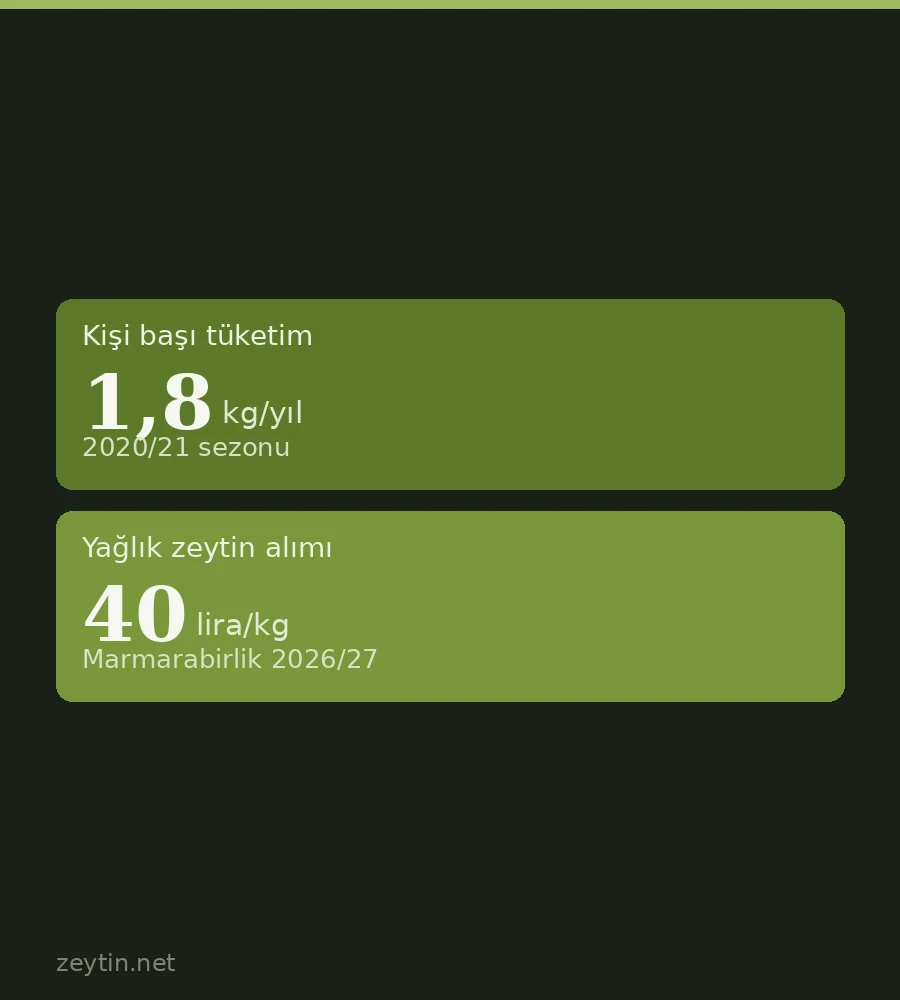
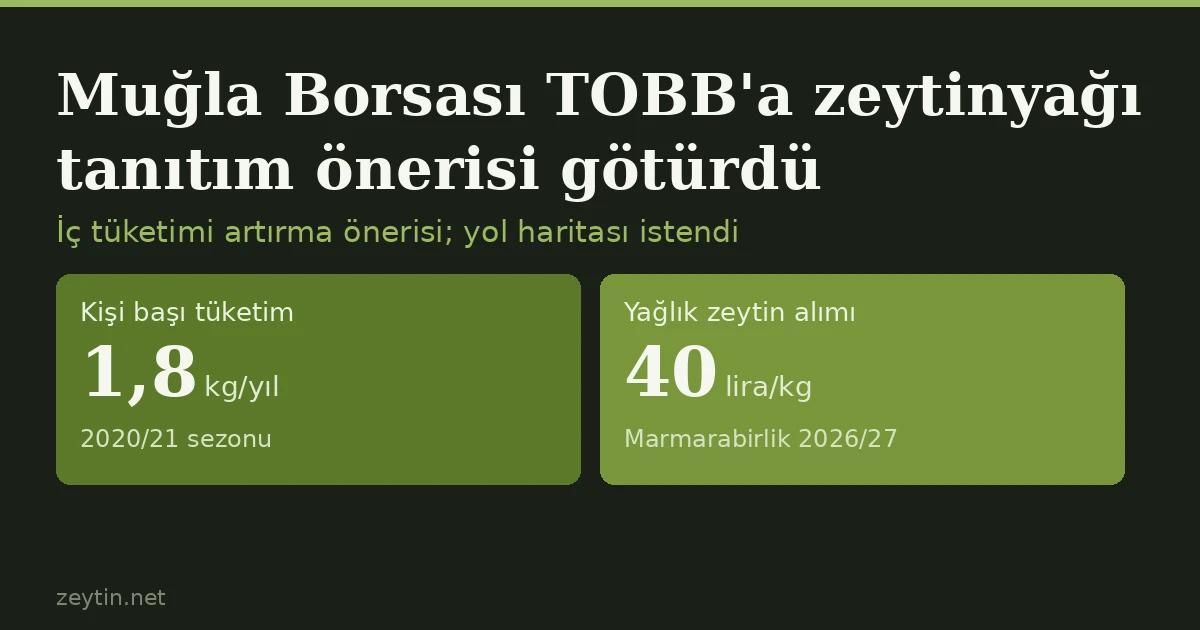
The finding that consumption is low matches data we have published before. In our article on per-capita olive oil consumption, a report from the institute attached to the Ministry of Agriculture and Forestry, based on International Olive Council data for the 2020/21 season, puts Türkiye at 1.8 kilograms per person per year, against 11.4 in Spain, 10.3 in Greece and 2.5 in Tunisia. Total consumption in the same article's series swings between 105,000 and 177,000 tonnes.
On the production side there is the expectation of the National Olive and Olive Oil Council (UZZK): its chairman, Dr. Mustafa Tan, said they expect 4.03 million tonnes of olives and 588,000 tonnes of olive oil in 2026/27 (details). Because the consumption series belongs to earlier seasons and the production expectation to the new one, we do not divide one by the other to produce a ratio. Still, putting the magnitudes side by side suggests that the domestic market will not find it easy to absorb the whole crop of the new season.
Why is consumption low?
The same article suggests that the problem may have more to do with price than with habit. According to the report's data on table olives, per-capita table olive consumption in 2020/21 was 3.9 kilograms in Türkiye against 3.5 kilograms in Spain: olives are on the table, but the oil is not. The article notes that sunflower, corn oil and margarine are sold at roughly half the price of olive oil. In our retail measurement on 8 October 2026, the average shelf price of extra virgin olive oil across 24 products was 423 lira per litre. A promotion effort can raise awareness but cannot close a price gap, so the effect of the proposal may depend on whether a campaign would also address price. That last sentence is our own assessment and is not in the report.
What it means on a daily scale
Annual consumption of 1.8 kilograms works out to about 5 grams a day. In the Mediterranean diet studies discussed in our daily amount article, the regular consumption range usually falls around 20-40 grams a day. An average consumer sitting far below that range helps explain why promotion efforts target the domestic market; but this is a national average, and households that use olive oil every day are far above this figure.
The price side
The timing of the proposal is also notable. In the Marmarabirlik 2026/27 purchase list, oil olives fell from 53 to 40 lira. UZZK chairman Tan had said that the cost of a kilogram of olive oil is 240-280 lira, while the purchase price stays at 170-200 lira. Against this background, the promotion proposal appears as a way to widen demand rather than to push prices up directly. What effect such a campaign would have on prices cannot be said today.
What the report does not contain
- The campaign's budget, timetable, responsible institution and content (advertising, public procurement and so on).
- TOBB's own statement; the positive reception and the roadmap request are reported in the words of the Muğla delegation.
- A figure supporting the finding that export prices are low; the report gives no export unit price.
- Which types or brands of olive oil would be featured in a promotion effort.
Why this matters
So far this season's agenda has been discussed through prices, costs and queues in front of mills. This report is a reminder that the problem also has a demand leg: if production grows while per-capita consumption stays flat, the surplus has to go to exports and storage. Whether the proposal becomes reality depends on when the roadmap is prepared and which institutions take part; once those are announced, we will update this report. For readers outside Türkiye: TOBB is the umbrella body of the country's chambers of commerce and commodity exchanges, so a request for a roadmap from its president is a procedural step, not a decision to fund a campaign.
One rating per visitor; you can change yours at any time. Ratings are real reader votes — no seeded or default scores.
Related
 Article
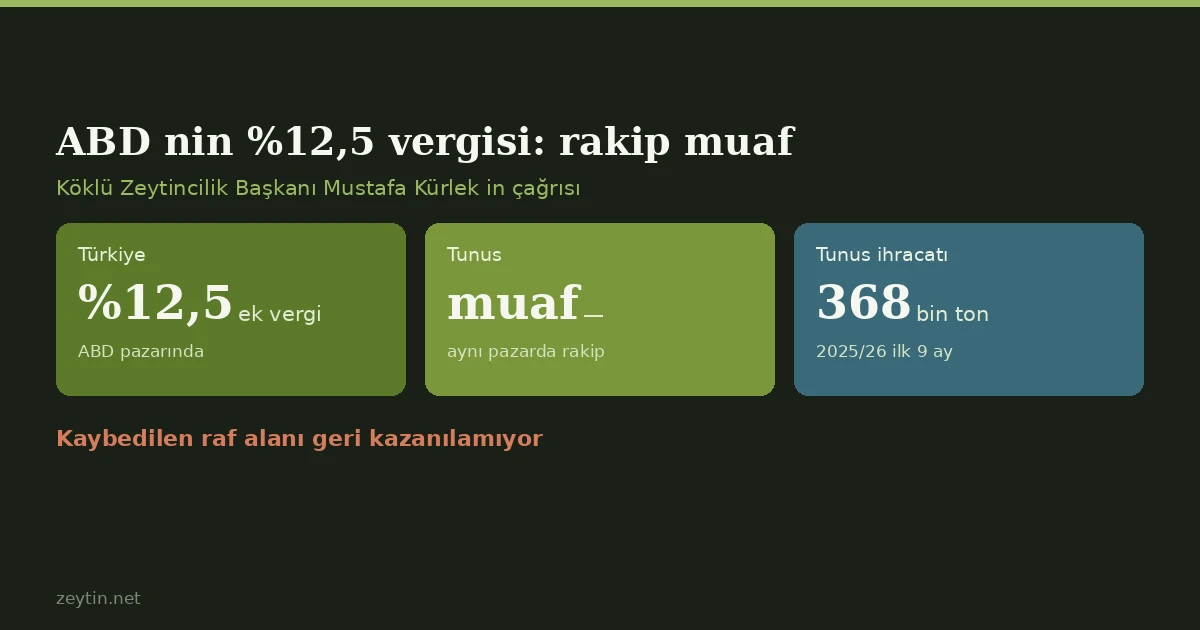
The 12.5% US tariff: the competitor is exempt, the Turkish exporter is not
Mustafa Kürlek notes the 12.5% additional US tariff on Turkish olive products is not applied to competitors such as Tunisia, and calls for DFİF and Eximbank measures.
 Article
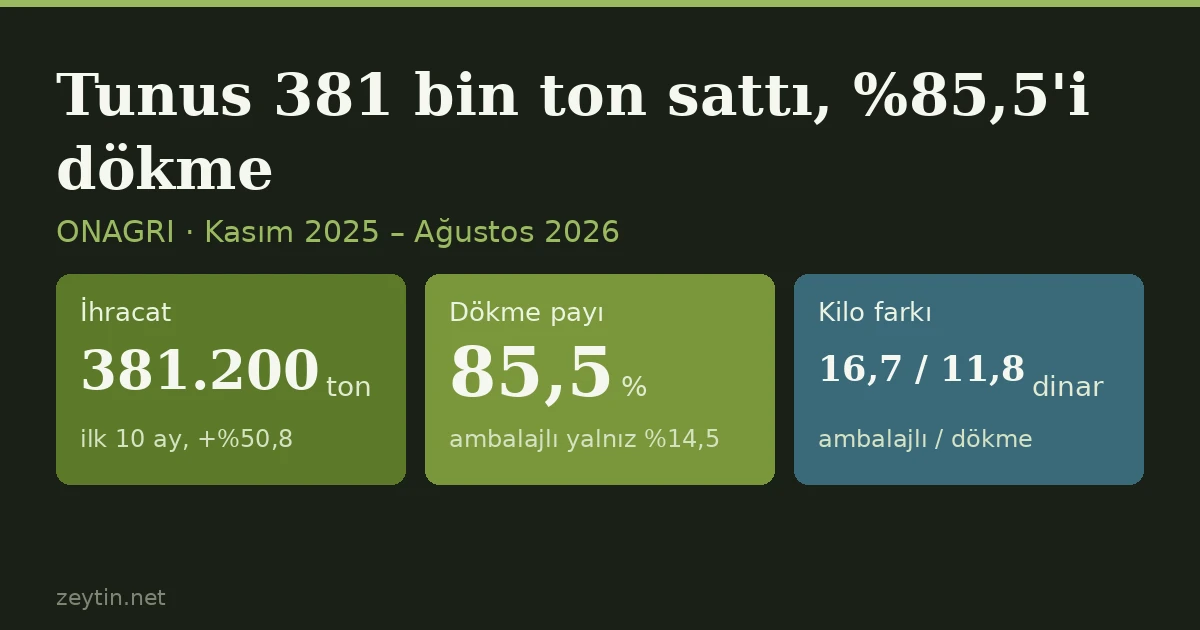
Tunisia sold 381,000 tonnes of olive oil in ten months: 85.5% in bulk, half of it to Spain and Italy
According to the National Observatory of Agriculture (ONAGRI), Tunisia exported 381,200 tonnes of olive oil in the first ten months of the 2025/26 season — volumes up 50.8% and receipts up 41.2% year on year. But 85.5% of it left the country in bulk, and more than half went to Spain and Italy. Packaged oil averaged 16.7 dinars per kilo against 11.8 for bulk. Production is set to fall 40% next season, which changes the bulk market Turkish exporters face.
 Article
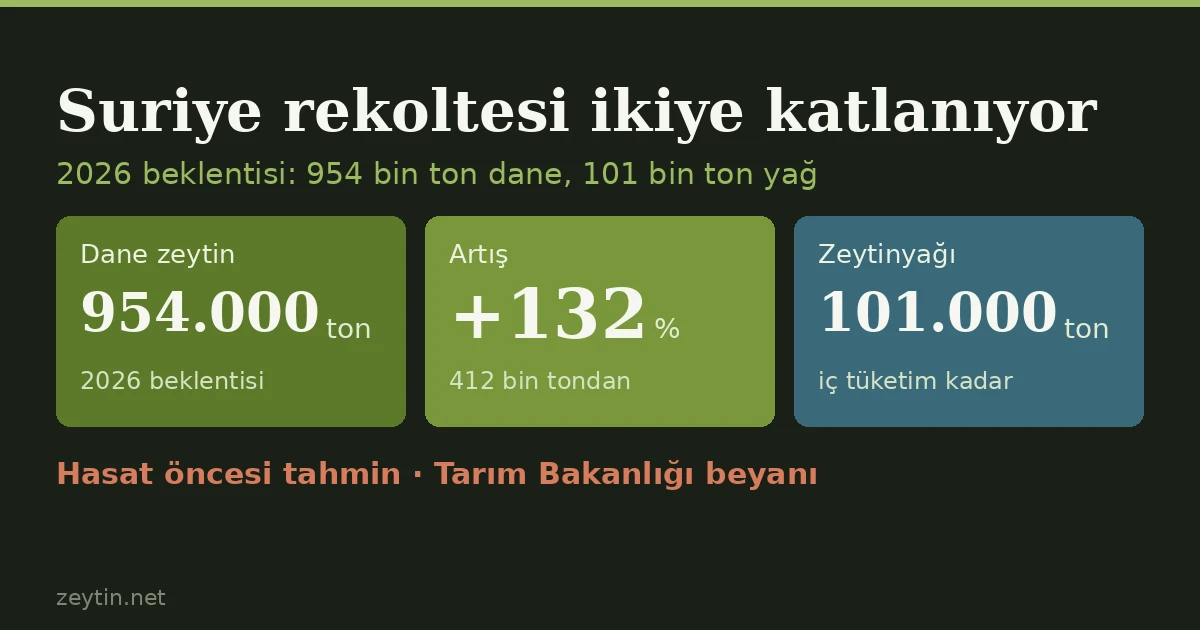
Syria's crop doubles to 954,000 tonnes — and the oil still only feeds itself
Syria's Ministry of Agriculture expects 954,000 tonnes of olives in 2026, up from 412,000 last season. The 101,000 tonnes of oil that implies barely covers domestic consumption — a doubled crop that still produces no export surplus.
 Article
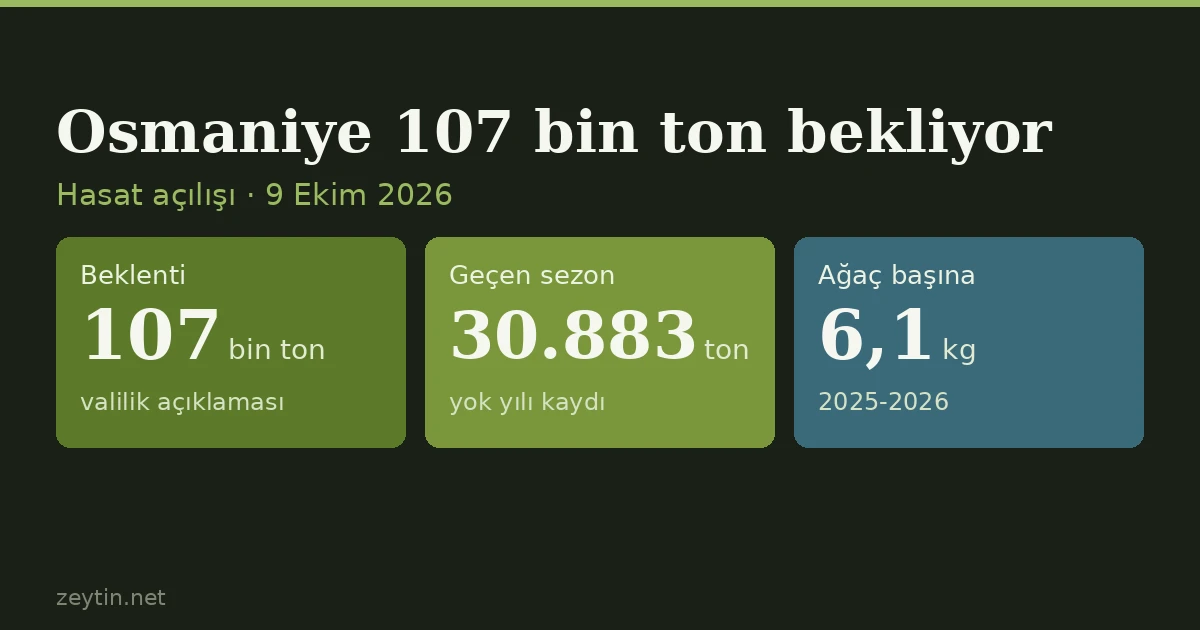
Osmaniye expects 107,000 tonnes: 3.5 times last season, in line with on-year averages
The governor's office in Osmaniye says the province's roughly 10 million olive trees are expected to yield more than 107,000 tonnes this year. That is 3.5 times last season — but 2025-2026 was an off year, and the forecast is consistent with on-year yields. Small discrepancies remain in tree counts and ranking.