Arbequina olive: Spain's oil variety
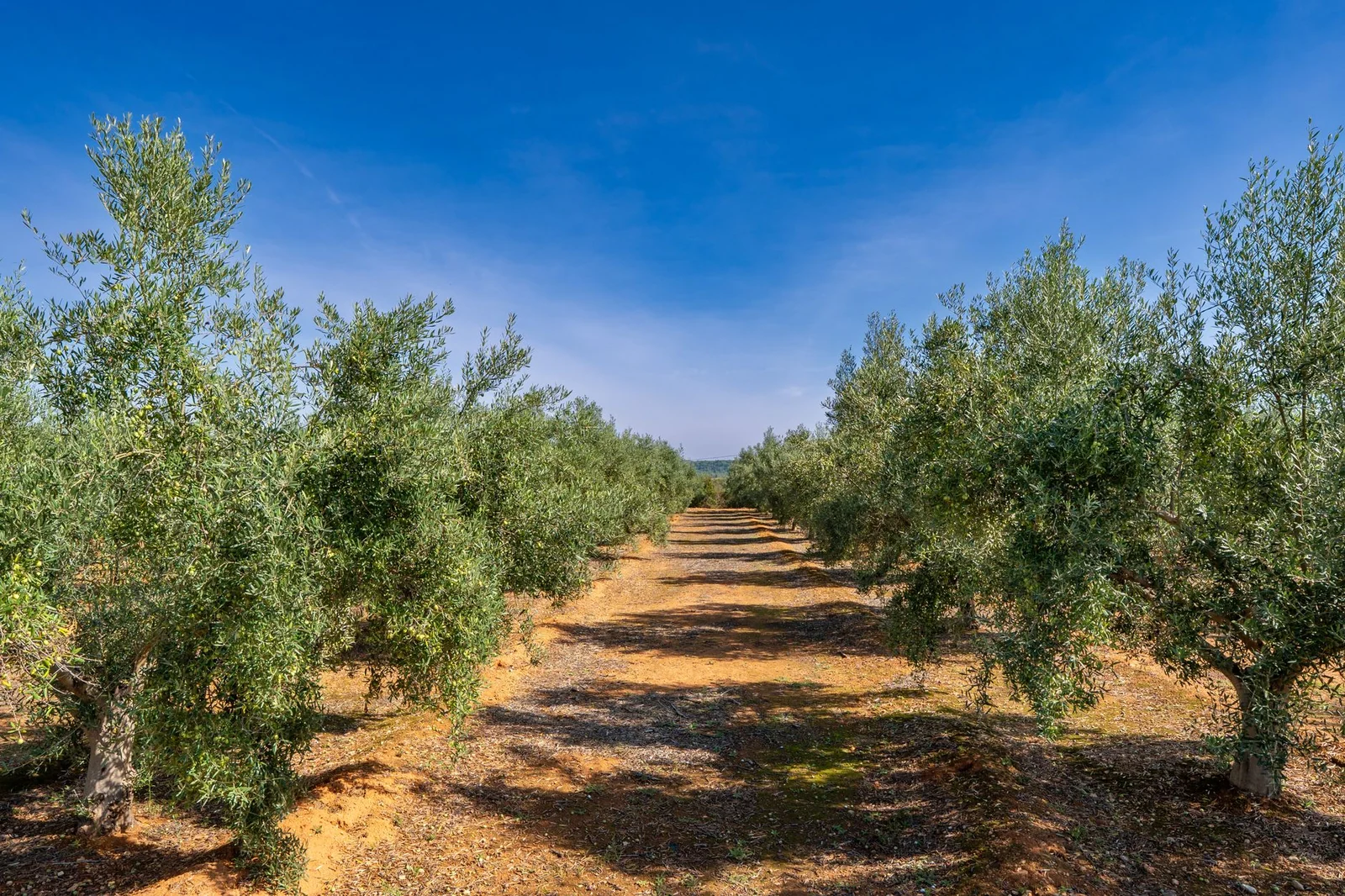
The mainstay of super-high-density planting. Small canopy, small fruit, early bearing — the variety that changed modern olive growing.
The biggest break in modern olive growing came not from a machine but from a variety: Arbequina. Super-high-density planting — 1,500 to 2,000 trees per hectare, harvested by machine — was not possible without it.
Why is being small an advantage?
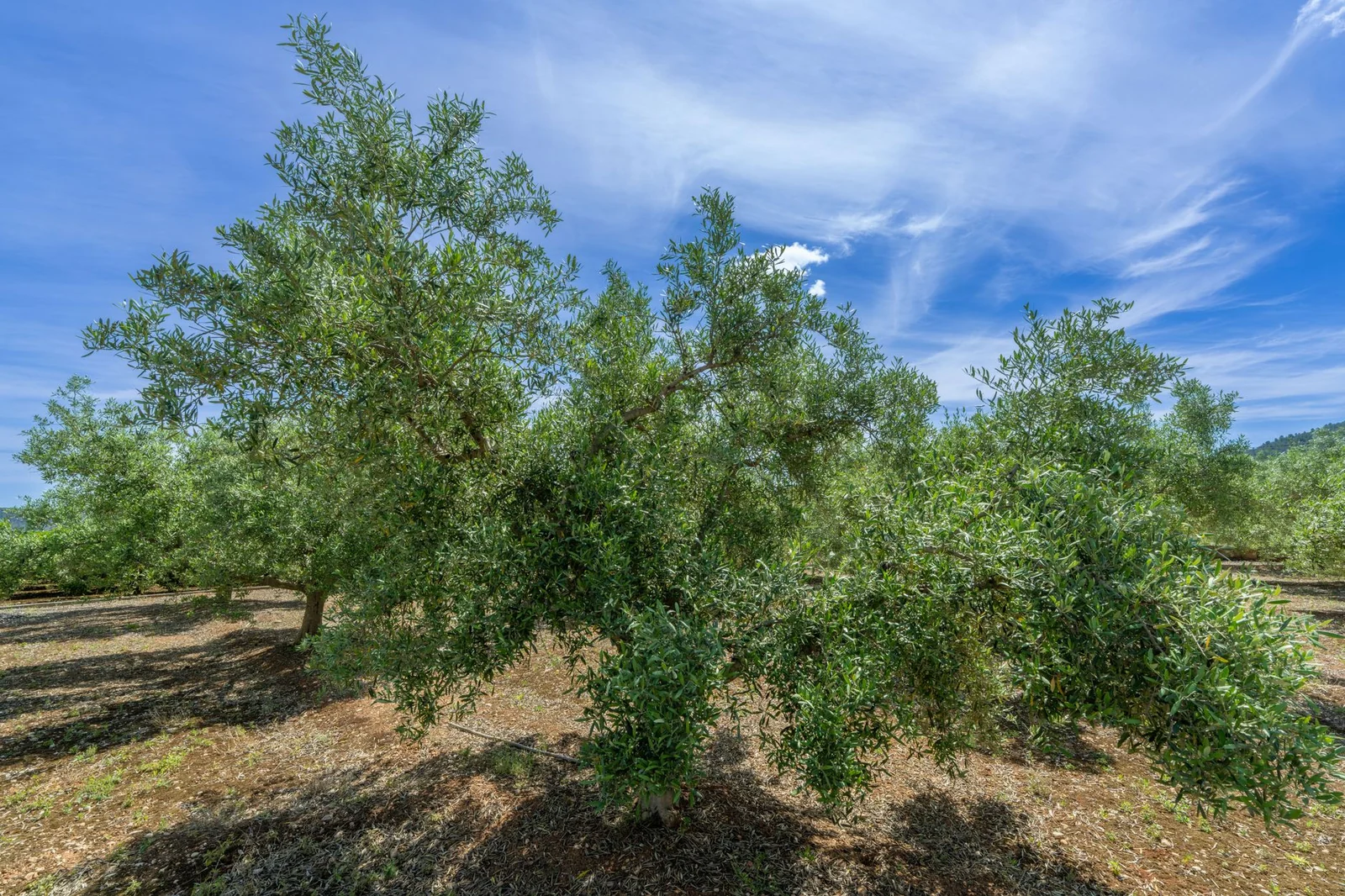
In a traditional grove the tree is large, the canopy spreads wide, and harvest is done by pole or by hand. Arbequina's advantage is the opposite of all that:
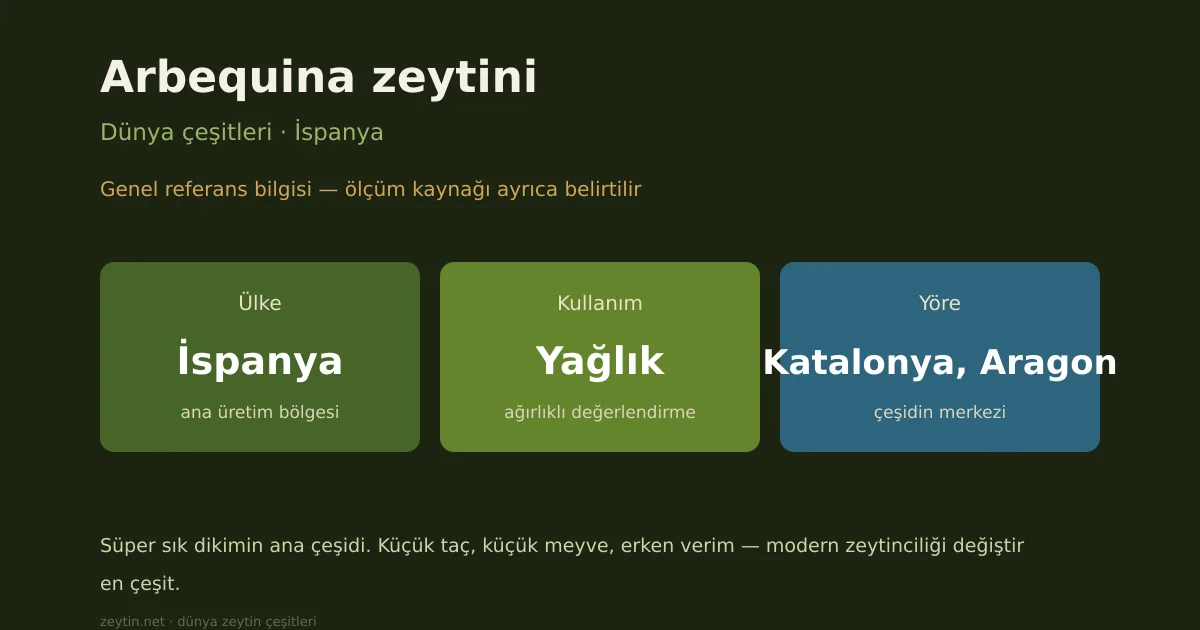
- A small, upright canopy — it can be planted in rows, like a vineyard.
- Early bearing — it starts cropping in the third year after planting; traditional varieties take six to eight.
- Small fruit — suited to over-the-row harvesters.
A measurement made in Türkiye puts numbers to that smallness. Compared against nine Turkish varieties in Çukurova University's germplasm collection, Arbequina IRTA-18 showed:
| Fruit weight | 1.09 g |
| Fruit length | 13.10 mm |
| Fruit width | 11.43 mm |
| Fruit shape index | 1.15 (round) |
| Flesh weight | 0.83 g |
| Flesh ratio | 76% |
| Pit weight | 0.27 g |
| Flesh-to-pit ratio | 3.07 |
| Soluble solids | 13.4% Brix |
| Chilling requirement | 289 chill units (459 hours) |
Source: Gündeşli and Küden (2020). Arbequina had the smallest fruit in the trial; for comparison, Karamürsel Su measured 34.83 mm in length — nearly three times as long.
What is the oil like?
Arbequina oil is mild, fruity and low in bitterness, with almond and apple notes commonly described. That places it at the opposite pole from Picual and Coratina.
The commercial consequence: Arbequina is the entry point for consumers who find olive oil harsh, which is why it spread so quickly on the world market. But the same mildness means low polyphenols — its shelf life does not match Picual's.
What it means for Türkiye
On chilling requirement, Arbequina fell into the same group as Gemlik and below Memecik. It can therefore grow along Türkiye's temperate coastal belt.
Super-high-density planting is being tried in Türkiye too; on the economics of spacing: Planting density: how many trees per decare?
The economics of dense planting
Arbequina's real claim is not yield but how fast the money comes back. A comparison in Morocco's unirrigated Haouz region measured it directly:
| Moroccan Picholine (semi-dense) | Arbequina (super-high-density) | |
|---|---|---|
| Trees per decare | 27.7 | 133 |
| Oil content | 20.63% | 17.84% |
| Payback period | 15 years | 8 years |
Source: Hmida (2010), cited in Atmaca and Ülger, Zeytin Bilimi. Note that Arbequina's oil content came out lower. The gain in super-high-density planting does not come from oil in the fruit; it comes from the number of trees per decare and from bearing early.
That is the whole argument about spacing: picking a high-oil variety is one thing, taking a lot of oil off a decare is another. More: planting density — how many trees per decare?
The list of varieties proven in this system is short. In Spanish screening trials Arbequina IRTA-18 and Arbosana came out as the two best suited, with Greek Koroneiki third. Most of the Italian varieties tested — Coratina, Frantoio, Leccino — were not found suitable.
Related pages
Where it stands among measured varieties
çeşit sayfası
çeşit sayfası
çeşit sayfası
çeşit sayfası
çeşit sayfası
Values are those published on each variety's own page; the comparison covers only varieties with a measured figure, so it is a comparison of what is known — not of every Turkish variety. See the full ranking and how it is built →
One rating per visitor; you can change yours at any time. Ratings are real reader votes — no seeded or default scores.
Related
 Article
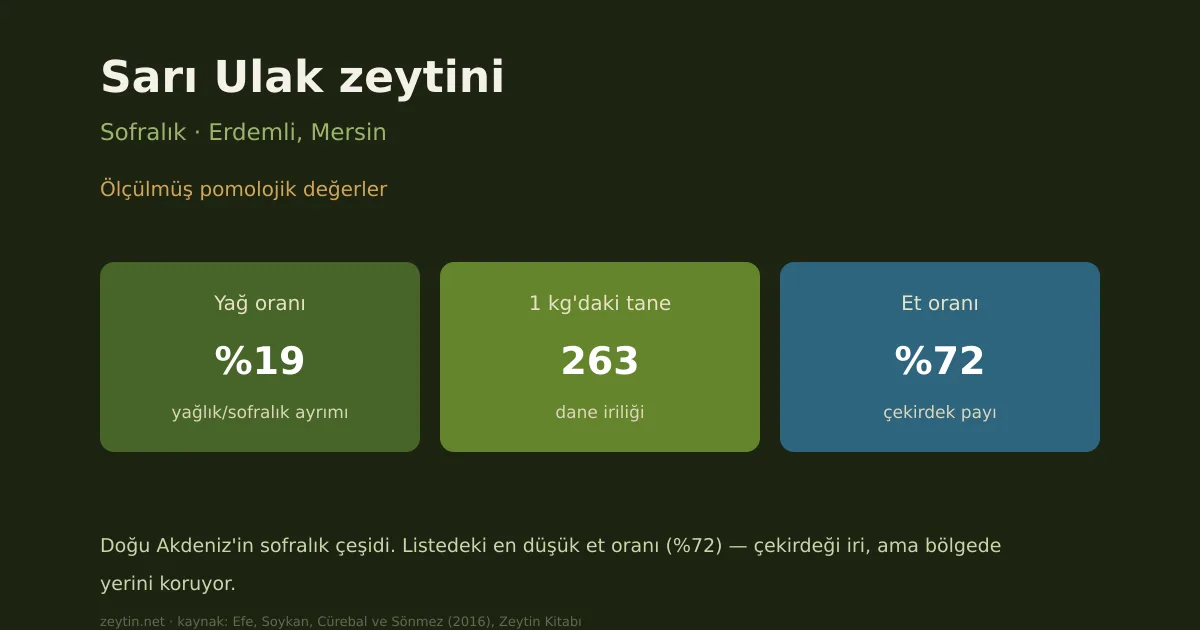
Sarı Ulak olive: characteristics, oil content and growing areas
The eastern Mediterranean's table variety. The lowest flesh ratio on the list (72%) — a large stone, yet it holds its ground.
 Article
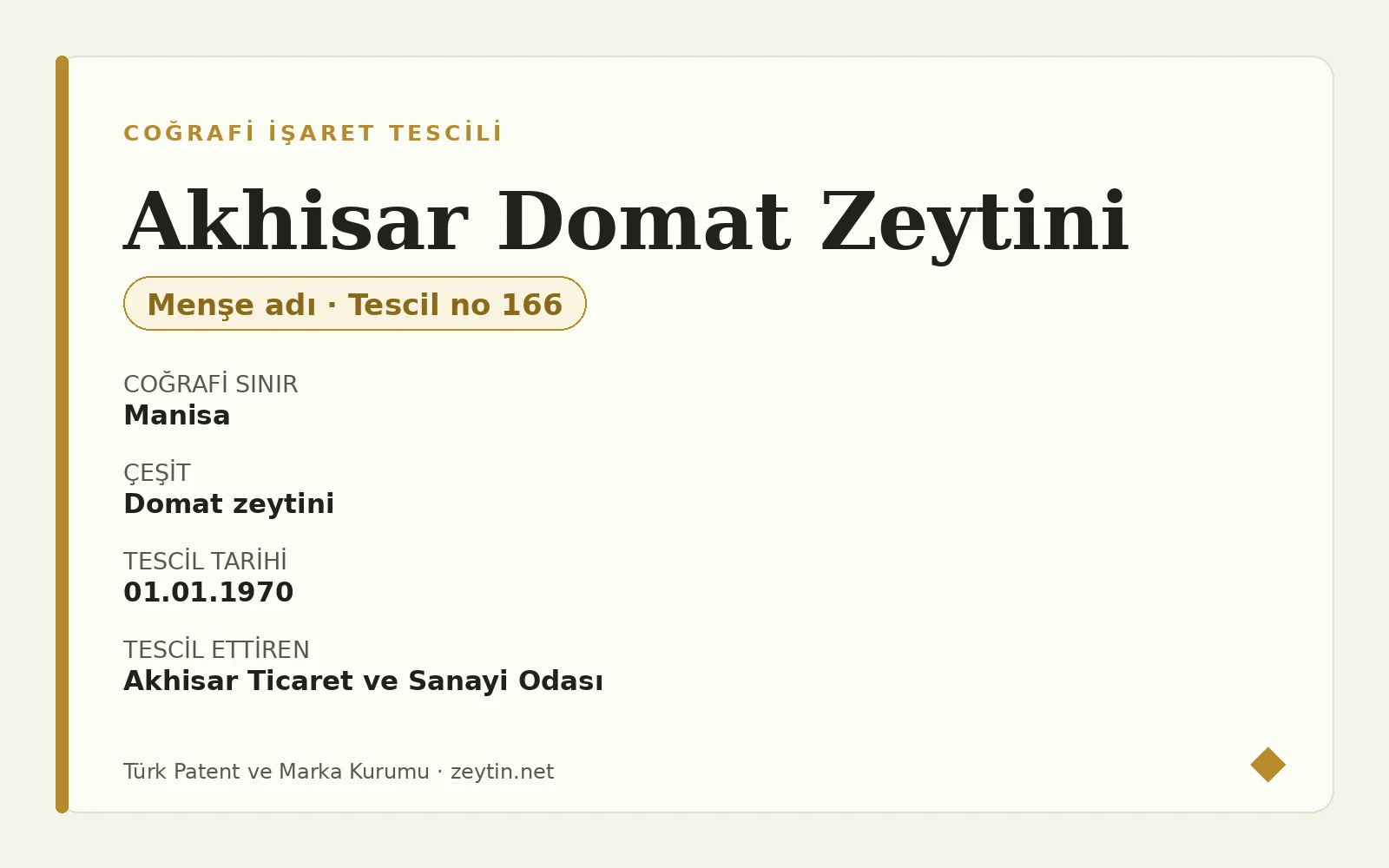
Akhisar Domat Olive: the specification behind stuffed olives
Registered in 2010. The certificate sets calibre separately for each product form — 170-290 for stuffed, 110-260 for cocktail. One cultivar, different sizes.
 Article
Olive and Olive Oil Glossary
Oleuropein, lampante, pomace, malaxation, designation of origin… Short, verifiable definitions of olive and olive oil terms.
 Article
The Olive Harvest: When and How
Early harvest or late? The timing of picking directly determines the oil's acidity, polyphenols and yield.