World olive varieties: from Picual to Kalamata
About 1,200 cultivars exist; commercial weight sits in a few dozen. Picual, Arbequina, Koroneiki, Kalamata, Frantoio — compared with Türkiye.
Roughly 1,200 olive cultivars have been described worldwide. The number that matters commercially is far smaller — a few dozen varieties carry most of world production.
Türkiye's own position shows the same pattern: as of 2021 the country has 100 registered varieties (two hybrids, one clone), yet outside Gemlik, Ayvalık, Memecik and Domat, production volumes are very limited.
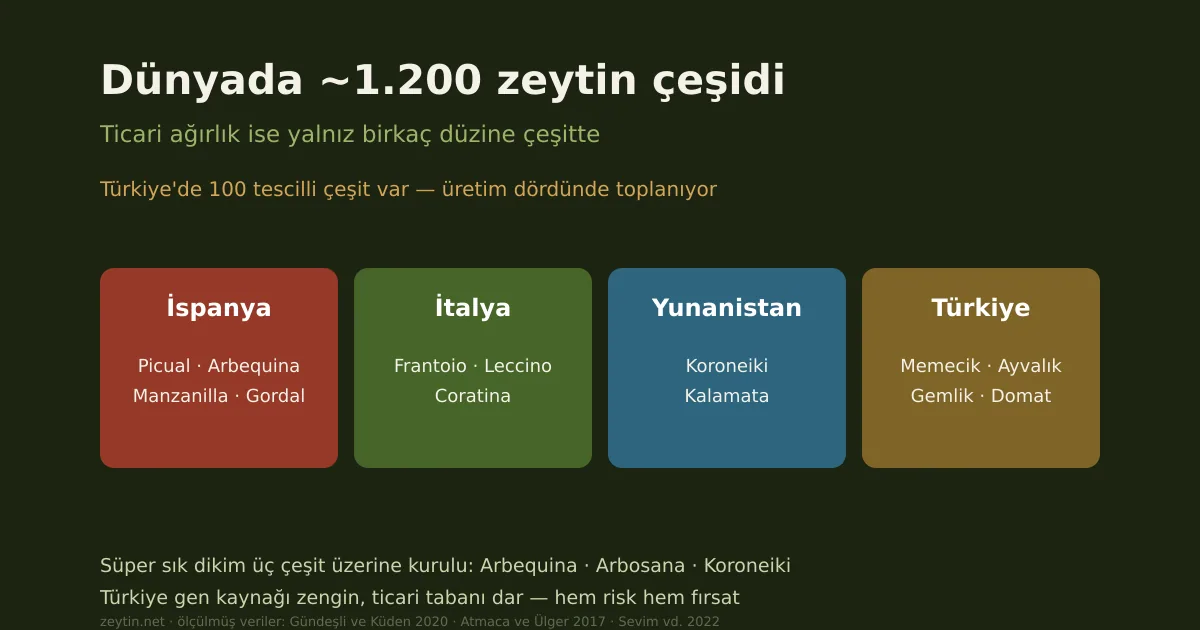
The olive world rests on a broad gene pool and a narrow commercial base.
Leading varieties by country
| Variety | Country | Main use | Known for |
|---|---|---|---|
| Picual | Spain | Oil | One of the largest shares of world olive oil; high antioxidants, pungent |
| Arbequina | Spain | Oil | Small fruit, soft fruity profile; the main variety of super-intensive planting |
| Hojiblanca | Spain | Oil + table | Dual purpose; Spain's third largest variety |
| Cornicabra | Spain | Oil | Horn-shaped fruit; stable oil |
| Manzanilla | Spain | Table | The world's most widespread green table variety; also grown in Türkiye |
| Gordal | Spain | Table | Very large fruit ("gordal" = fat) |
| Koroneiki | Greece | Oil | Small fruit, high polyphenols; used in super-intensive systems |
| Kalamata | Greece | Table | Large, almond-shaped, purplish black; among the best-known table olives |
| Frantoio | Italy | Oil | The emblem of Tuscany; balanced, aromatic oil |
| Leccino | Italy | Oil | Blended with Frantoio; softer profile, cold-hardy |
| Coratina | Italy | Oil | Very high polyphenols, marked bitterness |
| Taggiasca | Italy | Oil + table | Liguria; small and mild |
| Picholine | France | Table + oil | A classic among green table olives |
| Galega | Portugal | Oil | Portugal's traditional principal variety |
| Chemlali | Tunisia | Oil | Most of Tunisian production; drought-tolerant |
| Barnea | Israel | Oil | A modern breeding product; high yielding |
| Mission | USA (California) | Table + oil | Carried to the Americas by Spanish missionaries; hardy |
⚠ This table is general reference information, not values we measured or took from a single source. The sections below report measured data, with sources given.
Measured data: Arbequina and Manzanilla
Two world varieties have been measured academically in Türkiye, trialled alongside nine Turkish varieties at Çukurova University's gene resource orchard:
| Measure | Arbequina IRTA-18 | Manzanilla | Comparison |
|---|---|---|---|
| Chilling requirement | 289 CU 459 h | 319 CU 520 h | Same band as Gemlik / level with Memecik |
| Fruit weight | 1.09 g | — | Smallest fruit in the trial |
| Fruit length | 13.10 mm | — | Smallest (Karamürsel Su 34.83 mm) |
| Fruit width | 11.43 mm | — | Smallest |
| Flesh ratio | 0.76 | — | Lowest (Mavi 0.87) |
| Fruit shape | 1.15 (round) | — | Karamürsel Su 1.60 (long) |
Source: Gündeşli and Küden (2020). More detail: chilling requirement in olives.
Arbequina coming out smallest on every measure is no accident — the variety was selected for a small canopy and small fruit.
The three varieties of super-intensive planting
The biggest change in world olive growing over the last thirty years is super-intensive planting (200-300 trees per decare). The system rests on three varieties:
- Arbequina (Spain)
- Arbosana (Spain)
- Koroneiki (Greece)
All three have small canopies and come into bearing early. The system grows a hedge rather than a tree, harvested by continuous machines resembling grape harvesters.
⚠ Türkiye does not use the model. Trials were made but failed, and the reason was not the variety but the system: groves planted with Spanish varieties suited to super-intensive growing were managed on small plots by traditional methods. More: twenty trees per decare, or 250?
Türkiye's own varieties — Memecik, Ayvalık, Gemlik — were never bred for it. Every country runs breeding programmes to find which of its varieties suit the system; that is long work.
Compared with Türkiye's varieties
| World | Türkiye | |
|---|---|---|
| Described cultivars | ~1,200 | 100 registered (2021) |
| Commercial weight | A few dozen | Four: Gemlik, Ayvalık, Memecik, Domat |
| Leading oil varieties | Picual, Frantoio, Koroneiki | Memecik, Ayvalık |
| Leading table varieties | Manzanilla, Kalamata, Gordal | Gemlik, Domat, Uslu |
| Super-intensive | Arbequina, Arbosana, Koroneiki | Not practised |
The real observation from the table: Türkiye is rich in genetic resources but narrow in commercial base. Ninety-six of the hundred registered varieties are in limited production. That is both a risk (dependence on four varieties) and an opportunity (unused genetic diversity).
The nameless genotypes of the southeast are the concrete example: local genotypes with no name, never catalogued, yet beating the standard varieties on flesh ratio.
Summary
- About 1,200 cultivars are described worldwide; commercial weight sits in a few dozen.
- Türkiye has 100 registered varieties (2021), but production concentrates in four.
- Spain's Picual holds one of the largest shares of world oil production.
- Kalamata and Manzanilla are the best-known table varieties.
- Frantoio and Leccino are Tuscany's emblem; Coratina is known for very high polyphenols.
- Super-intensive planting rests on three varieties: Arbequina, Arbosana, Koroneiki.
- Measured: Arbequina IRTA-18 had the trial's smallest fruit (1.09 g) and lowest flesh ratio (0.76).
- Türkiye is genetically rich but commercially narrow — both a risk and an opportunity.
Sources
Measured values:
t; Gündeşli, K.T. and Küden, A.B. (2020). Determination of chilling requirements and fruit quality characteristics of some domestic and foreign olive cultivars. Anadolu Journal of Agricultural Sciences, 35: 285-291. — Arbequina IRTA-18 and Manzanilla measurements
t; Atmaca, S. and Ülger, S. (2017). Olive High Density Planting in Turkey and the World. Zeytin Bilimi, 7(1): 17-24. — Super-intensive varieties
t; Sevim, D., Varol, N. and Köseoğlu, O. (2022). The Effects of Global Climate Change on Olive Growing and Olive Oil. Journal of the Agricultural Faculty of Bursa Uludağ University, 36(2): 415-432. — Number of registered varieties in Türkiye
⚠ The country-by-country table is general reference information and contains no measured values.
Related reading: Olive varieties (Türkiye) · Chilling requirement in olives · Twenty trees per decare, or 250? · The nameless olives of southeast Anatolia
Every variety has its own page
For oil
- Picual — the largest single share of world production; sharp, stable oil
- Arbequina — the super-high-density variety; smallest fruit measured (1.09 g)
- Koroneiki — the backbone of Greek oil, very high polyphenols
- Frantoio — Tuscany's balanced, aromatic cultivar
- Leccino — Frantoio's blending partner, cold tolerant
- Coratina — the top of the world's polyphenol scale
For the table
- Kalamata — the best-known table olive, a protected designation of origin
- Manzanilla — the international standard for stuffed olives; grown in Türkiye too
- Mission — the variety behind the California-style black olive
Dual purpose
- Hojiblanca — black table olives and oil alike; Spain's third-largest variety
→ For Türkiye's varieties: Olive varieties: Türkiye's 17 in numbers
One rating per visitor; you can change yours at any time. Ratings are real reader votes — no seeded or default scores.
Related
 Article
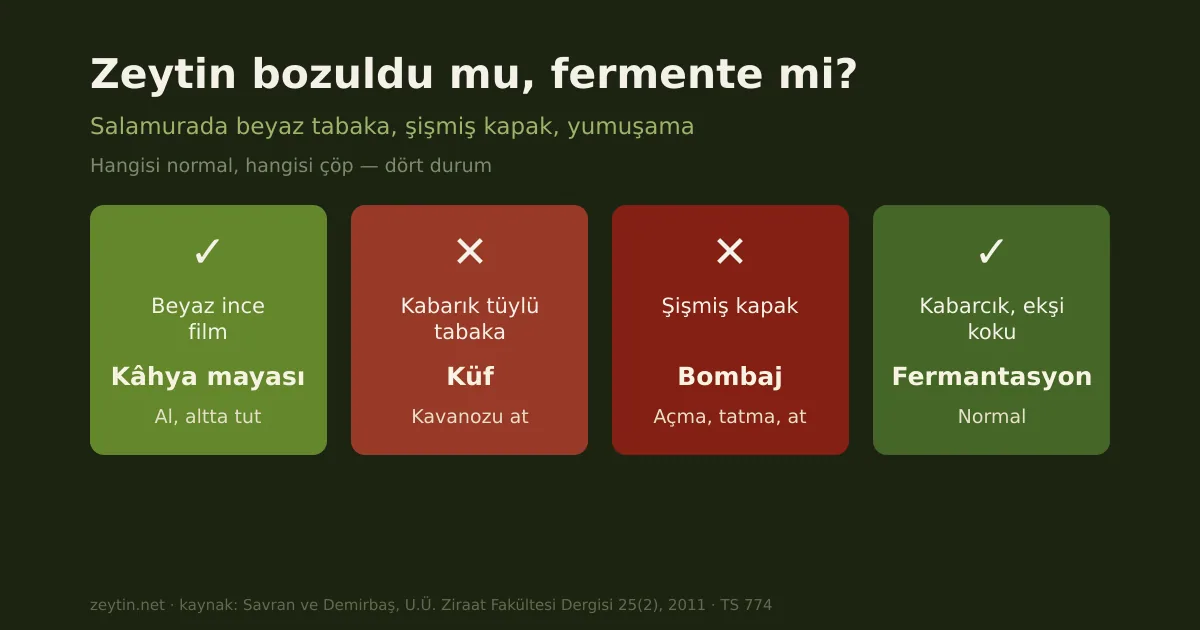
Are my olives spoiled? Mould, bulging lids and softening
A white film on brine is not always mould. But a bulging lid is not debatable: discard it unopened. How kahm yeast differs from mould.
Article
Are my olives spoiled? Mould, bulging lids and softening
A white film on brine is not always mould. But a bulging lid is not debatable: discard it unopened. How kahm yeast differs from mould.
 Article
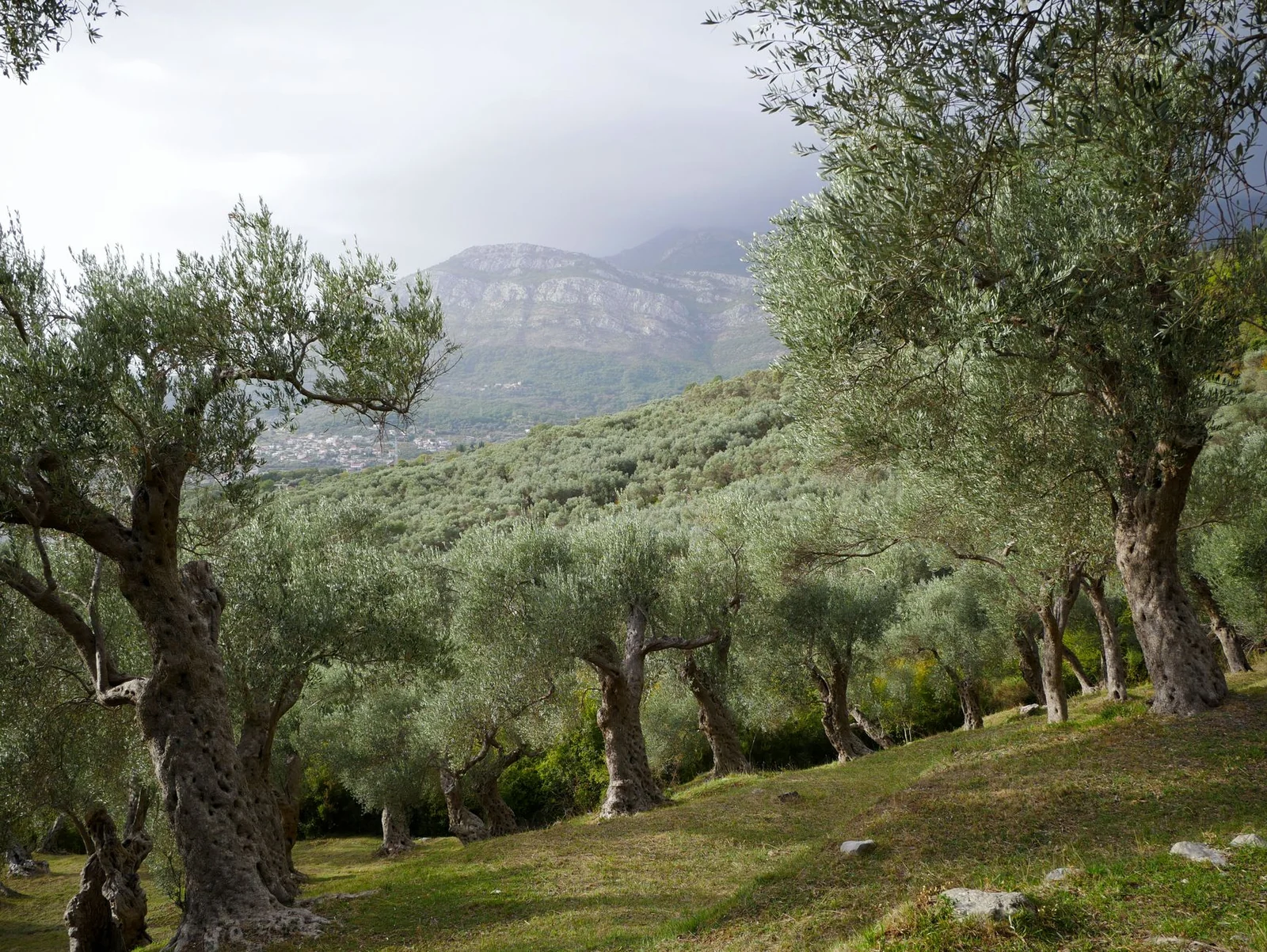
Table Olive Varieties
From Gemlik to Kalamata, Manzanilla to Castelvetrano: the world's best-known table olives and what each is good for.
Article
Table Olive Varieties
From Gemlik to Kalamata, Manzanilla to Castelvetrano: the world's best-known table olives and what each is good for.
 Article
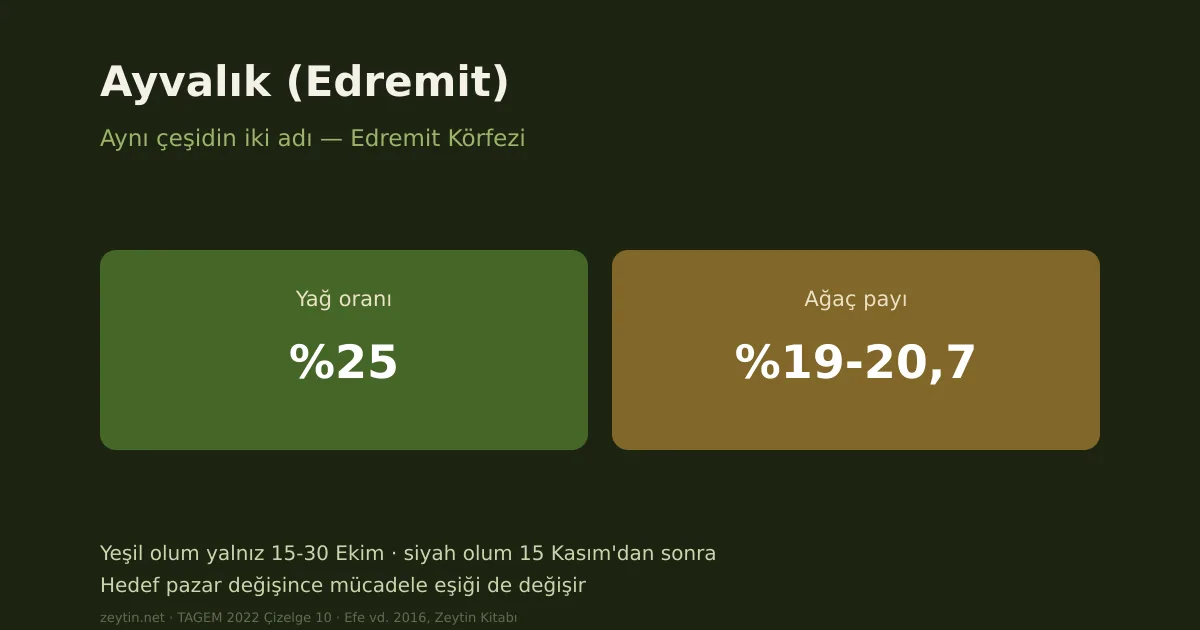
The Ayvalık (Edremit) olive: one variety, two names
19-20.66% of the tree stock, second after Memecik. 25% oil. Green maturity only between 15 and 30 October; black maturity after 15 November, among the latest.
Article
The Ayvalık (Edremit) olive: one variety, two names
19-20.66% of the tree stock, second after Memecik. 25% oil. Green maturity only between 15 and 30 October; black maturity after 15 November, among the latest.
 Article
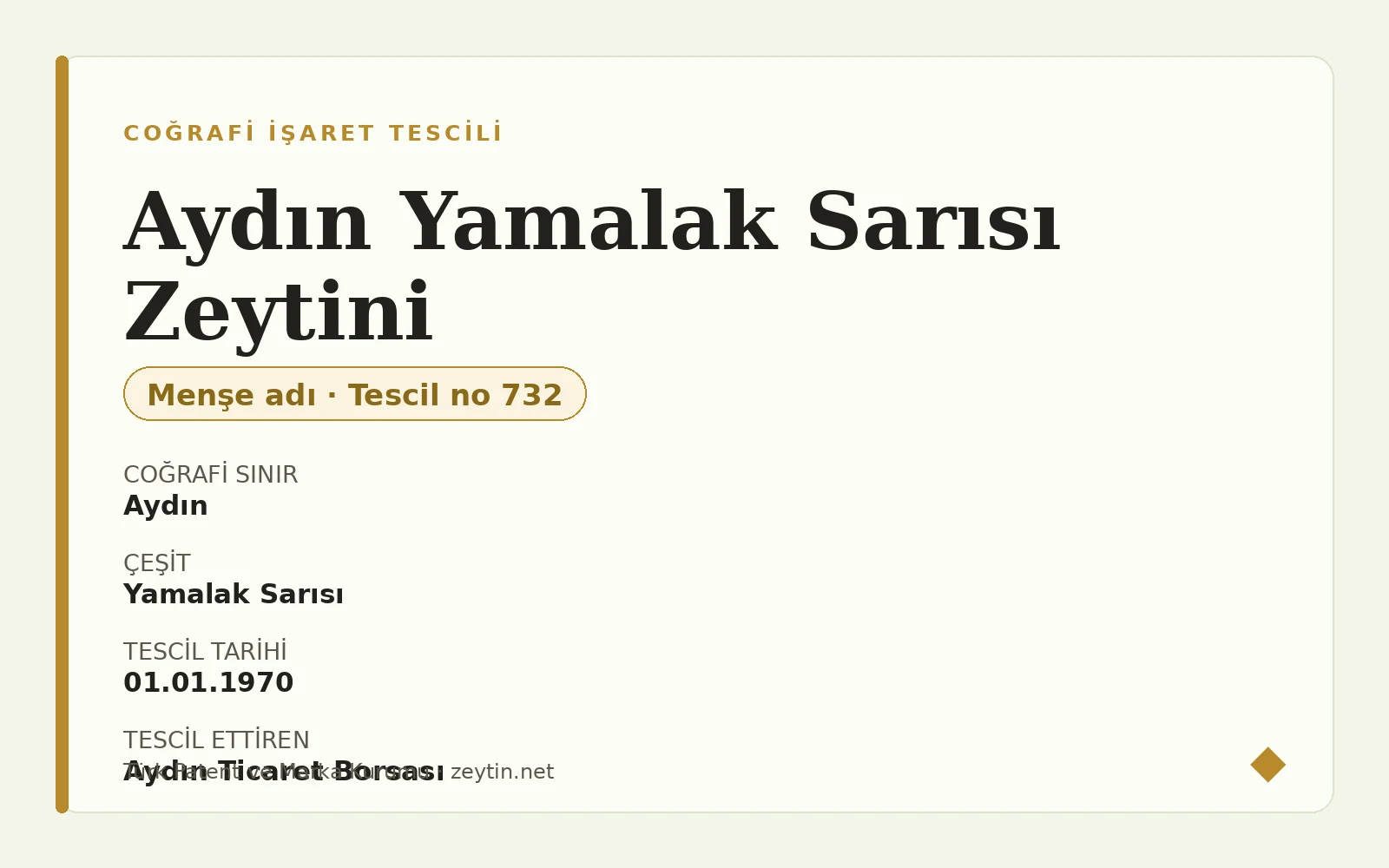
Aydın Yamalak Sarısı Olive: a table fruit reaching 11 grams
Registered in 2021. At 6-11 g the fruit is among Turkey's largest table olives. It is propagated by grafting onto wild rootstock and harvested in late September.
Article
Aydın Yamalak Sarısı Olive: a table fruit reaching 11 grams
Registered in 2021. At 6-11 g the fruit is among Turkey's largest table olives. It is propagated by grafting onto wild rootstock and harvested in late September.