Frantoio olive: Italy's oil variety
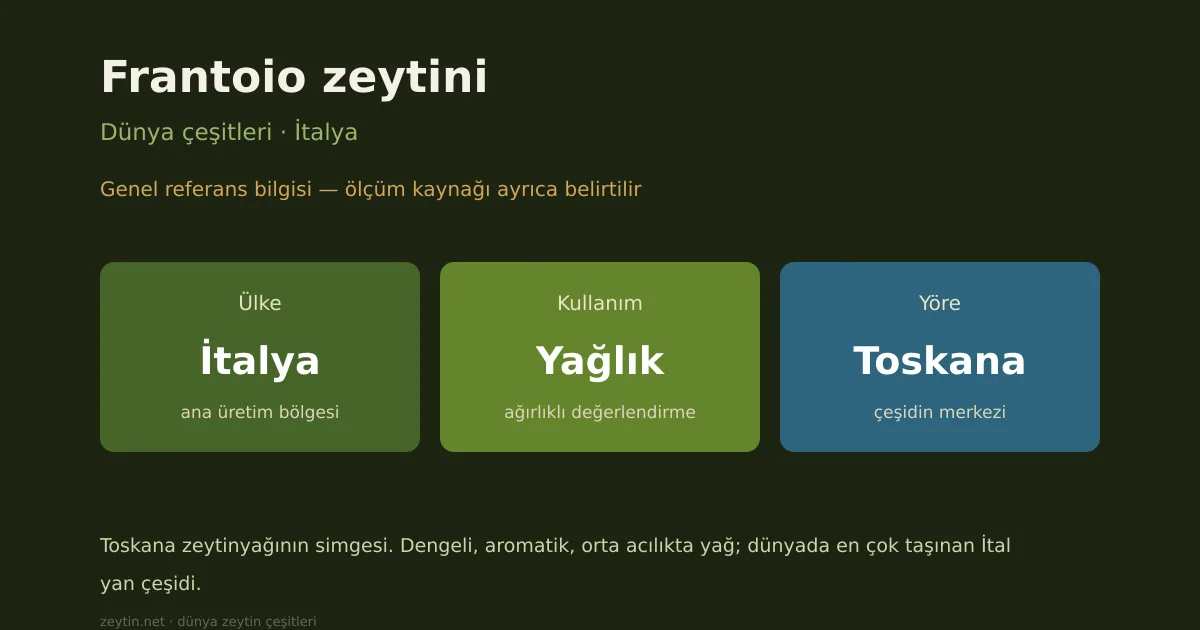
The emblem of Tuscan olive oil. A balanced, aromatic, moderately bitter oil, and the most widely exported Italian variety.
The flavour most people associate with Italian olive oil comes largely from one variety: Frantoio. Even its name gives away the trade — frantoio is Italian for "olive mill".
Tuscany's variety
Frantoio is Tuscany's emblematic cultivar, but it did not stay there: most new groves in Australia, Chile, Argentina, California and New Zealand include it. It is the most widely exported Italian variety.
The reason it travelled is that its oil is balanced: neither as sharp as Picual nor as mild as Arbequina. Moderate bitterness and pungency, with a clear but not overwhelming fruitiness.
Flavour profile
Green almond, artichoke, fresh grass and a faint almond sweetness are commonly described, finishing with a clean bitterness.
That profile makes Frantoio useful both as a single-variety oil and as the backbone of blends.
The partnership with Leccino
In Tuscany, Frantoio is rarely planted alone; its classic partner is Leccino. Frantoio brings structure and aroma, Leccino softness and cold tolerance.
The logic is the same as mixing varieties in Türkiye: relying on one cultivar is a weakness both for pollination and for risk. That the wrong pollinator shrinks Domat's fruit by a third is another face of the same issue.
Compared with Türkiye
For balance and dual use, Frantoio's closest Turkish counterpart is Memecik: oil and table alike, mid-intensity oil, the country's most widespread variety. Each defines its own country's "default" taste of olive oil.
Frantoio in numbers
| Use | Oil |
| Oil content | ~18% |
| Oleic acid | ~75% |
| Total phenols | High |
| Productivity | High and constant |
| Self-fertility | ~28% (high) |
| Entry into production | Medium |
| Ripening | Medium-late |
| Cold | Moderately susceptible |
| Verticillium | Partially resistant |
| Highly susceptible to | Leaf spot, olive knot, olive fly |
| Propagation by cutting | 70% success |
Source: International Olive Council (IOC), World Catalogue of Olive Varieties. Main growing areas: Tuscany, Umbria, Liguria and Puglia.
Two lines explain why Frantoio travelled. The first is the 70% success rate from cuttings: a variety that is easy to propagate spreads, one that is difficult stays home. The second is partial resistance to Verticillium — precisely Picual's weakest point, and a serious argument for countries planting new groves.
Against that, it is highly susceptible to olive fly and leaf spot; in humid, mild climates the spraying burden rises.
Its self-fertility is high (~28%), yet in Italy it is still planted alongside Leccino — not only for pollination, but for the balance of the blend.
Related pages
Where it stands among measured varieties
et/çekirdek oranı 5,15'ten türetildi — kaynak: IOC Dünya Zeytin Çeşitleri Kataloğu — Avustralya denemesi 19
çeşit sayfası
IOC Dünya Zeytin Çeşitleri Kataloğu — Avustralya denemesi 1998-2004 (Tablo 4)
IOC Dünya Zeytin Çeşitleri Kataloğu — Avustralya denemesi 1998-2004 (Tablo 4)
Values are those published on each variety's own page; the comparison covers only varieties with a measured figure, so it is a comparison of what is known — not of every Turkish variety. See the full ranking and how it is built →
One rating per visitor; you can change yours at any time. Ratings are real reader votes — no seeded or default scores.
Related
 Article
Hursuki olive
Hursuki is a recorded variety of south-eastern Anatolia. No measured pomological data published.
Article
Hursuki olive
Hursuki is a recorded variety of south-eastern Anatolia. No measured pomological data published.
 Article
The Olive Sector in Turkey: Structure, Exports and Challenges
Production, exports, business structure and price: the Turkish olive sector in figures, and where the chain breaks.
Article
The Olive Sector in Turkey: Structure, Exports and Challenges
Production, exports, business structure and price: the Turkish olive sector in figures, and where the chain breaks.
 Article
How long does an olive tree live?
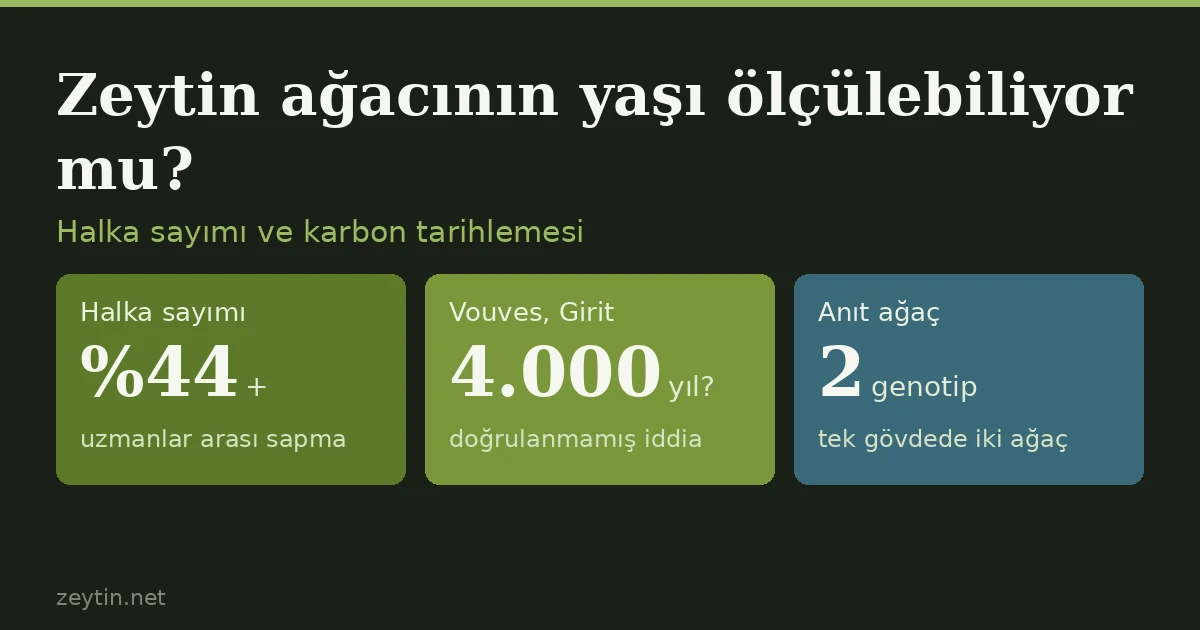
There are plenty of "thousand-year-old olive" signs and almost no measurements. Counting annual rings does not work on olive: when ten experts in five laboratories were given the same samples, their ring counts differed by more than 44%. Radiocarbon dating carries its own trap. So does the tree have a real age limit — and what does it mean that Crete's famous monumental olive turns out to consist of two different genotypes?
Article
How long does an olive tree live?
There are plenty of "thousand-year-old olive" signs and almost no measurements. Counting annual rings does not work on olive: when ten experts in five laboratories were given the same samples, their ring counts differed by more than 44%. Radiocarbon dating carries its own trap. So does the tree have a real age limit — and what does it mean that Crete's famous monumental olive turns out to consist of two different genotypes?
 Article
Sarı Ulak olive: characteristics, oil content and growing areas
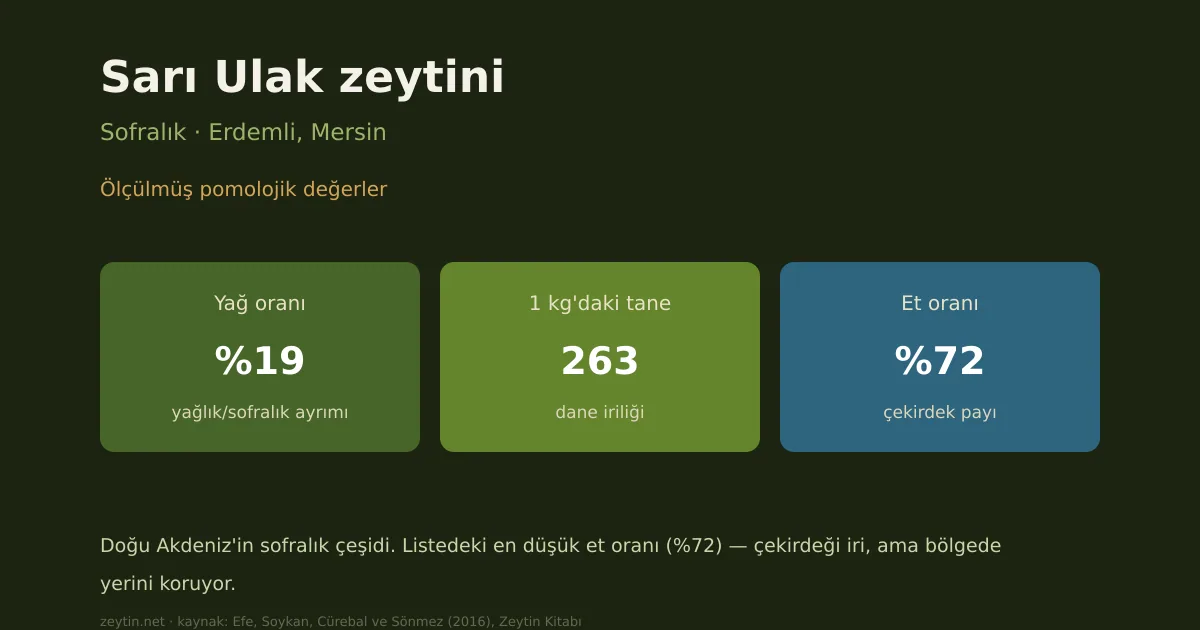
The eastern Mediterranean's table variety. The lowest flesh ratio on the list (72%) — a large stone, yet it holds its ground.
Article
Sarı Ulak olive: characteristics, oil content and growing areas
The eastern Mediterranean's table variety. The lowest flesh ratio on the list (72%) — a large stone, yet it holds its ground.