The Domat olive: the cultivar behind stuffed olives, in numbers
Domat, Turkey's largest table cultivar: 7.96 g fruit, 89% flesh, a 552-hour chilling requirement. Why stuffed olives are always made from it, the disagreement over oil content, and why it is never planted alone.
In Turkey, green table olives mean one cultivar: Domat. The stuffed olives you buy — the ones filled with pepper, carrot or almond — are almost all made from it. The reason is not taste but measurement: Domat's fruit is among the largest grown in Turkey, and its pit is small relative to the flesh. Removing the pit and replacing it with a filling requires exactly that.
This page gathers the cultivar's measured characteristics: fruit size, flesh ratio, chilling requirement, pollination behaviour and growing regions. Sources are listed at the end; where sources disagree, the disagreement is shown rather than hidden.
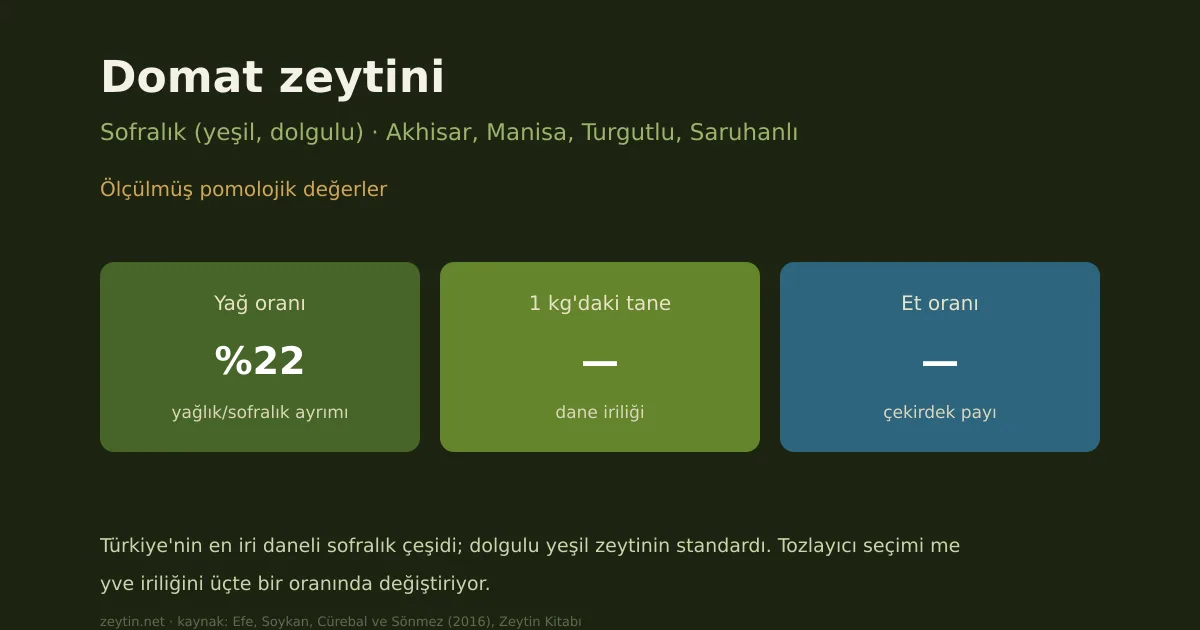
Domat in numbers
| Property | Value | Note |
|---|---|---|
| Fruit weight | 5.30 g | Measured in the Adana trial; trade sources give 10-12 g |
| Flesh as share of fruit | 83.76% | The technical condition for stuffed olives |
| Oil content | 20.57% | ⚠ Some sources say 28-30% — explained below |
| Chilling requirement | 552 hours | 333 chill units; the highest among cultivars tested |
| Self-fertility | none | Planted without a pollinator it sets very little fruit |
| Planting distance | 6×8 m · 7×7 m | Spaced widely because of its broad canopy |
| Harvest | Sept-Nov | Green table fruit is hand-picked in September-October |
Why stuffed olives are always Domat
The whole production chain for stuffed olives rests on one ratio: flesh to pit. Enough flesh must remain for the fruit to hold together while the pit is machine-extracted, and the cavity left behind must be wide enough to take the filling. In Domat the flesh accounts for 89% of the fruit — the pit occupies barely a tenth.
Add a 9-12 gram fruit to that and you get an olive that can be pitted, filled, and still holds in brine. This is why Akhisar has processed the same cultivar for close to a century, and why Akhisar Domat Olive carries a geographical indication. For comparison: Gemlik runs 4-5 grams and goes to black brine. The two sit on the same shelf but do different jobs.
The disagreement over oil content
Sources give two ranges for Domat's oil content: 20-23% and 28-30%. Neither is wrong, because they are not measuring the same thing.
Oil content in olives rises with harvest maturity. In fruit picked green, oil accumulation is not yet complete; fruit taken from the same tree at black maturity measures markedly higher. Because Domat is picked green for table use, the figure that enters the table is the lower range. When the same cultivar goes to oil — and early-harvest Domat oil is now produced in Akhisar — the upper range is approached.
A figure that does not state the maturity at which it was measured means little on its own. That is also the heart of the early-harvest question.
The chilling paradox: the cultivar that needs the most cold is also among the most frost-sensitive
The most striking of the measurements on Domat is this: among the Turkish and foreign cultivars tested, Domat had the highest chilling requirement — 552 hours, 333 chill units.
Yet the same cultivar is sensitive to winter frost and is not recommended for regions with hard winters. It looks like a contradiction. It is not: these are two different phenomena.
- Chilling requirement is the amount of cool hours a tree needs in order to break dormancy and flower properly. If it is not met, the tree does not die — it does not flower, so there is no crop.
- Frost tolerance is the ability of tissue to survive sub-zero temperatures. If that is not met, branches — or the tree — die.
Domat asks for a narrow band between the two: a winter cool enough to trigger flowering, mild enough not to kill tissue. The Aegean and Mediterranean climates provide exactly that; central Anatolia and high altitudes do not.
For the detail of that distinction and chilling hours by cultivar: chilling requirement in olives.
⚠ With warming winters this stops being theoretical. The same study notes that chilling durations in the region vary year to year, and that in high-requirement cultivars such as Ayvalık and Domat the requirement goes unmet in some years. The same work records flowering shifting into February in Domat and Karamürsel Su during warm winters.
Pollination: never planted alone
Domat is not self-fertile. In a single-cultivar orchard it flowers but sets no fruit; a pollinator is required.
The established pollinator for Domat is Ayvalık (Edremit). Gemlik, Memecik and Erkence are also used. In practice a share of the orchard is given over to the pollinating cultivar, positioned with the prevailing wind in mind.
This shapes the planting decision directly: a grower who decides on Domat has in fact decided on two cultivars.
Where it grows
Domat's centre is Manisa — Akhisar in particular. Beyond that it is grown across districts of Aydın, İzmir and Balıkesir. In the TAGEM classification it is listed among cultivars moderately resistant to drought.
Its broad canopy also sets the planting plan: 6×8 or 7×7 metre spacing is preferred, so the number of trees per decare is low. It is not a cultivar suited to the high-density model — which cultivars are is a separate question: trees per decare.
Ministry programmes continue clone selection work in the Ayvalık and Domat cultivars, so today's figures may shift as selected clones come through.
A second source: the IOC catalogue
The values above come from Turkish sources. The table below is taken from the International Olive Council's world catalogue — the same variety as recorded internationally. We keep the two tables apart because some of the figures do not agree.
| Origin | Akhisar (Manisa) · Aegean Region |
| Use | Table — stuffed green olives, owing to fruit size |
| Fruits per kilo | 165 |
| Fruit weight | 5.30 g |
| Flesh-to-stone ratio | 5.25 |
| Oil content | 20.57% |
| Ripening | Mid-October |
| Yield | High and regular under good husbandry |
| Self-fertility | Partial — pollinators Ayvalık, Memeli, Memecik, Gemlik |
| Pollen | Abundant, with high germination power |
| Drought and cold | Moderately tolerant to both |
| Growing note | Irrigation advised; the wide crown requires generous spacing |
Source: International Olive Council (IOC), World Catalogue of Olive Varieties.
The figure of ~140 fruits per kilo states Domat's size on its own: Gemlik runs to 273 and Memecik to 220. That is why the stuffed-olive line was built on this variety.
Two growing notes stand out. Its pollen is abundant and germinates well — so although Domat is only partly self-fertile itself, it serves as a good pollinator for others. And its wide crown demands generous spacing, making it the opposite of a super-high-density variety; compare Arbequina.
On its share of the national tree stock the sources diverge: the Turkish figure used on this page and the catalogue figure differ. Comparison and discussion: olive varieties of Türkiye.
In short
Domat does a specific job in Turkish table-olive growing: large fruit, high flesh ratio, a pit cavity suited to filling. In return it is particular about climate, requires a pollinator, and does not take to high-density planting.
The questions to ask when planting are, in order: is the winter cool enough (552 hours) but mild enough not to freeze; has room been left for a pollinator; is the crop going to table or to oil — because harvest maturity changes both the oil content and the price.
Registered names built on this variety
The registration covers the product of a defined area — not this variety wherever it is grown.
- Akhisar Domat Zeytini designation of origin · reg. no 166
- Akhisar Domat Zeytinyağı geographical indication · reg. no 1055
Where it stands among measured varieties
Türkpatent Coğrafi İşaret Tescil Belgesi — Akhisar Domat Zeytini (no 166) — bu çeşidin ölçüm takımı bu çalışmadan (2 kaynak arasından)
Türkpatent Coğrafi İşaret Tescil Belgesi — Akhisar Domat Zeytini (no 166)
Türkpatent Coğrafi İşaret Tescil Belgesi — Akhisar Domat Zeytini (no 166) — bu çeşidin ölçüm takımı bu çalışmadan (2 kaynak arasından)
Türkpatent Coğrafi İşaret Tescil Belgesi — Akhisar Domat Zeytini (no 166) — bu çeşidin ölçüm takımı bu çalışmadan (2 kaynak arasından)
Türkpatent Coğrafi İşaret Tescil Belgesi — Akhisar Domat Zeytini (no 166), 100 meyve 530,30 g
Values are those published on each variety's own page; the comparison covers only varieties with a measured figure, so it is a comparison of what is known — not of every Turkish variety. See the full ranking and how it is built →
One rating per visitor; you can change yours at any time. Ratings are real reader votes — no seeded or default scores.
Related
 Article
Products from Olive
Table olives, oil, pomace, leaf and soap: what is made from each part of the tree, and what each is good for.
Article
Products from Olive
Table olives, oil, pomace, leaf and soap: what is made from each part of the tree, and what each is good for.
 Article
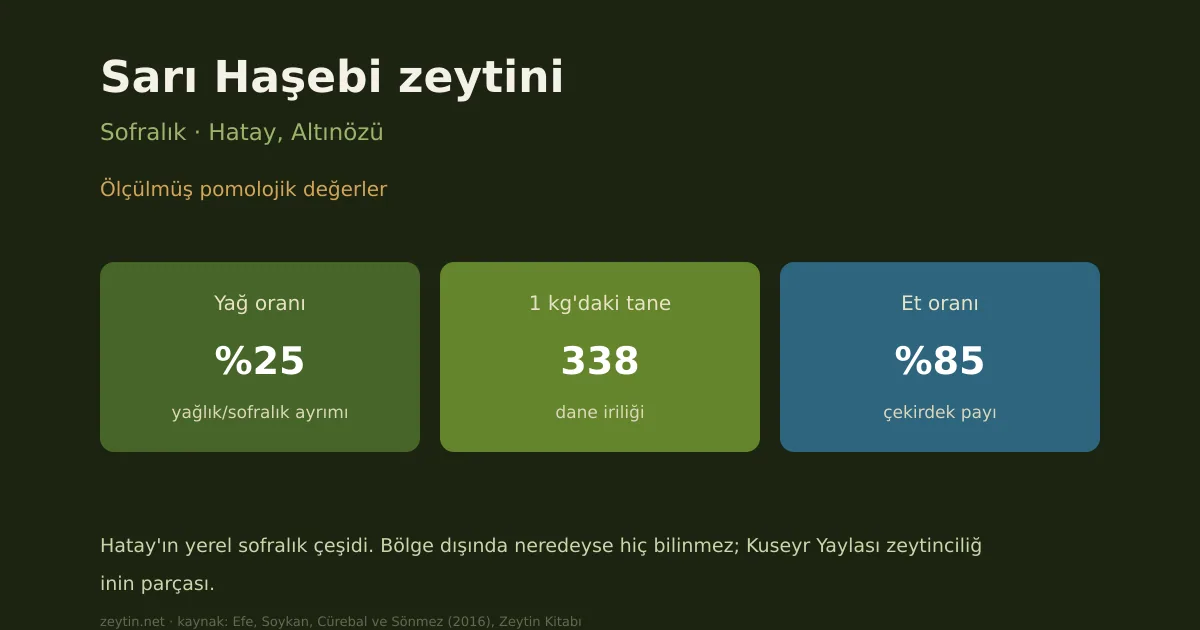
Sarı Haşebi olive: characteristics, oil content and growing areas
Hatay's local table variety, virtually unknown outside the region and part of Kuseyr Plateau olive growing.
Article
Sarı Haşebi olive: characteristics, oil content and growing areas
Hatay's local table variety, virtually unknown outside the region and part of Kuseyr Plateau olive growing.
 Article
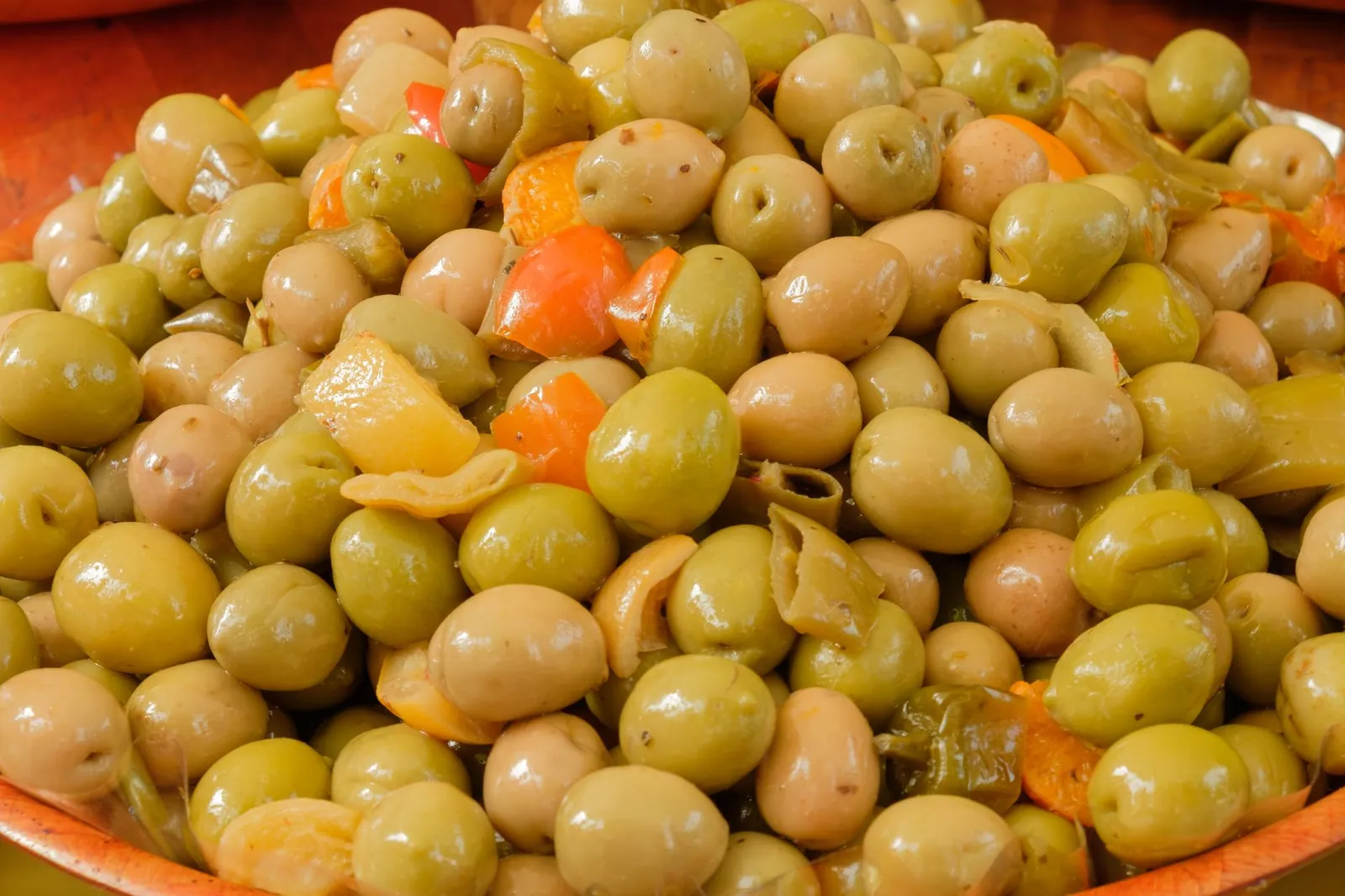
Geographical Indication Olives and Olive Oils of Turkey
Türkiye's registered olive and olive oil geographical indications: which product, which locality, under what conditions — and what registration means.
Article
Geographical Indication Olives and Olive Oils of Turkey
Türkiye's registered olive and olive oil geographical indications: which product, which locality, under what conditions — and what registration means.
 Article
Arbequina olive: Spain's oil variety
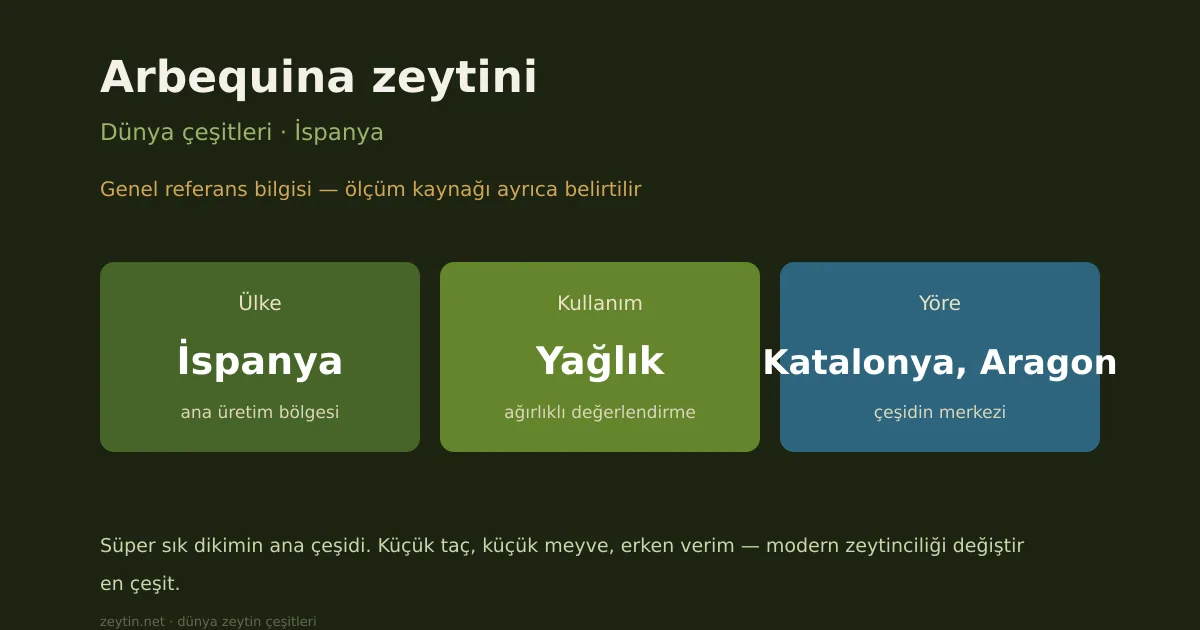
The mainstay of super-high-density planting. Small canopy, small fruit, early bearing — the variety that changed modern olive growing.
Article
Arbequina olive: Spain's oil variety
The mainstay of super-high-density planting. Small canopy, small fruit, early bearing — the variety that changed modern olive growing.