Uslu olive: characteristics, oil content and growing areas
Akhisar's black table variety. Overshadowed by Gemlik, yet holding its own market.
Uslu is the Aegean's name for the black table olive. What Gemlik is to Marmara, Uslu is around Akhisar — though it never gained the same national profile.
Uslu in numbers
| Oil content | 21.50% |
| Fruits per kilo | 283 |
| Flesh ratio | 85.17% |
| Use | Table (black) |
| Main areas | Akhisar |
Source: Efe, Soykan, Cürebal and Sönmez (2016), Zeytin Kitabı. Fields the source leaves blank are shown as "—"; nothing has been estimated.
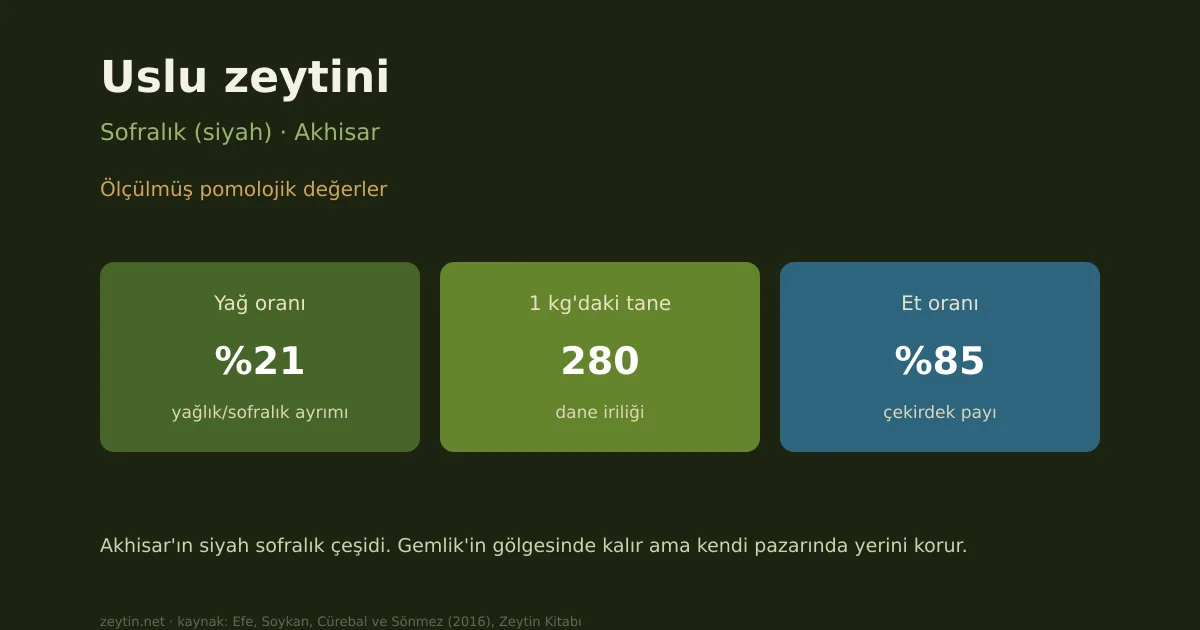
Akhisar's black table olive
Uslu is one of three varieties — with Gemlik and Edincik Su — that are widely processed as black table olives in Türkiye. Its centre is Akhisar; it is also grown in the western Mediterranean.
At 280 fruits per kilo and 85% flesh, it sits slightly larger and fleshier than Gemlik rather than in the same class. One study measured Uslu fruit length at 24.65 mm, against 25.67 mm for Memecik in the same work.
Why is it less known than Gemlik?
In the black table market Gemlik became the standard, backed by geographical indication and Marmara's processing infrastructure. Uslu stayed tied to Akhisar: a strong local processing tradition, but no national brand.
Its 21% oil also limits dual use; Uslu is essentially a table variety, and its value lies in size and flesh ratio.
Catalogue data
Uslu is one of four Turkish varieties listed in the International Olive Council's world catalogue — the others being Domat, Gemlik and Memecik. The catalogue records:
| Origin | Akhisar (Manisa) |
| Growing provinces | Manisa · İzmir · Muğla |
| Use | Oil and black table olives |
| Fruits per kilo | 283 |
| Fruit weight | 3.53 g |
| Flesh-to-pit ratio | 7.3 |
| Oil content | 21.50% |
| Total phenols | 182-494 mg CAE/kg |
| α-tocopherol | 380-486 mg/kg |
| Sensory profile | Medium fruitiness, bitterness and pungency |
| Flowering and ripening | Early — beginning of October |
| Yield | Regular under good husbandry |
| Self-fertility | Yes |
Source: International Olive Council (IOC), World Catalogue of Olive Varieties. ⚠ Some of these figures differ from those in Turkish sources, where 21% oil, 280 fruits per kilo and 85% flesh are also reported. The differences may stem from orchard, season and harvest timing; we report the figures as published, with their source named.
What the figures say
A flesh-to-pit ratio of 7.3 means roughly 88% of the fruit by weight is flesh. In a table variety this is the decisive measure, and Uslu is strong on it. For comparison, the same region's green table variety Domat sits at 4.85 and Gemlik at 3.60 (Çukurova trial).
At ~260 fruits per kilo, Uslu belongs among the large-fruited varieties. The contrast with oil varieties is clear: Kilis Yağlık runs to 560 fruits per kilo, Kalem Bezi to 450.
Being self-fertile is a practical advantage in table-olive growing: an orchard can be planted without a pollinator variety.
One detail also corrects the harvest account above: the catalogue lists Uslu among the early-ripening varieties, with veraison beginning in early October. Uslu is picked late not because it ripens slowly, but because black table processing waits for the full colour change.
In short
Uslu is Akhisar's black table variety: 280 fruits per kilo, 85% flesh, 21% oil. Slightly larger and fleshier than Gemlik, yet it never became a national brand. Conserving it as a regional asset matters for varietal diversity.
Registered names built on this variety
The registration covers the product of a defined area — not this variety wherever it is grown.
- Akhisar Uslu Zeytini designation of origin · reg. no 165
- Akhisar Uslu Zeytinyağı geographical indication · reg. no 1056
Where it stands among measured varieties
Türkpatent Coğrafi İşaret Tescil Belgesi — Akhisar Uslu Zeytini (no 165)
Türkpatent Coğrafi İşaret Tescil Belgesi — Akhisar Uslu Zeytini (no 165)
Türkpatent Coğrafi İşaret Tescil Belgesi — Akhisar Uslu Zeytini (no 165)
Türkpatent Coğrafi İşaret Tescil Belgesi — Akhisar Uslu Zeytini (no 165)
Türkpatent Coğrafi İşaret Tescil Belgesi — Akhisar Uslu Zeytini (no 165), 100 meyve 353,40 g
Values are those published on each variety's own page; the comparison covers only varieties with a measured figure, so it is a comparison of what is known — not of every Turkish variety. See the full ranking and how it is built →
One rating per visitor; you can change yours at any time. Ratings are real reader votes — no seeded or default scores.
Related
 Article
Kan Çelebi olive
Kan Çelebi is a recorded variety of south-eastern Anatolia. Described in the source.
Article
Kan Çelebi olive
Kan Çelebi is a recorded variety of south-eastern Anatolia. Described in the source.
 Article
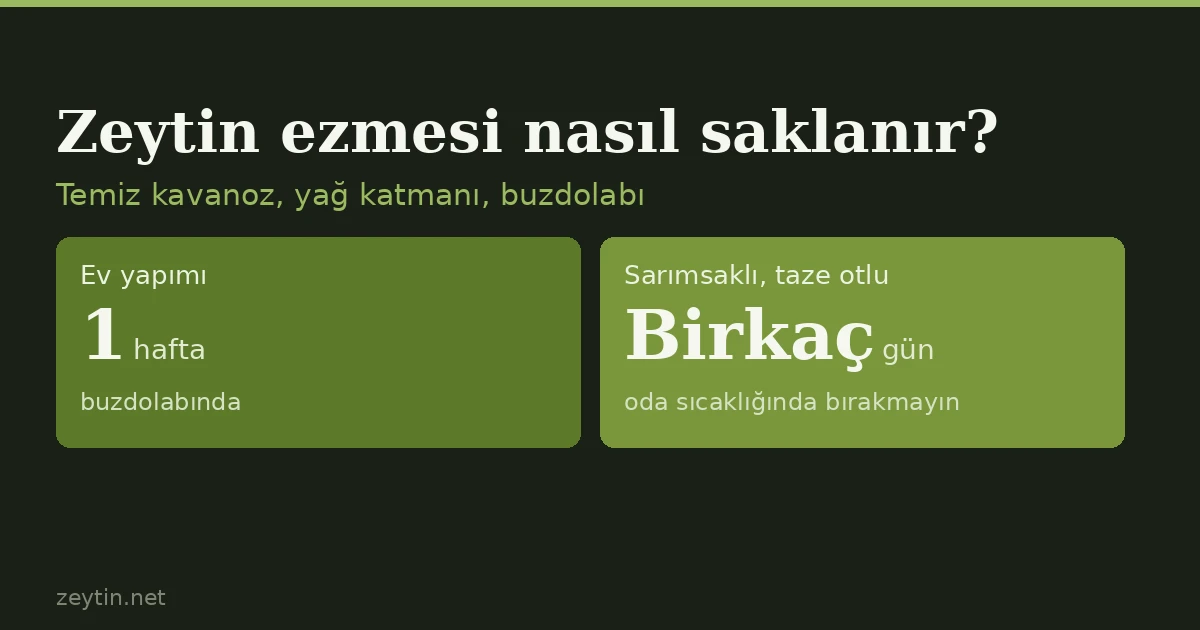
How to store olive spread: homemade, opened jars and freezing
Homemade olive spread is kept in the fridge in a clean glass jar, covered with a thin layer of olive oil, and eaten within about a week. For opened shop-bought jars, the time on the label applies. Spread with garlic or fresh herbs should never be left at room temperature.
Article
How to store olive spread: homemade, opened jars and freezing
Homemade olive spread is kept in the fridge in a clean glass jar, covered with a thin layer of olive oil, and eaten within about a week. For opened shop-bought jars, the time on the label applies. Spread with garlic or fresh herbs should never be left at room temperature.
 Article
Hursuki olive
Hursuki is a recorded variety of south-eastern Anatolia. No measured pomological data published.
Article
Hursuki olive
Hursuki is a recorded variety of south-eastern Anatolia. No measured pomological data published.
 Article
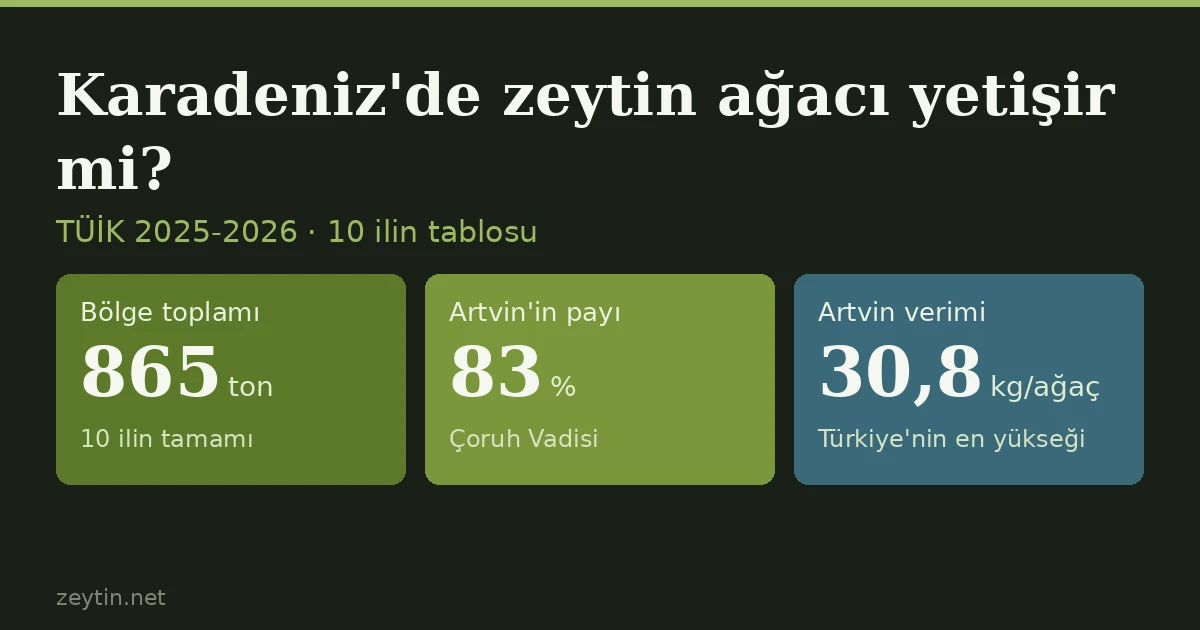
Do olive trees grow on the Black Sea coast?
Ten Black Sea provinces produce 865 tonnes between them, 83 per cent of it in Artvin. Trabzon gets 98 tonnes from 36,000 trees; Samsun none from 13,000. The obstacle is humidity, not cold.
Article
Do olive trees grow on the Black Sea coast?
Ten Black Sea provinces produce 865 tonnes between them, 83 per cent of it in Artvin. Trabzon gets 98 tonnes from 36,000 trees; Samsun none from 13,000. The obstacle is humidity, not cold.