Where did olives come from? Origin and domestication
The olive was domesticated about 6,000 years ago in the Levant — but not at a single centre. Genetic work shows the cultivated olive kept mixing with the wild oleaster throughout its spread.
For a long time the answer to where olives come from was simply "the Mediterranean". Two decades of genetic work have both narrowed that answer and complicated it: the olive was not domesticated once in one place. A process that began in the eastern Mediterranean repeatedly mixed with wild populations as it moved west.
The wild ancestor: the oleaster
The orchard olive (Olea europaea var. europaea) is the domesticated form of the wild olive — the oleaster, var. sylvestris. They are not separate species but two varieties of one.

The oleaster is native to the Mediterranean basin and spreads without human help: birds eat the fruit and carry the seed. The olives growing unbidden in Aegean and Mediterranean scrub in Türkiye are this wild form — small-fruited, large-stoned, often thorny-shooted and low-yielding in oil.
Domestication was essentially the selection and propagation of individuals with larger, oilier fruit. But sow an olive seed and the resulting tree will not resemble its parent. Domestication was therefore only possible through cuttings and grafting — the copying of a single admired tree. Every tree we now call Gemlik or Ayvalık is a clone of one individual selected centuries ago.
When and where?
Archaeobotanical and genetic evidence converge on this: the olive was domesticated about 6,000 years ago in the Levant — the eastern Mediterranean strip covering present-day Syria, Lebanon, Israel, Palestine and southern Türkiye. The first attempts at cultivation are thought to reach back some 8,000 years.
That makes the olive one of humanity's oldest perennial crops — first among tree crops, after the cereals and pulses.
Tracing domestication is difficult because it did not happen at a single centre at a single moment. The research describes a diffuse process: it began in the Levant, but numerous secondary domestication events occurred as it spread west.
What the genetics say
A genome study published in BMC Biology in 2020 found that cultivated olives have lost far less genetic diversity relative to the wild form than expected. In most crops, domestication creates a sharp bottleneck as propagation proceeds from a narrow set of individuals, and diversity collapses. In the olive the bottleneck is mild.
The reason is that the olive continued exchanging genes with its wild relatives after domestication. Being wind-pollinated, an orchard tree receives pollen from nearby oleasters. On top of that, cultivated forms spreading west hybridised with local wild populations — markedly so in the western Mediterranean.
The consequence is that variety origins cannot be reduced to a single family tree. Today's diversity is the product of an eastern cultivated lineage mixing repeatedly with local wild ones.
The move west
The olive's distribution is bound up with trade. By the Bronze Age an olive oil trade had developed in the eastern Mediterranean, with oil carried as food, lamp fuel and ceremonial substance. Because it travelled in vessels, it is archaeologically traceable: amphorae and press installations record where the olive arrived and when.
The spread runs broadly east to west — from the Levant to the Aegean and Anatolia, on to Greece and Italy, then the Iberian Peninsula and North Africa. At each stop, mixing with local wild populations happened again.
Anatolia does not sit in the middle of that line but very close to its beginning. Türkiye's southern and western coasts adjoin the region where domestication is held to have occurred. Türkiye remains one of the most varietally diverse olive countries in the world, which is why so many local varieties are recorded on this site. See olive varieties for the distribution.
"Who invented olives?"
The honest answer is nobody. Domestication is not an invention but a practice of selection and propagation spread across millennia. There is no named inventor.
Even so, nearly every Mediterranean culture wrote the olive an origin story. In the Greek account, Athena competes with Poseidon for the patronage of Athens, offers the city the olive tree, and wins. Such stories show economic value hardening into cultural identity. For what the tree carries as a symbol, see why the olive branch is a symbol of peace and the olive in scripture and folk belief.
Why the relationship lasted
Several concrete properties have sustained six thousand years of partnership:
The oil keeps. Fresh fruit spoils; oil does not. Olive oil is a dense calorie source producible with pre-industrial technology and storable for months.
The tree lives on poor ground. Olives crop on stony, sloping land where cereals cannot be grown, so they do not compete for arable soil.
It withstands drought. It can pass a rainless Mediterranean summer without irrigation.
It can be copied. Cuttings and grafts allow an admired tree to be multiplied indefinitely; a good individual's qualities are never lost.
It lives a long time. A grove planted once yields for generations — which is why olive groves are inherited property.
One rating per visitor; you can change yours at any time. Ratings are real reader votes — no seeded or default scores.
Related
 Article
Why Is the Olive Branch a Symbol of Peace?
From the dove of the flood narrative to the emblem of the United Nations: how a tree branch has carried the same meaning for thousands of years.
Article
Why Is the Olive Branch a Symbol of Peace?
From the dove of the flood narrative to the emblem of the United Nations: how a tree branch has carried the same meaning for thousands of years.
 Article
The Olive Oil Trade in the Ancient World
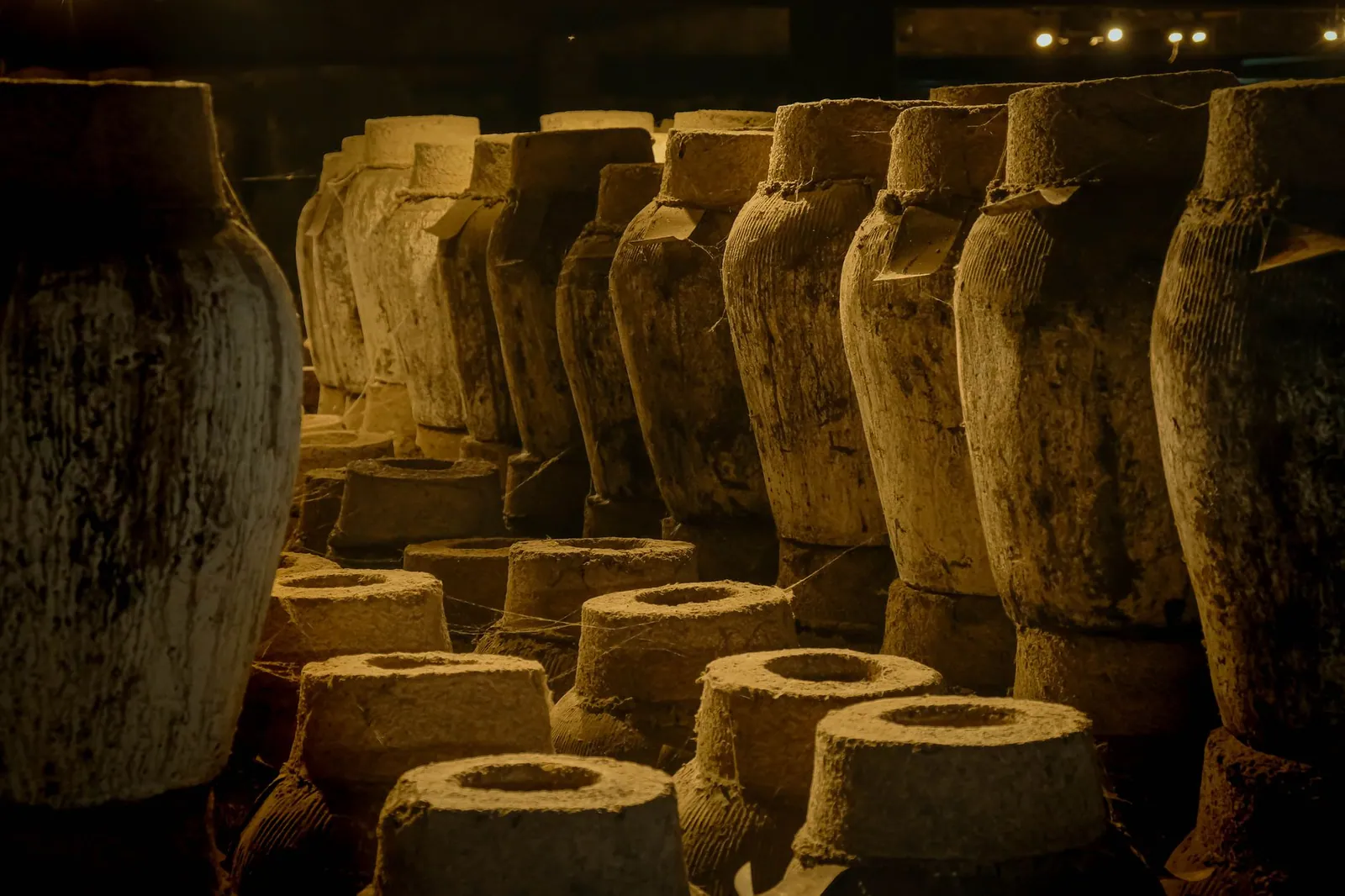
Amphorae, sea routes and a Roman hill made of broken jars: olive oil was one of the Mediterranean's first large-scale commodities.
Article
The Olive Oil Trade in the Ancient World
Amphorae, sea routes and a Roman hill made of broken jars: olive oil was one of the Mediterranean's first large-scale commodities.
 Article
History of the Olive
The olive was domesticated in the eastern Mediterranean some six thousand years ago. Traces in Anatolia, routes of spread and the birth of trade.
Article
History of the Olive
The olive was domesticated in the eastern Mediterranean some six thousand years ago. Traces in Anatolia, routes of spread and the birth of trade.
 Article
Edremit's monumental olives: four old trees, measured
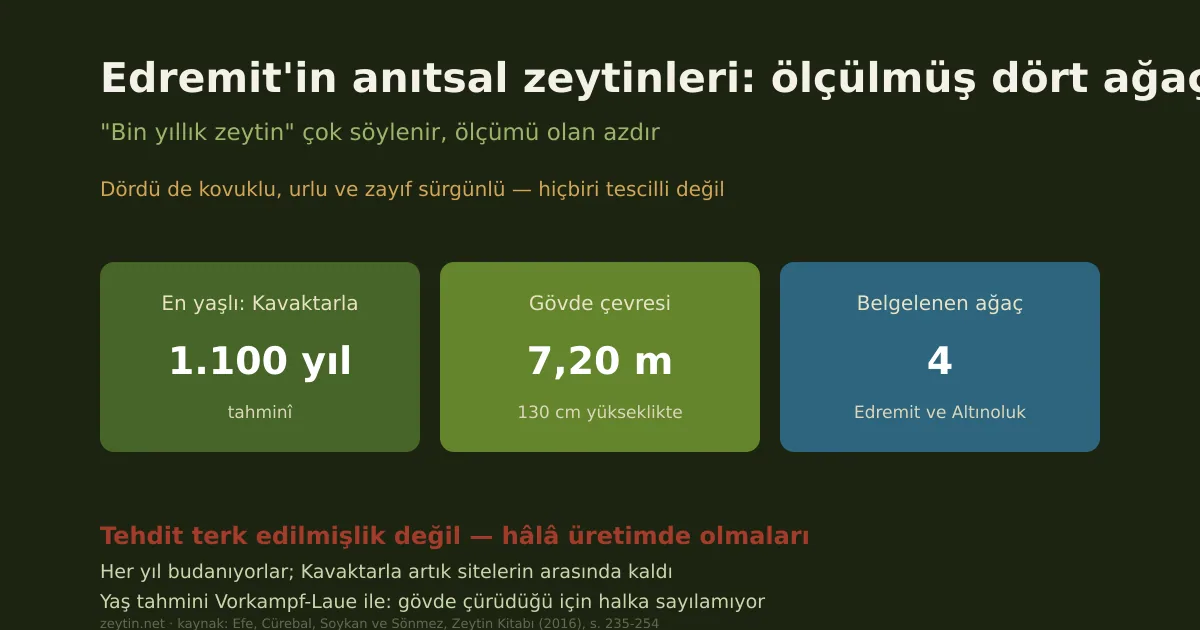
At an estimated 1,100 years and a 7.20 m girth, Kavaktarla is Edremit's oldest olive. All four are hollowed and galled, none is registered, and the real threat is that they are still in production.
Article
Edremit's monumental olives: four old trees, measured
At an estimated 1,100 years and a 7.20 m girth, Kavaktarla is Edremit's oldest olive. All four are hollowed and galled, none is registered, and the real threat is that they are still in production.