The real price of olive oil: the inflation-adjusted calculation
The lira price rose 11.5-fold, inflation 7.6-fold. The real increase is 1.56-fold — and it matches the euro-based calculation.
We wrote earlier on this site that the lira price of olive oil rose thirteen-fold since 2019, but the increase in euros was only 1.6-fold — meaning most of the rise was currency. That article ended with a promise: we would publish the inflation-adjusted calculation once we had a verified consumer price index.
We have the index. Here is the calculation.
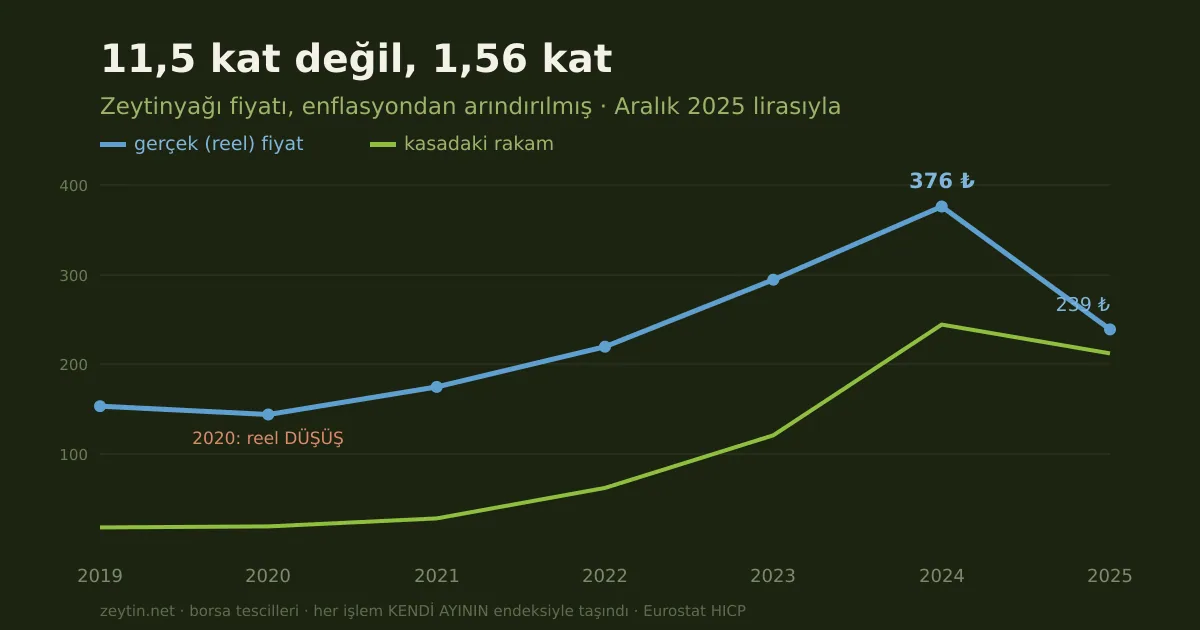
Method
Adjusting for inflation is not done with a single multiplier. Correcting a year's average price by that year's average inflation produces serious error in periods when prices move quickly.
The right way is this: each transaction is carried forward by the index of the month it took place in. That is what we did.
- Prices: extra virgin olive oil registrations on the Aydın, Edremit, Nazilli, Gaziantep and Bandırma exchanges — 1,257 records.
- Index: Türkiye's consumer price index, monthly, 84 months (January 2019 – December 2025).
- Operation: each registration's price divided by its own month's index and multiplied by the latest month's. Annual values are volume-weighted.
Results are expressed in December 2025 lira.
The table
| Year | Nominal TL/kg | Nominal rise | Inflation | Real TL/kg* | Real rise |
|---|---|---|---|---|---|
| 2019 | 18.53 | 1.00× | 1.00× | 153.51 | 1.00× |
| 2020 | 19.59 | 1.06× | 1.12× | 144.29 | 0.94× |
| 2021 | 28.51 | 1.54× | 1.34× | 175.03 | 1.14× |
| 2022 | 62.46 | 3.37× | 2.31× | 219.86 | 1.43× |
| 2023 | 121.09 | 6.54× | 3.56× | 294.48 | 1.92× |
| 2024 | 244.45 | 13.20× | 5.65× | 376.10 | 2.45× |
| 2025 | 212.41 | 11.47× | 7.62× | 239.07 | 1.56× |
* In December 2025 lira. 2026 registrations are excluded: the index series we use ends in December 2025 and we do not extrapolate. Index source below.
The answer: not 11.5×, but 1.56×
Between 2019 and 2025 the lira price of olive oil rose 11.5-fold. Over the same period the general price level rose 7.6-fold.
The difference is the real increase: 1.56×, or 56%.
That figure matters to us for another reason: our earlier calculation in euros gave 1.6×. Two independent methods — one using exchange rates, the other a consumer price index — arrive at almost the same answer. Two measurements that confirm each other are far more reliable than one.
2020: the year the price actually fell
The most surprising row is 2020.
That year the lira price of olive oil rose, from 18.53 to 19.59. But because inflation ran 12% over the same period, the real price fell from 153.51 to 144.29 — a decline of 6%.
That is what growers felt: the money coming in looked larger, what it bought was smaller. Nobody reading nominal figures can see this.
The 2024 peak and the 2025 erosion
The real price peaks in 2024: 376 lira per kilogram in today's money, 2.45 times the 2019 level. That is genuine expense even after adjusting for inflation — it coincides with the years supply tightened across the Mediterranean, which we measured separately.
Then comes 2025 and the real price falls to 239 lira. A third gone in a single year.
How that erosion happened is worth noting: the nominal price fell from 244 to 212, a drop of 13%. But the real loss was 36%. Inflation covered the difference — even had the price stood still, the grower would have lost.
For a grower the sentence reads: in 2025 olive oil did not get cheaper, money got dearer.
Three measurements side by side
We measured the same series in three units, and the three say three different things:
| Measure | Increase | What it describes |
|---|---|---|
| Turkish lira (nominal) | 11.5× | The figure in the till |
| Euro | 1.6× | Value on world markets |
| Inflation-adjusted | 1.56× | Real domestic purchasing power |
When a news report says "olive oil went up eleven times", it is not saying anything false — but it is not saying anything about olive oil either. That sentence is about the currency.
The accurate sentence is: in real terms olive oil became about half as expensive again over six years, peaked in 2024, and gave back much of that gain in 2025.
Limits
2026 is not in the calculation. The index series we use ends in December 2025. The table will extend itself as new months are published; we do not fill the gap with estimates.
We measured with a consumer index, not a producer one. This answers "how much more expensive did olive oil become relative to the general consumption basket". A grower's input costs — fertiliser, diesel, crop protection, packaging — are a different basket and move differently. If we can reach an agricultural input index, we will run that calculation too.
These are exchange prices. Bulk, wholesale, registered. They cannot be compared directly with a shop label — the last link of the value chain is still the part we cannot measure.
Sources
The price series is data we collect ourselves from the open registration records of commodity exchanges affiliated with TOBB; it can be downloaded as CSV from our market page.
The consumer price index is the Türkiye series in Eurostat's harmonised index of consumer prices database (`prc_hicp_midx`, all items, monthly). It is open access and updates automatically from source.
For anyone wanting to repeat the calculation, the method is stated in full above: divide each registration by its own month's index, multiply by the latest month's, and average by volume. If you get a different answer, we would like to hear about it.
Related reading: Did olive oil go up 13.5 times, or 1.6? · How Spain's drought set the price · Tree to shelf: the value chain
One rating per visitor; you can change yours at any time. Ratings are real reader votes — no seeded or default scores.
Related
 Article
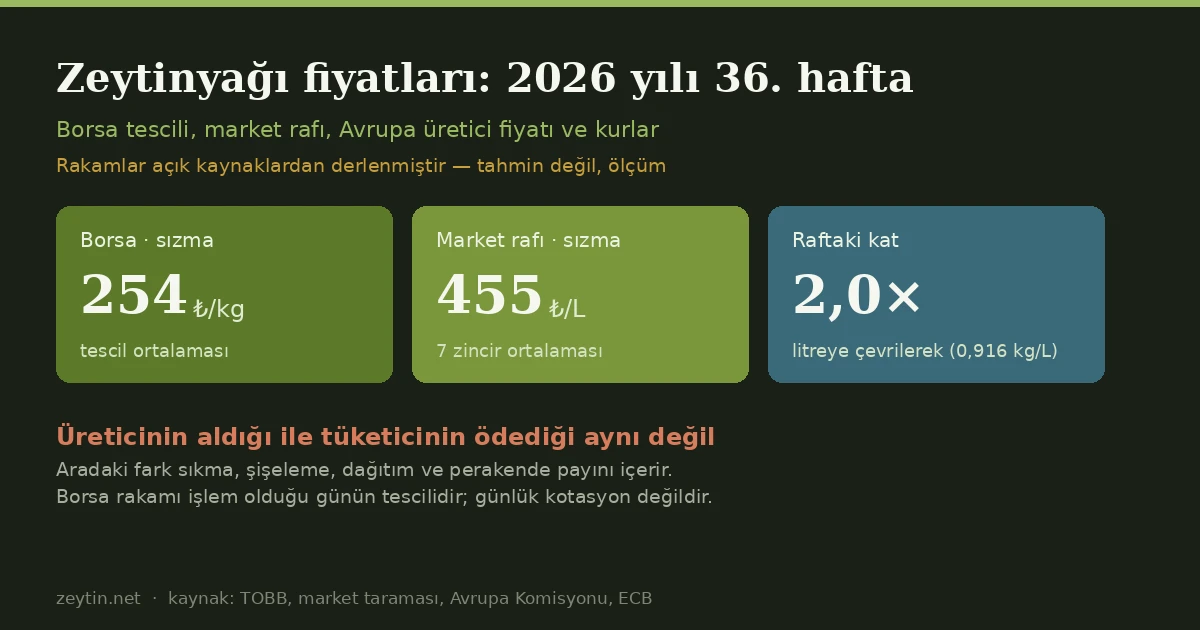
Olive Oil Prices: Week 36 of 2026
Week 36 of 2026: Turkish exchange prices, European producer prices and exchange rates side by side.
Article
Olive Oil Prices: Week 36 of 2026
Week 36 of 2026: Turkish exchange prices, European producer prices and exchange rates side by side.
 Article
Olive Oil Prices: Week 35 of 2026
Turkish exchange prices, European producer prices and exchange rates side by side: extra virgin at 300 TL/kg in Edremit, Spain's national average €3.52/kg.
Article
Olive Oil Prices: Week 35 of 2026
Turkish exchange prices, European producer prices and exchange rates side by side: extra virgin at 300 TL/kg in Edremit, Spain's national average €3.52/kg.
 Article
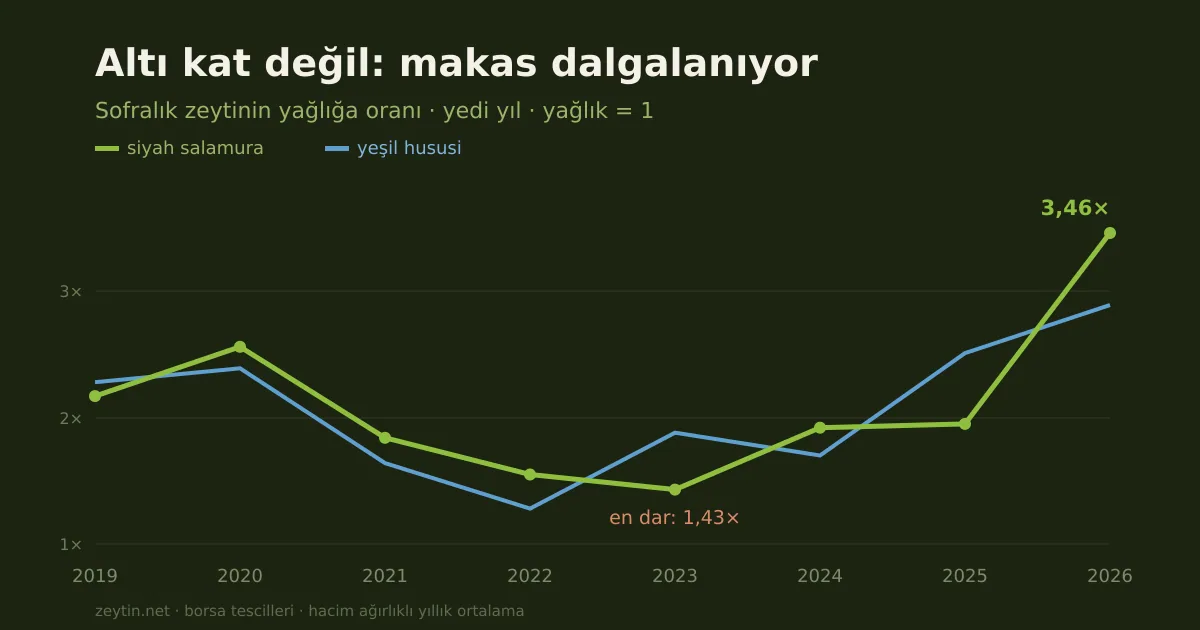
Was it six times? Seven years of the table olive gap
How many times the oil price does a table olive fetch? Over seven years the ratio ranged 1.43 to 3.46, never below 1.
Article
Was it six times? Seven years of the table olive gap
How many times the oil price does a table olive fetch? Over seven years the ratio ranged 1.43 to 3.46, never below 1.
 Article
Vegetation water and pomace: olive oil's waste problem
Processing 1.5–2 million tonnes of olives yields 1 million tonnes of vegetation water and 1 million tonnes of pomace. Waste, or resource?
Article
Vegetation water and pomace: olive oil's waste problem
Processing 1.5–2 million tonnes of olives yields 1 million tonnes of vegetation water and 1 million tonnes of pomace. Waste, or resource?