How many times more expensive is olive oil than sunflower oil? 12 years of world prices and today's shelf
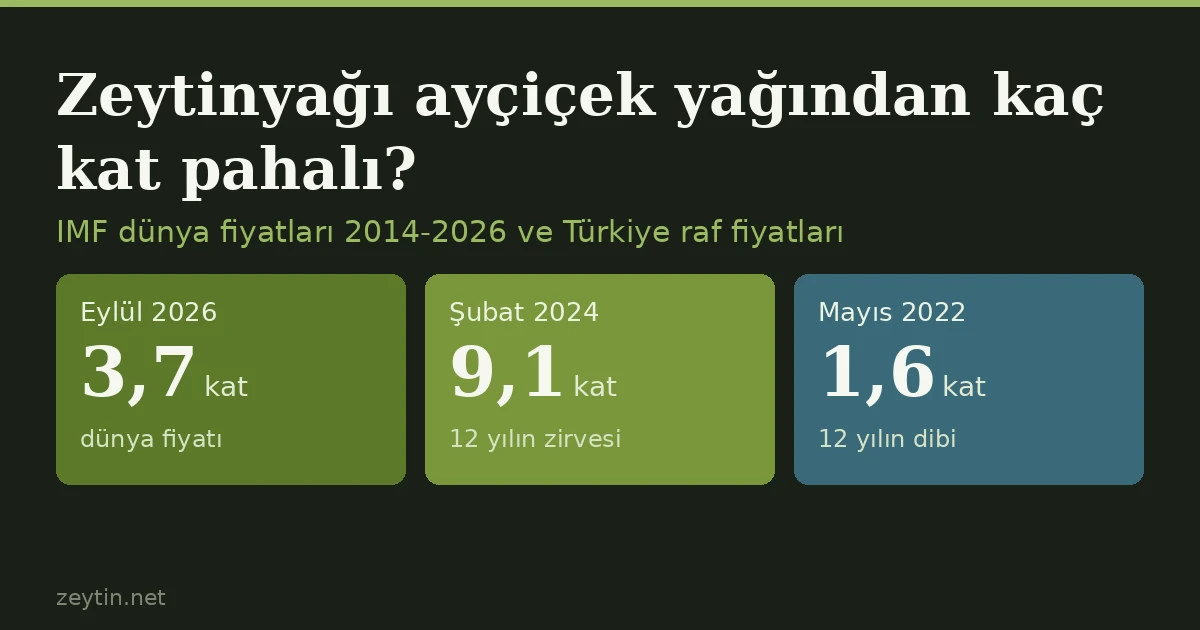
IMF data put olive oil at $6,205 and sunflower oil at $1,677 a tonne in September 2026: a ratio of 3.7. The ratio was around 4 in 2014-2019, fell to 1.6 in 2022 and topped 9 in 2024. On Turkish shelves it is 2.1 for the cheapest products and 3.1 in 5-litre packs.
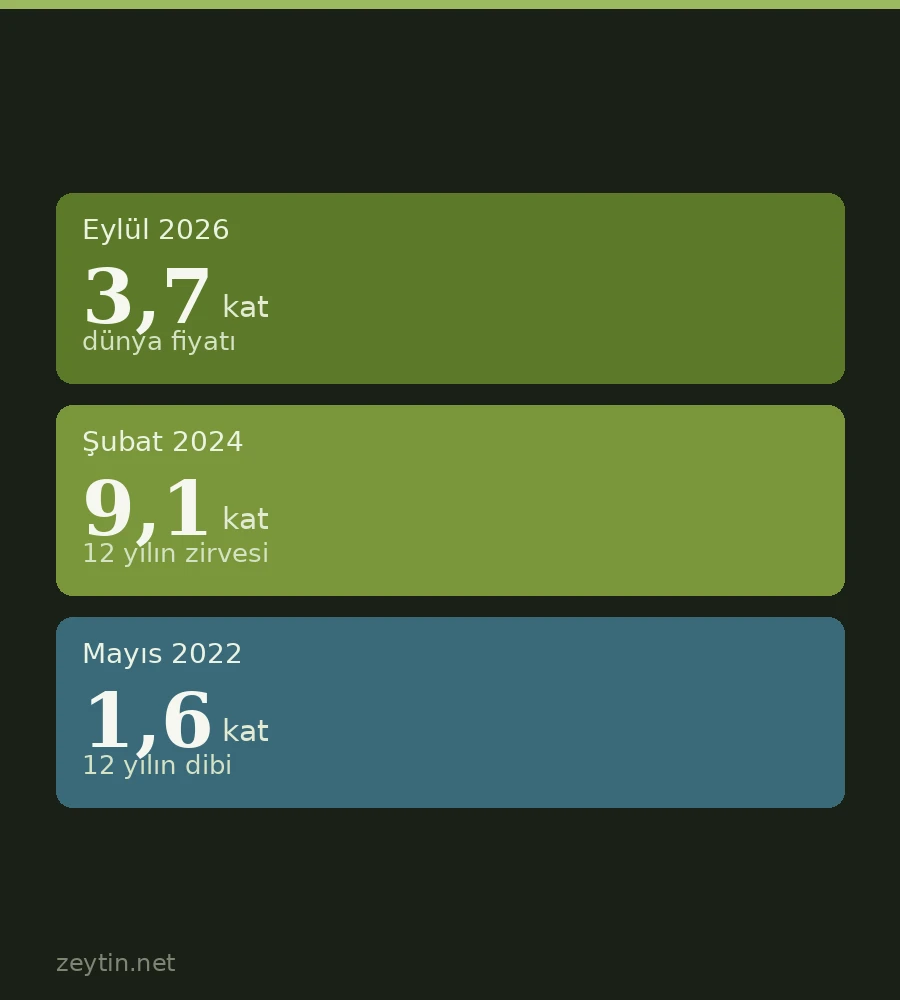
According to the International Monetary Fund's commodity price system, a tonne of olive oil cost $6,205 on the world market in September 2026, while a tonne of sunflower oil cost $1,677. Olive oil was 3.7 times as expensive as sunflower oil. That ratio is far from both the record prices of the past two years and the 2022 spike, when war sent sunflower oil soaring. On Turkish supermarket shelves, the gap ranges between two and three times depending on which products are compared.
This article answers the question not with a single number but with a 12-year series and today's shelf prices.
Today: 3.7 times on the world market
In the IMF's monthly series, olive oil and four major vegetable oils were priced as follows in September 2026:
| Oil | Price | Olive oil, times |
|---|---|---|
| Olive oil | 6,205 | — |
| Sunflower oil | 1,677 | 3.70 |
| Soybean oil | 1,596 | 3.89 |
| Rapeseed oil | 1,430 | 4.34 |
| Palm oil | 1,133 | 5.48 |
Source: IMF Primary Commodity Prices (PCPS), monthly averages, update of 6 October 2026. Ratios are our calculation.
A year earlier, in September 2025, the ratio was 3.69, so it has barely moved over twelve months. Both oils rose at almost exactly the same pace: olive oil by 6.6 percent, sunflower oil by 6.3 percent.
How the ratio moved over 12 years
To see where the ratio sits over the long run, we need annual averages going back to 2014.
| Year | Olive oil | Sunflower oil | Ratio |
|---|---|---|---|
| 2014 | 3,781 | 1,080 | 3.50 |
| 2015 | 4,293 | 1,022 | 4.20 |
| 2016 | 3,978 | 1,010 | 3.94 |
| 2017 | 4,530 | 953 | 4.75 |
| 2018 | 3,912 | 901 | 4.34 |
| 2019 | 3,166 | 884 | 3.58 |
| 2020* | 2,884 | 990 | 2.91 |
| 2021 | 4,185 | 1,719 | 2.43 |
| 2022 | 4,470 | 1,934 | 2.31 |
| 2023 | 7,710 | 1,218 | 6.33 |
| 2024 | 8,860 | 1,270 | 6.98 |
| 2025 | 5,465 | 1,526 | 3.58 |
| 2026 (9 months) | 6,162 | 1,768 | 3.48 |
Source: IMF PCPS. *The 2020 average covers January-October; the reason is explained under "Reading notes". Ratios are the ratio of annual average prices.
The table shows three distinct periods.
2014-2019: around four times. Over these six years the monthly ratio averaged 4.06. The lowest value was 2.95 in December 2019 and the highest 5.15 in August 2015. This period can reasonably be seen as olive oil's "normal" premium.
2020-2022: the gap closed. This time the move came from sunflower oil rather than olive oil. Sunflower oil became more expensive through 2021, and when war disrupted supply from the Black Sea in spring 2022 it peaked at $2,537 per tonne in April 2022, the highest point in the series. In May 2022 the ratio fell to 1.64, the lowest in 12 years. In those months olive oil cost less than twice as much as sunflower oil.
2023-2024: the gap blew open. Two consecutive drought seasons in Spain pushed olive oil prices to historic levels; we described how the Andalusian drought fed through to Turkish prices in a separate article. In the IMF series, olive oil peaked at $10,281 per tonne in January 2024. Sunflower oil, meanwhile, had fallen to around $1,100. In February 2024 the ratio reached 9.07: the price of one tonne of olive oil would have bought more than nine tonnes of sunflower oil.
Since 2025 the ratio has settled in a range of 3.4 to 3.8. Olive oil is 40 percent below its peak, sunflower oil 34 percent below its 2022 high. The median of the 12-year monthly series is 3.83, so today's 3.70 sits slightly below it.
Against the other oils
Making the same comparison with the other seed oils changes the picture somewhat. In 2014-2019, measured as the average of the annual ratios, olive oil cost 6.5 times as much as palm oil, 5.6 times as much as soybean oil, 4.7 times as much as rapeseed oil and 4.1 times as much as sunflower oil. Today those ratios are 5.5, 3.9, 4.3 and 3.7 respectively.
In other words, olive oil now sits below its 2014-2019 average premium against all four oils. The largest narrowing is against soybean oil: olive oil's premium over soy is about 30 percent smaller than the average of that period. The reason is not that olive oil has become cheap but that soybean oil has risen through 2026; in the IMF series it climbed from $1,111 per tonne in January to $1,596 in September.
How many times on the shelf?
World prices are bulk prices. The price of oil on a supermarket shelf also includes the bottle, transport, distribution and the retailer's margin. Data we pulled from the Turkish Trade Ministry's official supermarket price service on the morning of 27 October look like this:
| Comparison | Extra virgin olive oil | Sunflower oil | Times |
|---|---|---|---|
| Cheapest 1-litre product | 249.00 | 119.50 | 2.08 |
| Median 1-litre price | 359.00 | 125.47 | 2.86 |
| Same store brand, 1 litre | 309.50 | 125.95 | 2.46 |
| Same store brand, 5 litres | 299.99 | 95.99 | 3.13 |
Source: Turkish Trade Ministry supermarket price service, 27 October 2026. In the 1-litre size, 23 extra virgin and 10 sunflower oil products; the median is the middle of each product's lowest price. The "same store brand" rows are one chain's own label. Ratios are our calculation.
On the shelf the gap is clearly narrower than on the world market. Between the cheapest extra virgin olive oil and the cheapest sunflower oil there is a factor of only 2.1. One reason is fixed costs: the bottle, label, transport and shelf margin cost similar amounts per litre for both oils, and they make up a larger share of the price of the cheaper product. In the 5-litre pack that fixed share shrinks, and the ratio rises to 3.1, close to the world figure. We looked separately at how pack size affects price in our article on large packs.
Why the ratio matters
For consumers: The ratio shapes the kitchen calculation of which oil is used for what. We explained in our frying article that olive oil can be used for frying too, but a threefold difference is the economic reason most households fry with sunflower oil.
For enforcement: The wider the gap between olive oil and cheap seed oils, the bigger the payoff from blending seed oil into olive oil. The gap of 2023-2024, averaging 6.8 times and peaking at 9, was the period when selling adulterated oil paid best. How adulteration is done and how it is caught is covered in our fraud and adulteration article.
For producers: Sunflower oil indirectly sets a ceiling on olive oil demand. When the gap gets too wide, consumers switch to the cheaper oil. The return of the ratio to around 3.5 after 2024, as olive oil prices fell, suggests the market has settled back into that balance.
Reading notes
⚠ The benchmark matters. The IMF olive oil benchmark is the price of extra virgin olive oil with less than 1 percent free acidity, delivered ex-tanker in the United Kingdom, and it is higher than producer prices around the Mediterranean. Using the European Commission's Spanish producer price for the week to 18 October (€3.26 per kilogram, about $3,647 per tonne), the ratio drops to 2.2. Which olive oil price you take changes the answer.
⚠ The last two months of 2020 are excluded. The IMF series shows olive oil at $1,300-1,400 per tonne for November and December 2020, against $3,286 and $3,468 in the months immediately before and after. Because this break is inconsistent with the rest of the series, those two months were left out of the averages.
⚠ Kilograms and litres. World prices are per tonne, shelf prices per litre. The densities of the two oils are very close (about 0.91-0.92 kilograms per litre), so the ratios are comparable.
⚠ A shelf price is a snapshot of one day. Promotions and stock levels change prices from day to day.
One rating per visitor; you can change yours at any time. Ratings are real reader votes — no seeded or default scores.
Related
 Article
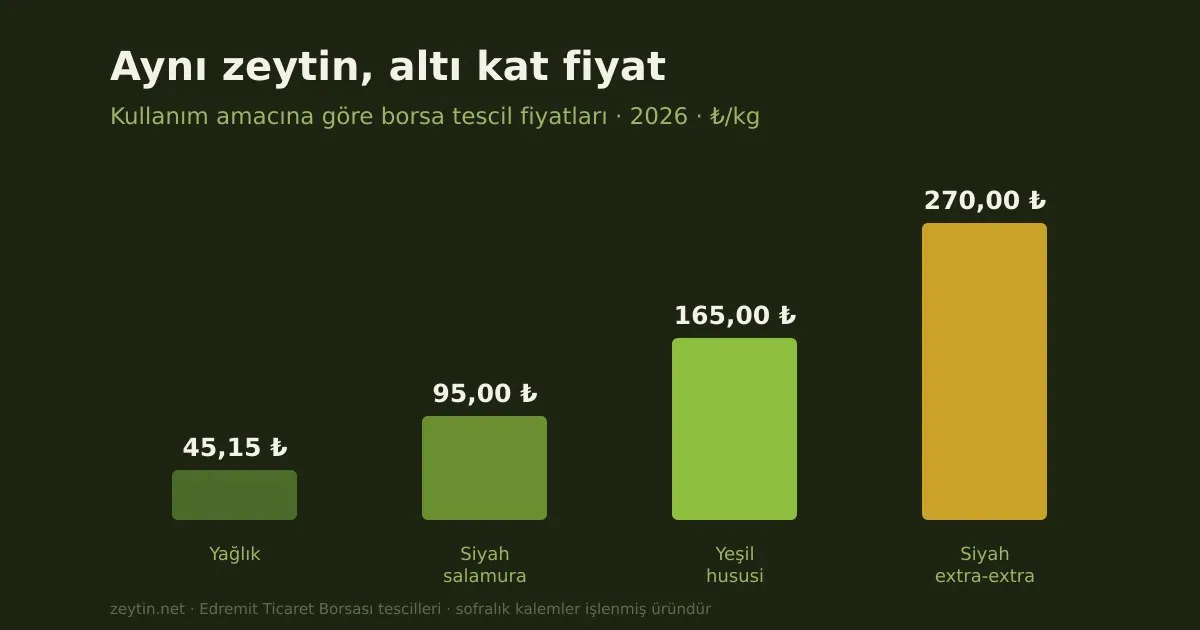
The same olive, six times the price: the quiet advantage of table olives
How much more does the same fruit fetch as a table olive than for oil? Measured over seven years of exchange data: 1.43 to 3.46 times.
 Article
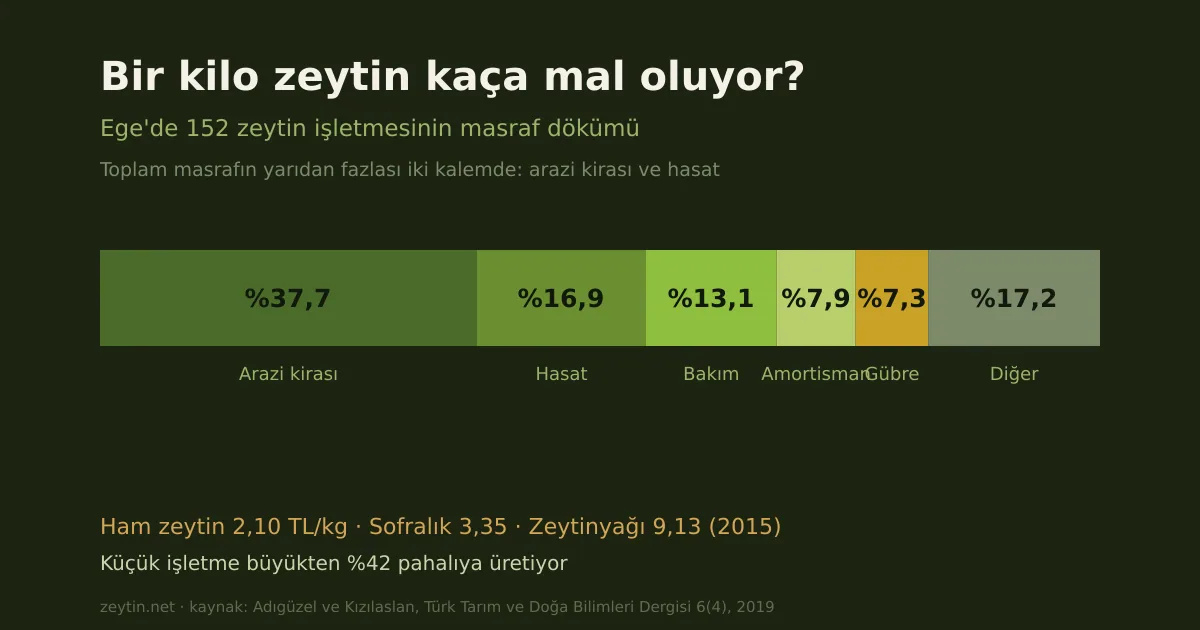
What does a kilo of olives cost? The cost sheet of 152 Aegean farms
Land rent is 37.70% of cost, harvest 16.90%. In table olives 73% of processing cost is rejected fruit; in oil, 94% is the fruit itself.
 Article
How much is the olive picking and pruning daily wage in 2026?
Turkish chambers recommend 1,200-1,500 lira a day for olive picking in 2026/27, up to 1,900 for shaking and 1,750 for pruning; none is binding.
 Article
Climate change and the olive: the tree survives, but will it crop?
The olive is drought-hardy but works in narrow bands. 85% of Türkiye's groves are unirrigated, 75% on mountainous land.