How to Store Olives: From an Opened Jar to a Winter Batch
How long does an opened jar last, what to do when the brine runs low, how to keep dry-cured olives? Why mould forms and what the white film actually is.

Stored properly, olives keep for months; stored badly they mould within days. The difference comes down to one rule: the fruit must stay below the liquid.
An opened jar
Keep it refrigerated. The critical point is that the olives stay under the brine — any that rise meet air, and that is where mould starts. As the jar empties the olives rise, so a half-finished jar is riskier than a full one.
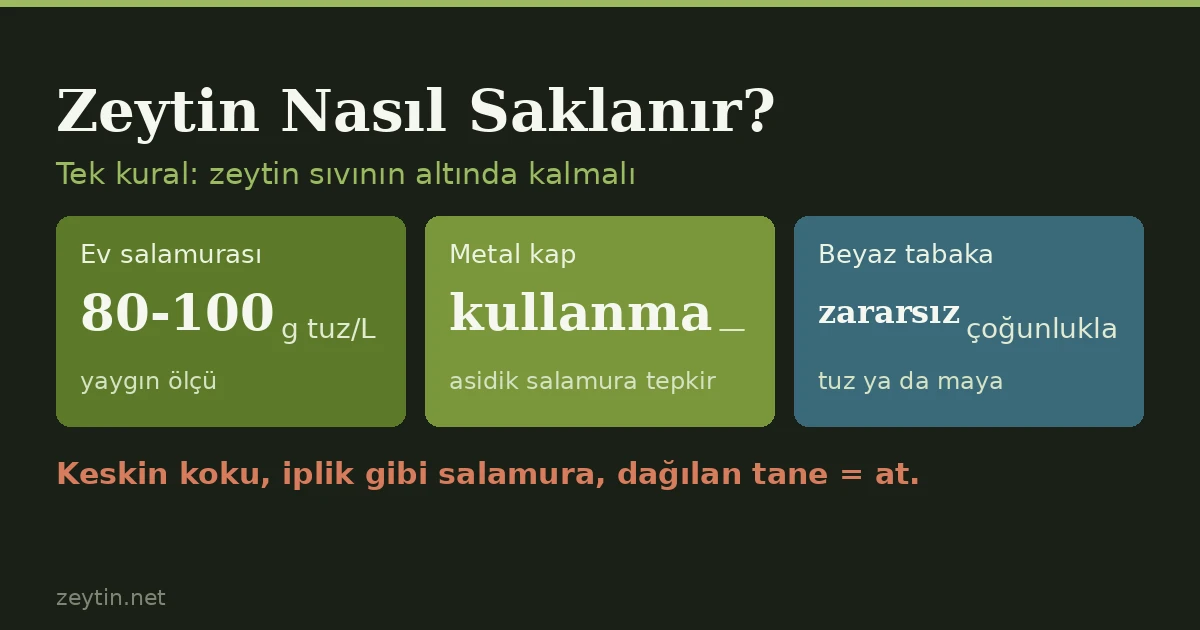
The fix is simple: pour a finger of olive oil on top. The oil forms a thin layer and cuts off air. It is a generations-old household method and still the most practical.
When the brine runs low
Top up with salted water that has been boiled and cooled. Boiling removes microorganisms; adding tap water straight dilutes the brine and speeds spoilage.
Salt matters: too little spoils the brine, too much shrivels the fruit. A common home measure is roughly 80-100 grams of salt per litre.
Never use metal
Use glass or food-grade plastic. Not metal — acidic brine reacts with it and the result carries into taste and colour. That reaction is not incidental: throwing scrap iron into a tank to darken olives is a known fraud method in industry. At home the same thing happens by accident.
What is the white film?
Usually harmless — either salt crystals or the natural yeast flora of the brine. It can be skimmed off.
But three signs mean spoilage and the batch should go: a sharp bad smell beyond sourness; cloudy, stringy brine; fruit collapsing into mush. If in doubt, do not taste — discard.
Dry-cured olives
These are made in dry salt rather than brine and are already durable. They keep well in a closed container in a cool place, and longer in the fridge. A little olive oil slows drying. The wrinkled look is the method's natural result, not spoilage.
Can they be frozen?
Technically yes, but it is not advised. Freezing damages cell structure and the fruit turns soft on thawing. Olives already keep long; freezing is unnecessary.
Why do olives mould?
Mould is not an accident but a result of conditions, and it needs three things at once: air, moisture and salt that is too low. Olives under the brine have no air, so mould does not start there. A single fruit above the surface can be the starting point for the whole jar.
The second cause is dilution. Taking olives out with a wet spoon carries water and microorganisms into the brine each time. Using a dry, clean fork is a more effective precaution than it looks.
Does it need refrigeration?
Unopened, no — a cool dark cupboard is enough. Once opened, yes: at room temperature fermentation speeds up, the brine clouds and the texture softens. Spoilage is usually slow rather than sudden; the taste turns sour over days and by the time it is noticed the batch is gone.
How long does it keep?
| Condition | Time |
|---|---|
| Unopened pack | To the date on the label |
| Opened, refrigerated, under brine | Several months |
| Opened, sealed with olive oil on top | Longer |
| Dry-cured, closed container | Months |
| Without brine, exposed | Days |
Sealing with olive oil
A layer of oil not only cuts off air but adds flavour. Thyme, bay leaf, garlic or lemon peel are common household additions. They do not extend storage — the oil layer and the salt do the preserving, not the herbs.
The quality of the oil carries into the taste; a stale oil will spoil good olives. It need not be an expensive extra virgin, but it must be one that has been stored properly.
One rating per visitor; you can change yours at any time. Ratings are real reader votes — no seeded or default scores.
Related
 Article
World olive varieties: from Picual to Kalamata
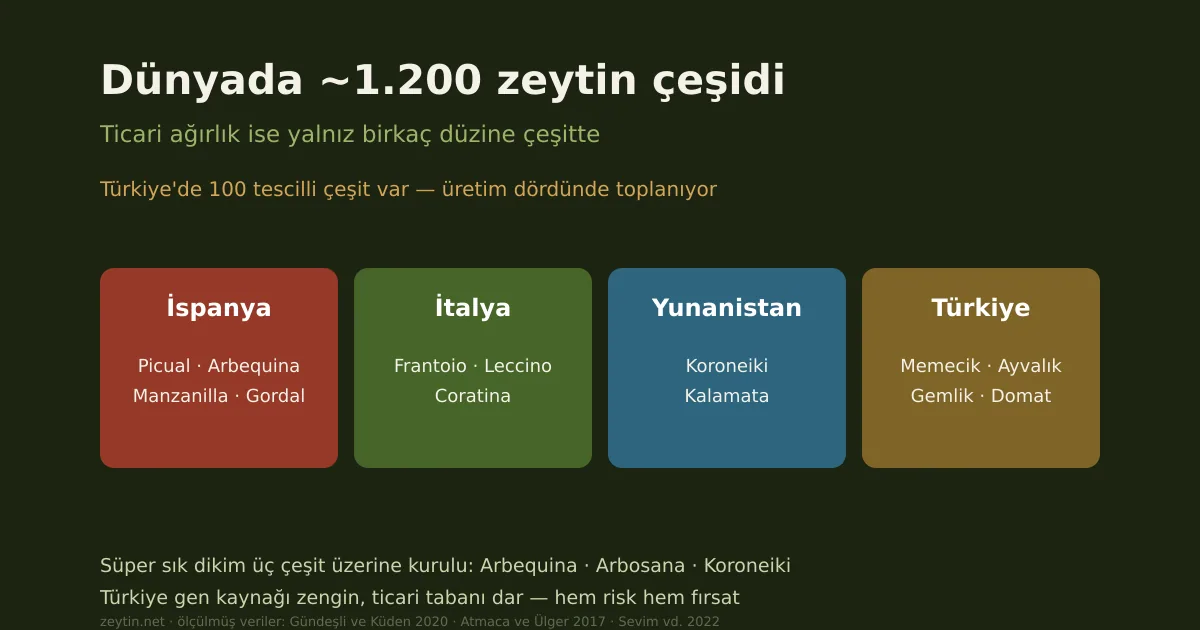
About 1,200 cultivars exist; commercial weight sits in a few dozen. Picual, Arbequina, Koroneiki, Kalamata, Frantoio — compared with Türkiye.
Article
World olive varieties: from Picual to Kalamata
About 1,200 cultivars exist; commercial weight sits in a few dozen. Picual, Arbequina, Koroneiki, Kalamata, Frantoio — compared with Türkiye.
 Article
Olea europaea: the botany of the olive tree
The olive's scientific name and classification, why its leaves are silver, its floral structure, the layers of its fruit, its root system and lifespan — and how the wild oleaster relates to the orchard olive.
Article
Olea europaea: the botany of the olive tree
The olive's scientific name and classification, why its leaves are silver, its floral structure, the layers of its fruit, its root system and lifespan — and how the wild oleaster relates to the orchard olive.
 Article
Hursuki olive
Hursuki is a recorded variety of south-eastern Anatolia. No measured pomological data published.
Article
Hursuki olive
Hursuki is a recorded variety of south-eastern Anatolia. No measured pomological data published.
 Article
Mission olive: United States's table and oil variety
America's historic variety: carried by the Spanish missions, it built California's black table olive industry.
Article
Mission olive: United States's table and oil variety
America's historic variety: carried by the Spanish missions, it built California's black table olive industry.