Milas Ekşili Olive: a table olive lightened with lemon
Registered in 2024. The aroma of lemon and olive oil is pronounced, and the astringency of other table olives is absent. Total phenols at least 135.38 mg/100 g.
In Milas, olives go to different products at different stages of ripeness. Milas Ekşili Olive is one of them, and what distinguishes it is an addition: lemon.
The record
| Registration no | 1691 |
| Protection from | 12.08.2022 |
| Type | Geographical indication |
| Registered by | Milas Chamber of Commerce and Industry |
| Area | The Milas district of Muğla |
| Cultivar | Memecik |
What the lemon does
According to the certificate the product has a pronounced aroma formed by lemon and olive oil, and a striking colour. Compared with ripe oily olives and fully ripe pressed olives, it is lighter, through the effect of lemon acidity.

The absence of one negative is also recorded: “the astringency felt in other table types is not perceived.”
Astringency is the drying sensation left by phenolic compounds. Acid masks it; lemon here performs a technical function.
Two colours
The certificate separates them:
| Colour | |
|---|---|
| Fruit to be processed | light green / pink variegated |
| Product after processing | light green / yellow variegated |
The raw material leans pink while the finished product leans yellow.
Measured values
| Criterion | Value |
|---|---|
| Fruit length | 2.3 – 2.6 cm |
| Fruit width | 0.8 – 1.2 cm |
| Stone length | 0.8 – 1.2 cm |
| Stone width | 0.8 – 1 cm |
| Fruits/kg (minimum) | 180 |
| Salt in fruit (maximum) | 3% |
| Brine pH (minimum) | 3.73 |
| Total phenols (minimum) | 135.38 mg/100 g |
| Moisture (minimum) | 71.69% |
| Oil (minimum) | 19.27% |
Capping salt at 3% stands out — table olives usually run 5-7%. Low salt, together with the acidity of lemon, completes the description of “lightness”.
Four registrations in Milas
Milas alone carries four olive registrations: Milas Olive Oil (201), Milas Oil-Cured Olive (446), Milas Ekşili Olive (1691) and Milas Çekişke Olive (1109). Four different products from one cultivar — Memecik.
The cultivar behind it, measured
The registration is granted to a place, but the cultivar the definition rests on has measurable values:
| Property | Value |
|---|---|
| 1 kg’daki tane sayısı | 210 |
| Et oranı | %88 |
| Et / çekirdek oranı | 5,86 |
| Et/çekirdek oranı | 6,7 |
| Yağ oranı | %25-28 |
| Toplam fenol | 296-407 mg CAE/kg |
| α-tokoferol | 219-324 mg/kg |
| Olgunlaşma | Kasım ortası - aralık ortası |
| Kendine verimlilik | Kısmi |
| Soğuğa dayanım | Orta |
| Kullanım | Yağlık; yeşil ve siyah sofralık olarak da tüketilir |
| Ağaç | yarı dik, kuvvetli |
Oil content reaches 28% at the top of its range — on its own enough to justify pressing. The cultivar is partially self-fertile; pollinators are used to secure yield. A flesh-to-stone ratio of 5.86 is the basic measure of how much of a table olive is actually eaten.
Its place in Muğla's olive production
| Item | Value |
|---|---|
| Fruit production | 174,376 t |
| — for oil | 162,632 t |
| — for the table | 11,744 t |
| Olive oil production | 32,142 t |
| Trees | 14,844 thousand |
| Yield per tree | 11.7 kg |
93% of the province's fruit goes to oil — so this table-olive registration defines a niche outside the main flow.
Masking the phenols instead of removing them
Two of the document's requirements look contradictory at first:
- Total phenol of at least 135.38 mg/100 g — phenol is protected by a floor.
- "The astringency felt in other table types is not perceived" — the best-known sensory consequence of phenol is not wanted.
Phenolic compounds are the source of bitterness and astringency in olives. The study by Yemişçioğlu and colleagues (2016) on Memecik measures that link: there is a statistically significant relationship between total polyphenol and the bitterness index K225 (P<0.01), expressible as a logarithmic equation. Bitterness is not an impression but the counterpart of a measurable phenol content.
So how do you keep the phenol and lose the astringency?
The classical route in table olive processing is to remove the phenol — a lye treatment breaks down oleuropein and long brining washes it out. The cost is that the antioxidant value goes with it.
Milas Ekşili takes another route: it leaves the phenol in place and masks its sensory effect with acid. Three figures in the document set this up together:
| Criterion | Requirement | Function |
|---|---|---|
| Total phenol | ≥ 135.38 mg/100 g | the value being kept |
| Brine pH | ≥ 3.73 | acidic medium — suppresses astringency |
| Salt in fruit | ≤ 3% | salt masking kept low |
The third row confirms the reading. Salt in table olives is usually 5-7%, and salt is itself a masking agent. Here it is deliberately kept low, because the masking is done by lemon acidity. Keeping salt high as well would break the "lightness" the document describes.
The result is a table olive that is both high in phenol and free of astringency. Nutritionally, that means a method which — unlike classical lye processing — preserves the phenolic value. We covered the compounds themselves in oleocanthal and polyphenols.
⚠ One note: because the values in the document are floors, products may exceed them; the registration sets no ceiling.
Further sources
- Yemişçioğlu, F., Özdikicierler, O., Çapar, S. & Gümüşkesen, A.S. (2016). The effect of ripeness degree on total polyphenol content and bitterness index of virgin olive oil in Memecik and Erkence olive cultivars. Gıda, 41(6), 381-386.
One rating per visitor; you can change yours at any time. Ratings are real reader votes — no seeded or default scores.
Related
 Article
Tavşanyüreği olive
Tavşanyüreği is a recorded variety of the Mediterranean. Described in the source.
 Article
Sat olive
Sat is a recorded variety of the Black Sea. No measured pomological data published.
 Article
Kilis Yağlık olive: characteristics, oil content and growing areas
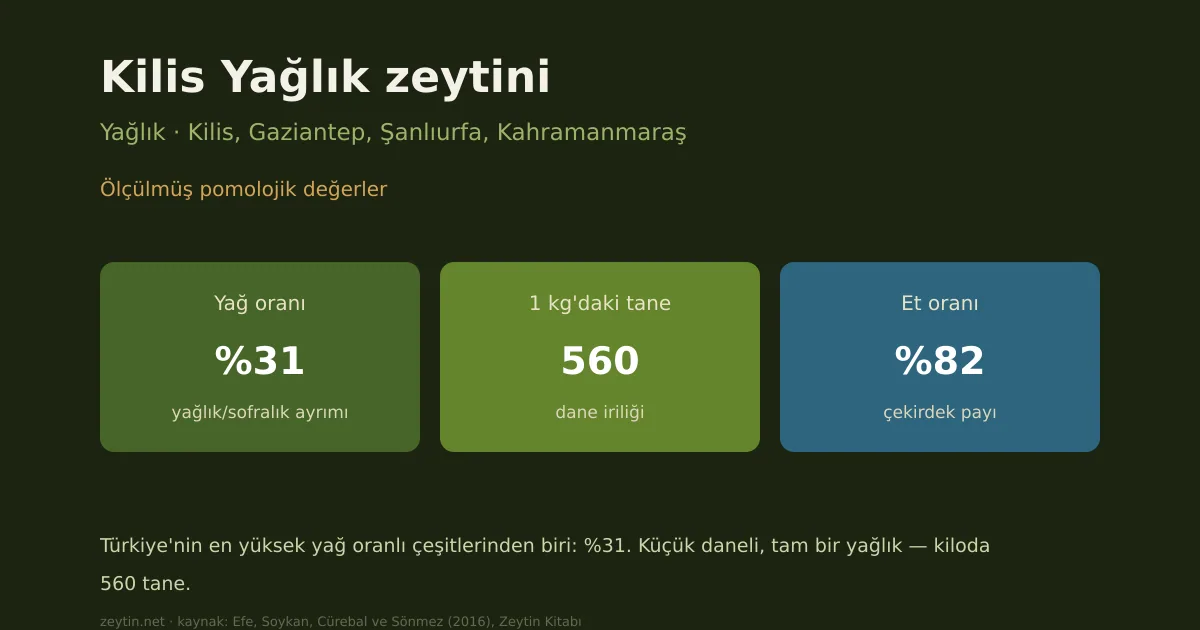
One of Türkiye's highest oil-yielding varieties at 31%. Small-fruited and purely for oil — 560 fruits per kilo.
 Article
The Olive Harvest: When and How
Early harvest or late? The timing of picking directly determines the oil's acidity, polyphenols and yield.