Do batches get mixed at the olive mill? Dead volume in the line and milling order
A mill line does not empty completely between batches: oil remains in the crusher, malaxer, decanter, separator and pipework. Part of the first oil out therefore comes from the previous batch. Why milling order is a rule, why organic certification requires line cleaning, and what a grower should ask at the mill.
During milling season, one question crosses the mind of everyone who brings olives to the mill, though few ask it out loud: "Is the oil I am handed really the oil of my olives?" It is not paranoia; it is an engineering question. And the answer is clear: the line does not empty completely between batches, so some degree of mixing is unavoidable. What matters is how much, and how it is managed.
The oil left in the line: dead volume
A modern continuous line is a chain of connected vessels and pumps. The fruit passes through these units in order:
| Unit | What stays inside |
|---|---|
| Washing and destemming | Leaves, soil, water; no oil |
| Crusher (hammer/disc) | A film of paste on the body |
| Malaxer | Paste and oil on paddles and walls |
| Paste pump and pipework | Paste equal to the pipe volume |
| Decanter (horizontal centrifuge) | Oil in the bowl and scroll |
| Vertical separator | Oil in the disc stack |
| Oil pump and line | Oil in pipes and valves |
The total internal volume of these units is called dead volume. When a new batch enters the line, it advances by pushing the oil and paste ahead of it. In practice this means the first oil out of a batch is largely oil from the previous batch, while the last oil out is largely the batch's own. Because the malaxer is the largest-volume vessel in the chain, it is also the most decisive point for mixing.
⚠ We could not find a published general figure for how much oil remains in the line; the value depends on the mill's capacity, pipe diameters and number of units. This page explains the mechanism and does not give a ratio. Only your own mill operator can tell you the figure for that plant.
This is why the real rule is milling order
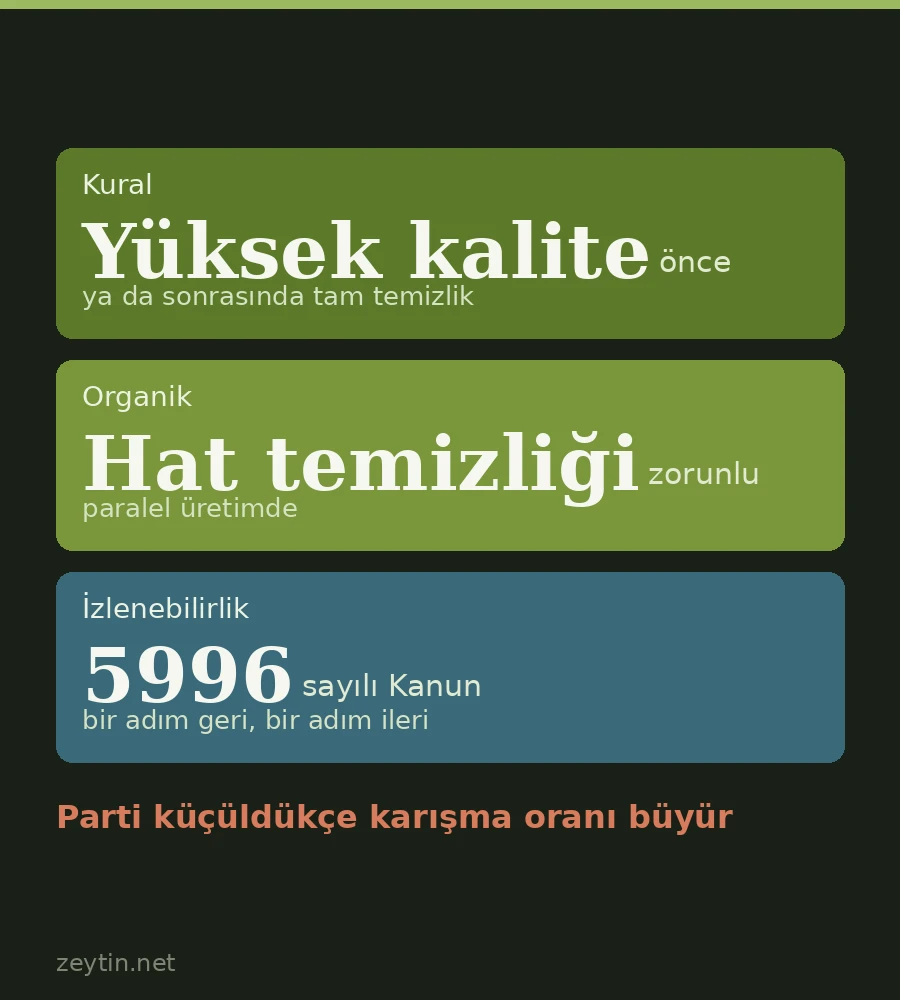
Rather than trying to reduce mixing to zero, the industry uses a different solution: manage the order. Turkish technical guidance states the rule as follows — when products of different quality are processed one after another, the high-quality olives are processed first, or the system is cleaned completely after low-quality olives have been processed.
The logic is simple. Dead volume always contaminates backwards, never forwards. If a poor batch follows a good one, the loss stays with the owner of the poor batch; if the order is reversed, the owner of the good batch receives oil from the mouldy, worm-infested or fermented fruit milled before them. Milling order is therefore not a courtesy but a quality decision.
For the same reason, the first milling of the day is the cleanest one. If the line has stood overnight, the oil left inside has oxidised and its acidity has risen, and that oil is not wanted in a fresh batch. Why acidity rises in standing oil is explained in what free acidity means.
What spoiled raw material leaves behind in the line is also measurable: defects appear by name on a tasting panel. The full list is in our article on olive oil tasting.
The small-batch disadvantage
Here the arithmetic works against the smallholder. Dead volume does not scale with batch size — it is whatever the line holds. So the smaller the batch, the larger the proportion of mixing. For a grower milling five tonnes, the residue in the line is negligible; for someone arriving with two crates, a noticeable share of the delivered oil may be someone else's.
This is also why mills ask for a minimum batch weight. The line has to be filled once, and with a very small batch that filling is larger than the batch itself. A grower with a few crates has two options: combine with neighbours into a single batch, or find a mill that runs a separate arrangement for small lots.
In organic certification, line cleaning is mandatory
Mixing also has a legal side, and it is clearest in organic production. Where organic and conventional products are processed on the same line at different times, cleaning the line before organic processing is mandatory. Buildings, tools and equipment used in conventional production may be used in organic production only after being cleaned and disinfected. In plants with parallel production, the sacks, containers and boxes holding organic product must be labelled at every step within the facility.
In practice this means organic olives are milled first and conventional olives afterwards, or a full cleaning is inserted between them. The field results of organic olive growing are discussed in organic olive cultivation.
The same care applies to valuable batches without certification: an early-harvest, single-cultivar, geographically registered or competition-bound oil deserves to be the first batch on the line. The cost and the value of early harvest are weighed in early harvest: expensive or valuable.
On a batch press, mixing comes from elsewhere
Alongside the continuous line, the batch press is still in use, and there the problem is not dead volume but the pressing mats. The paste is spread onto stacked fibre or synthetic mats and pressed; the pores of those mats retain paste and oil after every pressing. An unwashed mat is considered a classic residue point that carries a fermented odour into every subsequent batch.
So at a press the question changes: instead of "is the line washed," ask "how often are the mats washed." The other points where the continuous line and the batch press diverge are compared in how cold-pressed olive oil is produced.
Traceability: the mill's legal obligation
Keeping a record of what was milled, when and for whom is not optional. In Türkiye, traceability is mandatory under Law No. 5996 on Veterinary Services, Plant Health, Food and Feed; food business operators must establish traceability systems at all stages of production, processing and distribution. The core of the system is "one step back, one step forward": which raw-material lot came from which supplier, and which shipment lot went to which customer.
That is the grower's strongest tool. Because records must be kept, the question "what was milled before me" has to have an answer.
What to ask at the mill
| Question | Why it matters |
|---|---|
| What was milled before me? | If it was a low-quality batch, ask for cleaning |
| Is this the line's first run today? | Oil left overnight has higher acidity |
| Is the line cleaned between batches? | Shows how the mill is run |
| Can the first oil out be set aside? | The most practical way to limit mixing on a small batch |
| What is the minimum batch weight? | A batch small relative to dead volume is a problem |
| Will I get a weighbridge slip and yield record? | The record of the oil handed over |
The whole preparation before milling — waiting time, transport container, two-phase versus three-phase, the form of the milling fee — is set out as a checklist in what to watch for when milling at a mill. How long olives can wait is covered in how soon must harvested olives be pressed, and the line's temperature and time settings in how cold-pressed oil is produced.
If doubt remains after you take delivery, the laboratory settles it: free acidity, peroxide value and sensory analysis read together reveal the character of the batch. How to read the report is explained in how to read an olive oil analysis report.
In short
Some mixing of batches at the mill comes from the physics of the line, not from bad faith: oil remains in every unit from crusher to separator, and the next batch advances by pushing it along. The industry's answer is therefore not "no mixing at all" but getting the order right and washing the line when needed. In organic production this is a regulatory requirement; for a high-quality batch it is simply the grower's own interest. The practical summary: make small batches bigger, put the good batch first, and ask what was milled ahead of you.
One rating per visitor; you can change yours at any time. Ratings are real reader votes — no seeded or default scores.
Related
 Article
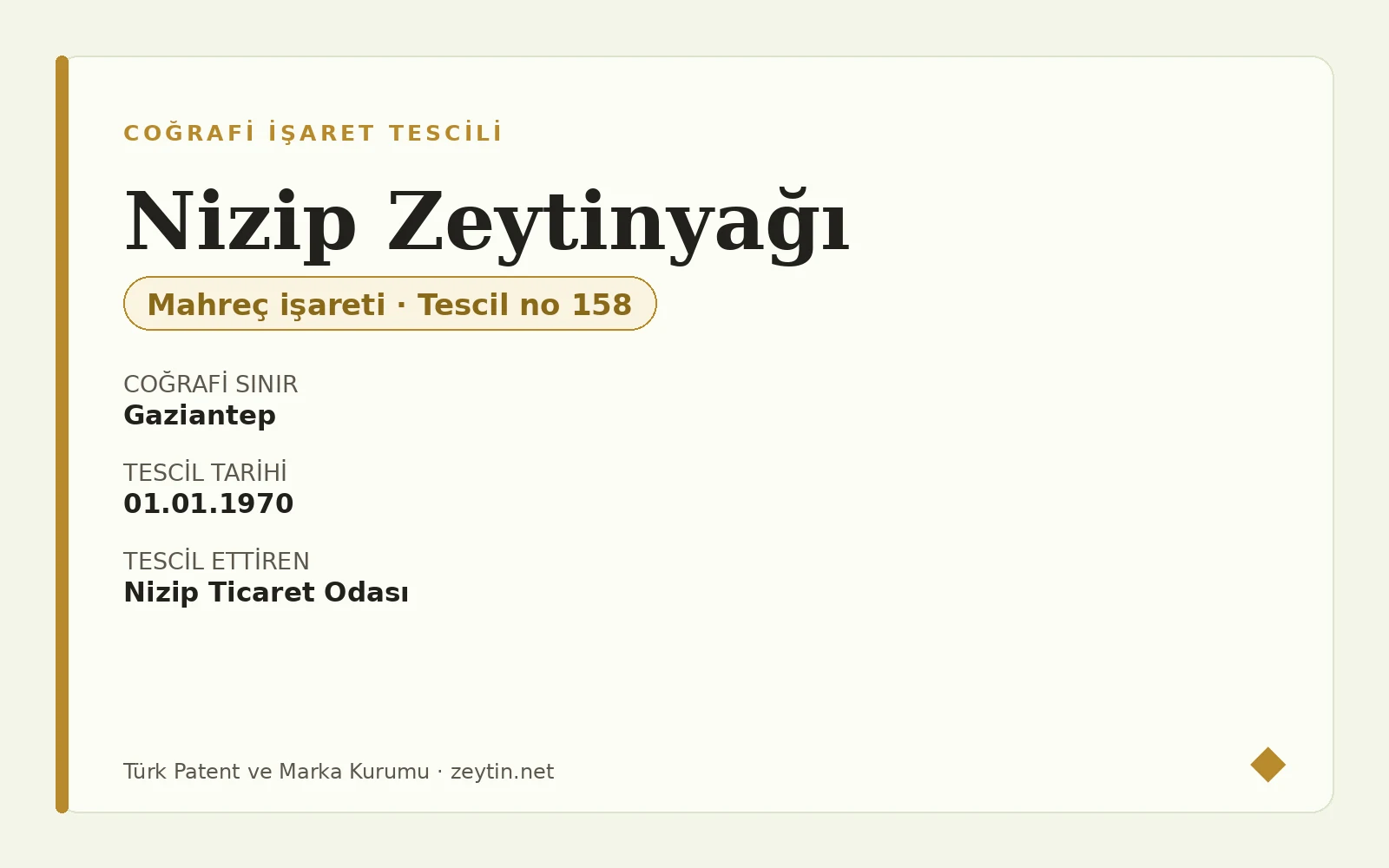
Nizip Olive Oil: a registration that sets a floor for its raw material
Registered in 2011. The certificate sets conditions on the fruit, not just the oil: 15-17 mm wide, 19-20 mm long, at least 25% oil. Fruit outside that cannot be used.
Article
Nizip Olive Oil: a registration that sets a floor for its raw material
Registered in 2011. The certificate sets conditions on the fruit, not just the oil: 15-17 mm wide, 19-20 mm long, at least 25% oil. Fruit outside that cannot be used.
 Article
Tarsus Sarıulak Olive Oil: milling required immediately after harvest
Registered in 2020. The certificate ties product quality to one condition: the olives must be milled as soon as they are picked. Peroxide averages 8.23.
Article
Tarsus Sarıulak Olive Oil: milling required immediately after harvest
Registered in 2020. The certificate ties product quality to one condition: the olives must be milled as soon as they are picked. Peroxide averages 8.23.
 Article
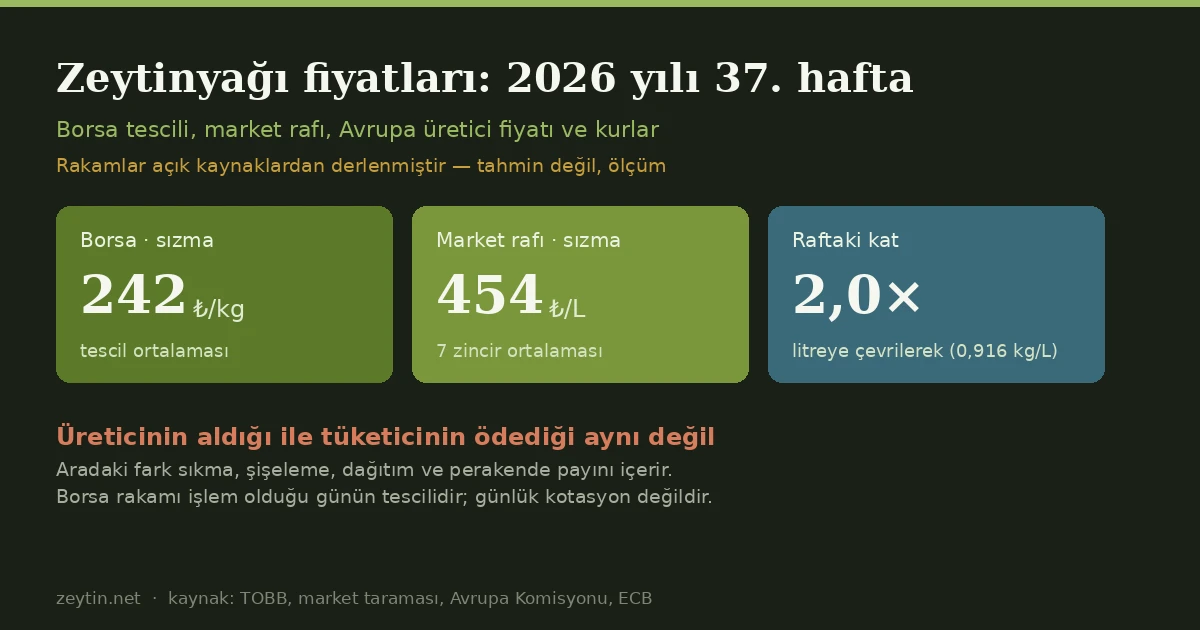
Olive Oil Prices: Week 37 of 2026
Week 37 of 2026: Turkish exchange prices, European producer prices and exchange rates side by side.
Article
Olive Oil Prices: Week 37 of 2026
Week 37 of 2026: Turkish exchange prices, European producer prices and exchange rates side by side.
 Article
Extra Virgin, Virgin, Riviera: Olive Oil Grades Explained
What do 'extra virgin', 'riviera' and 'refined' mean on the label? The difference lies in the production method and acidity.
Article
Extra Virgin, Virgin, Riviera: Olive Oil Grades Explained
What do 'extra virgin', 'riviera' and 'refined' mean on the label? The difference lies in the production method and acidity.