What temperatures can the olive withstand?
Ideal 15–20 °C, an upper limit of 40 °C (with irrigation), a lower limit of −7 °C. Temperature thresholds, chilling requirement, and the climate risk of production narrowed to four varieties.
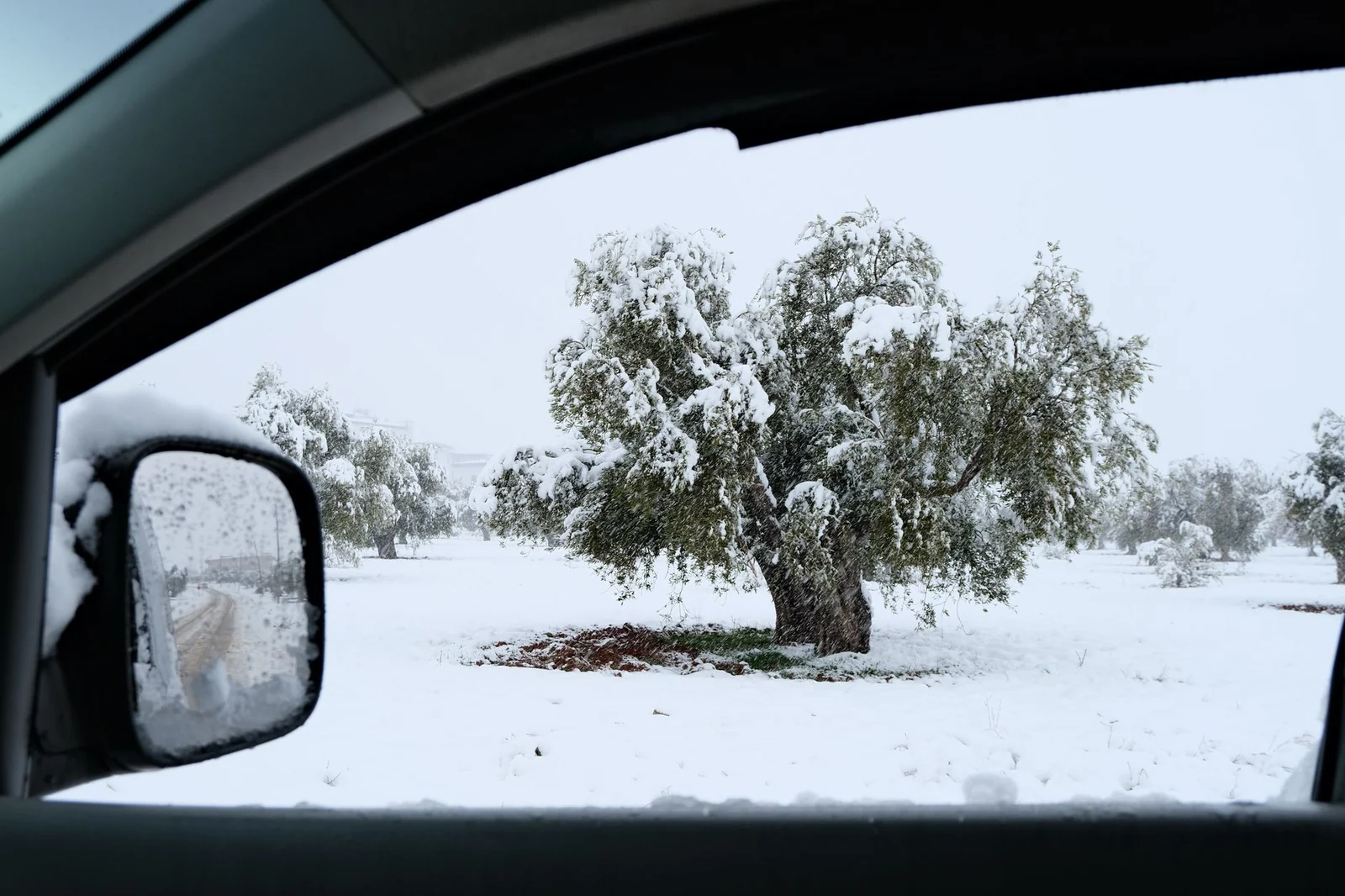
The olive is known as a heat-loving tree. True, but incomplete: it also has an upper limit, a lower limit, and a narrow band between them where it actually works well.
A review from the İzmir Olive Research Institute sets out those thresholds — and which one comes into play as the climate warms.
The olive's temperature thresholds
| Threshold | Temperature | What happens |
|---|---|---|
| Ideal annual average | 15–20 °C | the typical range of olive-growing regions |
| Upper tolerance | 40 °C | withstood provided there is irrigation |
| Spring heat spike | above seasonal norms | fertilisation affected, fruit set drops |
| Lower limit | −7 °C | damage can begin, from buds down to the roots |
The critical part of that table is the condition beside 40 °C: "provided there is irrigation". The olive's heat tolerance is not absolute; it depends on water. In an unirrigated grove the same temperature does not give the same result — and most of Turkey's olive land is unirrigated.
What the heat breaks
Rising temperature does not act at one point but along four links of the chain:
1. The growing season lengthens. It sounds like a benefit but isn't: the tree's phenological calendar shifts and flowering timing changes.
2. Flowering falters. When May and June run above seasonal norms, transpiration in the leaves rises and shrivelling can appear. Spring heat spikes affect fertilisation directly, reducing fruit set.
3. Ripening accelerates. High temperature and increased evaporation ripen the fruit quickly. The result is a perverse necessity: the grower has to harvest early even at a lower ripeness level.
4. Quality falls. Adverse effects are reported on yield, on table olive quality and on olive oil quality.
The fourth link is the sum of the first three. What early harvest means as a deliberate choice is a separate question: is early harvest expensive or valuable.
The cold side: −7 °C
Warming dominates the conversation, but the lower bound still holds. Below −7 °C damage can begin, and it does not take one form; depending on the severity and duration of the cold, and on the tree's stage of growth and age, it appears at levels ranging from the buds down to the roots.
Here is the insidious part of climate change: as averages rise, extreme events also grow more frequent. An early warm spell in winter wakes the trees, and a cold snap that follows strikes a tree already awake. Frost damage can increase even though the mean temperature has gone up.
The chilling requirement: the forgotten side
Talk of temperature brings upper and lower limits to mind. But the olive has a need that comes before
the lower limit: spending a certain number of winter hours below 7.2 °C. Without enough cold the buds do
not break properly, flowering falters and yield falls — while the tree looks entirely undamaged.
Varieties differ widely here — roughly four weeks separate the earliest and latest variety in breaking dormancy.
The measured variety table and detail: Chilling requirements in olive
Turkey's real risk: a narrow base
Turkey has 100 registered varieties. But production is concentrated in only four of them: apart from Gemlik, Ayvalık, Memecik and Domat, the output of the rest is very limited.
In climate terms that means: national production hangs on the climatic behaviour of four varieties. If those four struggle under similar conditions, the problem spreads nationwide in the same year.
Yet among the 96 remaining varieties in the inventory there are types that behave differently — needing less cold, flowering later, standing drought better. Most of them have not even been measured pomologically. The full distribution: olive varieties.
What the study proposes: the selection criteria must change
The review lists the criteria to be weighed when choosing new varieties:
1. Resistance to pests and disease
2. Tolerance of high temperature
3. Tolerance of drought
4. Strong table and oil quality characteristics
5. High antioxidant properties
The order is telling: resilience comes before quality. It marks a change of outlook — the variety sought is no longer the one that yields most, but the one that goes on yielding under changed conditions.
The study also stresses the urgent need for forward planning in the face of climate change, and for projects focused on how varieties behave under these conditions.
What can be done today
Breeding is long-term work; but there are decisions available at grove scale now:
- Irrigation. Tolerance of 40 °C depends on water; irrigation is no longer a luxury but insurance.
- Variety diversification. A grove planted with a single variety carries that variety's risk in full.
- Chilling suited to the locality. Planting a high-chilling variety where winters are growing mild is buying the problem in advance.
- Harvest timing. If ripening is accelerating, the harvest calendar has to move with it; a late harvest raises acidity.
Sources
- Sevim, D., Varol, N., Köseoğlu, O. (2022) — Effects of Global Climate Change on Olive Growing and Olive Oil, İzmir Olive Research Institute
- Özaltaş et al. (2016) — registered variety inventory
One rating per visitor; you can change yours at any time. Ratings are real reader votes — no seeded or default scores.
Related
 Article
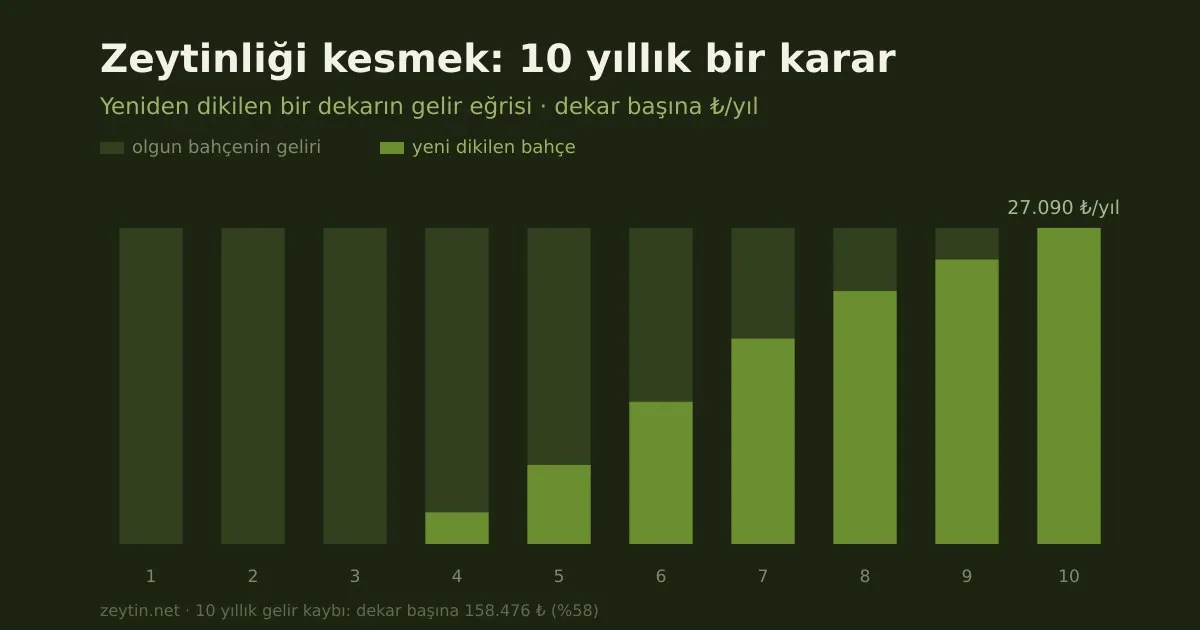
Felling an olive grove: the arithmetic of a ten-year decision
The ten-year cost of clearing a grove for another crop: establishment, years to bearing and forgone income, per decare.
Article
Felling an olive grove: the arithmetic of a ten-year decision
The ten-year cost of clearing a grove for another crop: establishment, years to bearing and forgone income, per decare.
 Article
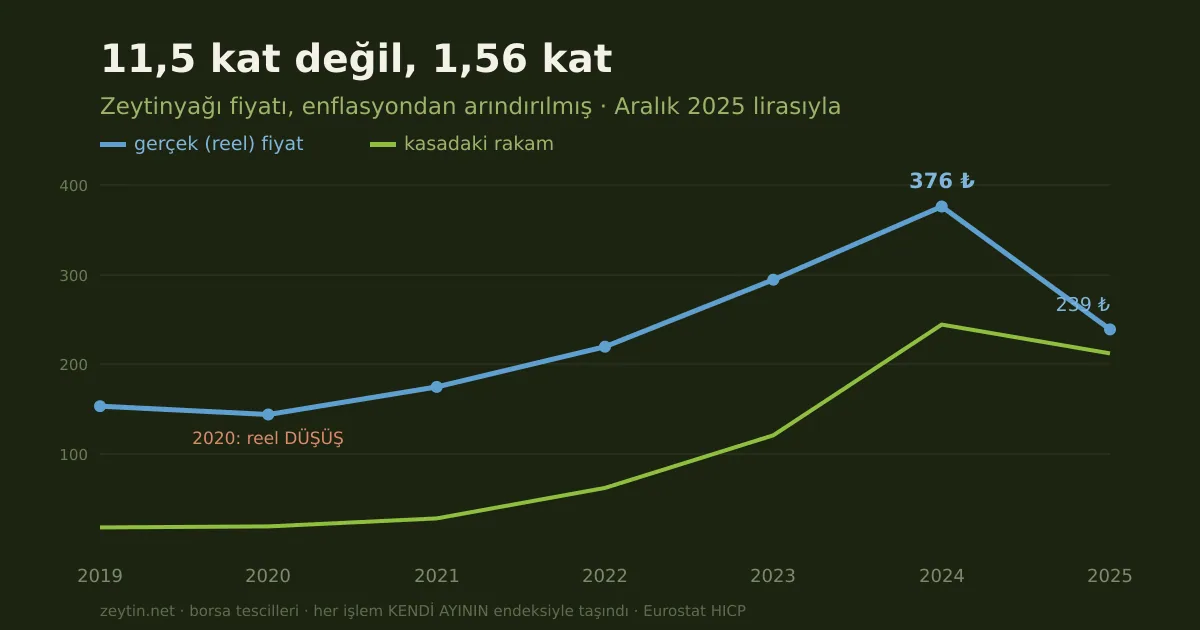
The real price of olive oil: the inflation-adjusted calculation
The lira price rose 11.5-fold, inflation 7.6-fold. The real increase is 1.56-fold — and it matches the euro-based calculation.
Article
The real price of olive oil: the inflation-adjusted calculation
The lira price rose 11.5-fold, inflation 7.6-fold. The real increase is 1.56-fold — and it matches the euro-based calculation.
 Article
Olive oil enterprises in Mut: a field study
More than 4% of Turkey's olive production comes from Mut. In a 2025 study of 14 enterprises, raw material quality ranks last among their problems. All eight websites of firms wanting to export are monolingual.
Article
Olive oil enterprises in Mut: a field study
More than 4% of Turkey's olive production comes from Mut. In a 2025 study of 14 enterprises, raw material quality ranks last among their problems. All eight websites of firms wanting to export are monolingual.
 Article
The economics of caliber: how fruit size triples the price
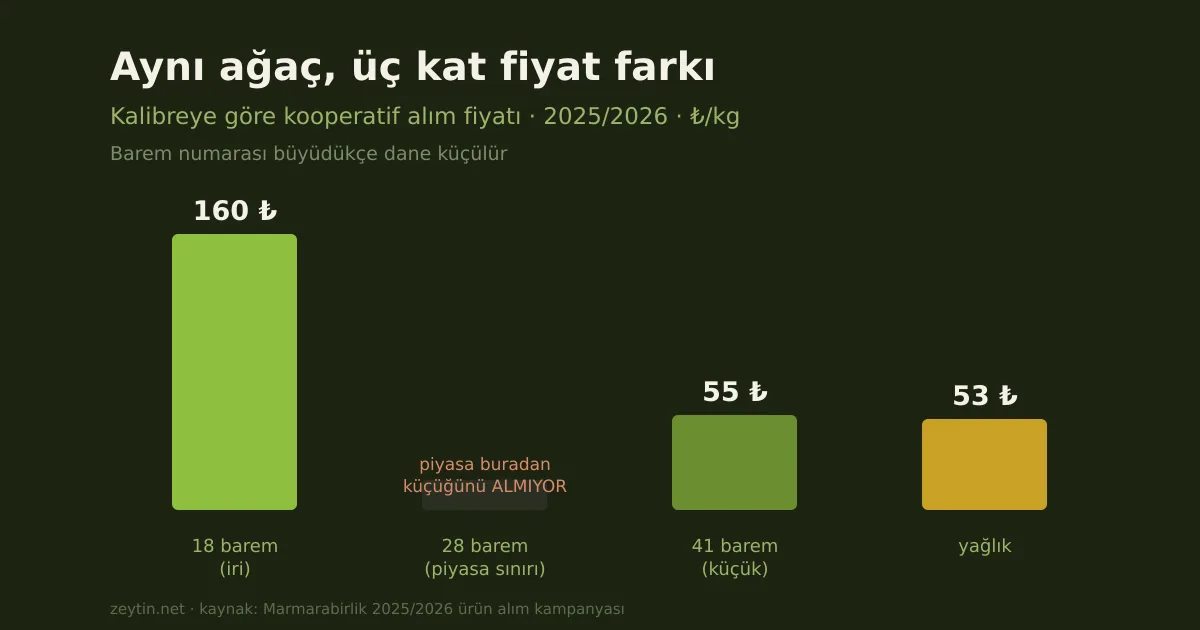
160 TL at caliber 18, 55 TL at caliber 41. Fruit size is price — and the cooperative pays 16% above the exchange average.
Article
The economics of caliber: how fruit size triples the price
160 TL at caliber 18, 55 TL at caliber 41. Fruit size is price — and the cooperative pays 16% above the exchange average.