Olive oil trade in the Ottoman Empire: Britain the buyer, the crop the price
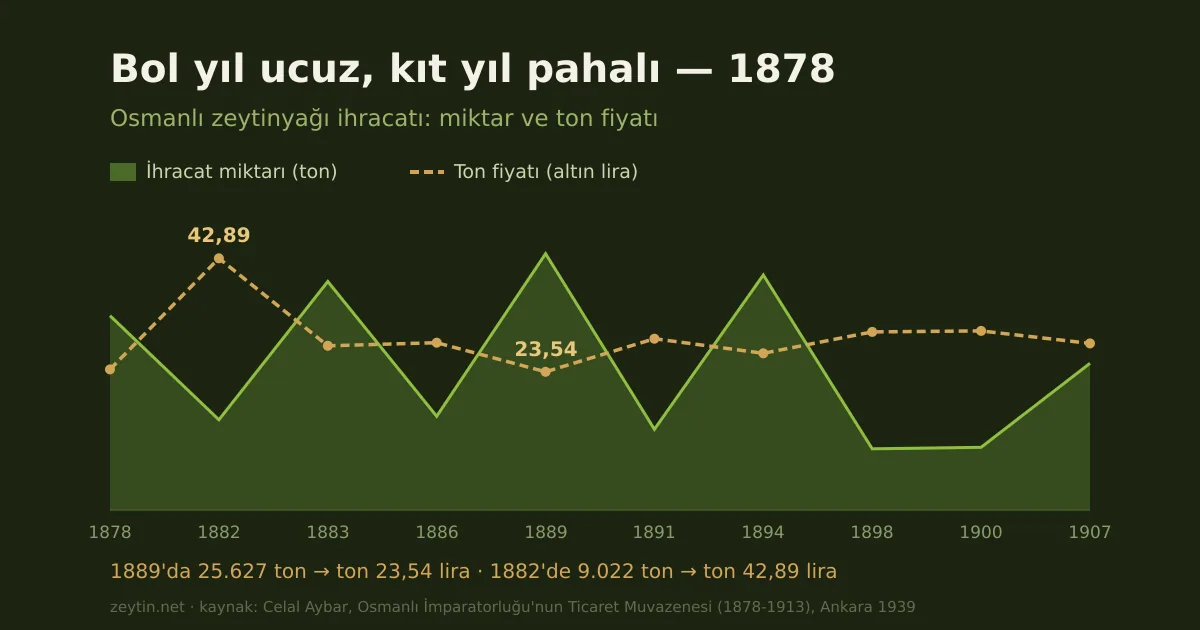
25,627 tonnes exported in 1889 at 23.54 lira a tonne; 9,022 tonnes in 1882 at 42.89. The crop-price inverse held a century ago too.
We write constantly on this site about why olive oil prices swing, why exports matter so much, why a drought hits the price at once. None of it is new.
Trade statistics from the Ottoman Empire's last forty years show that every mechanism we discuss today worked the same way a century ago. The figures below come from the official statistics of the period and from documents in the Ottoman Archives.
Britain was the buyer of Ottoman olive oil
Among the Mediterranean's principal producers, the Ottoman Empire ranked fourth, after Italy, Spain and France. Türkiye's place in the ranking today is much the same.
Britain alone took more than half of exports; the northern European states came second. Ottoman olive oil was sold north, where the tree does not grow — a different arrangement from today, when much of Türkiye's export goes to Italy and Spain and onward from there.
The uses were different too. Until the early twentieth century olive oil was above all a lighting fuel in the Ottoman lands: government offices, places of worship. Beyond that it greased slipways in the navy and harness in the palace stables, and fed the soap industry. Cooking was not the only entry on the list.
Thirty years of exports: the crop sets the price
Across the series from 1878 to 1907, the lowest export year was 1898 at 6,124 tonnes and the highest 1889 at 25,627 tonnes. A fourfold range.
And the price moves in exactly the opposite direction:
| Year | Quantity (t) | Value (gold lira) | Price per tonne (lira) | Share of total exports |
|---|---|---|---|---|
| 1878 | 19,433 | 523,762 | 23.95 | 6.2% |
| 1882 (lean year) | 9,022 | 396,036 | 42.89 | 3.6% |
| 1889 (heavy year) | 25,627 | 680,149 | 23.54 | 4.5% |
| 1891 | 8,070 | 235,480 | 29.18 | 1.5% |
| 1894 | 23,496 | 627,459 | 26.70 | 4.6% |
| 1898 (lowest) | 6,124 | 183,843 | 30.35 | 1.4% |
| 1907 | 14,668 | 473,055 | 28.38 | 2.7% |
Source: Celal Aybar, The Trade Balance of the Ottoman Empire (1878-1913), Ankara 1939.
The highest price falls in the leanest year (1882: 42.89 lira/tonne), the lowest in the heaviest (1889: 23.54). The inverse relation between crop and price is precisely the mechanism by which drought in Spain lifts the Turkish price today.
Olive oil's share of total exports averaged 3.2% over the thirty years, with a high of 6.2% (1878) and a low of 1.3% (1900). It was never the empire's leading export — a second-rank product beside wheat, raisins, tobacco and cotton. That too resembles the present.
What did the state do? Tax exemptions — that did not work
The Ottoman administration used the one real instrument it had for expanding olive groves: tax relief.
- 1850: 25 years' exemption for newly established groves, 20 years for grafted wild olives.
- Exemption Regulation of 27 June 1862: replanted groves exempt from tithe for three years from first crop. Trees planted grafted at two to five years old: ten years' exemption; grafted and planted older than five: seven years. Anyone selling an exempt grove sold the exemption with it — the right attached to the land, not the person.
- 1882-83: five years' tithe exemption for grafting wild olives.
The result? In the source's words, "efforts at grafting mostly failed to produce the results desired." The reasons are listed:
- Insufficient capital for grafting
- Unsuitable land
- Lack of trained personnel
- Fear of damage to forests
- Failures in enforcing the laws
The first should look familiar. Aegean olive farms today run on 92.71% equity — debt-free but without access to credit. The Ottomans built agricultural credit institutions too: the Memleket Sandıkları after 1863 and, from 1888, the Ziraat Bankası. The verdict is blunt: they "failed in particular to meet the credit needs of the smallholding peasant." A sentence written about the nineteenth century describes today's picture.
The length of the exemption is telling in itself: 25 years, because that is how long an olive tree takes to repay its investment. The modern figure is 8 to 15 years.
Where were the trees? In the province of Aydın
The Ottoman agricultural statistics of 1909 record 19,568,335 olive trees in the empire. Of these, 47.1% — 9,225,095 trees — stood in the province of Aydın alone. The crop was 98,893 tonnes.
By 1914 the count had fallen to 12,199,180, largely through loss of territory: the Balkan Wars took the Rumelian lands and their groves with them.
Of the trees remaining in 1914, 77.5% were in four cities: İzmir, Bursa, Balıkesir and Manisa.
Those four names remain the centre of Turkish olive growing. In a hundred and ten years the geography has not moved.
War: an export ban and a 25-fold price
The First World War broke the arrangement entirely.
A cabinet decision of 16 December 1914 drew up a list of goods forbidden for export. The first article covered wheat, flour, semolina, maize, pulses, potatoes, rice, fats and olive oil. From 11 November 1914, the export of olive oil and of table olives was banned.
Olive oil was no longer an export commodity but a subsistence good.
The ban was not absolute: on 18 June 1916 the export of one million kıyye (roughly 1,283 tonnes) of olive oil to Germany was authorised, and four months later exports to friendly and neutral states were permitted. Because the foreign trade statistics were not published during the war, the quantities actually shipped are unknown.
At home, the price went the other way:
| Date | Price | 1914 = 100 |
|---|---|---|
| July 1914 | 8 | 100 |
| January 1917 | 45 | 563 |
| September 1917 | 140 | 1,750 |
| January 1918 | 200 | 2,500 |
| September 1918 | 180 | 2,250 |
One okka ≈ 1.283 kg. Source: Vedat Eldem, The Economy of the Ottoman Empire in the War and Armistice Years, Turkish Historical Society, Ankara 1994.
Twenty-five fold in four years. This is not an olive oil story but a war-inflation story: every food price followed a similar path.
Production fell as well. The series runs downward every year from 1914 to 1918, with the 1917 and 1918 figures at a third and a quarter of 1915. (The unit in the source reads "kg", but the magnitudes are implausibly small for an empire and should almost certainly be tonnes. We therefore report the trend rather than the absolute numbers.)
The reason is simple: the farming population was under arms. The state formed agricultural regiments from non-Muslim subjects and, in the Fourth Army, from women; taught farming in the ranks; imported tractors and threshers from Germany and Austria-Hungary. Production fell every year regardless.
A detail: a delegate to Corsica in 1913
Shortly before the war, a cabinet decision of 13 April 1913 resolved to bring in experts from Europe to develop olive cultivation. Later that year the empire sent a representative to the International Congress of the Olive Tree and the Olive Industries held in Corsica.
The idea of international cooperation on olives was on the Ottoman table some forty years before the International Olive Council was founded in 1959. A year later the war came.
What changed, what did not
Unchanged:
- Price moves inversely to the crop — the mechanism of 1882 is the mechanism of 2026.
- The geography of production: İzmir, Balıkesir, Bursa, Manisa. Aydın province alone held half the trees.
- Smallholders' lack of access to credit.
- Olive oil's share of total exports: small but emblematic.
Changed:
- Olive oil is no longer a lighting fuel.
- The buyer is no longer Britain.
- Instruments like a 25-year tax exemption gave way to support payments.
- Measurement: in 1909 trees were counted; today exchange registrations are published daily.
Summary
- The Ottoman Empire was the Mediterranean's fourth producer, after Italy, Spain and France.
- Britain took more than half of exports; olive oil averaged 3.2% of total exports.
- Price ran inverse to crop: 23.54 lira a tonne in the heavy year of 1889, 42.89 in the lean year of 1882.
- 19.5 million olive trees in 1909, 47.1% in the province of Aydın.
- Of the trees left in 1914, 77.5% were in İzmir, Bursa, Balıkesir and Manisa.
- The state's instrument was tax exemption (25 years from 1850); it failed, chiefly for want of capital.
- From 11 November 1914 olive oil and olive exports were banned; the product became a subsistence good.
- During the war the price rose twenty-five fold in four years while production fell every year.
Sources
The figures in this article are drawn from an academic compilation titled Olive and Olive Oil Production and Exports in Anatolia in the Last Years of the Ottoman State (1908-1922). The copy we hold is an unsigned draft, so we cannot cite the work itself; instead we give the primary sources it rests on, to which the figures belong:
t; Aybar, C. (1939). Osmanlı İmparatorluğu'nun Ticaret Muvazenesi (1878-1913) [The Trade Balance of the Ottoman Empire]. Central Statistical Office, Ankara, pp. 55-65. — Export quantities, values and prices.
t; Eldem, V. (1994). Harp ve Mütareke Yıllarında Osmanlı İmparatorluğu'nun Ekonomisi [The Economy of the Ottoman Empire in the War and Armistice Years]. Turkish Historical Society, Ankara, pp. 37-38. — Wartime production and prices.
t; Agricultural Statistics of the Ottoman Dominions, 1325, 1329 and 1330 (1909, 1913, 1914). Ministry of Forests and Mines; Ministry of Trade and Agriculture. — Tree counts and production.
t; Ottoman Archives of the Presidency (BOA), MV classification files 194/25, 195/51, 176/14; DH.MUİ classification. — Export bans and incentive decisions.
t; Doğan, F. (2007). Osmanlı Devleti'nde Zeytinyağı 1800-1920 [Olive Oil in the Ottoman State]. PhD thesis, Istanbul. — Exemption regulations and regional structure.
Related reading: Drought in Andalusia, price in Türkiye · What does a kilo of olives cost? · Exchange volume is not the crop · Two thirds of exports are table olives
One rating per visitor; you can change yours at any time. Ratings are real reader votes — no seeded or default scores.
Related
 Article
What temperatures can the olive withstand?
Ideal 15–20 °C, an upper limit of 40 °C (with irrigation), a lower limit of −7 °C. Temperature thresholds, chilling requirement, and the climate risk of production narrowed to four varieties.
Article
What temperatures can the olive withstand?
Ideal 15–20 °C, an upper limit of 40 °C (with irrigation), a lower limit of −7 °C. Temperature thresholds, chilling requirement, and the climate risk of production narrowed to four varieties.
 Article
Rain in Andalusia, prices in Aydın: how Spain's drought set the price in Türkiye
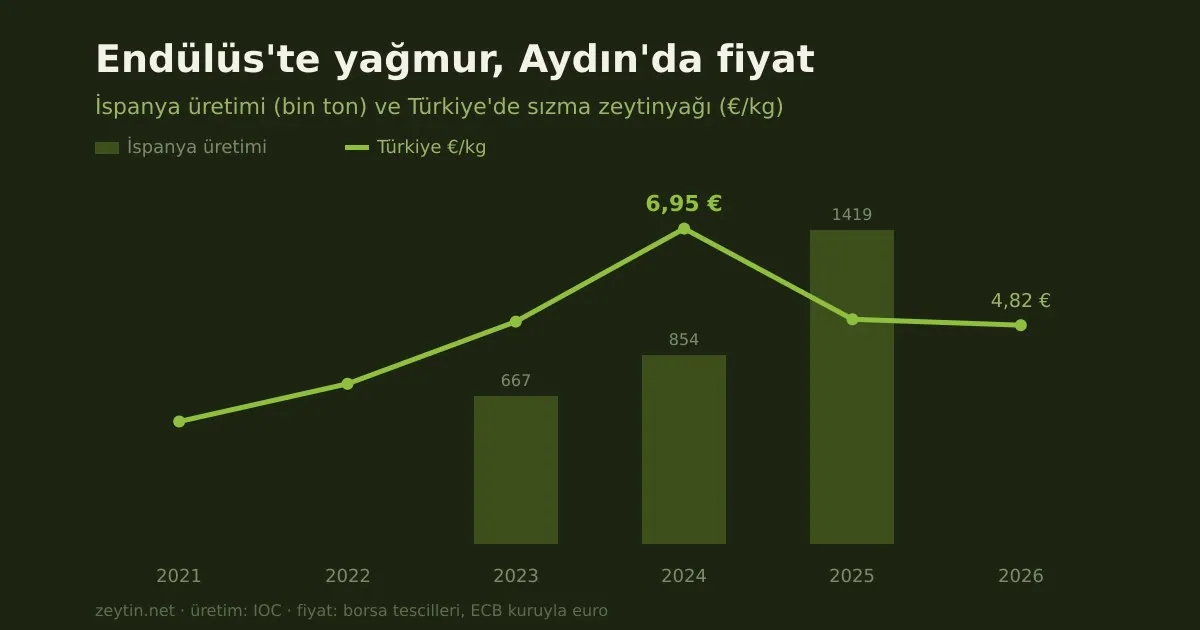
Spain makes 40% of the world's olive oil. Its output halved in 2022/23 and Türkiye's euro price went from €2.70 to €6.95.
Article
Rain in Andalusia, prices in Aydın: how Spain's drought set the price in Türkiye
Spain makes 40% of the world's olive oil. Its output halved in 2022/23 and Türkiye's euro price went from €2.70 to €6.95.
 Article
What does a kilo of olives cost? The cost sheet of 152 Aegean farms
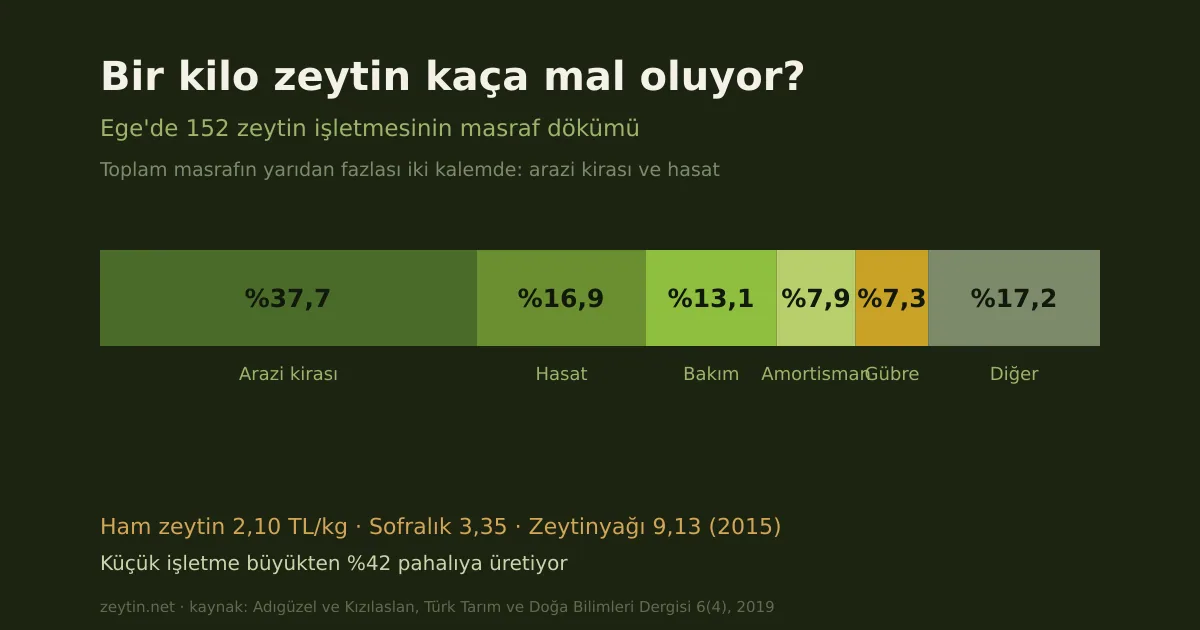
Land rent is 37.70% of cost, harvest 16.90%. In table olives 73% of processing cost is rejected fruit; in oil, 94% is the fruit itself.
Article
What does a kilo of olives cost? The cost sheet of 152 Aegean farms
Land rent is 37.70% of cost, harvest 16.90%. In table olives 73% of processing cost is rejected fruit; in oil, 94% is the fruit itself.
 Article
The profitability problem in olive oil exports
Turkey sold to the US at $3,492 a tonne while the world average was $4,235 - the furthest supplier and the cheapest. The EU tariff wall, the Tunisia comparison, and the method none of 17 exporters knew.
Article
The profitability problem in olive oil exports
Turkey sold to the US at $3,492 a tonne while the world average was $4,235 - the furthest supplier and the cheapest. The EU tariff wall, the Tunisia comparison, and the method none of 17 exporters knew.