Climate change and the olive: the tree survives, but will it crop?
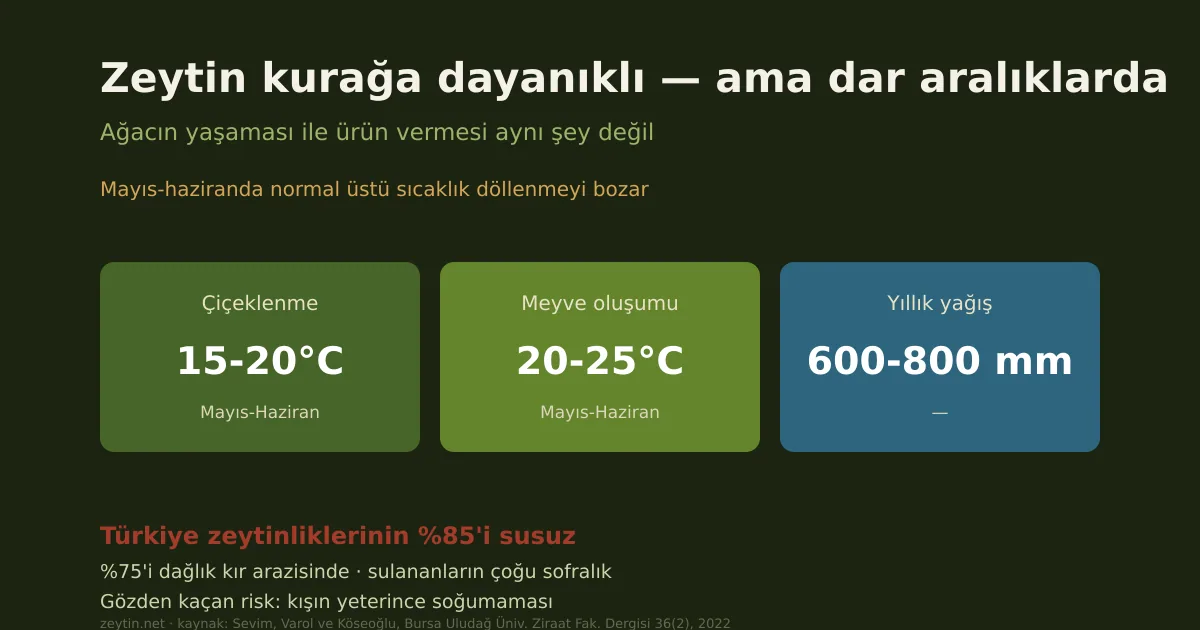
The olive is drought-hardy but works in narrow bands. 85% of Türkiye's groves are unirrigated, 75% on mountainous land.
The olive is drought-hardy — which is why it is often treated as "safe" in the climate debate. But a tree surviving and a tree cropping are not the same thing.
The olive's requirements are defined by narrow bands, and outside those bands the tree does not die: yield falls, quality suffers, the calendar shifts.
The olive's narrow bands
| Stage | Required temperature |
|---|---|
| Bud break to shoot formation (Feb-Mar) | 5-10°C |
| Flowering (May-June) | 15-20°C |
| Fruit formation and growth (May-June) | 20-25°C |
| Full ripening to end of harvest (Nov-Jan) | 5°C |
Mean annual temperature requirement: 15-20°C. With irrigation it tolerates up to 40°C. Damage begins below -7°C. Annual rainfall requirement: 600-800 mm.
The critical point is flowering: above-normal temperatures in May and June disrupt fertilisation and harm fruit set. A hot May does not kill the tree; it takes that year's crop.
Türkiye's position
| Share | |
|---|---|
| Groves on mountainous rural land | 75% |
| Unirrigated groves | 85% |
Those two figures summarise the country's exposure: three quarters of the groves sit on mountainous land that is hard to irrigate, and 85% depend on rainfall. Of the groves that are irrigated, most are in table production — meaning the oil varieties are largely dry-farmed.
Olive-growing areas are already semi-arid to arid, and in recent years rainfall has fallen short in the periods when the tree needs it.
Türkiye is counted among the at-risk group for climate change.
The two most water-sensitive periods
The moments when the tree is most exposed to water stress are known:
1. Stone hardening — late July to early August
2. Colour change in the fruit — late September to early October
Irrigation in these windows produces a direct increase in yield.
Drought-hardy though it is, water stress in the olive causes poor flower and fruit set, reduced leaf area, limited photosynthesis and disrupted flowering.
Measured irrigation programmes
Two Turkish studies give concrete programmes:
For Memecik (Aşık et al., 2011): 25% of Class A pan evaporation, every five days, applied by drip.
For deficit irrigation (Akkuzu et al., 2015): three irrigations — at stone hardening, fruit growth and oil accumulation — applying 50% of the depleted moisture in the 0-90 cm soil profile.
⚠ Both studies warn that limited water must be used to a plan; mis-timed irrigation can produce consequences that are hard to reverse.
What do the future scenarios say?
Pessimistic and optimistic projections point in different directions, and that difference deserves to be reported as it stands.
The general trend is negative. Orlandi et al. (2020): rising temperatures and shifting rainfall produce negative outcomes for olive yield, and even the most optimistic scenarios show falling fruit production across most olive-growing areas. The olive oil regions of the Mediterranean basin will be substantially affected.
But there is an exception — and a surprising one. Lorite et al. (2018) ran the "Adapta Olive" model for Andalusia in southern Spain. The result:
| Condition | Yield change |
|---|---|
| Rainfed | +7.1% |
| Full irrigation | +28.9% |
Irrigation requirements also fall, by 0.5% to 6.2%.
The reason: the positive effect of rising atmospheric CO₂ offsets the negative effect of declining rainfall. Plants photosynthesise more efficiently and use water more economically at higher CO₂.
⚠ This does not mean climate change is good for olives. The model covers a single region (Andalusia) under specific scenarios and assumes irrigation remains available. Türkiye's 85%-unirrigated structure does not meet that assumption.
The model's real lesson: variety choice
The most useful finding in that study is not the scenarios but which varieties hold up better:
t; The best performance was recorded in varieties with early flowering dates and those suited to regulated deficit irrigation.
Concretely: in the Baeza area, early-flowering varieties cut full irrigation requirements by 12% against late-flowering ones, and raised rainfed yield by 7%.
Under regulated deficit irrigation, water demand falls 46% while yield falls 18% — you can cut three quarters of the water and keep four fifths of the crop. In a drought that is a survival strategy.
Chilling: the overlooked risk
The warming debate always runs on summer heat. But for the olive, winters not getting cold enough is also a risk.
The olive must spend a set time below 7.2°C in winter. Türkiye's two big oil varieties sit high on that list: Memecik 520 hours, Ayvalık 509. As winters warm those hours shrink, and where the requirement goes unmet the tree survives but fails to crop in some years, with flowering shifting into February.
More: chilling requirement in olives.
The pests will change too
Climate does not act on the tree alone:
t; Changing temperatures affect the diversity and frequency of insects in a given area. Rising CO₂ levels will intensify most insect and pest problems.
That raises the importance of integrated pest management. The olive fruit fly produces 4-5 generations in the Aegean and 3-4 in Marmara; in a warming climate those numbers are expected to rise.
What should be done?
The study's recommendations:
- Forward planning is urgently needed
- Projects should focus on how varieties behave under these conditions
- Criteria for selecting new varieties:
- Resistant to diseases and pests
- Tolerant of high temperature and drought
- Good quality and antioxidant properties for table and oil
Those criteria also explain why the southeast's local genotypes, adapted to heat and drought, matter: the answer to climate change may lie in a genotype that has not yet been named.
Summary
- The olive works in narrow bands: flowering 15-20°C, fruit formation 20-25°C, annual rainfall 600-800 mm.
- Above-normal heat in May-June disrupts fertilisation — the tree lives, the crop goes.
- 75% of Türkiye's groves are on mountainous land, 85% unirrigated.
- The two most water-sensitive periods: stone hardening and colour change.
- Measured programme: for Memecik, 25% of pan evaporation every five days.
- The general trend is negative; even optimistic scenarios show production falling in most areas.
- In the Andalusia model, CO₂ raises yield — but only assuming irrigation continues.
- The model's real lesson: early-flowering varieties do better; deficit irrigation cuts 46% of the water for only 18% of the yield.
- The overlooked risk: winters not cold enough (Memecik 520, Ayvalık 509 hours).
- Rising CO₂ will intensify pest problems.
Source
t; Sevim, D., Varol, N. and Köseoğlu, O. (2022). The Effects of Global Climate Change on Olive Growing and Olive Oil. Journal of the Agricultural Faculty of Bursa Uludağ University, 36(2): 415-432.
Sources cited within that study: Aşık et al. (2011), Akkuzu et al. (2015), Orlandi et al. (2020), Lorite et al. (2018), Fraga et al. (2021), Moran (2014), Kadıoğlu et al. (2017).
Related reading: Chilling requirement in olives · Olive fruit fly control · Drought in Andalusia, price in Türkiye · The nameless olives of southeast Anatolia
One rating per visitor; you can change yours at any time. Ratings are real reader votes — no seeded or default scores.
Related
 Article
The nameless olives of southeast Anatolia: Mardin, Şırnak and the pollinator problem
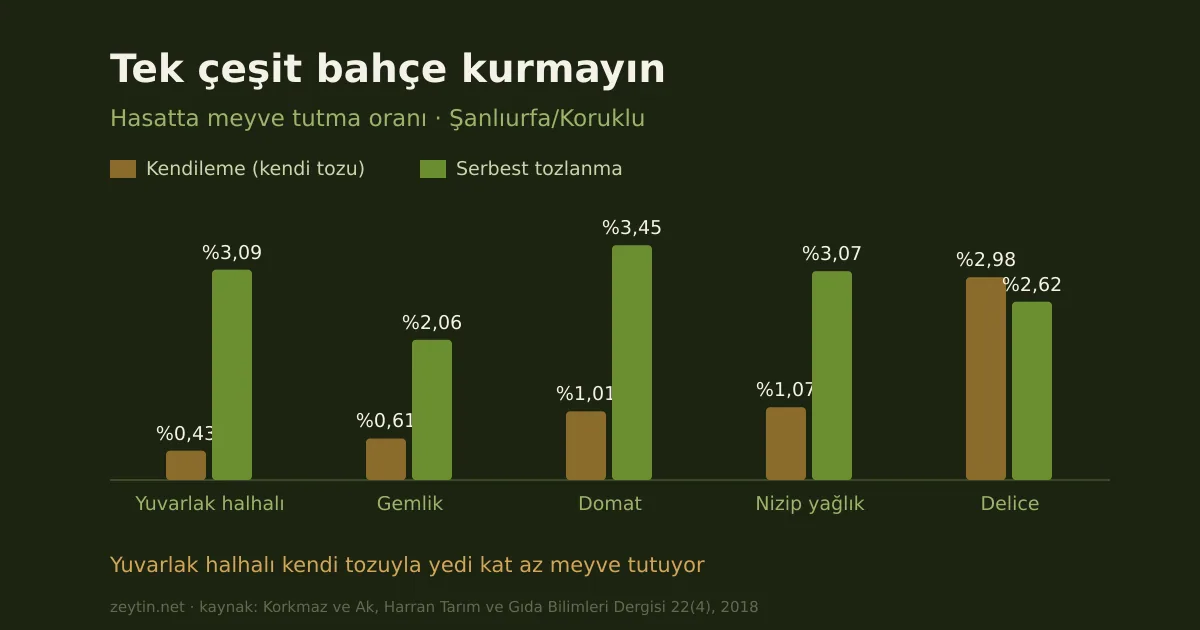
Kumçatı and Derik genotypes beat Ayvalık and Gemlik on flesh ratio. Yuvarlak halhalı sets only 0.43% of its flowers with its own pollen.
Article
The nameless olives of southeast Anatolia: Mardin, Şırnak and the pollinator problem
Kumçatı and Derik genotypes beat Ayvalık and Gemlik on flesh ratio. Yuvarlak halhalı sets only 0.43% of its flowers with its own pollen.
 Article
Olive oil enterprises in Mut: a field study
More than 4% of Turkey's olive production comes from Mut. In a 2025 study of 14 enterprises, raw material quality ranks last among their problems. All eight websites of firms wanting to export are monolingual.
Article
Olive oil enterprises in Mut: a field study
More than 4% of Turkey's olive production comes from Mut. In a 2025 study of 14 enterprises, raw material quality ranks last among their problems. All eight websites of firms wanting to export are monolingual.
 Article
The gap between extra virgin and riviera is only 4% at wholesale
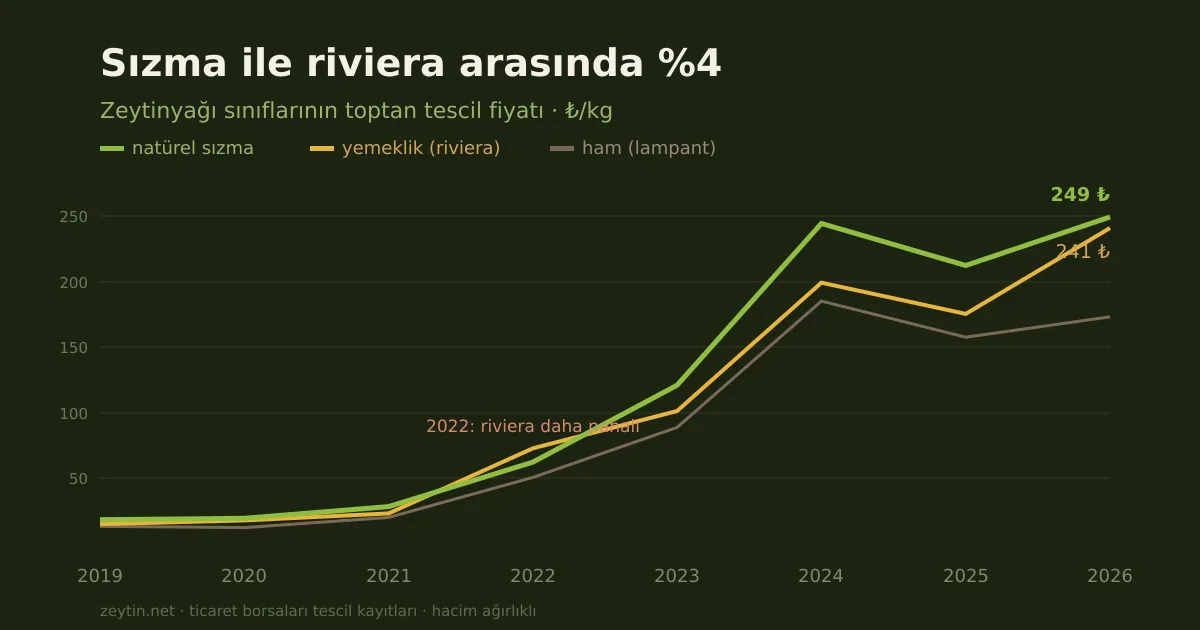
At wholesale, extra virgin is only 4-23% dearer than cooking oil; the seven-year average is 13%. The shelf gap comes from packaging.
Article
The gap between extra virgin and riviera is only 4% at wholesale
At wholesale, extra virgin is only 4-23% dearer than cooking oil; the seven-year average is 13%. The shelf gap comes from packaging.
 Article
Vegetation water and pomace: olive oil's waste problem
Processing 1.5–2 million tonnes of olives yields 1 million tonnes of vegetation water and 1 million tonnes of pomace. Waste, or resource?
Article
Vegetation water and pomace: olive oil's waste problem
Processing 1.5–2 million tonnes of olives yields 1 million tonnes of vegetation water and 1 million tonnes of pomace. Waste, or resource?