Soma Olive Oil: how a cooler climate lifts yield in a lignite basin
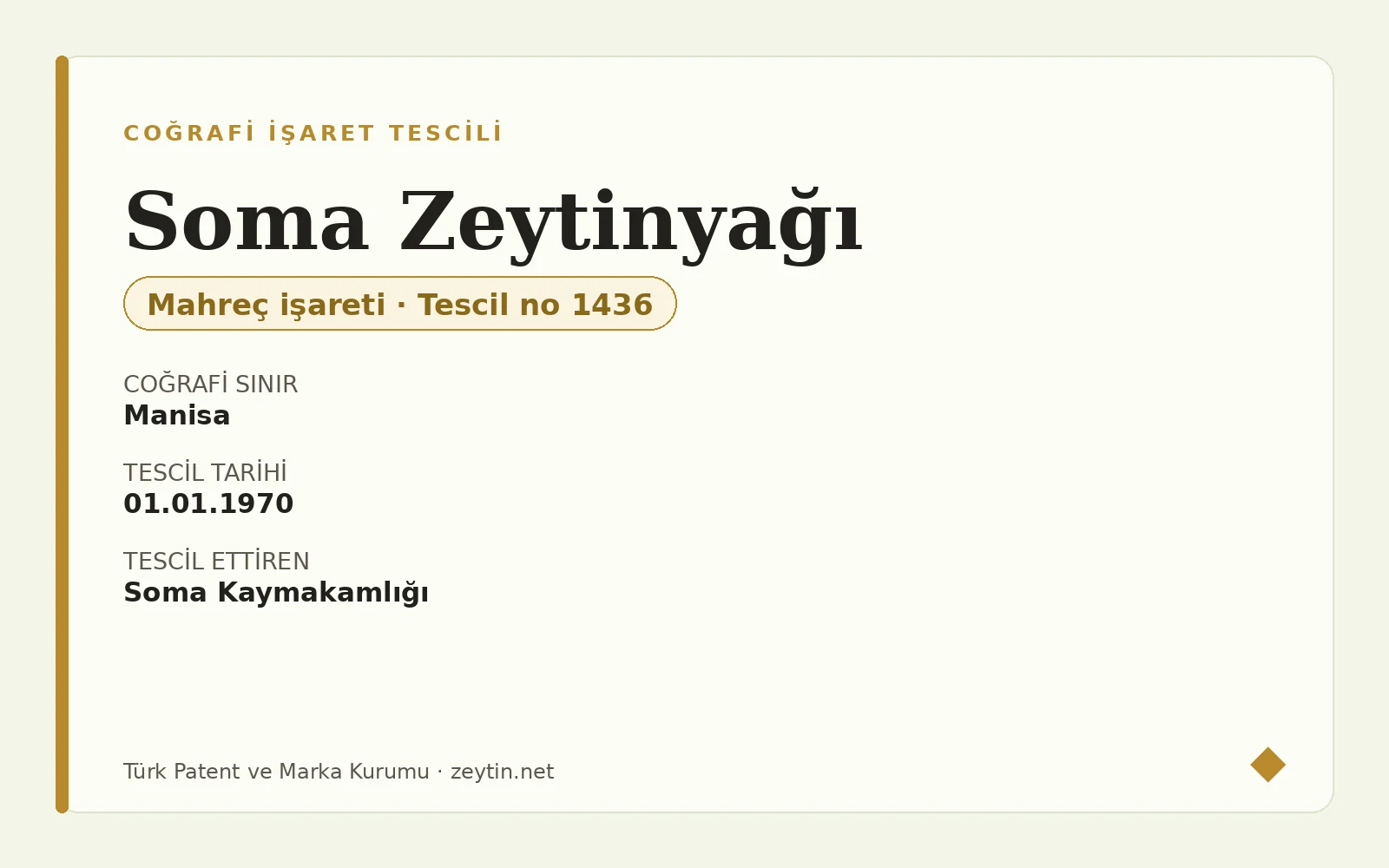
Registered in 2023. Mean temperature 15.3 °C; the certificate ties that relative coolness to yields reaching 796 kg/da. Free acidity 0.18-0.55.
Olives like warmth, but not too much of it. The certificate for Soma Olive Oil sets out that balance in figures: the district's relative coolness lifts the yield.
The record
| Registration no | 1436 |
| Registration date | 04.08.2023 |
| Protection from | 30.07.2021 |
| Type | Geographical indication |
| Registered by | Soma District Governorship |
| Area | The Soma district of Manisa |
| Cultivars | Edremit Yağlık and Gemlik |
Climate and yield
| Measurement | Value |
|---|---|
| Annual rainfall | 652.4 mm |
| Mean annual temperature | 15.3 °C |
| Yield | up to 796.22 kg/da |
The link the certificate draws is explicit: the relatively low temperature allows the cold-hardy Edremit Yağlık and Gemlik cultivars to yield up to 796.22 kg/da.
Soma has a semi-humid Mediterranean climate: mild winters, hot dry summers. Rainfall is sufficient for olives.
Fruit measurements
The certificate gives two columns (for the two cultivars):
| Criterion | I | II |
|---|---|---|
| Fruit length (mm) | 15.78 – 21.15 | 20.66 – 21.21 |
| Fruit width (mm) | 15.16 – 16.98 | 16.62 – 16.94 |
| Flesh weight (g) | 2.52 – 3.44 | 3.03 – 3.54 |
| Flesh ratio (%) | 79.71 – 81.75 | 82.03 – 83.49 |
| Flesh-to-stone ratio | 4.02 – 4.82 | 4.66 – 5.38 |
| Fruits per 100 g | 25.88 – 32.69 | 25.46 – 28.41 |
| Oil content (%) | 22.4 – 27.5 | 25.5 – 33.2 |
Properties of the oil
| Criterion | Value |
|---|---|
| Free acidity | 0.18 – 0.55 |
| Peroxide | 3.20 – 8.70 meq/kg |
| E232 | 1.20 – 2.14 |
| E270 | 0 – 0.13 |
| Delta E | 0.001 – 0.003 |
| Total biophenols | 163 – 229 mg/kg |
Peroxide of 3.20-8.70 is very low against a codex ceiling of 20. Free acidity reaching as low as 0.18 is likewise the mark of fresh, quickly processed oil.
In short
Soma Olive Oil is a registration that puts numbers on the relationship between climate and yield: a mean of 15.3 °C, two cold-hardy cultivars, and yields up to 796 kg/da. On the oil side, low acidity and low peroxide stand out.
The criteria the document binds
The registration does not only protect a name; it defines the product numerically:
| Criterion | Value in the document |
|---|---|
| Peroxide value | 3.20 meq O₂/kg (max) |
Inspection. Members: Orman Müdürlüğünden ve Soma Ticaret ve Sanayi Odası. Results are reported under Industrial Property Law no. 6769 and submitted to the Turkish Patent and Trademark Office.
The production steps in the document
The registration describes production step by step. The document's own sequence:
1. Zeytin hasadı — Hasat olgunluğuna gelen zeytin taneleri; makine veya elle meyveye hasar vermeyecek şekilde hasat edilerek toprakla temas etmeden toplanır ve gıda ile temasa uygun, plastik kasalarda, hava alacak şekilde işletmeye getirilir.
2. Zeytinlerin temizlenmesi — Zeytinler; yaprak, toz, toprak, çakıl taşı vb.
3. Zeytinlerin kırılması ve ezilmesi — Zeytinler, kırıcı üniteler ile kırılır, parçalanır.
4. Zeytin hamurundan yağın ekstraksiyonu — Ekstraksiyon, aşağıdaki metotlardan birisiyle gerçekleştirilir.
5. Karasuyun zeytinyağından ayrılması — Soma Zeytinyağının yoğunluk farkına dayanan santrifüjleme işlemi ile faz ayrımı yapılır.
6. Depolama ve ambalajlama — Soma Zeytinyağı konik dipli, kolay temizlenebilir, genelde seviye kontrollü ve numune almaya uygun olan paslanmaz çelik veya krom nikel kaplı tanklarda, inert gaz veya yüzer kapak sistemlerle depolanır.
That this sequence is binding is what separates a geographical indication from a trade mark: a mark says who produced something, a geographical indication also sets down how it must be produced.
Its place in Manisa's olive production
| Item | Value |
|---|---|
| Fruit production | 623,493 t |
| — for oil | 411,412 t |
| — for the table | 212,081 t |
| Olive oil production | 64,292 t |
| Trees | 24,982 thousand |
| Yield per tree | 25.0 kg |
Oil and table production are close in this province (66% for oil); the production base is not locked to one direction.
One rating per visitor; you can change yours at any time. Ratings are real reader votes — no seeded or default scores.
Related
 Article
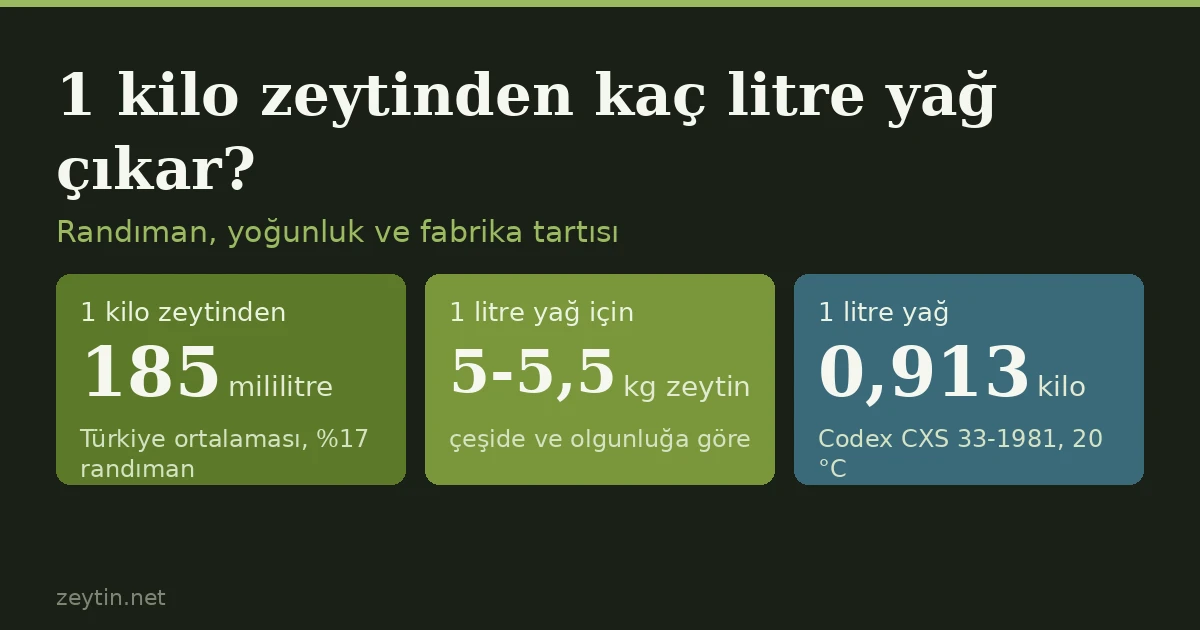
How many kilos of olives make 1 litre of oil? How many litres is 1 kg?
One kilo of olives gives about 185 ml of oil; a litre needs 5-5.5 kilos of olives. 1 kg of olive oil is 1.095 litres, so a 16 kg tin holds 17.5 litres.
 Article
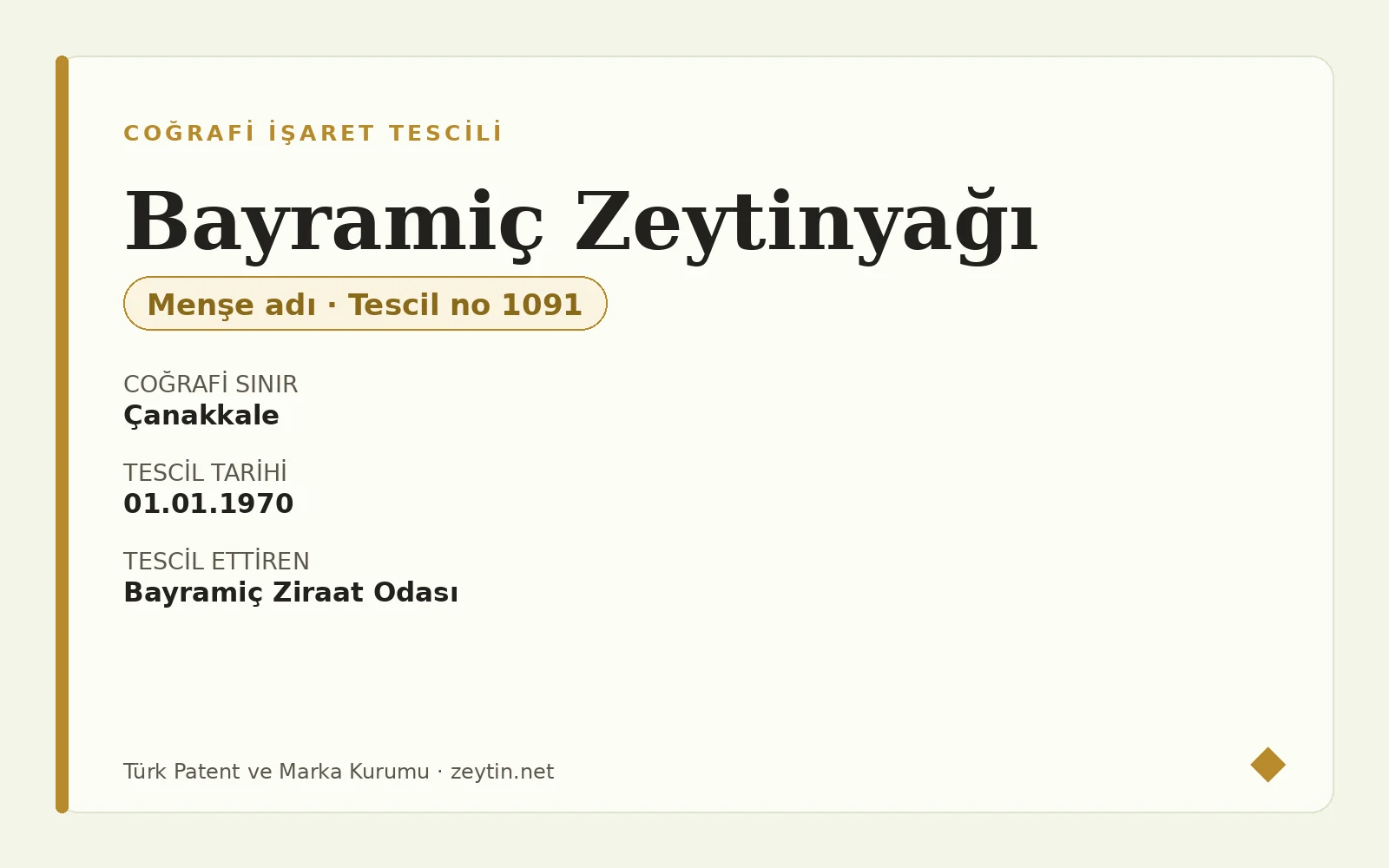
Bayramiç Olive Oil: aroma compounds defined as percentages
Registered in 2022. The certificate defines aroma by compound rather than adjective: hexanal 36.15%, E-2-hexenal 26.14%. Iodine value 80-93.
 Article
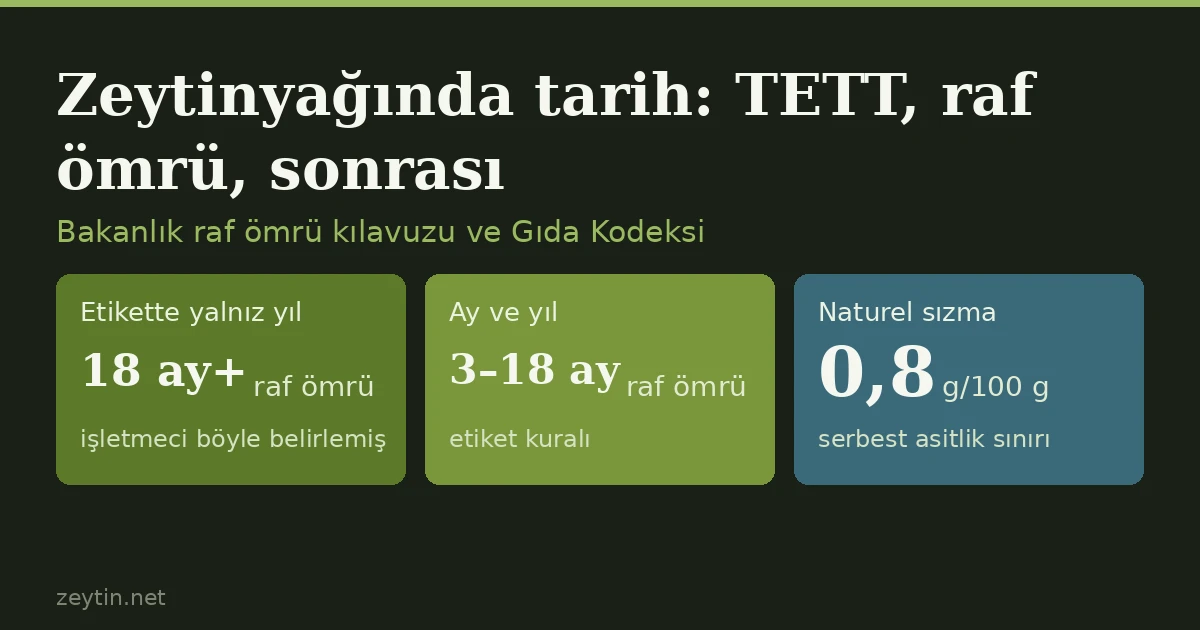
Does olive oil have a use-by date? Best-before dates, shelf life and oil past its date
Olive oil carries a best-before date, not a use-by date. Under the Turkish ministry's shelf-life guideline, oil past that date may be consumed, sold or donated if it was stored properly and its appearance, smell and taste are normal. Shelf life is set by the operator rather than by legislation — and even the format of the date reveals how long it is.
 Article
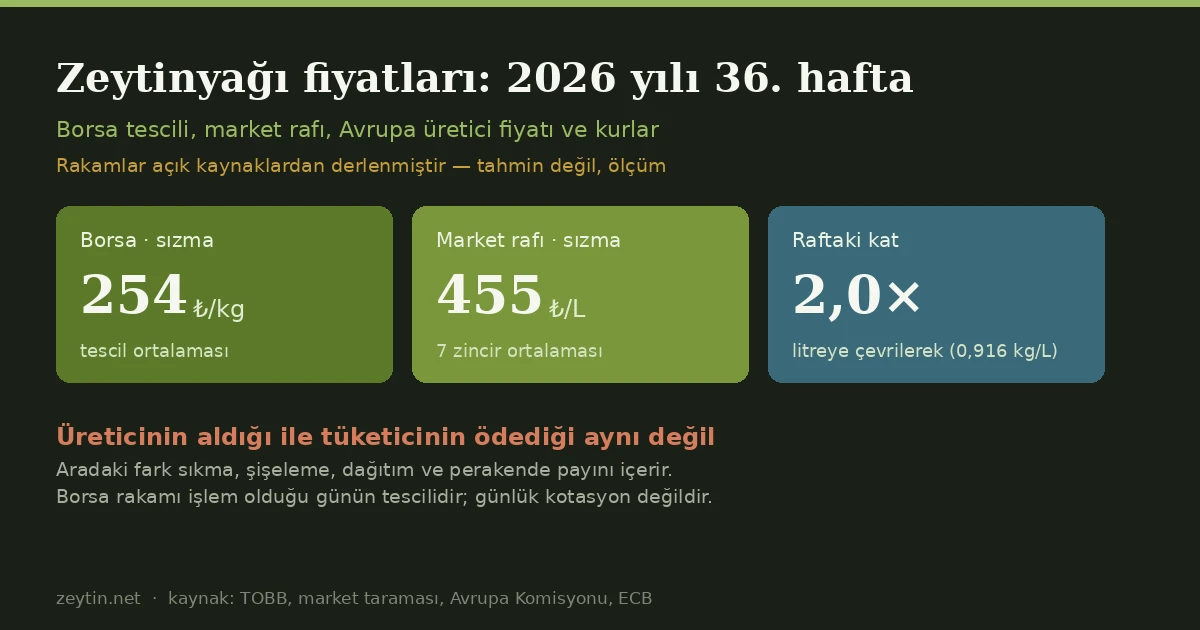
Olive Oil Prices: Week 36 of 2026
Week 36 of 2026: Turkish exchange prices, European producer prices and exchange rates side by side.