Are my olives spoiled? Mould, bulging lids and softening
A white film on brine is not always mould. But a bulging lid is not debatable: discard it unopened. How kahm yeast differs from mould.
A white layer on the surface of the brine. A bulging lid. Olives gone soft, the liquid cloudy, the smell changed. Almost anyone who brines olives at home meets one of these.
They are not the same thing. Some are harmless; some mean the jar goes in the bin. This article separates them.
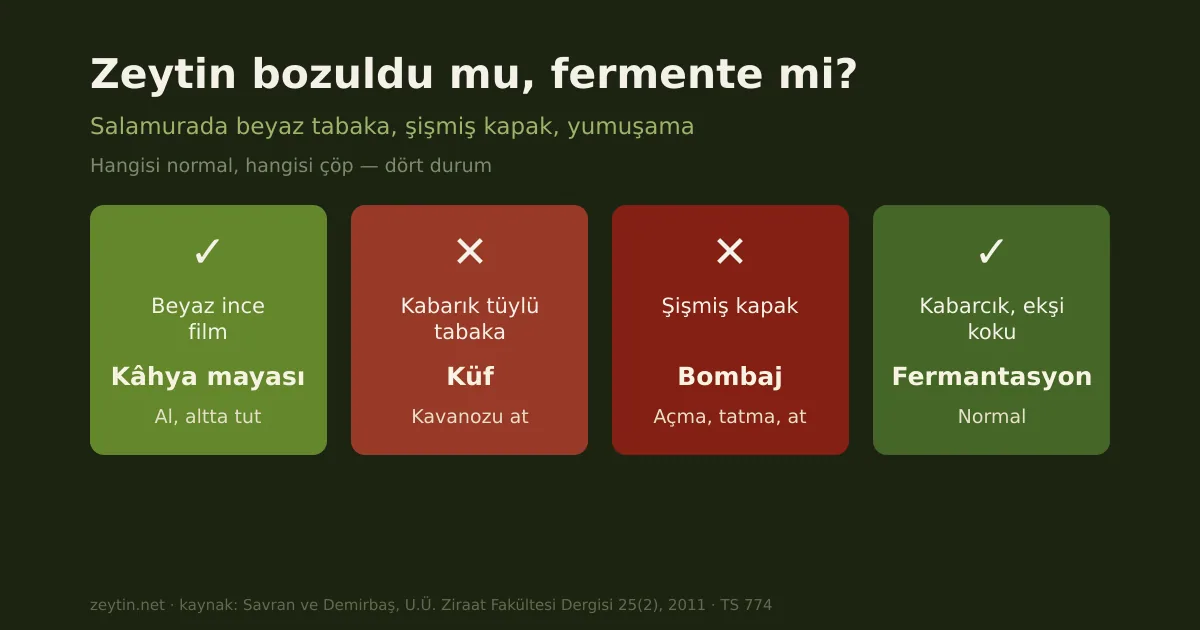
First: fermentation is not spoilage
A table olive is officially defined as fruit whose bitterness has been removed, "subjected or not subjected to lactic acid fermentation".
So something happening in the jar is normal. Lactic acid bacteria turn the sugars in the fruit into acid; the pH falls and the olive is preserved by its own acidity. Bubbles, a slight clouding, a sour smell — that is fermentation itself.
The problem is when the wrong microorganism wins.
The white layer: surface yeast or mould?
The white film on the surface comes in two forms, and telling them apart is easy:
| Surface (kahm) yeast | Mould | |
|---|---|---|
| Appearance | Thin, flat, whitish film; spreads like a slick | Raised, fluffy, fuzzy; green, grey, black or bluish |
| When stirred | Breaks up and disperses into the liquid | Stays in clumps, floats in pieces |
| Smell | Sour, yeasty | Musty, mouldy |
| What to do | Skim it, check the brine | Discard the jar |
Kahm yeast grows where the surface meets air. Olives floating above the brine, a jar not filled near the top, storage somewhere warm — all invite it. The source's advice runs the same way: preventing spoilage means "removing the sediment, controlling the pH and keeping surface yeast growth under control."
In practice: skim the film with a clean spoon, keep the olives below the brine (a clean weight, or a finger's depth of olive oil on top), and store the jar somewhere cool and dark.
Mould is another matter. When mould shows on the surface its threads may already run down into the liquid; "I took the top off" is not enough. Some moulds produce mycotoxins, and heat does not destroy those. A mouldy jar is not rescued.
A bulging lid: this one is serious
A jar with a domed lid, or one that releases pressure with a puff when opened, goes in the bin unopened. Do not taste it.
The mechanism the source describes: gas formation inside a container is generally the result of microbial growth. In sterilised black table olives the cause is insufficient heating, or a faulty or defective seal.
In industry this is called bombage. Swelling in a sealed container signals a gas-producing organism inside — and among the gas producers is the genus Clostridium. The source attributes butyric fermentation and similar defects to the multiplication of Clostridium and Propionibacterium and to fluctuating temperature during fermentation.
The rule is simple and not open to debate: bulging lid = do not open, do not taste, do not boil, do not try. Discard.
The same holds for cans. The source also lists "galvanocorrosion" in cans as a separate, chemical-physical defect — a non-microbial cause of gas. From the consumer's side it makes no difference: a swollen can is not opened.
Why do olives go soft?
Softening is the commonest quality loss in table olives. The causes, in order:
1. How they were picked. Table olives must be harvested by hand and without mechanical damage. Beating with poles bruises and marks the fruit; every bruise is the start of spoilage. This is the technical answer to why table olives cost more than oil olives — the same tree's fruit, a different price.
2. The wait between harvest and processing. The source is explicit: harvested olives must never be left in the sun; even in shade, a long wait brings staining and spoilage. Olives carried in heaps or sacks, or held in closed trucks or closed rooms, spoil through heating. Shallow plastic crates are essential.
3. Too little salt. Salt in brine is both flavour and preservative. Too little softens the flesh and opens the door to unwanted organisms.
4. Temperature. Fluctuating temperature during fermentation is the common cause behind every defect the source lists.
The defects the industry knows
You rarely meet these at home, but knowing the names makes a jar easier to read:
- Gas pocket: caused by unwanted bacteria multiplying in the first phase of fermentation, showing as splits, cracks and pockets of gas in the flesh of the fruit. Cut the olive open and you find a cavity.
- Alambrado (fish-eye): visible gas bubbles in the flesh.
- Butyric fermentation: a sharp smell like rancid butter. Caused by Clostridium.
- Zapatería: a heavy, distinctive stench often described as like shoe polish. It appears when fermentation goes out of control.
The source's most important sentence on this: "Once some forms of spoilage have occurred, there is no remedy." The only solution is to prevent them: observe basic aseptic rules, remove the sediment, control the pH, keep surface yeast in check, and keep standing water and organic waste away.
What does pasteurisation do?
The definition of a table olive includes "subjected or not subjected to pasteurisation or sterilisation" — heat treatment is not compulsory.
- Unpasteurised olives are alive: fermentation continues, if slowly; once opened the jar belongs in the fridge and the contents should be eaten before long. In return, texture and aroma are livelier.
- Pasteurised or sterilised olives have been stabilised by heat: long shelf life, softer texture. But as the source warns, if the heating is insufficient or the container badly sealed, spoilage follows anyway — that is precisely the cause of gas formation in sterilised black olives.
So a "pasteurised" label is no guarantee against spoilage. The bulging-lid rule applies to pasteurised products exactly as it does to any other.
The brine has a standard of its own
A little-known detail: table olives in Türkiye are governed by TS 774, the Table Olive Standard (April 2003), while the brine falls under TS 266, the Standard for Water Intended for Human Consumption (April 2005).
In other words, the water used in brine must meet drinking-water standards. That is the reason for using boiled or potable-quality water when brining at home.
A structural problem: 8,000 of 8,500 plants unregistered
Behind the quality debate lies a structural fact. On the figures given in the study, some 8,000 unregistered enterprises were estimated to exist in Türkiye, out of roughly 8,500 table-olive processing units in total. Installed capacity stood at 450,000 tonnes, of which 40-50% was in use.
The great majority are small family businesses; weak infrastructure limits quality and raises cost. The study's proposed remedies are technical: plastic or polyester tanks suitable for food storage instead of concrete pools (or concrete lined with polyester), washing before fermentation, grading and sorting machinery, freshly prepared brine at packing, and HACCP and ISO 9001 systems actually operated rather than merely held.
None of this concerns the jar in your kitchen — but it describes what stands behind the olives you buy off a shelf.
Short answers
Is the white layer on the brine harmful?
If it is a thin, flat film that disperses, it is kahm yeast: skim it and keep the olives under the brine. If it is raised, fuzzy and coloured, it is mould: discard the jar.
Can I eat olives from a jar with a bulging lid?
No. Throw it away unopened. Gas formation signals microbial growth, and the gas producers include Clostridium.
Why did my olives go soft?
Bruising at harvest, delay and heating afterwards, too little salt in the brine, and fluctuating temperature. Soft olives are not necessarily spoiled, but their quality has dropped.
Are bubbles in the brine normal?
In the first weeks, yes — that is lactic fermentation. But if a sharp rancid-butter smell comes with them, it may be butyric fermentation.
Can I skim the mould and eat the rest?
No. Mould visible on the surface may have spread into the liquid, and some moulds produce toxins that heat does not destroy.
How long does an opened jar keep?
Unpasteurised product should be kept in the fridge with the olives below the brine, and eaten before long. A finger's depth of olive oil on top separates the surface from the air.
Source
t; Savran, M.K. and Demirbaş, N. (2011). The Quality Problem in the Table Olive in Turkey and Some Suggestions. Journal of the Agricultural Faculty of Uludağ University, 25(2): 89-99.
Standards: TS 774 Table Olive Standard (April 2003); TS 266 Standard for Water Intended for Human Consumption (April 2005); the table olive communiqué under the Turkish Food Codex Regulation (Official Gazette 16/11/1997, no. 23172 repeated).
This article is general information and does not replace expert advice on food safety. With a doubtful product the rule is always the same: if you are not sure, do not eat it.
Related reading: How to brine olives · Table olive varieties · When and how olives are harvested · Frequently asked questions
One rating per visitor; you can change yours at any time. Ratings are real reader votes — no seeded or default scores.
Related
 Article
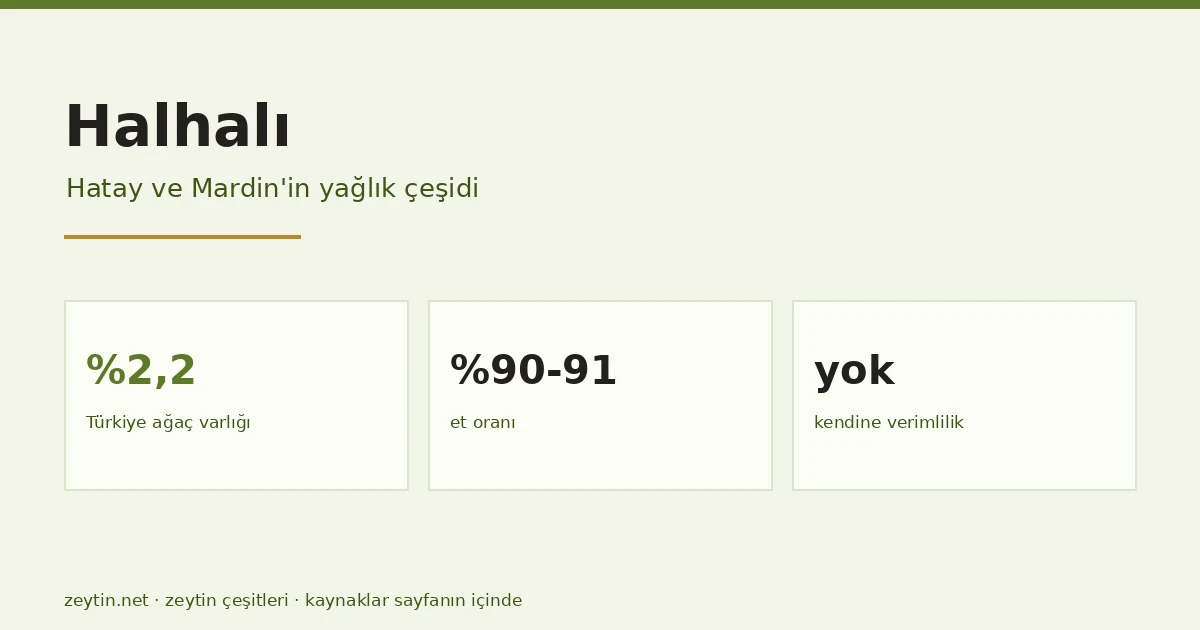
The Halhalı olive: Hatay's oil cultivar
Halhalı accounts for 2.2% of Turkey's olive trees, the main oil cultivar of Hatay and Mardin. The measured self-sterility of Yuvarlak Halhalı and what it means for orchard planning.
Article
The Halhalı olive: Hatay's oil cultivar
Halhalı accounts for 2.2% of Turkey's olive trees, the main oil cultivar of Hatay and Mardin. The measured self-sterility of Yuvarlak Halhalı and what it means for orchard planning.
 Article
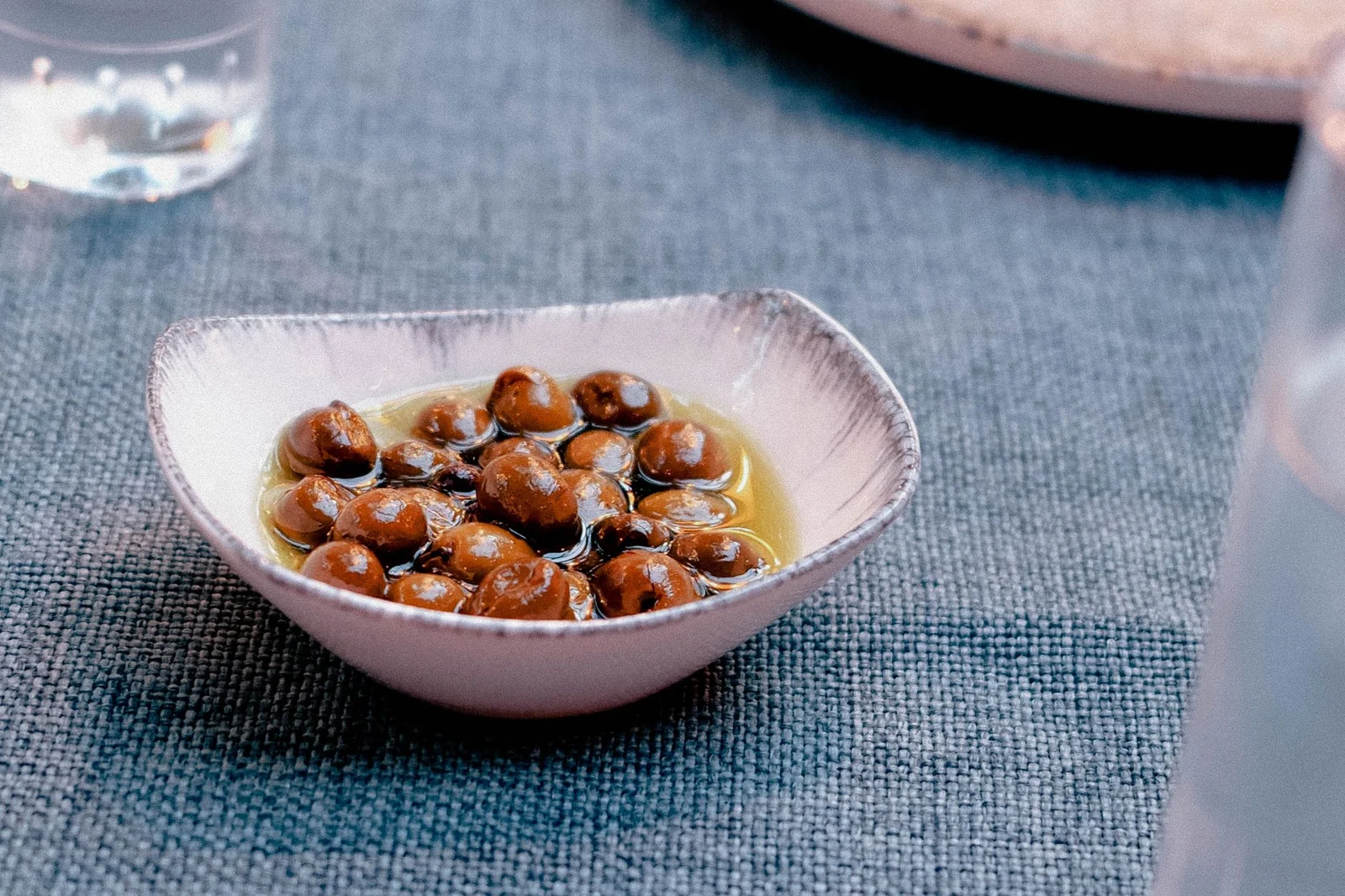
Which table olive variety is best?
The leading varieties for black and green table olives, measured fruit weights, and how curing affects quality.
Article
Which table olive variety is best?
The leading varieties for black and green table olives, measured fruit weights, and how curing affects quality.
 Article
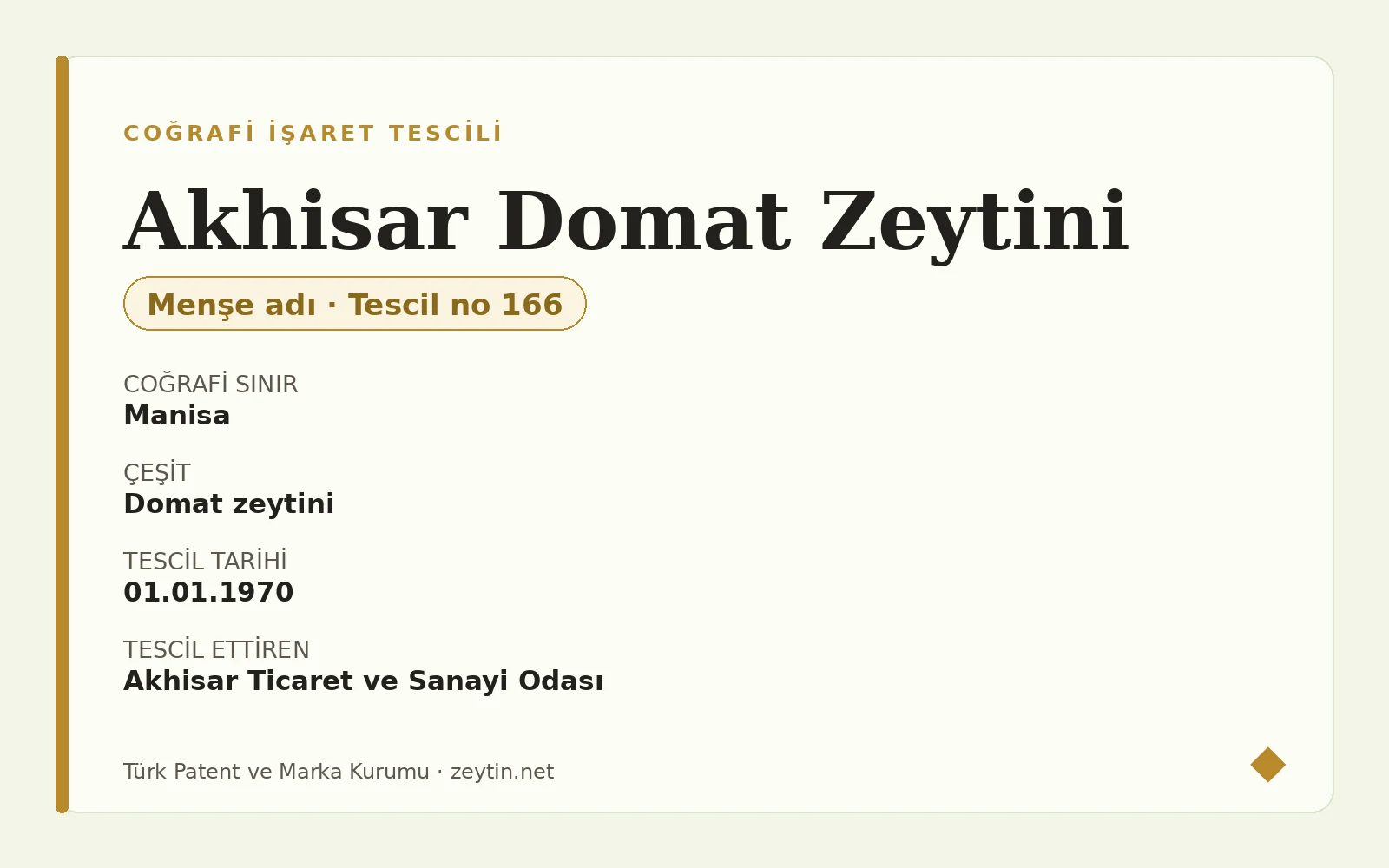
Akhisar Domat Olive: the specification behind stuffed olives
Registered in 2010. The certificate sets calibre separately for each product form — 170-290 for stuffed, 110-260 for cocktail. One cultivar, different sizes.
Article
Akhisar Domat Olive: the specification behind stuffed olives
Registered in 2010. The certificate sets calibre separately for each product form — 170-290 for stuffed, 110-260 for cocktail. One cultivar, different sizes.
 Article
How Are Olives Cured?
An olive straight from the tree is inedible — it is bitter. In water, in salt, in lye or scored: the methods that remove the bitterness, and how long each takes.
Article
How Are Olives Cured?
An olive straight from the tree is inedible — it is bitter. In water, in salt, in lye or scored: the methods that remove the bitterness, and how long each takes.