How much is the olive pressing fee in 2026? Cash or a share of the oil?
Pressing fees for 2026-27: 30 lira per kilo of oil in Antalya, 35–40 lira in Alanya, 4 lira in Osmaniye; in the Aegean mills mostly take a share of the oil. We compare the three payment methods by yield and current exchange price.
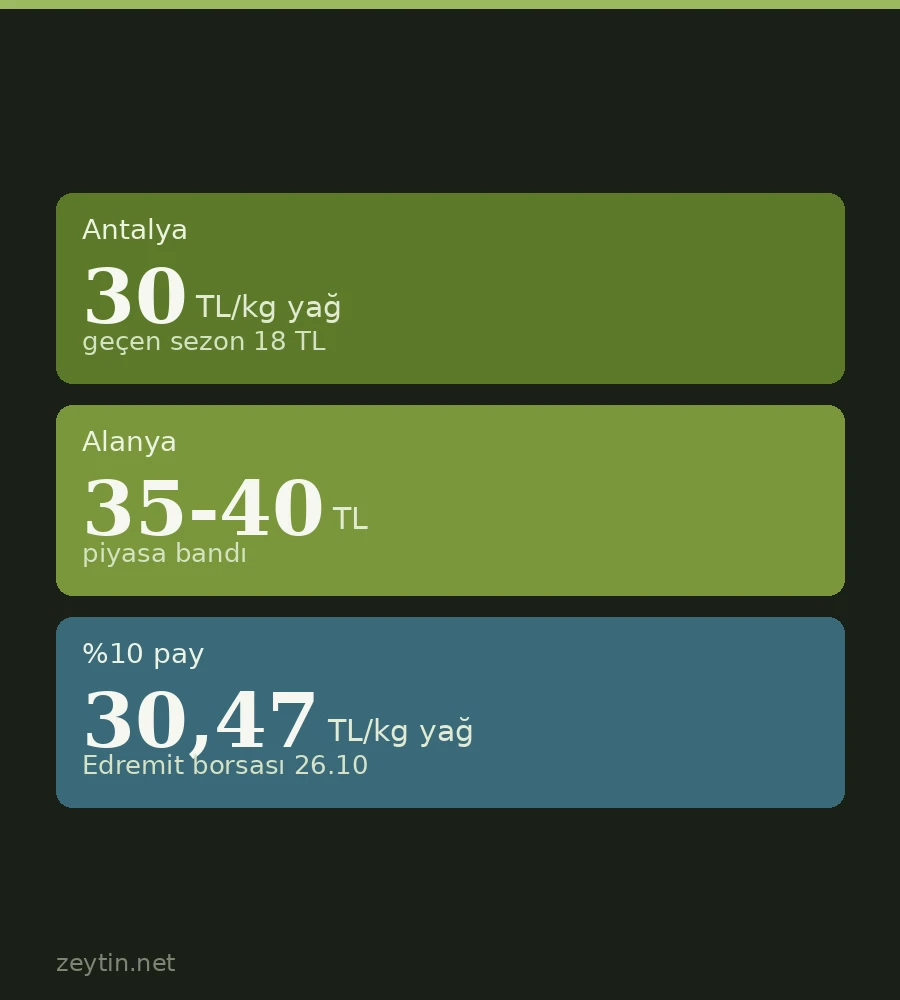
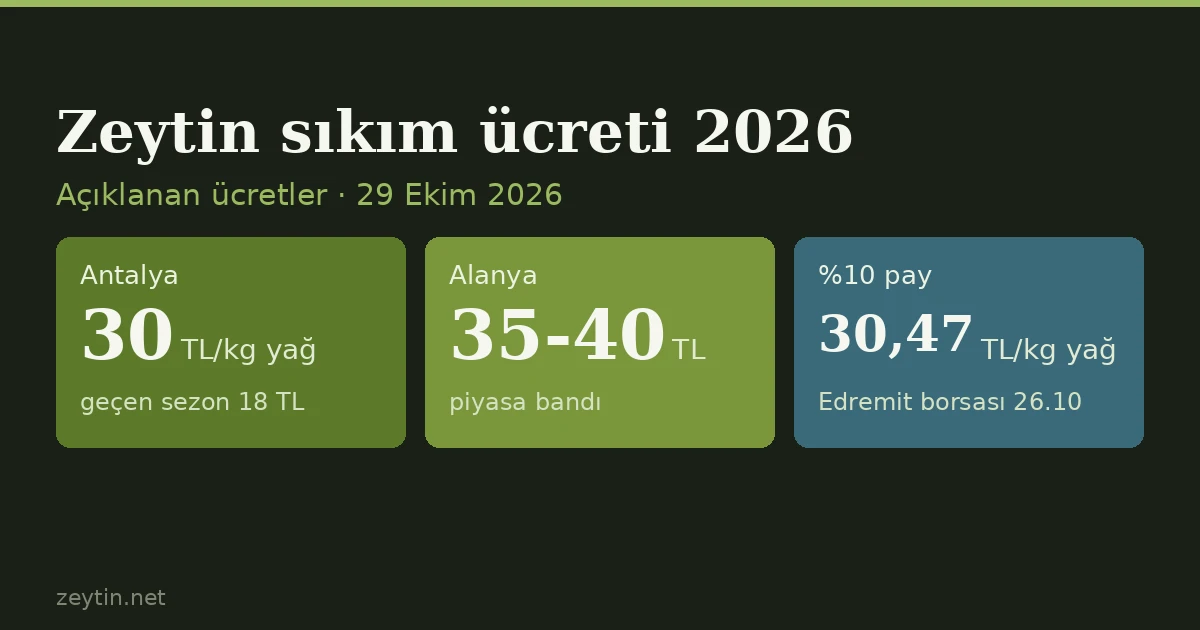
Short answer: there is no single olive pressing fee in Türkiye for the 2026-27 season. The fee depends on the region, the mill and the way you pay. As of late October, these are the figures announced so far: mills in Antalya charge 30 lira per kilo of oil produced (18 lira last season), the going rate in Alanya is 35–40 lira, and mill owners in central Osmaniye agreed a common fee of 4 lira. In much of the Aegean the fee is taken not in cash but as a share of the oil, and 2026 rates there have not yet been announced.
Before putting these numbers side by side, one thing needs to be clear: they do not measure the same thing.
Three ways of paying
Toll pressing — taking your own olives to a mill and paying for the service — is charged in three ways:
1. Cash per kilo of olives. The olives are weighed on arrival and a fee is paid per kilo. In Aydın, Çine Municipality set the fee for its Topçam Madran olive oil mill at 2.25 lira per kilogram at a council meeting in December 2024. Mayor Mehmet Kıvrak said at the time that the mill was "not making a loss, but not aiming for a profit either".
2. Cash per kilo of oil. Common along the Mediterranean coast, this method calculates the fee on the oil that comes out. The Taşağıl and Doğançam mills run by the Manavgat Chamber of Agriculture charged 22 lira per kilogram of olive oil last season.
3. A share of the oil. The grower pays no cash and leaves a percentage of the oil at the mill. The same Manavgat mills took one litre in ten from growers who did not want to pay cash. In İzmir, Kemalpaşa Municipality kept its share at 10% in 2024, rising to 12% if the municipality collected the olives from the orchard; Seferihisar Municipality's mill took shares of 8% and 12%.
The same picture emerged at a sector meeting held at the Çanakkale Chamber of Commerce and Industry at the end of September: some customers leave a share of oil, some pay oil plus cash, some pay cash only, and the rules differ from mill to mill. The chamber said a common practice on fees was needed, but announced no figure.
What has been announced for 2026 so far
| Place | Fee | Unit | Announced by |
|---|---|---|---|
| Antalya | 30 lira (18 lira last season) | per kg, on oil produced | Local press, 26 October |
| Alanya | 35–40 lira on the market; 30 lira at one mill | Not stated in the report | Mill owner, 23 October |
| Central Osmaniye | 4 lira | Not stated in the report | Mill owners' majority vote, 13 September |
| Çanakkale | Not announced | — | Chamber of commerce and industry meeting, 29 September |
The 30 lira in Alanya is a discount. Mill owner Vatan Demir said that, although the market rate was in the 35–40 lira band, the mill had lowered its fee to 30 lira at the request of the district governor and the head of the local chamber of agriculture. The Osmaniye decision was taken at a meeting of mill owners in the provincial centre, attended also by some mill owners from the Düziçi district.
We found no official decision setting the 2026 fee in Aydın, Balıkesir, İzmir, Manisa or Muğla. Municipal mills usually set their fee by council decision after pressing has started; in Çine in 2024 that decision came in early December.
Same fee, different bill: oil yield
A fee charged on oil depends on how much oil the olives give. The Antalya example shows this clearly. According to local press reports, last season an average of 7.5 kilos of olives gave 1 kilo of oil in the region, while this season 10–12 kilos of olives are needed.
The arithmetic works like this:
- Last season one tonne of olives gave about 133 kilos of oil; at 18 lira the pressing bill was 2,400 lira.
- This season the same tonne gives 83–100 kilos of oil; at 30 lira the bill is 2,500–3,000 lira.
So the fee per kilo of oil rose by 67%, but the money paid per tonne of olives rose by only 4% to 25%. When yields fall, what the mill collects falls with them automatically.
Cash or share? The sums at today's price
The cash value of a share depends on the price of oil on the day. On 26 October 2026, natural extra virgin olive oil traded at an average of 304.73 lira per kg on the Edremit Commodity Exchange. At that price a 10% share comes to 30.47 lira per kilo of oil — almost exactly the 30 lira charged in Antalya.
The table below compares the pressing bill for one tonne of olives at three different oil yields. The 17% figure is the Türkiye average we use in our piece on how much oil a kilo of olives gives.
| Fee type | Yield 10% | 17% | 20% |
|---|---|---|---|
| 30 lira per kilo of oil | 3,000 | 5,100 | 6,000 |
| 10% share of oil | 3,047 | 5,180 | 6,095 |
| 8% share of oil | 2,438 | 4,144 | 4,876 |
| 4 lira per kilo of olives* | 4,000 | 4,000 | 4,000 |
| 2.25 lira per kilo of olives (Çine, 2024 decision) | 2,250 | 2,250 | 2,250 |
*The unit of the Osmaniye decision was not given in the report, so it is assumed here to be per kilo of olives.
Three conclusions follow from the table:
- Fees charged on oil grow with yield. A grower whose olives give a lot of oil pays more under a per-kilo-of-oil fee or a share.
- A fee per kilo of olives is flat. If yields are high, this method works in the grower's favour; if they are low, in the mill's favour.
- The value of a share moves with price. When oil prices fall, the cash value of the share left at the mill falls too; when prices rise, a share can cost more than a cash fee. In Kemalpaşa in 2024, growers who wanted to pay their share in cash were charged 220 lira per litre of oil, which made a 10% share worth 22 lira for every litre produced.
Which option is better depends on your own yield and on when, and at what price, you plan to sell the oil. We looked at where pressing sits among production costs in what a kilo of olives costs to produce, and at how to read exchange prices in a separate piece.
What the fee covers
What the fee includes also varies from mill to mill:
- Transport: in the Kemalpaşa example, having the olives collected from the orchard added two percentage points to the share.
- Batch size: mills in Antalya press up to 500 kilos of olives as a single batch; growers with fewer olives have theirs combined with others' to make up 500 kilos. One mill in Alanya advertises that it presses lots above 400 kilos without mixing. Why and how batches get mixed is explained in a separate article.
- Pomace and wastewater: at the Çanakkale meeting, transporting olive pomace was described as the mills' biggest problem. We found no public tariff showing how that burden is passed on in the fee.
Questions to ask before going to the mill
When discussing the fee, make sure the answers to these four questions are clear:
1. Is the fee charged per kilo of olives, per kilo of oil, or as a percentage share?
2. Is the oil handed over by weight or by volume? There is a difference of about 9.5% between the two.
3. Are transport and tins included in the fee?
4. From what quantity are olives pressed as a separate batch?
What to check at handover is covered in what to check when having olives pressed at a mill, and this season's cost of harvest labour in olive picking and pruning daily wages.
Fees can also change during the season. The surest way to know the exact figure in your own area is to get it from the mill in writing, with its unit, before pressing.
One rating per visitor; you can change yours at any time. Ratings are real reader votes — no seeded or default scores.
Related
 Article
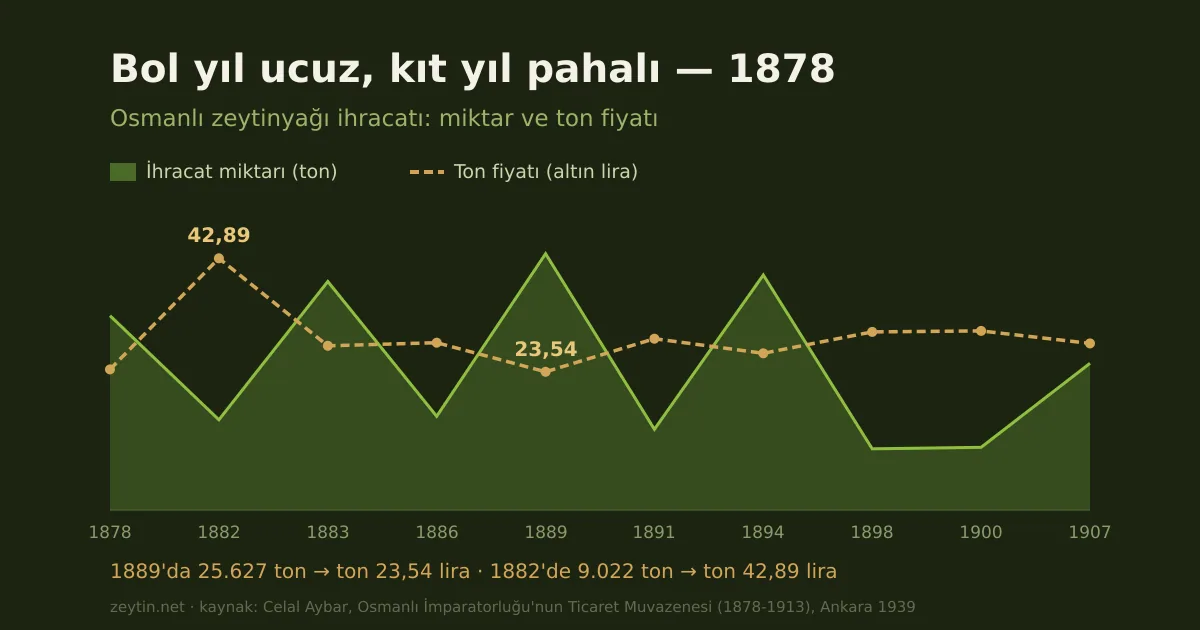
Olive oil trade in the Ottoman Empire: Britain the buyer, the crop the price
25,627 tonnes exported in 1889 at 23.54 lira a tonne; 9,022 tonnes in 1882 at 42.89. The crop-price inverse held a century ago too.
 Article
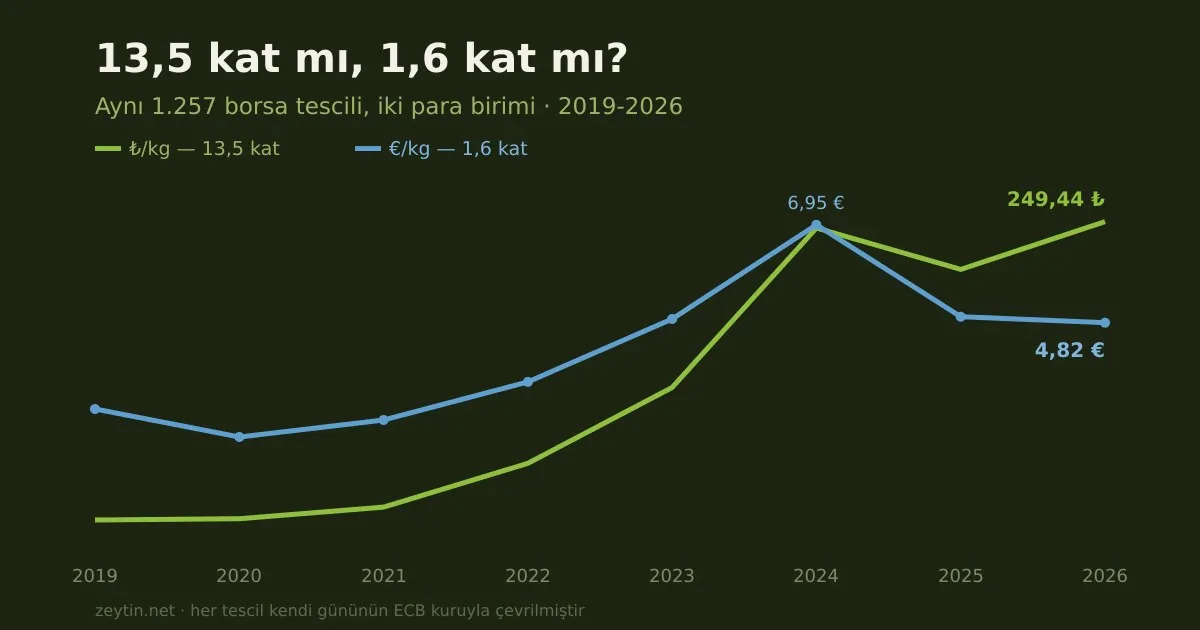
Did olive oil go up 13.5 times, or 1.6 times?
Up 13.5 times in lira, 1.6 times in euros. The same 1,257 registrations, each converted at its own day's ECB rate.
 Article
How war destroys an olive grove: denial of access does more than the bomb
An olive grove is not an annual field: first fruit takes 4-8 years, full yield 20-25. War's damage is therefore generational, not seasonal. We read the picture in Lebanon and Palestine through the tree's own biology.
 Article
Why do small olive growers sell at harvest? What do licensed warehouses and electronic receipts offer?
Exchange records show that prices do not bottom out at harvest every year; the real issue is the cost of waiting. Licensed warehouses and electronic receipts (ELÜS) are the legal way to raise cash without selling the oil: interest-free loans up to 75% of the receipt, storage fee support and tax exemptions. But as of October 2026, official records show no licensed olive oil warehouse with an operating permit.