How much is the olive picking and pruning daily wage in 2026?
Turkish chambers recommend 1,200-1,500 lira a day for olive picking in 2026/27, up to 1,900 for shaking and 1,750 for pruning; none is binding.
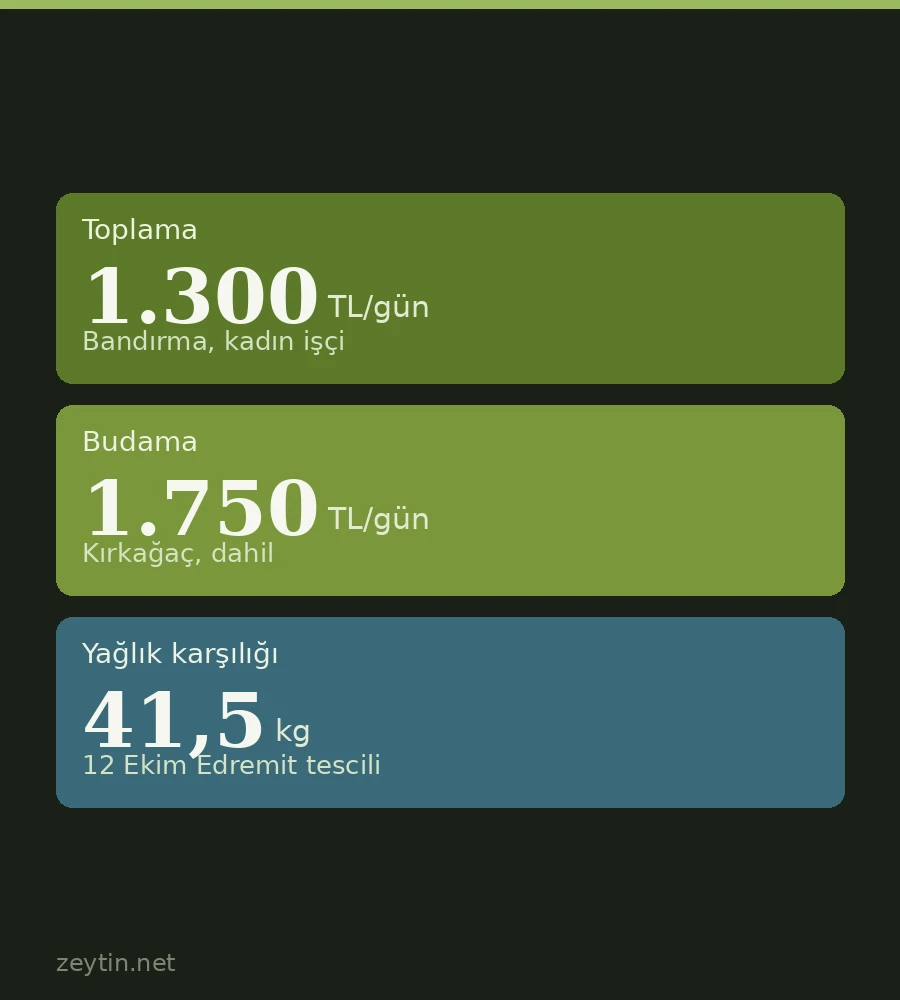
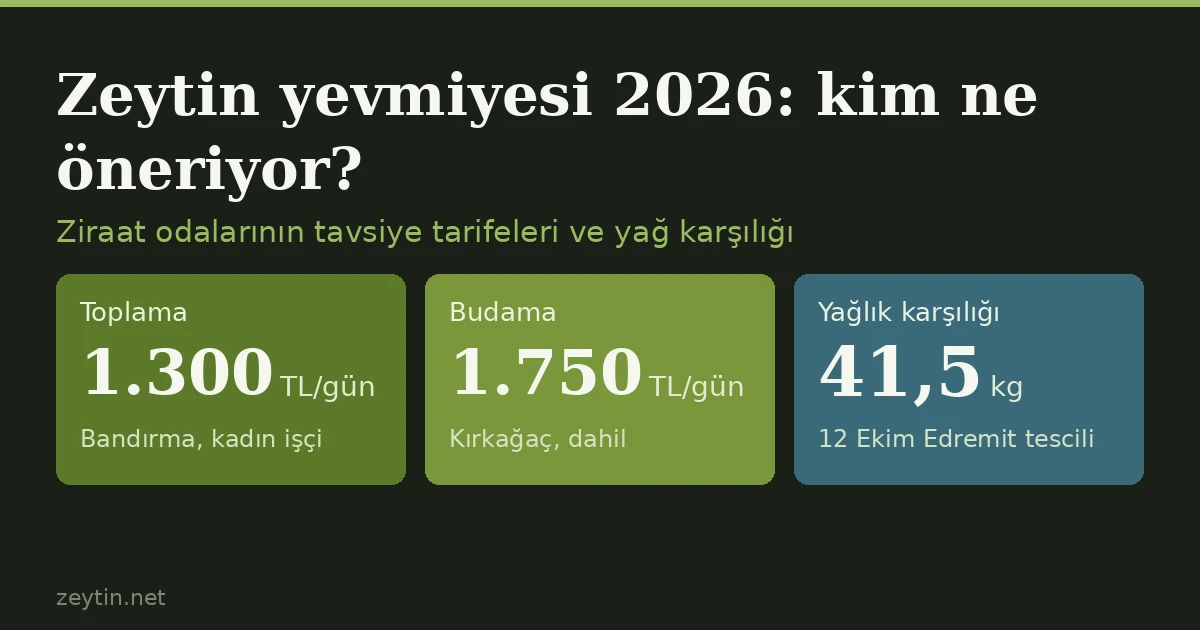
For the 2026/27 season, the olive picking wage that Turkish chambers of agriculture have announced is 1,200 to 1,500 lira a day. For workers who knock olives down with poles or shake the trees with machines, the recommendations go up to 1,500-1,900 lira. For pruning there is only one published figure, from Kırkağaç: 1,750 lira a day, crew boss and transport included. None of these numbers is binding. The chambers make recommendations, and the wage actually paid in the grove comes out of bargaining between the grower, the crew boss and the workers. The table below lists only figures that an institution announced. We left out any province where we found no announcement.
What is the daily wage in each district?
| Place | Institution and date | Picking | Other rates | What is included |
|---|---|---|---|---|
| Bandırma (Balıkesir) | Bandırma Chamber of Agriculture, 6 October 2026 | 1,300 (women pickers) | Comb-rake shaking 1,600 · motorised shaking 1,900 | Excludes start-of-work and transport fees, 08:00-16:00 |
| Edremit (Balıkesir) | Edremit Chamber of Agriculture, September assembly, published 1 October 2026 | 1,200 (picker) | Pole beater 1,500 · vehicle 4,000 (up to 100 km) | Foreman's share is deducted from these rates, 7 hours' work + 1 hour break |
| Kırkağaç (Manisa) | Kırkağaç Chamber of Agriculture board, 1 October 2026 | 1,500 | Harvesting machine 2,500 | Not stated |
| Didim (Aydın) | Didim Chamber of Agriculture assembly, September 2026 | 1,300 (net) | — | Excludes crew boss and transport |
| Mut (Mersin) | Mut Emek Labour Services Cooperative protocol, from 15 September 2026 | 1,400 (8 hours, 175 an hour) | Foreman paid a double wage · bus 3,500-5,500 | Transport separate, priced by village |
Mersin, Adana and Hatay also have a general figure. On 2 October 2026, Musa Yılmaz, head of the Mersin Chamber of Agriculture, said the 2026 seasonal farm worker wage in these three provinces is 1,613 lira, with the labour broker's share included. That rate covers all farm work, not just olives.
We found no olive-specific announcement from a chamber or a governor's office in İzmir, Muğla, Çanakkale, Bursa, Gaziantep or Hatay. Growers in those provinces quote rates, but no institution stands behind them, so they are not in the table.
Who sets the wage?
The short answer is that nobody sets it in a binding way. Chambers of agriculture publish recommended rates through a decision of their assembly or board. Kırkağaç says so in its own decision: the final wage depends on what the parties agree. Yılmaz in Mersin goes further. He says chambers have no authority to set wages at all. In his account the figure comes out of talks between farmer and worker representatives, and nothing enforces it.
The law does not fill this gap either. Prime Ministry Circular 2017/6 on seasonal farm workers sets up offices in governorates and a monitoring system. It says nothing about how wages are determined. There is still a floor. Article 2 of the Minimum Wage Regulation says the regulation covers every worker employed under an employment contract, whether or not the job falls under the Labour Law. That is why Edremit added a condition to its decision: if the minimum wage announced at the start of 2027 is higher than the harvest wage, the minimum wage applies.
Before comparing two tariffs, check what each one includes. Didim's 1,300 lira excludes the crew boss and transport. The foreman's share comes out of Edremit's 1,200. Kırkağaç's pruning rate includes both transport and the crew boss. Two numbers that look the same on paper can cost the grower hundreds of lira more or less per worker.
How much did the wage rise from last season?
| Item | 2025/26 | 2026/27 | Change |
|---|---|---|---|
| Bandırma, women pickers | 1,000 TRY | 1,300 TRY | +30% |
| Bandırma, comb-rake shaking | 1,300 TRY | 1,600 TRY | +23% |
| Bandırma, motorised shaking | 1,600 TRY | 1,900 TRY | +19% |
| Kırkağaç, picking | 1,200 TRY | 1,500 TRY | +25% |
| Net minimum wage (monthly) | 22,104.67 TRY | 28,075.50 TRY | +27% |
| Net minimum wage per day (one thirtieth) | 736.82 TRY | 935.85 TRY | +27% |
Bandırma's 2025 rates were announced in November 2025 by the chamber's head, Süleyman Dönmez. Kırkağaç gives its previous 1,200-lira rate in its own decision. We could not find Edremit's 2025 decision. In 2024 the chamber set 800 lira for women pickers and 1,000 for pole beaters, so over two seasons both rates rose by 50%.
The upshot is that harvest wages have risen at about the same pace as the minimum wage. In Bandırma, a woman picker earned 1.36 times the daily net minimum wage last season and earns 1.39 times this season. In Kırkağaç the ratio slipped from 1.63 to 1.60. Machine work rose a little more slowly than the minimum wage.
What does olive pruning pay?
In March 2026 the Kırkağaç Chamber of Agriculture set the pruning wage at 1,750 lira a day, including transport and the crew boss. Emin Özarı, the chamber's head, said that was a 17% rise, which puts the previous rate at around 1,500 lira. The chamber also noted that it raised the wage while olive and olive oil prices had fallen and yields had dropped.
Pruning pays more than picking because it is skilled work: whoever decides which branches stay also decides next year's crop (how and when to prune olive trees). We found no other chamber that has published a 2026 pruning rate. Pruning is done after the harvest and through the winter. If other chambers follow Kırkağaç's calendar, 2027 pruning rates will come out in late winter, after the new minimum wage is set.
How many kilos of oil olives does one day's wage buy?
The picture changes when you measure the wage in produce instead of lira. In October and November 2025, about 645 tonnes of oil olives were registered in 6 trades on the Edremit Commodity Exchange. The volume-weighted average price was 46.58 TRY/kg. This season's first oil-olive trade, on 12 October 2026, covered 525.6 tonnes at 31.31 TRY/kg.
| Daily wage | Oil olives | Extra virgin olive oil |
|---|---|---|
| Bandırma woman picker, 2025: 1,000 TRY | 21.5 kg | 3.6 kg |
| Bandırma woman picker, 2026: 1,300 TRY | 41.5 kg | 4.5 kg |
| Edremit picker, 2026: 1,200 TRY | 38.3 kg | 4.2 kg |
| Edremit pole beater / Kırkağaç picker, 2026: 1,500 TRY | 47.9 kg | 5.2 kg |
| Kırkağaç pruner, 2026: 1,750 TRY | 55.9 kg | 6.1 kg |
For 2025 we used the October-November 2025 oil-olive average and the October 2025 extra virgin average (280.44 TRY). For 2026 we used the 12 October oil-olive trade and the volume-weighted average of five extra virgin trades in October 2026 (287.90 TRY).
Measured in extra virgin oil, a worker-day became 27% more expensive, rising from 3.6 kg to 4.5 kg. Measured in oil olives, it almost doubled. The reason is that wages rose by 30% while the oil-olive price fell by a third. A grower who has the olives pressed and sells oil feels a rise about the size of the minimum wage increase. A grower who sells the fruit pays twice as much per worker-day. That gap is behind the protest in Akhisar, where growers stopped picking (fruit at 50, oil olives at 10 lira in Akhisar).
This season's oil-olive price rests on a single trade, so the average may shift as the season goes on. How much a worker picks in a day, what pressing costs per kilo, and the price below which picking loses money are worked out in when does picking olives lose money. The Söke finding that one worker-day costs about 10 kg of oil (one worker-day in Söke) is the same calculation for a table-olive district.
In short
- In chamber recommendations for 2026/27, picking pays 1,200-1,500 TRY a day and shaking 1,500-1,900 TRY. Pruning in Kırkağaç pays 1,750 TRY.
- The rates are not binding. The floor is the minimum wage, which in 2026 works out to 935.85 TRY net a day.
- Wages rose 19-30% from last season. The net minimum wage rose 27%.
- One worker-day now costs 4.5 kg of extra virgin oil or 41.5 kg of oil olives. Last season it cost 3.6 kg of oil or 21.5 kg of olives.
- When comparing tariffs, check whether the crew boss, transport and the bus are included.
One rating per visitor; you can change yours at any time. Ratings are real reader votes — no seeded or default scores.
Related
 Article
How to read olive oil exchange prices
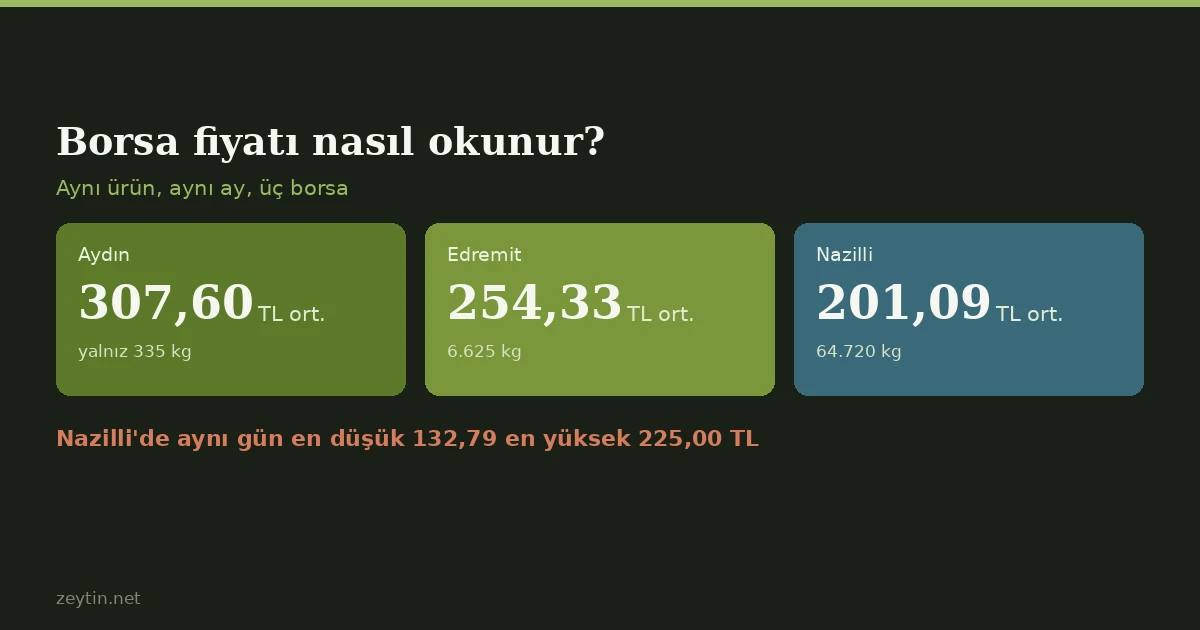
Three exchanges, three averages for the same product: 201, 254 and 308 lira. In Nazilli, trades from 132.79 to 225.00 in a single day. What an exchange price measures, and why date and volume matter more than the average.
 Article
How did olive oil prices open the 2026/27 season?
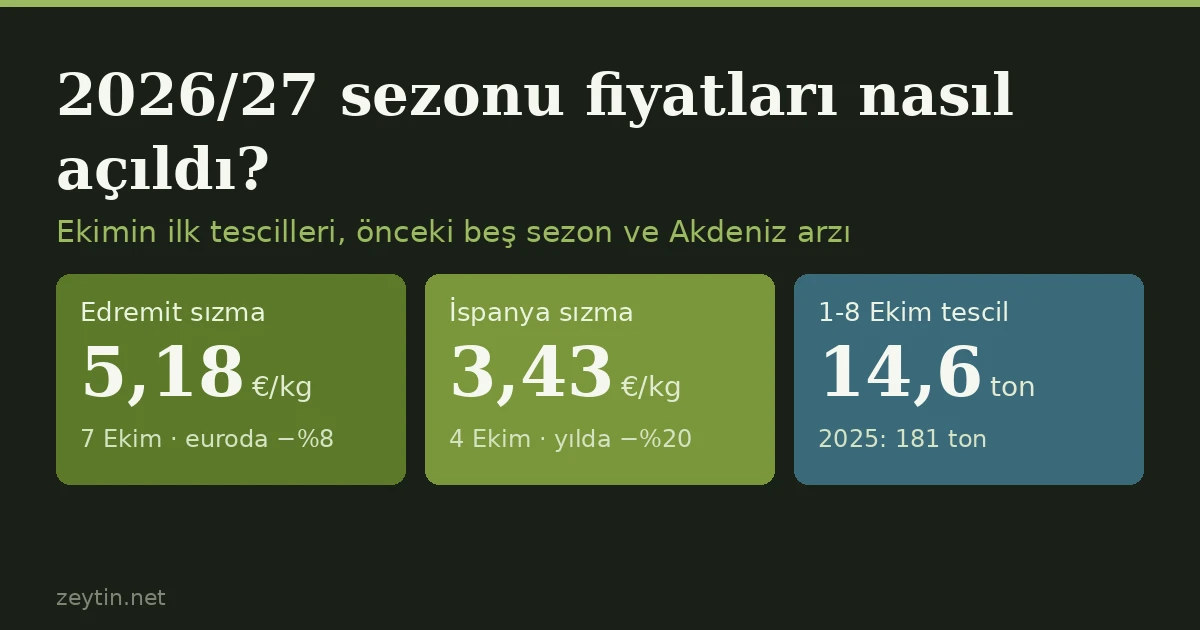
The first exchange registrations of October 2026 compared with the same weeks of the previous five seasons, in lira and euros: Edremit extra virgin is up 4% in lira and down 8% in euros; Spanish producer prices fell 20% in a year. The opening is thin, and Spain is the only major producer with an official supply figure.
 Article
Why do small olive growers sell at harvest? What do licensed warehouses and electronic receipts offer?
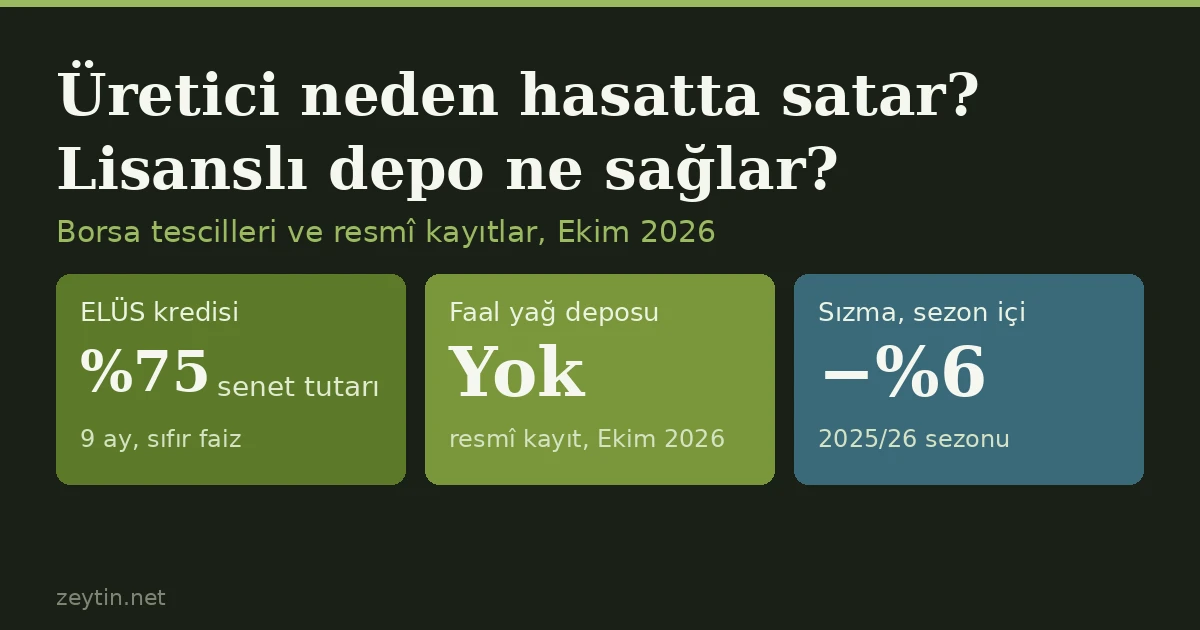
Exchange records show that prices do not bottom out at harvest every year; the real issue is the cost of waiting. Licensed warehouses and electronic receipts (ELÜS) are the legal way to raise cash without selling the oil: interest-free loans up to 75% of the receipt, storage fee support and tax exemptions. But as of October 2026, official records show no licensed olive oil warehouse with an operating permit.
 Article
How war destroys an olive grove: denial of access does more than the bomb
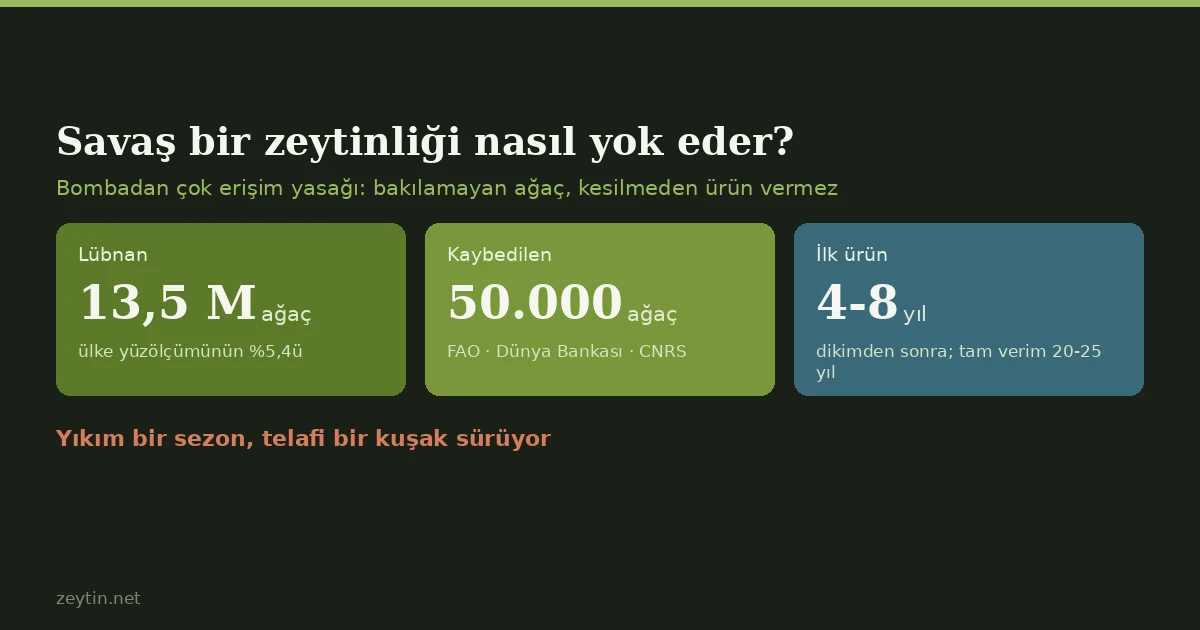
An olive grove is not an annual field: first fruit takes 4-8 years, full yield 20-25. War's damage is therefore generational, not seasonal. We read the picture in Lebanon and Palestine through the tree's own biology.