How much olive oil does one person in Türkiye consume?
Türkiye is one of the world's largest producers, yet consumes 1.8 kilos of olive oil per person a year. The same measure is 11.4 kilos in Spain and 10.3 in Greece. The same country, however, out-consumes Spain in table olives. The numbers point to price as the deciding factor.
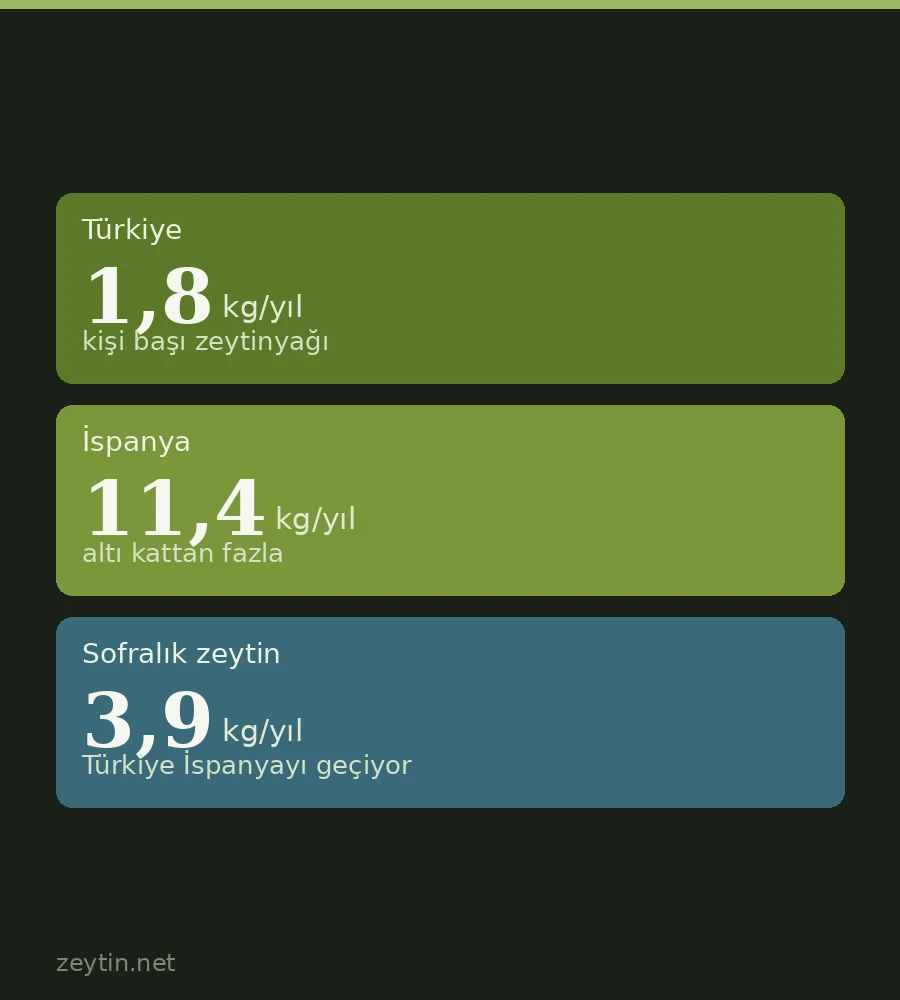
Türkiye is among the world's largest olive oil producers — and among those that consume the least of what they make. One figure captures it: 1.8 kilos per person a year.
The number comes from a sector report by the Agricultural Economic and Policy Development Institute of the Ministry of Agriculture and Forestry, drawing on International Olive Council data, and refers to the 2020/21 season.
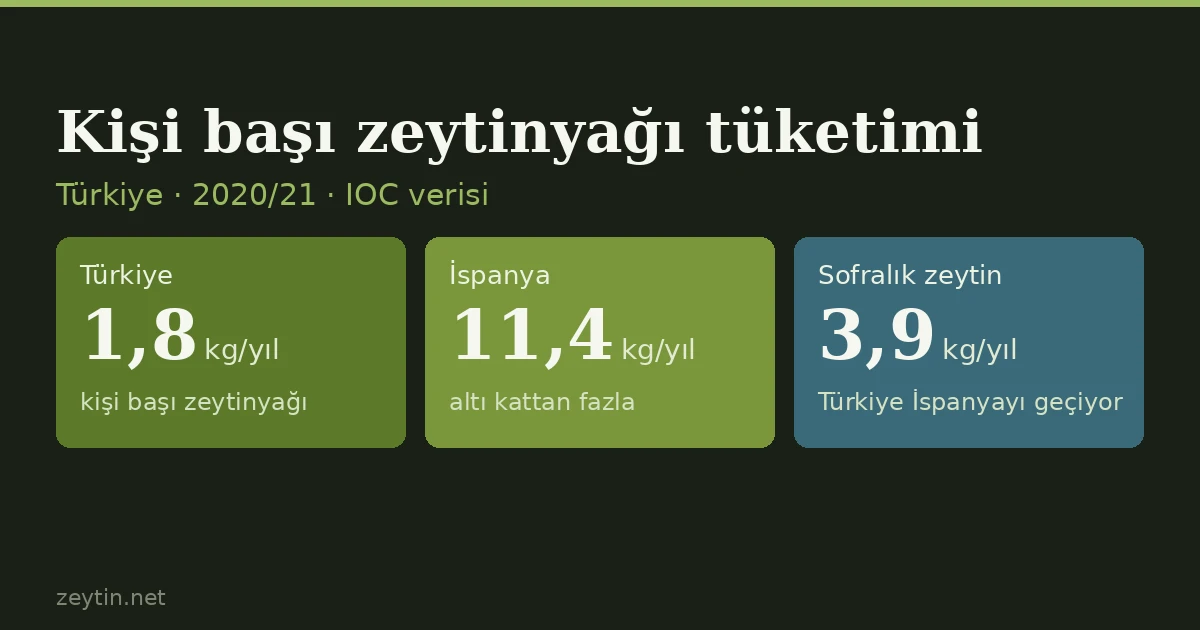
Consumption per person by country
| Country | kg / person / year |
|---|---|
| Spain | 11.4 |
| Greece | 10.3 |
| Italy | 7.1 |
| Syria | 6.8 |
| Portugal | 5.8 |
| Algeria | 5.2 |
| Morocco | 3.7 |
| Tunisia | 2.5 |
| Australia | 2.2 |
| Türkiye | 1.8 |
The placing is striking. Türkiye consumes less of its own product than Tunisia or Australia, and the gap with Spain is more than sixfold.
Set against importing countries, the scale reads differently again. In the previous season's data, consumption per person was 1.2 kg in the United States, 1.5 kg in Canada and 0.5 kg in Brazil and Japan. A producing country, in other words, sits closer to the importers than to its fellow producers in terms of habit.
Total consumption: a decade going nowhere
If the per-person figure feels abstract, the national series settles it. Türkiye's annual olive oil consumption, in thousand tonnes:
| Season | Consumption |
|---|---|
| 2012/13 | 150,000 t |
| 2013/14 | 105,000 t |
| 2015/16 | 116,000 t |
| 2017/18 | 177,000 t |
| 2019/20 | 170,000 t |
| 2020/21 | 150,000 t |
| 2021/22 (est.) | 170,000 t |
There is no trend here, only oscillation between 105,000 and 177,000 tonnes. Since the population grew across the same decade, a flat total means consumption per person actually fell.
The series can be checked against itself: 1.8 kg multiplied by a population of roughly 85 million gives about 153,000 tonnes, which matches the 150,000 tonnes recorded for 2020/21. The two figures corroborate each other.
The same country, a different story in table olives
Here is where it gets interesting. In the same report, per-person table olive consumption in 2020/21 was 6.2 kg in Algeria, 5.6 kg in Syria, 5.5 kg in Egypt, 3.9 kg in Türkiye and 3.5 kg in Spain.
So the country that consumes a sixth of Spain's olive oil consumes more table olives than Spain does. Olives are not missing from the Turkish table. What is missing is the oil.
The totals tell the same story. According to current International Olive Council statistics, Türkiye's table olive consumption rose from 110,000 tonnes in 1990/91 to 395,000 tonnes in 2024/25. One domestic market has more than tripled; the other has stood still.
The cause is price, not habit
The strongest explanation is the one the report itself points to: the price of olive oil relative to competing oils. Sunflower, corn and margarine sell for roughly half the price. Cooking-oil consumption in Turkish kitchens is high, but that volume flows toward whichever oil is cheaper.
The position of table olives supports the reading. A table olive is eaten on its own at breakfast and has no substitute. Olive oil has a direct substitute, and that substitute costs half as much.
In this site's retail survey on 8 October 2026, extra virgin olive oil on supermarket shelves averaged 423 lira a litre across 24 products, with the cheapest at 249 lira. At that level, switching daily cooking oil to olive oil is a serious budget decision for a household.
⚠ Price is not the only factor. Regional cuisine matters: olive-oil cooking is strong in the Aegean and the Mediterranean, while butter and tail fat dominate inland traditions. But regional habits do not shift this fast over a decade. What shifted was price.
Why it matters: the domestic market is a buffer
Consumption is not merely a question of diet; it is a question of price. A country with weak domestic consumption must sell most of what it produces abroad — and abroad, the price is not ours to set. A supply story such as Spain's 1.6-million-tonne crop estimate writes itself directly into what a Turkish grower is paid.
Last season demonstrated it: volumes rose while exports fell 62% in value. With stronger domestic consumption, part of that oil would have found its value at home instead of being bound to the world price.
This is why sector representatives raise domestic consumption every harvest. Lifting per-person consumption a few kilos above 1.8 would be a more durable support for prices than any record crop.
What does it amount to per day?
1.8 kilos a year is about 5 grams a day — half a teaspoon. Studies of the Mediterranean diet generally describe regular intake in the range of 20 to 40 grams a day. The average consumer in Türkiye therefore sits somewhere between a fifth and a tenth of the quantity discussed in the health literature. We cover how much to use daily in a separate article.
This is a national average. Households that already cook with olive oil sit far above it; those that never use it sit near zero. What lifts an average like this is not the enthusiasts using more, but the non-users starting.
One rating per visitor; you can change yours at any time. Ratings are real reader votes — no seeded or default scores.
Related
 Article
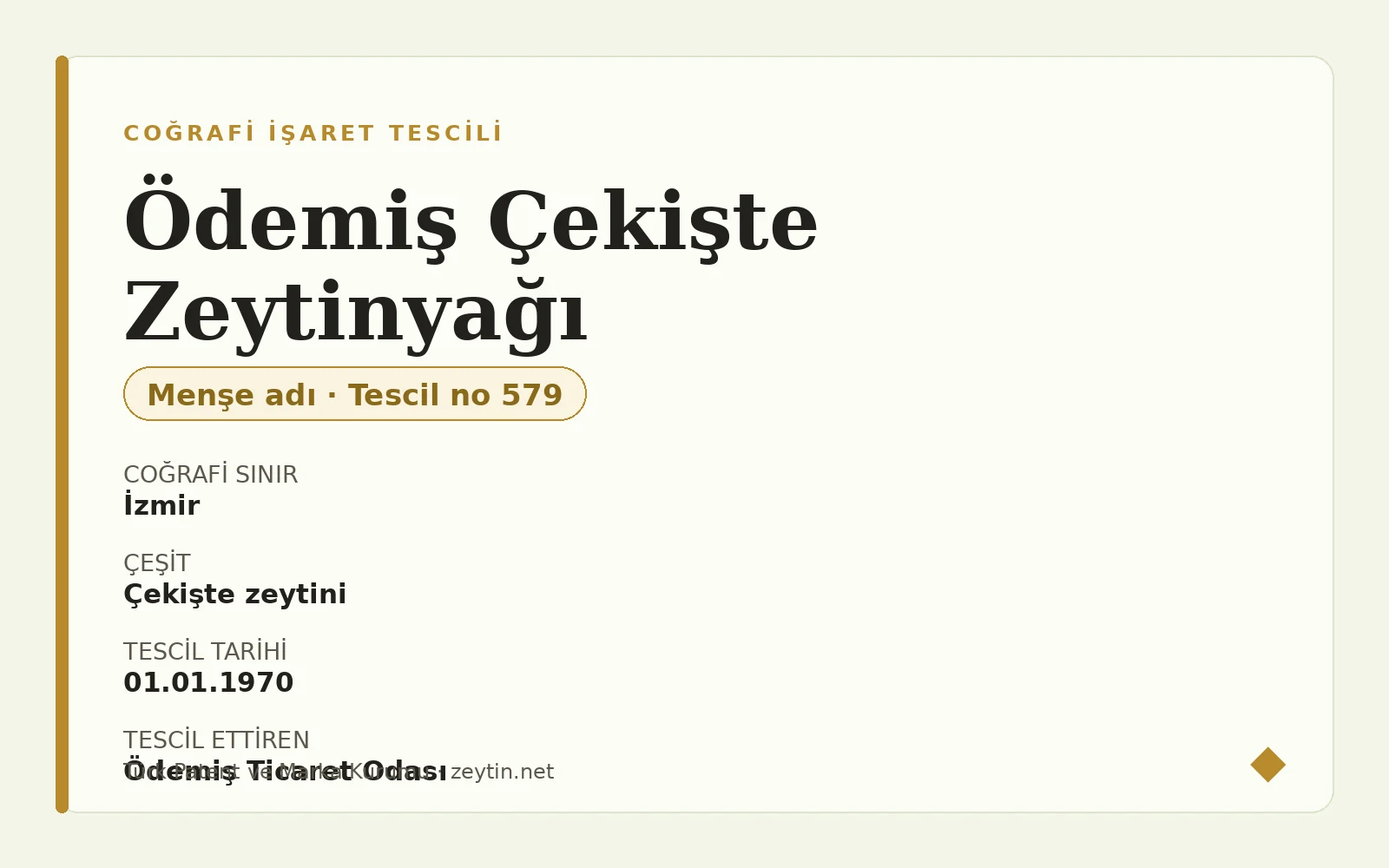
Ödemiş Çekişte Olive Oil: a separate harvest window called “çakır”
Registered in 2020. The certificate names two harvest windows: early (green, November-December) and “çakır” (green turning pink, mid-December to mid-January).
Article
Ödemiş Çekişte Olive Oil: a separate harvest window called “çakır”
Registered in 2020. The certificate names two harvest windows: early (green, November-December) and “çakır” (green turning pink, mid-December to mid-January).
 Article
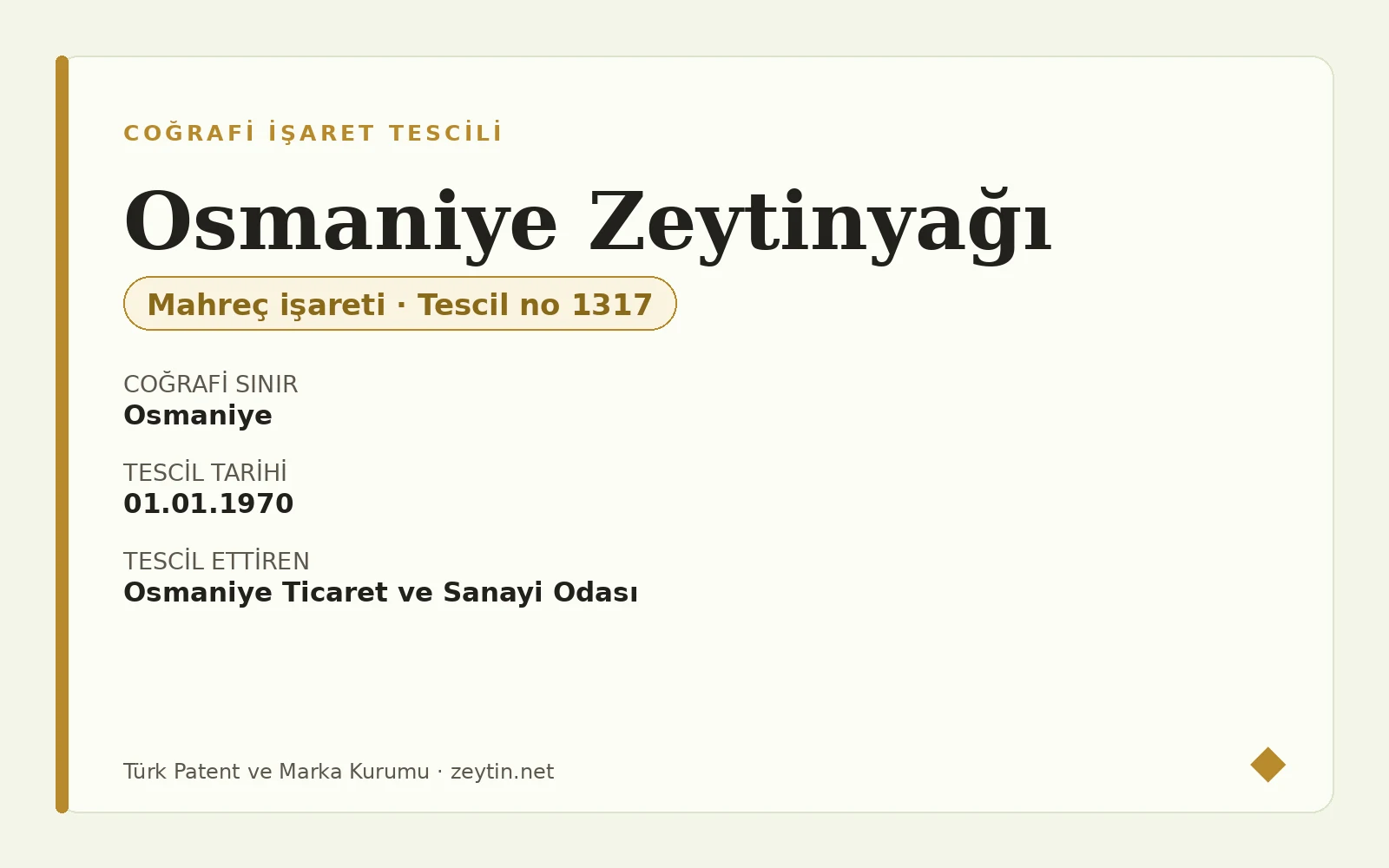
Osmaniye Olive Oil: a registration with sensory thresholds above six
Registered in 2022. Fruitiness ≥6.4, bitterness ≥6.0, pungency ≥6.1 — unusually high thresholds. Milling within 48 hours of harvest is required.
Article
Osmaniye Olive Oil: a registration with sensory thresholds above six
Registered in 2022. Fruitiness ≥6.4, bitterness ≥6.0, pungency ≥6.1 — unusually high thresholds. Milling within 48 hours of harvest is required.
 Article
North Aegean Olive Oils: a registration stricter than the food codex
The mark of ten localities rather than one district — and unusually, it sets tighter limits than the national standard on peroxide, FAEE, waxes and K270.
Article
North Aegean Olive Oils: a registration stricter than the food codex
The mark of ten localities rather than one district — and unusually, it sets tighter limits than the national standard on peroxide, FAEE, waxes and K270.
 Article
What does the colour of olive oil mean?
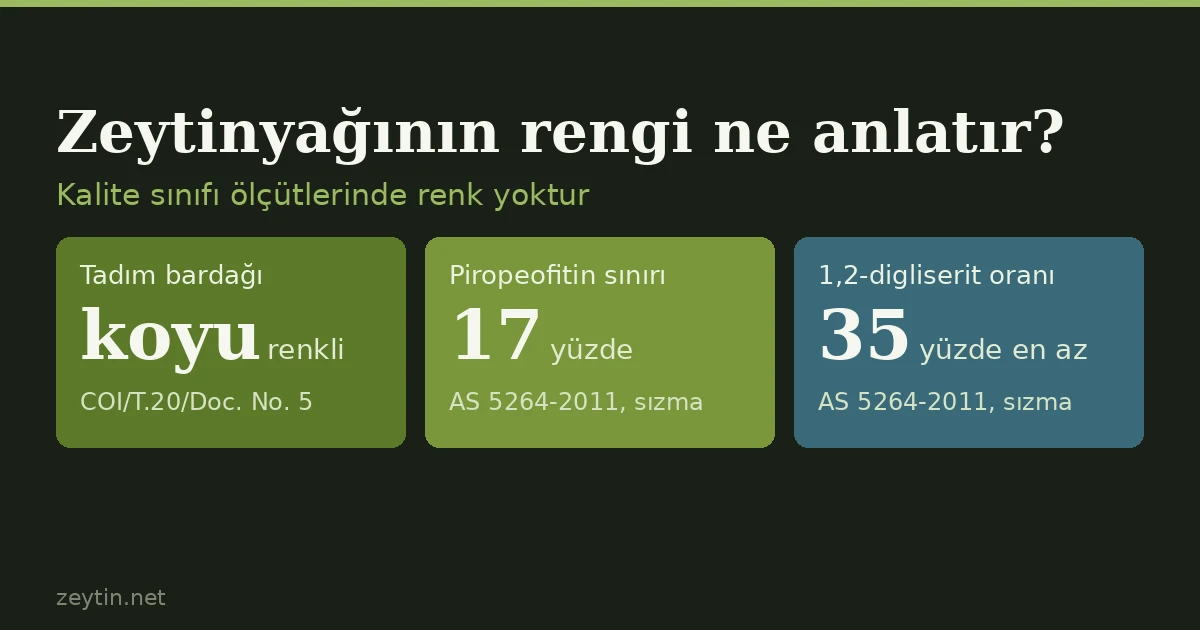
Dark green olive oil is widely assumed to be better, yet colour is not a criterion in any quality grade. The International Olive Council's official tasting glass must be dark enough that the colour of its contents cannot be seen — precisely so that the taster is not influenced by it. The chlorophylls and carotenoids that make the colour vary with cultivar, ripeness, leaf ratio and settling. Pigments do carry information in the laboratory as markers of freshness and heat treatment, but they cannot be read by looking at the bottle.
Article
What does the colour of olive oil mean?
Dark green olive oil is widely assumed to be better, yet colour is not a criterion in any quality grade. The International Olive Council's official tasting glass must be dark enough that the colour of its contents cannot be seen — precisely so that the taster is not influenced by it. The chlorophylls and carotenoids that make the colour vary with cultivar, ripeness, leaf ratio and settling. Pigments do carry information in the laboratory as markers of freshness and heat treatment, but they cannot be read by looking at the bottle.