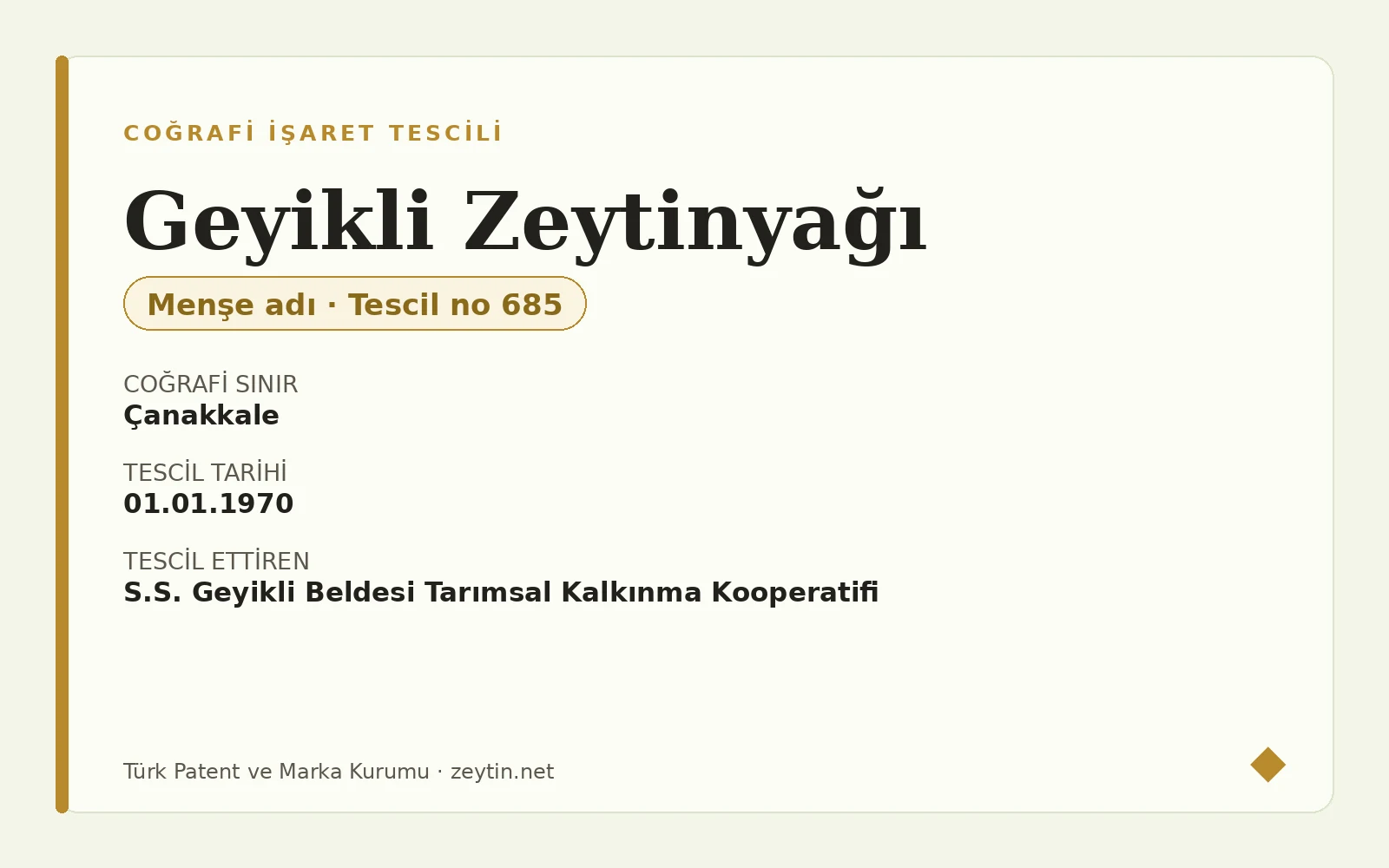
Geyikli Olive Oil: a registration that names its pollinators
Registered in 2020. From the Ayvalık cultivar; the certificate also records Gemlik and Hanım Parmağı as pollinators in the groves. Limits are set on 16 aroma compounds.
Olives are only partly self-fertile; a good crop usually needs a pollinator cultivar. Geyikli Olive Oil's certificate writes this into the production definition — it names the cultivars planted as pollinators.
The record
| Registration no | 685 |
| Protection from | 20.02.2020 |
| Type | Designation of origin |
| Registered by | S.S. Geyikli Agricultural Development Cooperative |
| Area | Geyikli, Ezine district, Çanakkale |
| Cultivar | Ayvalık (Edremit) |
| Pollinators | Gemlik and Hanım Parmağı |
That the registrant is a cooperative is itself notable — most registrations are held by chambers of commerce or commodity exchanges.
Sensory description
Clear at room temperature, colour running from green to yellow, lightly flowing and light on the palate.
The certificate even describes where the pungency is felt: rolled around the mouth, low-to-moderate bitterness and a moderate pungency varying with harvest maturity are perceived on the palate and particularly through the papillae at the centre and sides of the upper tongue.
Fruitiness must carry at least one of artichoke, green tomato, grass, green fruity and soft fruity; ripe fruit, green apple, green almond, flowers, vanilla, fresh walnut and hazelnut may also appear.
Limits on aroma compounds
The certificate sets numerical limits on 16 compounds. Among them:
| Compound | Limit (%) |
|---|---|
| Hexanal | ≤ 35.0 |
| Trans-2-hexenal | ≤ 25.0 |
| Cis-3-hexenal | ≤ 6.0 |
| 1-penten-3-one | ≤ 4.0 |
| 1-penten-3-ol | ≤ 3.5 |
| Alpha-linalool | ≥ 0.5 |
| Alpha-zingiberene | ≥ 0.3 |
Most compounds carry an upper limit; two carry a lower one — linalool and zingiberene. The certificate therefore requires certain aromas to be present: these are the chemical counterparts of its floral and spicy notes.
The criteria the document binds
The registration does not only protect a name; it defines the product numerically:
| Criterion | Value in the document |
|---|---|
| Harvest-to-pressing window | max 48 saat |
Limiting the time from harvest to pressing binds the operation rather than the outcome: free fatty acidity rises while the fruit waits.
Inspection. Members: Çanakkale Onsekiz Mart Üniversitesi, Ezine İlçe Tarım ve Orman Müdürlüğü, Ezine Ziraat Odası, Çanakkale Ticaret Borsası. Results are reported under Industrial Property Law no. 6769 and submitted to the Turkish Patent and Trademark Office.
The area as the document defines it
The short line in the record does not give the registration's full boundary. The document's own definition reads:
t; Çanakkale ili Ezine ilçesi Geyikli Beldesi ile Gökçebayır, Kema llı, Bozköy, Mecidiye, Kumburun, Çamoba, Dalyan, Tavaklı, Uluköy, Üvecik, Alemşah, Körüktaşı, Karadağ, Akçakeçili, Yeniköy, Yahyaçavuş,
The production steps in the document
The registration describes production step by step. The document's own sequence:
1. Hasat — Coğrafi sınırda yetişen Ayvalık çeşidi zeytin ağaçlarının meyveleri, hasar görmeyecek şekilde elle veya makinalı derim yöntemleriyle hasat edilir.
2. Zeytinlerin saklama ve taşıma koşulları — Hasat edilen zeytinler, gıda ile temasa uygun, temiz ve havalandırılabilir nitelikteki plastik kasalarda depolanır.
3. Zeytinlerin yıkanması ve temizlenmesi — Hasat edilen ve prosese alınan zeytinlerden yaprak, ince dal, toprak diğer bitkisel maddeler vb.
4. Zeytinlerin kırılması ve ezilmesi — Yabancı maddelerinden arındırılan zeytinler, kontinü sistemlerin kırıcı üniteleri tarafından kırılır ve hamur haline getirilir.
5. Zeytin hamurundan yağın ekstraksiyonu — Ekstraksiyon işlemi, aşağıda sıralanan yöntemlerden biriyle yapılabilir.
6. Depolama ve Ambalajlama — Geyikli Zeytinyağının depolanmasında gıda ile temasa uygun malzeme kullanılır.
That this sequence is binding is what separates a geographical indication from a trade mark: a mark says who produced something, a geographical indication also sets down how it must be produced.
Its place in Çanakkale's olive production
| Item | Value |
|---|---|
| Fruit production | 170,800 t |
| — for oil | 160,356 t |
| — for the table | 10,444 t |
| Olive oil production | 28,428 t |
| Trees | 5,161 thousand |
| Yield per tree | 33.1 kg |
94% of the province's fruit goes to oil. An oil-based registration matches how the province actually produces.
One rating per visitor; you can change yours at any time. Ratings are real reader votes — no seeded or default scores.
Related
 Article
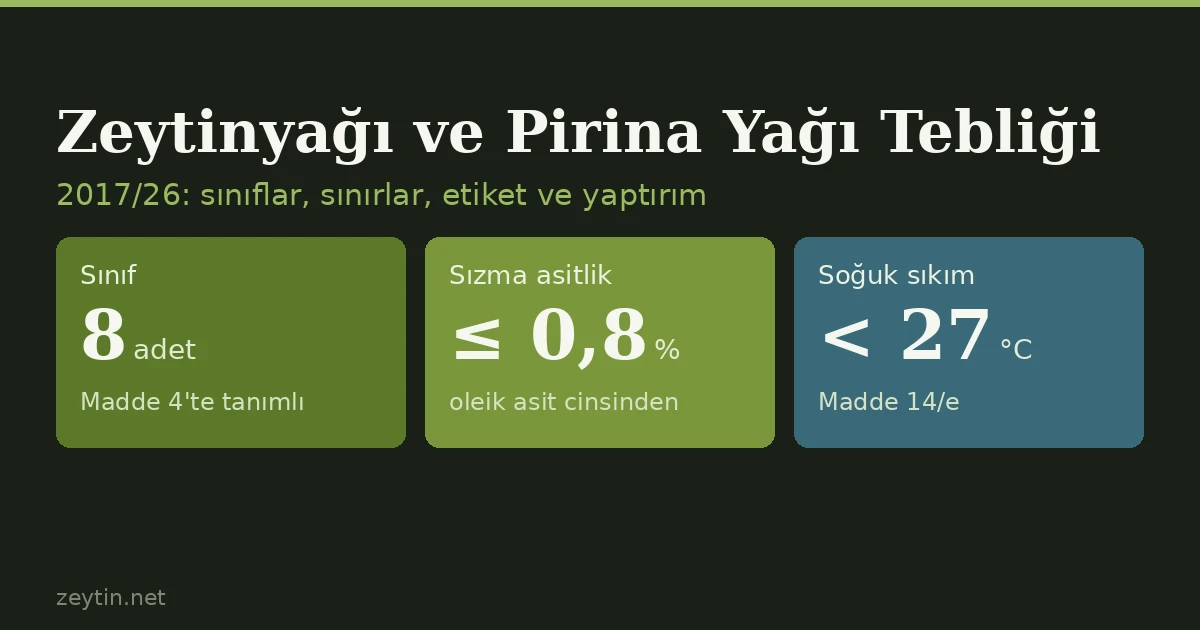
What is Türkiye's Olive Oil and Olive-Pomace Oil Communiqué, and what does it say?
Communiqué 2017/26 sets the grades, lab limits and label rules for olive and pomace oil sold in Türkiye; it was amended twice in 2023.
 Article
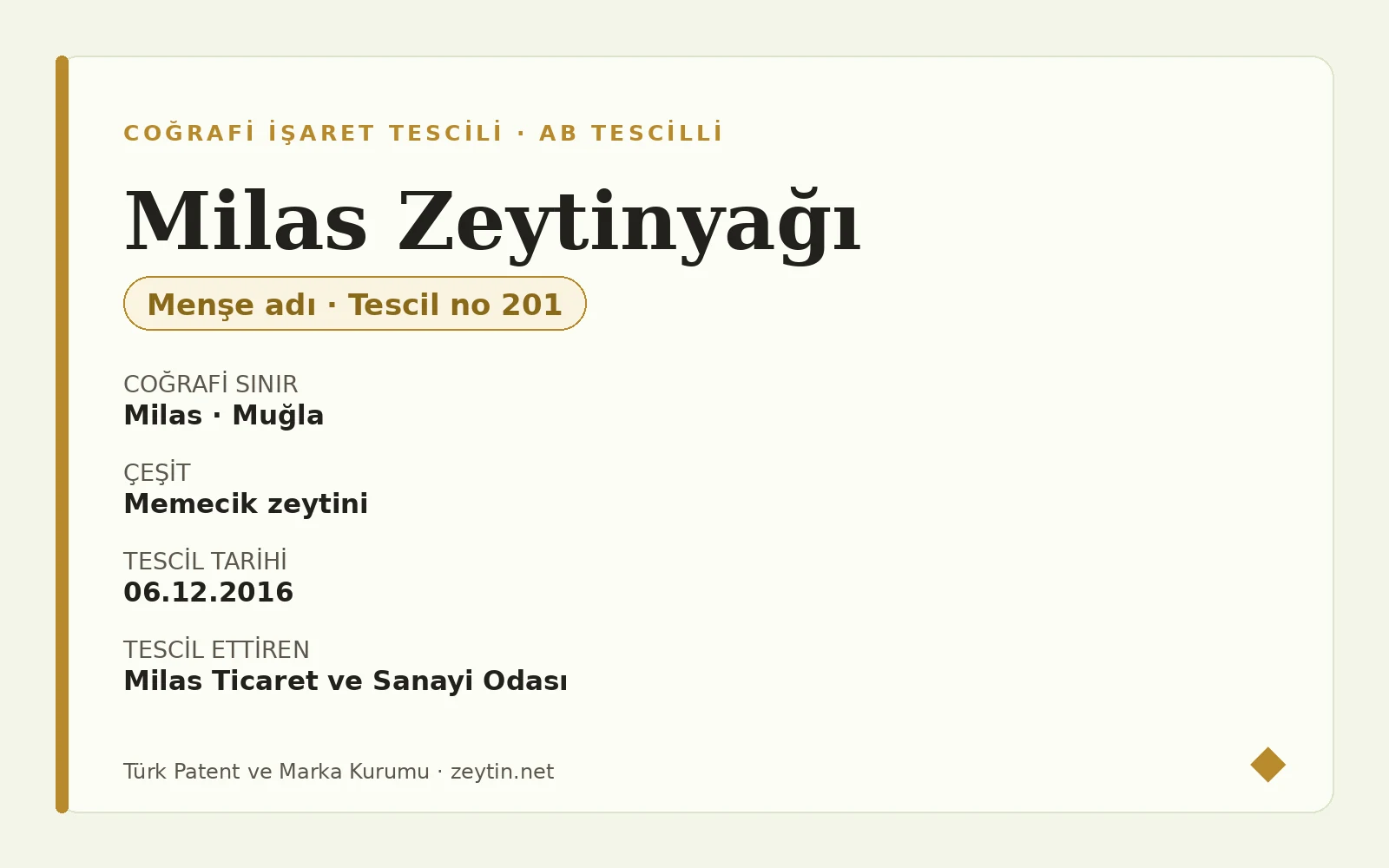
Milas Olive Oil: a press bed dated to 2000 BC
Registered in the European Union as well. The certificate's archaeological anchor is a press bed cut into rock at Pilavtepe — four thousand years old.
 Article
Which olive oil is the best quality?
The three measures that decide olive oil quality: grade, acidity and harvest year, plus how to read a label.
 Article
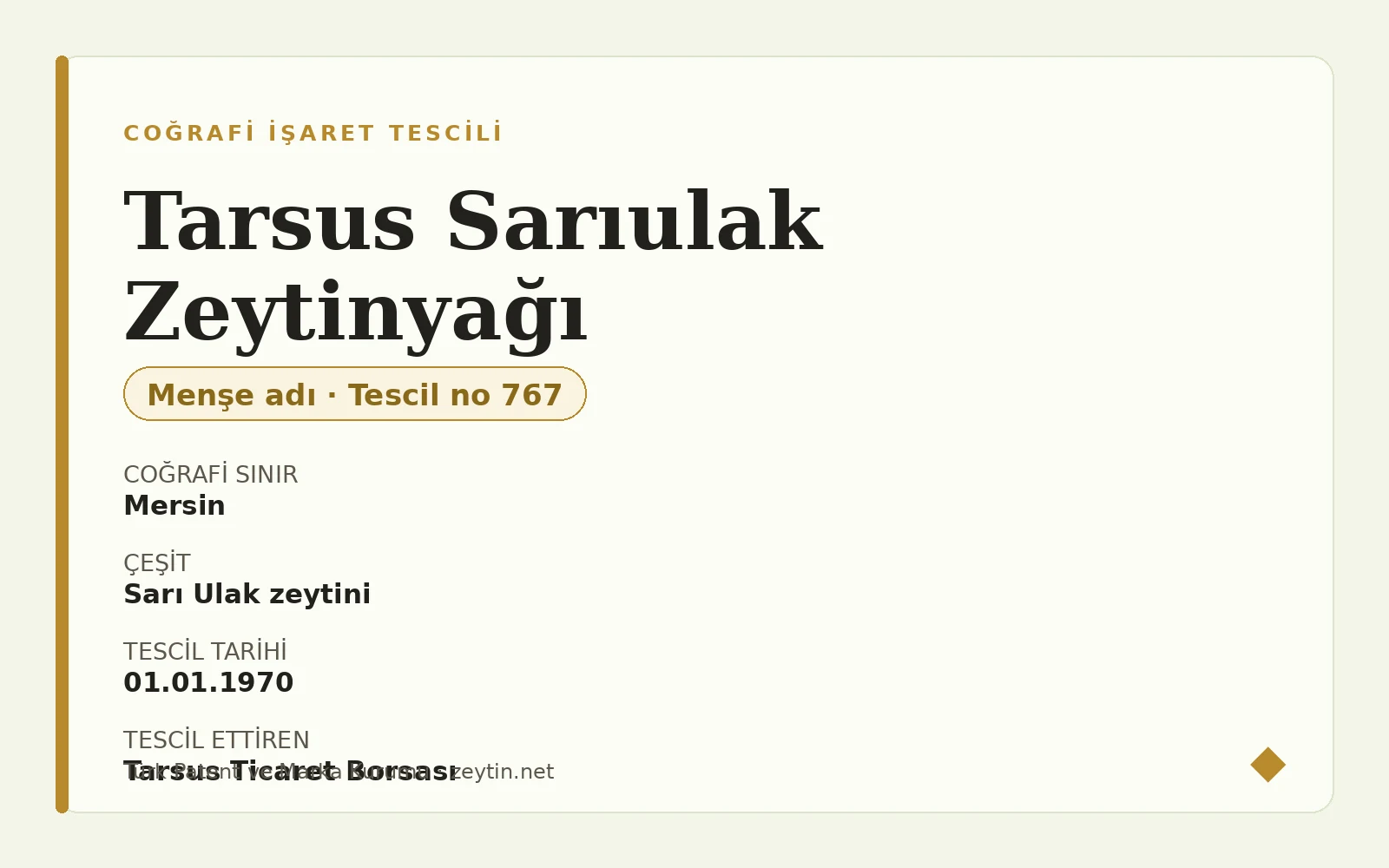
Tarsus Sarıulak Olive Oil: milling required immediately after harvest
Registered in 2020. The certificate ties product quality to one condition: the olives must be milled as soon as they are picked. Peroxide averages 8.23.