Akhisar Uslu Olive: the measured specification of a black table olive
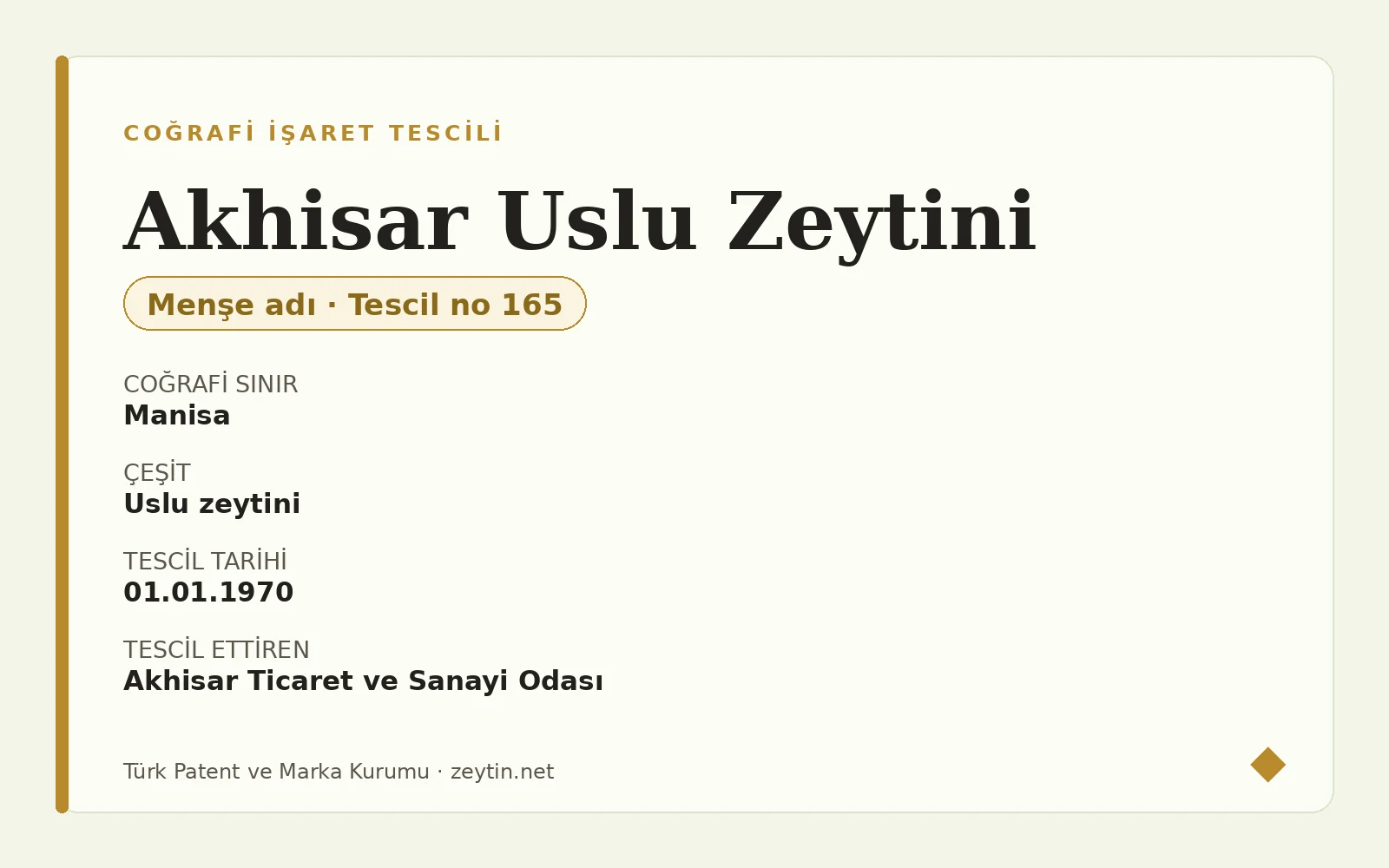
Registered in 2010 as a designation of origin. The certificate defines the Uslu cultivar in figures — and corrects a published error: the flesh ratio is 85.17%.
Uslu is one of the cultivars most often named in Turkish black table olive production, yet its measured values are scattered. The registration certificate gathers them in one place — and corrects a published error.
The record
| Registration no | 165 |
| Protection date | 04.11.2010 |
| Application | C2010/057 |
| Type | Designation of origin |
| Registered by | Akhisar Chamber of Commerce and Industry |
| Area | The Akhisar district of Manisa and its neighbours: Gölmarmara, Salihli, Turgutlu, Saruhanlı, Kırkağaç |
| Official notice | 12.04.2012 · Official Gazette 28262 |
Because it is a designation of origin, every stage must take place inside that boundary. We set out the distinction on the list of registrations.
The measured fruit
| Criterion | Value |
|---|---|
| Weight of 100 fruits | 353.40 g |
| Single fruit | ≈ 3.53 g |
| Fruits per kilogram | 283 |
| Length | 23.92 mm |
| Width | 18.12 mm |
| Length/width ratio | 1.32 |
| Flesh ratio | 85.17% |
| Oil content | 21.50% |
| Moisture | 60.61% |
One correction: a widely used source gives Uslu's flesh ratio as 15% and its stone ratio as 85%. That is physically impossible — the two values have been transposed. The certificate gives the correct figure: flesh 85.17%. The value on our Uslu olive page comes from here.
Tree and fruit
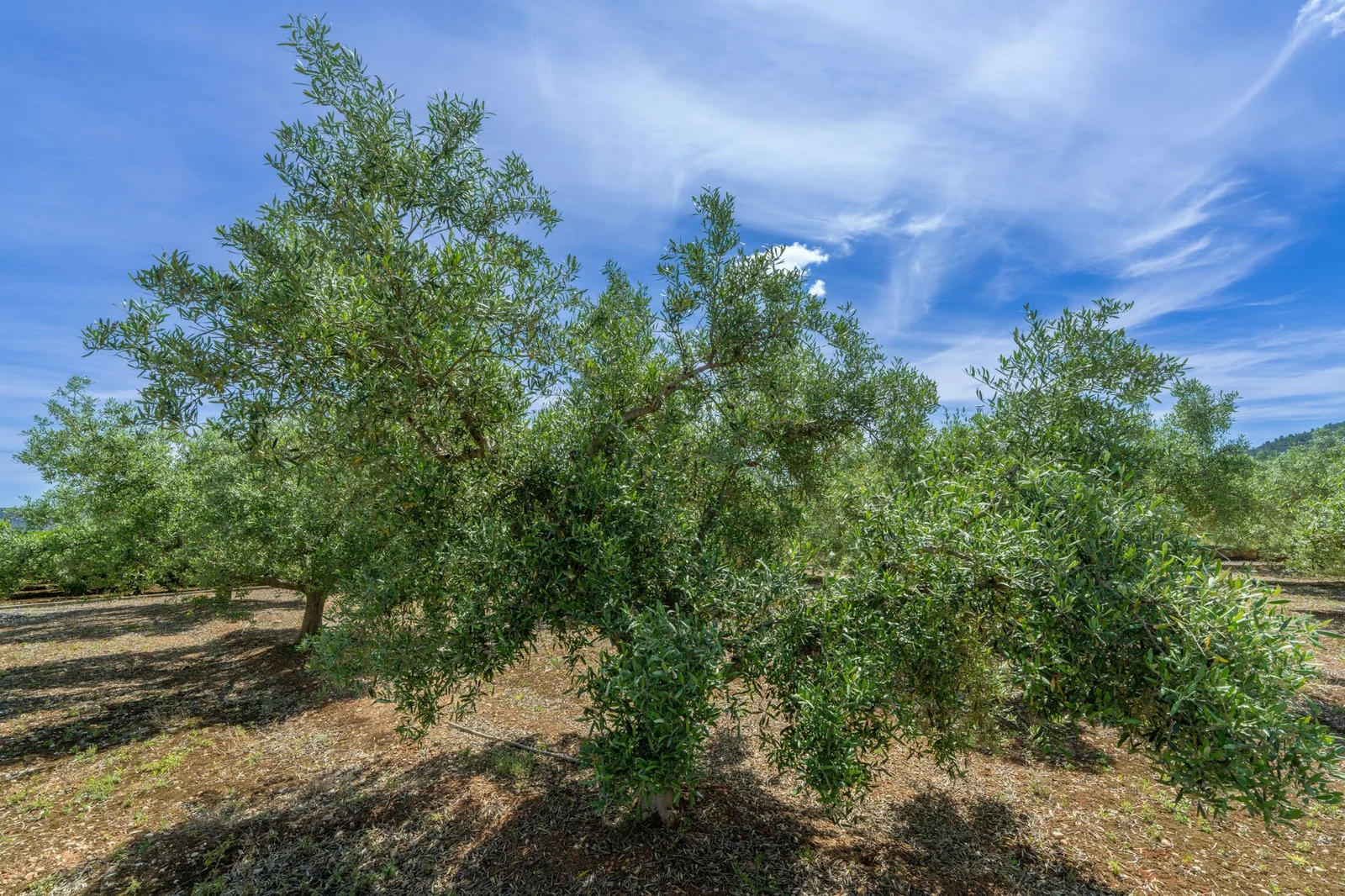
Under irrigation the tree grows very vigorously, forming a large, broad crown with dense branching and heavy foliage. Planting distances are therefore wide: 6×8 m or 7×7 m.
The fruit is medium-sized and oval. It is asymmetric lengthwise — the tip curves slightly downward — and symmetric across. The tip is rounded, without a nipple. Bright green when unripe, glossy deep black when mature; the ripe flesh is cream-coloured and soft, and separates easily from the stone.
Product classes and calibre
The certificate defines calibre separately for each product form — the same cultivar goes to different sizes under different processing:
| Product | Fruits/kg bands |
|---|---|
| Black natural · black confit | 240-280 · 281-330 · 331-370 |
| Sliced kalamata | 281-330 · 331-370 |
| Pitted / unpitted kalamata | 281-330 · 331-370 |
⚠ The certificate limits the tolerance on fruits per kilogram to (−3).
The two brines
Fermentation brine — to remove bitterness: prepared with drinking water at 0.5-7% salt and 0.065-1.2% acid, in accordance with the Table Olive Codex.
Packing brine — for presentation: drinking water with table salt and, where required, lactic acid, spices, vinegar, olive oil and herbs such as bay leaf.
We covered these processes generally in types of table olive.
Growing
The certificate describes planting step by step: pits of 80×80 cm, topsoil and subsoil kept separate, planting between November and April, shifted to March-April if the winter runs cold. Soil analysis before planting is mandatory.
And one provision governs table quality directly: harvest is by hand, and the olives are collected into crates. Bruised and damaged fruit in table olives is the consequence of pole-beating and sacks.
In short
The name Akhisar Uslu Olive belongs to Uslu-cultivar olives grown in Akhisar and five neighbouring districts, harvested by hand, and meeting nine measured values. What the certificate adds is a single reliable place for figures that were scattered — and, in one source, reversed.
The production steps in the document
The registration describes production step by step. The document's own sequence:
1. Dikim Sonrası Bakım — Dikim sırasında ve bunu takip eden yıllarda yetiştirme tekniklerine özen gösterilir.
2. Ambalaj Salamurası — İçme suyuna yemeklik tuzun, gerektiğinde laktik asit, baharat, sirke, zeytinyağı, aromalı ve aromasız bitkilerin (defneyaprağı vb.) maddelerin katılarak hazırlandığı karışımdır.
3. Dane İriliği — Ürünün irilik kriteri olup, ürünün halka arzında bir kg.’da bulunan ortalama adet sayısının gereklerini tarif eder.
4. Habitusu — Büyük, geniş taç oluşturur.
5. Taç Yoğunluğu — Dallanma sık ve dallar yoğun yapraklı Dalların Rengi : Yaşlı dallar gri, genç dallar ise gri-yeşil renklidir.
6. Dalların Açı Durumu — İki ve daha yaşlı dallar dik veya dar açılı, etek dalları ise geniş açılıdır.
7. Gövdenin Kuvveti — Kuvvetli Gövde Rengi : Gri Gövde Yüzeyinin Durumu : Dik ve yüzeyi düzgün YAPRAK Şekli : Uzun, orta geniş eliptik Üst Yüzey Rengi : Hafif puslu, koyu yeşil, genellikle 000858 (leek gren) renktedir.
8. Alt Yüzey Rengi — Yeşilimsi-gri Orta Damar : İçbükey bir hat halinde tüm yaprak boyunca belirgin çoğunlukla aya orta damara göre asimetrik Yan Damarlar : Silik Ucu : Genellikle uçta açık renkli küçük bir iğne bulunur.
That this sequence is binding is what separates a geographical indication from a trade mark: a mark says who produced something, a geographical indication also sets down how it must be produced.
The cultivar behind it, measured
The registration is granted to a place, but the cultivar the definition rests on has measurable values:
| Property | Value |
|---|---|
| Meyve ağırlığı | 3,53 g |
| 1 kg’daki tane sayısı | 283 |
| Et oranı | %85,17 |
| Et/çekirdek oranı | 5,74 |
| Yağ oranı | %21,50 |
| Toplam fenol | 182-494 mg CAE/kg |
| α-tokoferol | 380-486 mg/kg |
| Kendine verimlilik | Var |
| Kullanım | Yağlık ve siyah sofralık |
| Ana kullanım | siyah sofralık |
| Duyusal profil | Orta meyvemsilik, orta acılık, orta yakıcılık |
| Kökeni | Akhisar (Manisa) |
At 21.5% the oil content sits mid-range; yield alone is not the argument here, aroma is. A flesh-to-stone ratio of 5.74 is the basic measure of how much of a table olive is actually eaten.
Its place in Manisa's olive production
| Item | Value |
|---|---|
| Fruit production | 623,493 t |
| — for oil | 411,412 t |
| — for the table | 212,081 t |
| Olive oil production | 64,292 t |
| Trees | 24,982 thousand |
| Yield per tree | 25.0 kg |
Oil and table production are close in this province (66% for oil); the production base is not locked to one direction.
One rating per visitor; you can change yours at any time. Ratings are real reader votes — no seeded or default scores.
Related
 Article
İzmir Sofralık olive
İzmir Sofralık is a recorded variety of the Aegean. Described in the source.
Article
İzmir Sofralık olive
İzmir Sofralık is a recorded variety of the Aegean. Described in the source.
 Article
Olive and Olive Oil Glossary
Oleuropein, lampante, pomace, malaxation, designation of origin… Short, verifiable definitions of olive and olive oil terms.
Article
Olive and Olive Oil Glossary
Oleuropein, lampante, pomace, malaxation, designation of origin… Short, verifiable definitions of olive and olive oil terms.
 Article
Belluti olive
Belluti is a recorded variety of south-eastern Anatolia. No measured pomological data published.
Article
Belluti olive
Belluti is a recorded variety of south-eastern Anatolia. No measured pomological data published.
 Article
Butko olive
Butko is a recorded variety of the Black Sea. No measured pomological data published.
Article
Butko olive
Butko is a recorded variety of the Black Sea. No measured pomological data published.