The Olive in Religion
The tree sworn by in the Qur'an, blended into the holy anointing oil of the Torah, and burned in the lamp. The olive holds a shared place in all three faiths.

The olive appears in the scriptures of all three great monotheistic faiths born around the Mediterranean. That is no coincidence: in this geography olive oil was fuel, food and medicine at once — it sat at the centre of daily life. Sacred texts draw on what people already hold valuable.
Islam
The olive appears in the Qur'an in several places. Surah at-Tin opens with the words "By the fig and the olive"; that a chapter should open by swearing upon a tree indicates the regard in which it was held.
The best-known reference is the "verse of light" in Surah an-Nur. There the light of God is likened to a niche holding a lamp, whose oil comes from "a blessed olive tree, neither of the east nor of the west", and which seems to shine even untouched by fire. The image rests on the everyday fact that olive oil was the fuel burned in lamps.
The olive is also counted among created blessings in Surahs al-An'am and an-Nahl, and the hadith literature commends both eating olive oil and applying it to the body.
Judaism
Olive oil is regulated in detail in the Torah. The holy anointing oil described in Exodus is prepared by blending olive oil with spices such as myrrh, cinnamon and cassia; it consecrates both the tabernacle and its priests. Kings and priests were anointed with it — the root of the word "Messiah".
The seven-branched lampstand of the Temple, the menorah, likewise burned olive oil, and not ordinary oil at that: "pure beaten olive oil" is specified. The story of Hanukkah turns directly on that oil — one day's supply burning for eight.
The olive is also counted among the seven species that express the fertility of the land of Israel.
Christianity
In the New Testament the olive stands out as both place and symbol. The Mount of Olives, east of Jerusalem, hosts some of the most concentrated scenes of the narrative. The garden at its foot, Gethsemane, takes its name from the Aramaic for "oil press"; very old olive trees still stand there.
In his letter to the Romans, Paul likens Israel to a cultivated olive tree and the gentiles joining it to wild branches grafted onto that tree — explaining a theological argument through a farming technique.
Olive oil is also the base of the chrism used in anointing the sick and in rites such as baptism and confirmation.
What they share
In all three traditions the olive is tied to the same three things: light, consecration and continuity. It is the oil that lights the lamp, the oil that anoints, and the tree handed from one generation to the next. The fruit of an olive tree a person plants is often gathered by their grandchildren; perhaps that is precisely what is being called holy.
One rating per visitor; you can change yours at any time. Ratings are real reader votes — no seeded or default scores.
Related
 Article
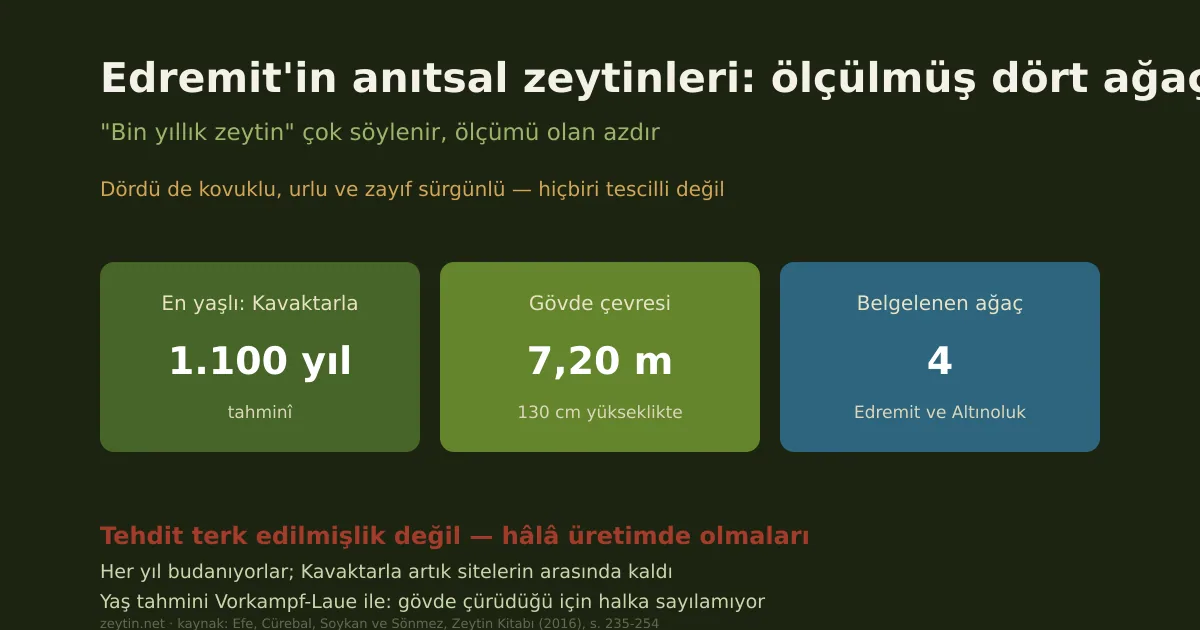
Edremit's monumental olives: four old trees, measured
At an estimated 1,100 years and a 7.20 m girth, Kavaktarla is Edremit's oldest olive. All four are hollowed and galled, none is registered, and the real threat is that they are still in production.
Article
Edremit's monumental olives: four old trees, measured
At an estimated 1,100 years and a 7.20 m girth, Kavaktarla is Edremit's oldest olive. All four are hollowed and galled, none is registered, and the real threat is that they are still in production.
 Article
Where did olives come from? Origin and domestication
The olive was domesticated about 6,000 years ago in the Levant — but not at a single centre. Genetic work shows the cultivated olive kept mixing with the wild oleaster throughout its spread.
Article
Where did olives come from? Origin and domestication
The olive was domesticated about 6,000 years ago in the Levant — but not at a single centre. Genetic work shows the cultivated olive kept mixing with the wild oleaster throughout its spread.
 Article
History of the Olive
The olive was domesticated in the eastern Mediterranean some six thousand years ago. Traces in Anatolia, routes of spread and the birth of trade.
Article
History of the Olive
The olive was domesticated in the eastern Mediterranean some six thousand years ago. Traces in Anatolia, routes of spread and the birth of trade.
 Article
The History of Olive Oil Soap
From Aleppo to Marseille, Castile to Ayvalık: how olive oil became soap, and how that trade built cities.
Article
The History of Olive Oil Soap
From Aleppo to Marseille, Castile to Ayvalık: how olive oil became soap, and how that trade built cities.