Karamürsel Samanlı Olive: low bitterness earns it the name “sweet olive”
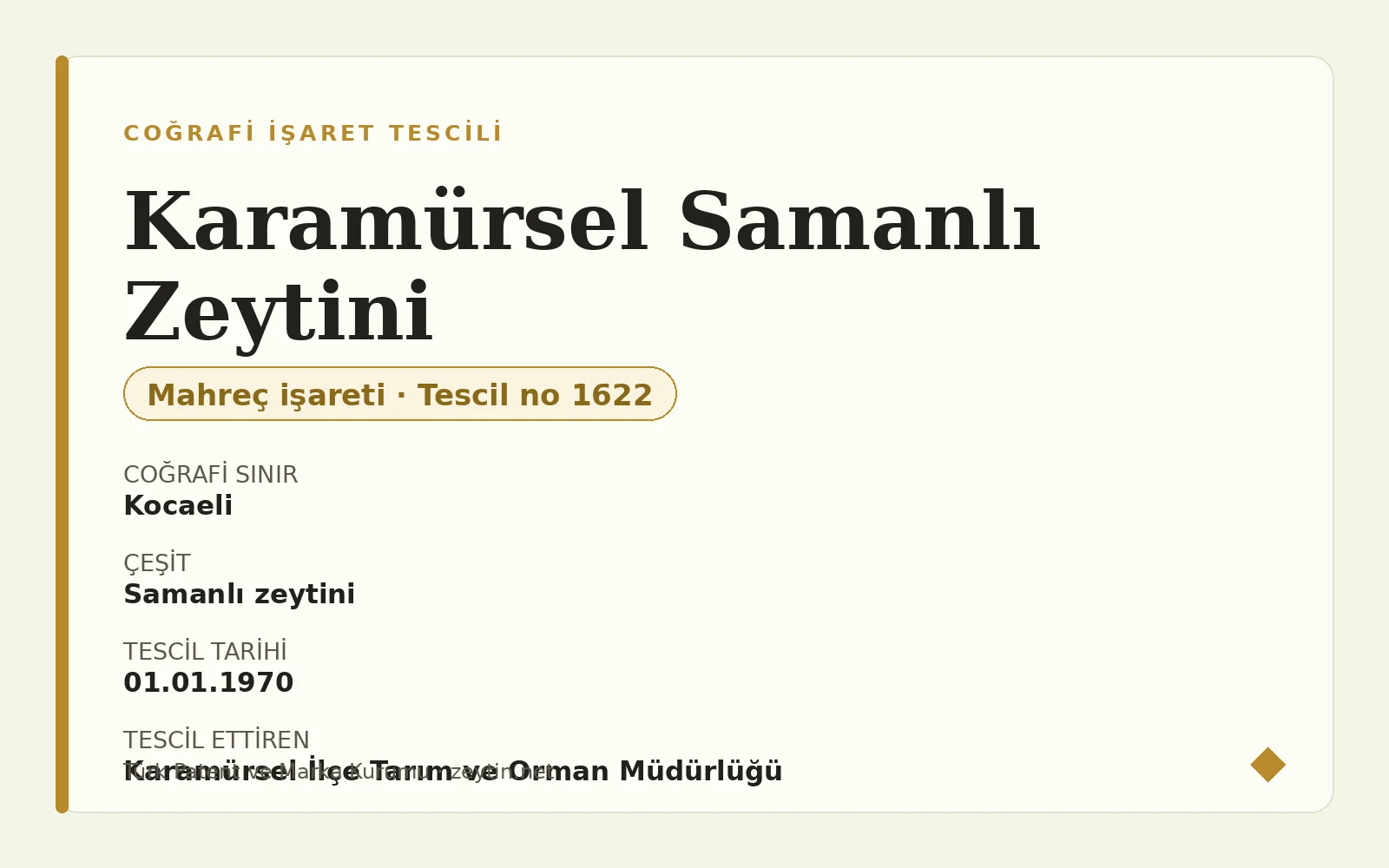
Registered in 2024. Its oleuropein content of 6-8% is low, so it debitters quickly and is locally called the sweet olive. Its skin is 0.2-0.4 mm.
An olive is bitter in its natural state, and that bitterness is carried by oleuropein. Most of table processing exists to remove it. What distinguishes Karamürsel Samanlı Olive is that there is less of it to begin with.
The record
| Registration no | 1622 |
| Registration date | 05.08.2024 |
| Application | C2021/023 · 21.01.2021 |
| Type | Geographical indication |
| Registered by | Karamürsel District Directorate of Agriculture and Forestry |
| Area | The Karamürsel district of Kocaeli |
| Cultivar | Samanlı |
Why “sweet olive”
According to the certificate the cultivar's oleuropein content is 6-8% — low. The consequence is direct: it debitters quickly, and within the defined area it is also known as the “sweet olive”.
This is a property that changes both the duration and the method of processing. Bitter cultivars need either long brining or caustic treatment; an olive low in oleuropein reaches the table through shorter, gentler handling.
Measured characteristics
| Criterion | Value |
|---|---|
| Fruits per kilogram | 250 on average |
| Codex class | L (230-260 per kg) |
| Skin thickness | 0.2 – 0.4 mm |
| Oil content | > 22% |
| Flesh ratio | ≈ 79 – 85% |
| Oleuropein | 6 – 8% |
The certificate gathers the distinguishing features into four points: thin skin, a small stone with abundant flesh, early ripening, and low oleuropein.
Thin skin and high flesh ratio should be read together: both produce the same result — little skin in the mouth, plenty of flesh.
Three presentations
The product reaches the market in three forms:
- Green in brine
- Black in brine
- Dry-salt cured black (kuru sele)
The ready-to-eat green product has a pH of 3.8-4.3 and 5-7% salt. We covered the dry-salt method in types of table olive — curing in salt, without brine.
Climate
Karamürsel's climate is transitional between the Mediterranean and the Black Sea: hot, dry summers and mild, wet winters. The certificate treats this transitional character as ideal for olive growing.
The southern shore of the Sea of Marmara is a frontier zone for olives; cultivars in this belt balance cold hardiness against large table fruit. We looked at the region's figures in olive growing in Marmara.
In short
Karamürsel Samanlı Olive is a thin-skinned, fleshy table olive that debitters quickly because it is less bitter to start with. The instructive part of the certificate is that it ties ease of processing to a measurable value — oleuropein content, giving the folk name “sweet olive” a figure behind it.
The production steps in the document
The registration describes production step by step. The document's own sequence:
1. Dikim — Yeni tesis edilecek zeytinliklerde derin işleme ve zorunlu hallerde tesviye, teraslama, drenaj vb.
2. Gübreleme — Gübreleme, Ağaçların yaş ve verim durumuna göre serpme olarak verilen gübre miktarları aşağıda belirtilmektedir.
3. Hasat — Zeytinde hasat geleneksel olarak el ile yapılır.
4. İşleme — Karamürsel Samanlı Zeytini üretimi salamura yeşil ve siyah ile kuru sele siyah sofralık zeytin olacak şekilde gerçekleştirilir.
That this sequence is binding is what separates a geographical indication from a trade mark: a mark says who produced something, a geographical indication also sets down how it must be produced.
The cultivar behind it, measured
The registration is granted to a place, but the cultivar the definition rests on has measurable values:
| Property | Value |
|---|---|
| 1 kg’daki tane sayısı | 250 |
| Et oranı | %84 |
| Yağ oranı | %21 |
| Ana kullanım | yeşil sofralık |
| Kabuk | ince |
| Meyve | yuvarlak, orta iri |
| Meyve boyu | 22 mm |
| Meyve eni | 20 mm |
| Verim | iyi |
| Yöre | Kocaeli · Karamürsel |
| Çekirdek | ufak |
At 21% the oil content sits mid-range; yield alone is not the argument here, aroma is.
Its place in Kocaeli's olive production
| Item | Value |
|---|---|
| Fruit production | 1,190 t |
| — for oil | 372 t |
| — for the table | 818 t |
| Olive oil production | 58 t |
| Trees | 38 thousand |
| Yield per tree | 31.1 kg |
69% of the province's fruit is table fruit — the registration runs with the grain of the province.
One rating per visitor; you can change yours at any time. Ratings are real reader votes — no seeded or default scores.
Related
 Article
Hatay Olive Salad: an olive dish registered together with its recipe
Registered in 2025. The document defines the salad by weight: 300 g cracked green olives, registered Hatay pomegranate molasses, extra virgin oil.
Article
Hatay Olive Salad: an olive dish registered together with its recipe
Registered in 2025. The document defines the salad by weight: 300 g cracked green olives, registered Hatay pomegranate molasses, extra virgin oil.
 Article
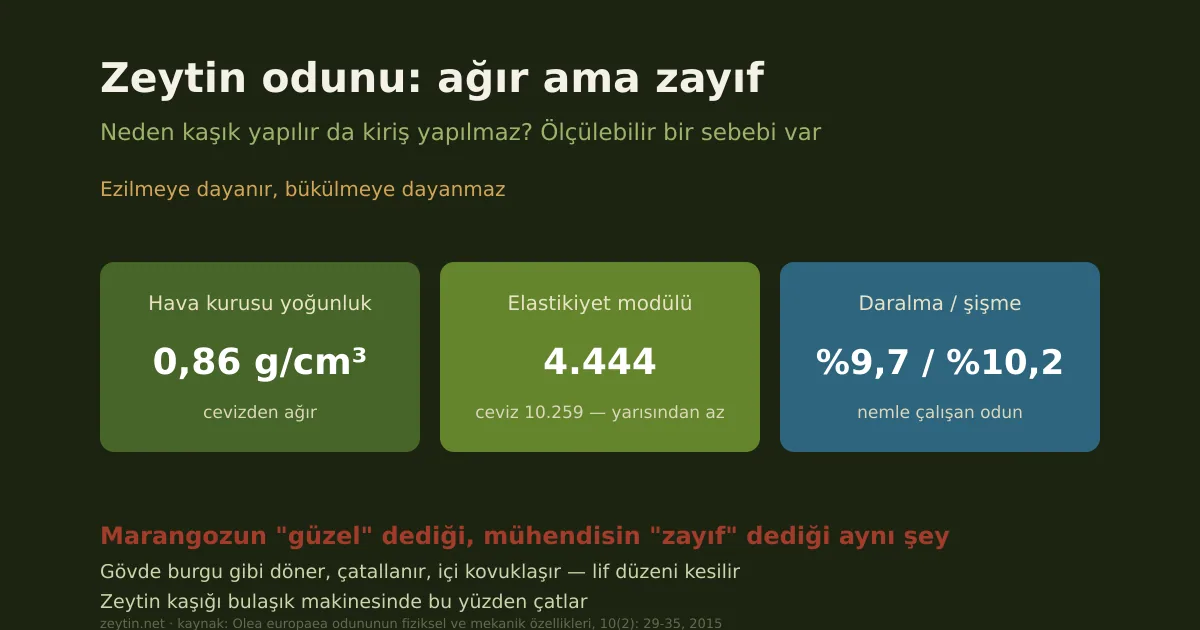
Olive wood: why spoons and not beams?
At 0.86 g/cm³ air-dried it is denser than walnut, yet its modulus of elasticity of 4,444 N/mm² is less than half walnut's. It resists crushing but not bending.
Article
Olive wood: why spoons and not beams?
At 0.86 g/cm³ air-dried it is denser than walnut, yet its modulus of elasticity of 4,444 N/mm² is less than half walnut's. It resists crushing but not bending.
 Article
The Çelebi olive: the green table cultivar of İznik
Grown around İznik in Bursa, Çelebi is a green table cultivar. Its oil content is lower than Gemlik's — which is no drawback for a table olive.
Article
The Çelebi olive: the green table cultivar of İznik
Grown around İznik in Bursa, Çelebi is a green table cultivar. Its oil content is lower than Gemlik's — which is no drawback for a table olive.
 Article
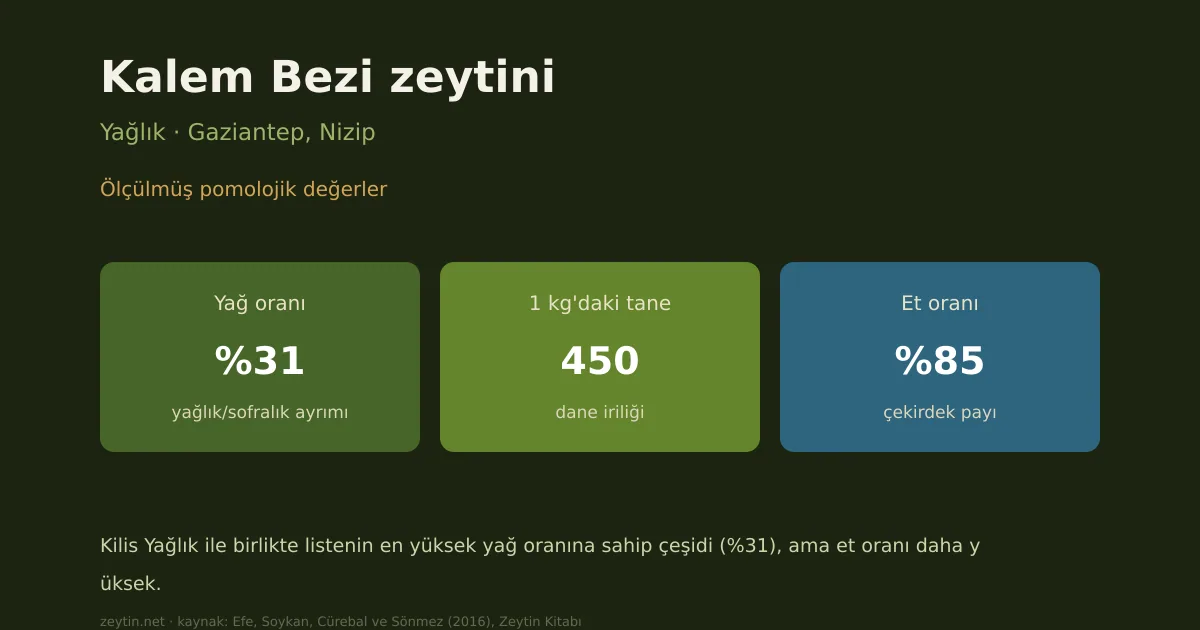
Kalem Bezi olive: characteristics, oil content and growing areas
Tied with Kilis Yağlık for the highest oil content on the list (31%), but with a better flesh ratio.
Article
Kalem Bezi olive: characteristics, oil content and growing areas
Tied with Kilis Yağlık for the highest oil content on the list (31%), but with a better flesh ratio.