Where does olive mill wastewater go? Lagoon rules and the two-phase option
When pressing starts, the dark liquid piling up behind the mill has one legal destination, and it is not the stream. Türkiye offers two lawful routes: switch to a two-phase system, or build a sealed evaporation lagoon. The lagoon's clay thickness, permeability, depth and area are all fixed by numbers in a ministry circular — worked example included.
A few days after pressing starts, the same question appears behind every mill: where is this dark, sharp-smelling liquid going to go?
The short answer: not into a stream, an irrigation channel, or "some empty patch of land". Discharging olive mill wastewater directly into the receiving environment is not an available option, and there are two lawful alternatives to it. Which one suits you depends on the system your mill runs on.
Why olive mill wastewater is such a problem
Karasu — olive mill wastewater — is the mix of the fruit's own water and the water added during processing. It is dark, acidic and extremely high in organic load. We have written before about the sheer scale of wastewater and pomace: the olives processed in Türkiye in a single season leave behind far more by-product than oil.
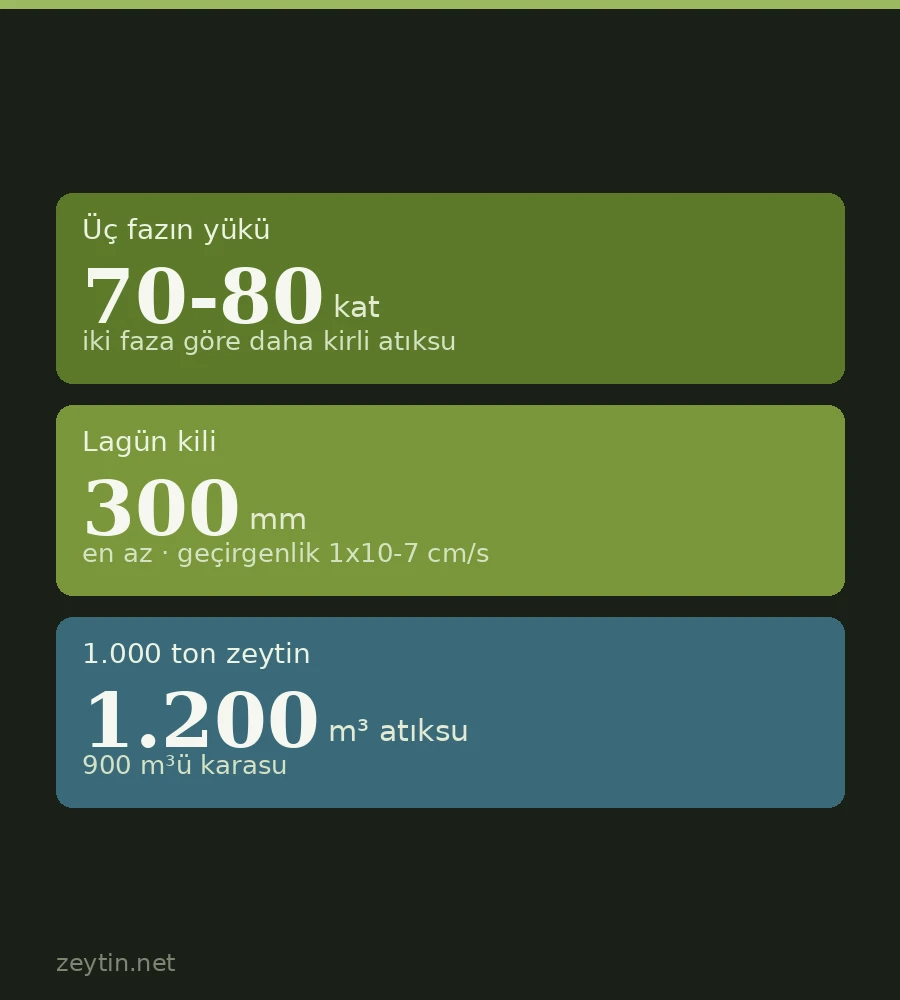
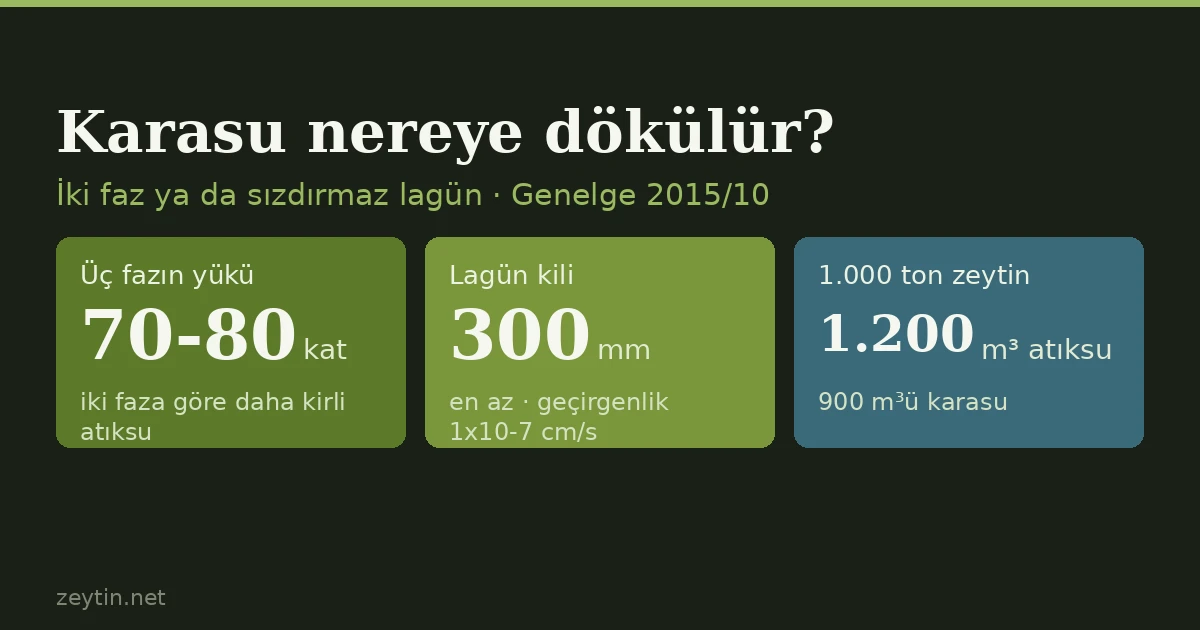
The real issue is not volume but load. The comparison in the Turkish environment ministry's dedicated circular is blunt: olives processed in a three-phase system produce wastewater 70 to 80 times dirtier than the same olives processed in two phases. In a two-phase mill, the washing and separator waters leaving the plant stay in the 3,000-15,000 mg/L COD range — treatable, and dischargeable to the sewer if acceptance criteria are met. The karasu produced in three-phase milling is nowhere near that description.
The legal basis: Circular 2015/10
The framework is set by the Ministry of Environment and Urbanisation's circular 2015/10, dated 17 November 2015, on the technical requirements for managing wastewater produced at olive oil facilities. It defines two routes:
1. Switch to two-phase decanting. The wastewater stays inside the pomace, and the wet pomace is sent to a pomace plant. No separate treatment or lagoon is needed.
2. Stay three-phase and build a sealed lagoon. The wastewater is collected in an impermeable lagoon and left to evaporate.
The governing principle sits above both: whichever route a business takes, it must never discharge its wastewater directly into the receiving environment. Existing and new facilities must satisfy the circular's requirements during the environmental permit process. Three-phase facilities also appear in Annex 2 of the Environmental Impact Assessment Regulation, which means the lagoon plan has to be approved while the project file is being assessed.
A business cannot draw up that lagoon plan on its own. The circular requires the plan to be prepared by the civil or environmental engineering department of a university, then reviewed and approved by the provincial directorate. Facilities that already have a lagoon are inspected on site; where a lagoon is found non-compliant, it has to be rebuilt. Information on approved lagoons is reported to the ministry every year by August.
What two-phase brings
The circular does not defend two-phase milling only on waste grounds:
- Because no water needs to be added to the decanter, water use falls to a third of the three-phase figure.
- The volume of wastewater produced is roughly five times smaller.
- Phenols, which are natural antioxidants, stay in the oil instead of passing into the water, so oil quality and shelf life are higher. Those same compounds are the source of bitterness and pungency — which is also the answer to why olive oil is bitter and pungent.
- Two-phase pomace is wetter, which makes stone separation easier and raises its potential as animal feed.
Against that, two-phase milling requires capital investment and an integrated arrangement for handling wet pomace, which is why the circular considers it more practicable for medium and large operations.
If you are building a lagoon: the numbers
An evaporation lagoon is not "dig a pit and fill it". The technical requirements in the circular are these:
| Item | Requirement |
|---|---|
| Base and side lining | Compacted clay or geomembrane |
| Clay permeability | 1x10⁻⁷ cm/s maximum |
| Clay layer thickness | 300 mm minimum |
| Geomembrane | PVC or HDPE, at least 1 mm, UV resistant |
| Side wall slope | 1/3 maximum · earth bund on top |
| Clearance to groundwater | 2 m minimum |
| Maximum depth | 1.5 m |
| Safety | Railing at least 1.5 m high, security fencing |
| Maintenance | Lining reviewed at least once a year |
Where suitable clay cannot be found, synthetic lining is used; if concrete or a similar material is preferred, the concrete class and sealing performance must be detailed in the university report. The geomembrane must be free of pinholes, blisters and contamination, every weld and seam must be watertight, and the lagoon must be fenced so that livestock and other animals cannot damage the lining.
How much area is needed: a worked example
The example the circular gives for Manisa is the clearest part of the document. A three-phase plant processing 1,000 tonnes of olives a year generates about 1,200 m³ of wastewater, of which 900 m³ is karasu and the rest washing and separator water.
In an open lagoon, rainfall counts too. Manisa's 1981-2010 normal rainfall is 582 mm, so 0.582 m of the 1.5 m maximum depth has to be reserved for rain, leaving 0.918 m for wastewater.
| Case | Open lagoon | Covered lagoon |
|---|---|---|
| Wastewater plus washing/separator water (1,200 m³) | 1,307 m² | 800 m² |
| Olive mill wastewater only (900 m³) | 980 m² | 600 m² |
Covering the lagoon nearly halves the land required. The practical conclusion is this: for a small mill with no land to spare, the real solution is not a bigger lagoon but a switch to two-phase. The circular says so explicitly.
Odour and sludge
The part of a lagoon that generates the most complaints is the smell. The practice recommended in the circular is simple: once the wastewater is in the lagoon, 10 kg of slaked lime (calcium hydroxide) per cubic metre is added and mixed in thoroughly. Aluminium sulphate is also among the materials used.
The sludge left at the bottom after evaporation is not unregulated either. It appears in Annex 4 of the Waste Management Regulation under waste code 02 03 05. It must be analysed and directed first to material or energy recovery; where that is not possible, it goes to a sanitary landfill, or to a pomace plant if one will accept it.
Do not skip the pomace side
Solving the wastewater and leaving the pomace in the open is a common mistake. Depending on the production method, pomace contains 50 to 70% water. If it cannot be sent straight to a pomace plant, it is stored in sealed pits or closed silos within the facility's own grounds, and transported in fully sealed tanker-type vehicles. The principle is that neither the pomace nor the water in it should reach the receiving environment during rain or while being loaded and unloaded.
What this means for a grower
If you have your own olives pressed at someone else's mill, this may look like someone else's problem. It is not. Add one more item to the list of things to ask when having olives pressed: how many phases does this mill run on, and where does its wastewater go? A plant whose answer is "the stream out back" may not be taking much care over the rest of the pressing line either.
One rating per visitor; you can change yours at any time. Ratings are real reader votes — no seeded or default scores.
Related
 Article
Edremit Olive Oil: thirteen separate fruity perceptions listed
Registered in 2017. The certificate lists thirteen fruity perceptions, from green almond to banana skin. At least one must be present at low or medium intensity.
Article
Edremit Olive Oil: thirteen separate fruity perceptions listed
Registered in 2017. The certificate lists thirteen fruity perceptions, from green almond to banana skin. At least one must be present at low or medium intensity.
 Article
Osmaniye Olive Oil: a registration with sensory thresholds above six
Registered in 2022. Fruitiness ≥6.4, bitterness ≥6.0, pungency ≥6.1 — unusually high thresholds. Milling within 48 hours of harvest is required.
Article
Osmaniye Olive Oil: a registration with sensory thresholds above six
Registered in 2022. Fruitiness ≥6.4, bitterness ≥6.0, pungency ≥6.1 — unusually high thresholds. Milling within 48 hours of harvest is required.
 Article
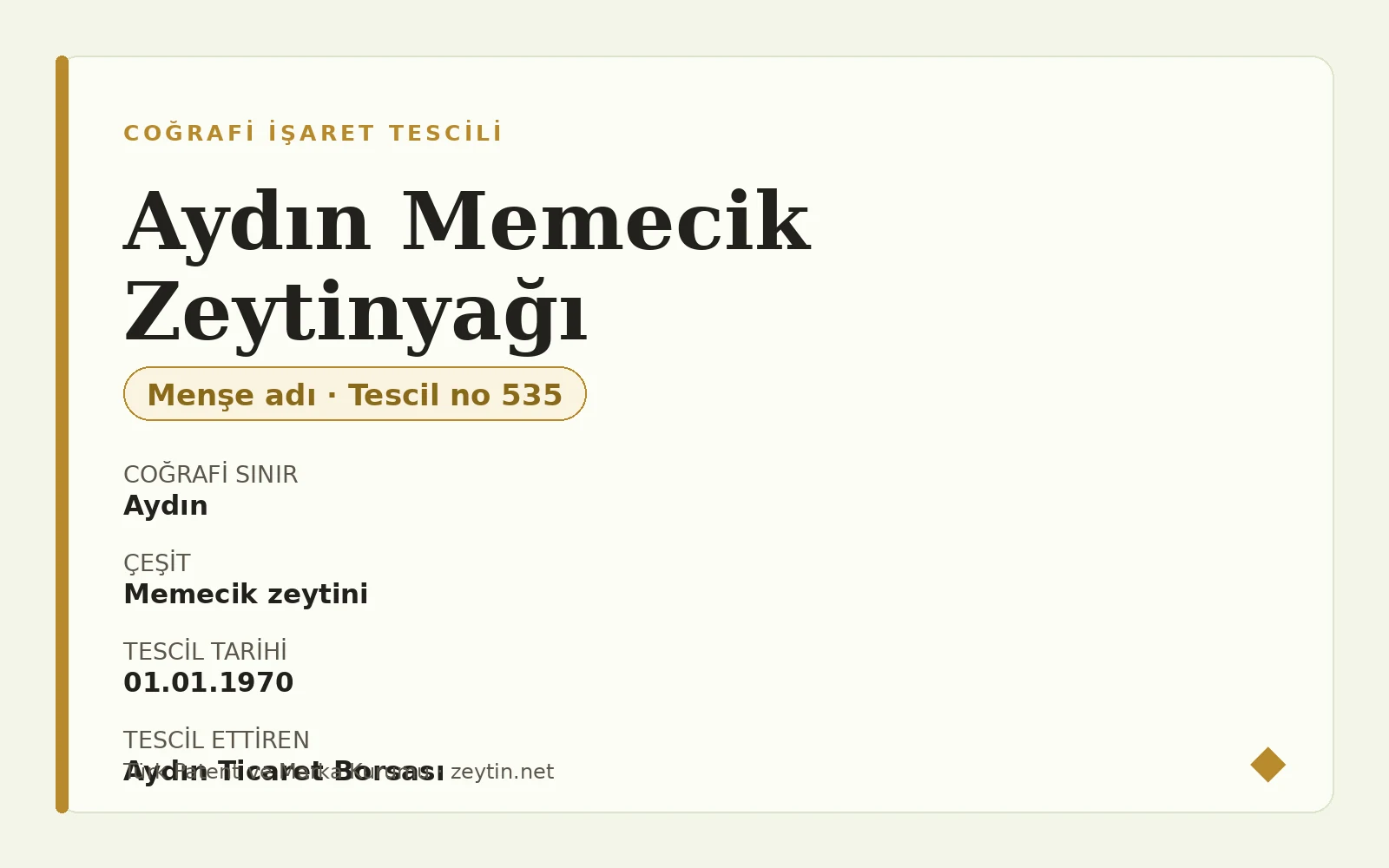
Aydın Memecik Olive Oil: bitterness and pungency written into the definition
Registered in 2020. Total phenols > 100 mg/kg, peroxide ≤ 18, defect median 0. Intense fruit aroma with pronounced bitterness and pungency.
Article
Aydın Memecik Olive Oil: bitterness and pungency written into the definition
Registered in 2020. Total phenols > 100 mg/kg, peroxide ≤ 18, defect median 0. Intense fruit aroma with pronounced bitterness and pungency.
 Article
Which olive oil is the best quality?
The three measures that decide olive oil quality: grade, acidity and harvest year, plus how to read a label.
Article
Which olive oil is the best quality?
The three measures that decide olive oil quality: grade, acidity and harvest year, plus how to read a label.