Why is olive oil bitter and pungent? Is it spoiled, or is it good?
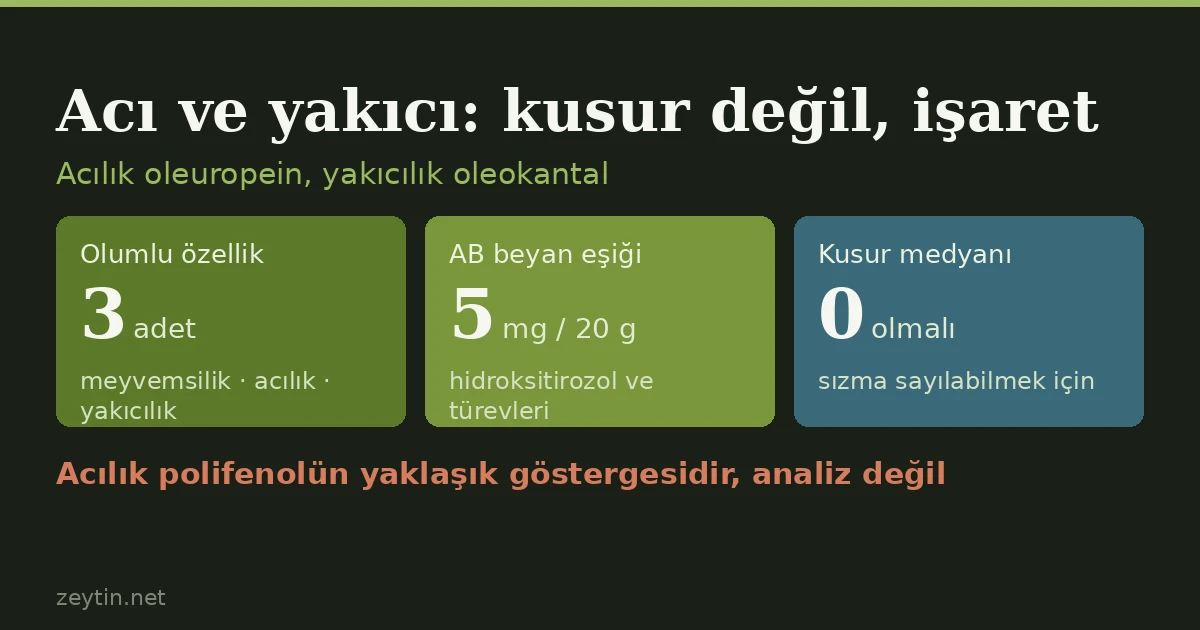
The bitterness and throat-catching pungency of freshly pressed olive oil is not a fault but a signal of polyphenols. Bitterness comes from oleuropein, pungency from oleocanthal, and both count as positive attributes in the international tasting standard. We also separate them from the defects they get confused with.

The same question comes back every November: "This year's oil is so bitter, it catches in my throat — has it gone bad?"
The short answer is the opposite. Bitterness and pungency are not faults in olive oil; in the international tasting standard they are defined as positive attributes. And both of them are a direct signal of how much polyphenol the oil carries.
Bitterness and pungency are not the same thing
Consumers usually describe both with one word ("bitter"), but they are separate sensations, felt in different places, coming from different molecules.
| Sensation | Where it is felt | Source |
|---|---|---|
| Bitterness | Back of the tongue | Oleuropein and its derivatives |
| Pungency | Back of the throat, on swallowing | Oleocanthal |
Bitterness comes from oleuropein, the olive fruit's own defensive compound, and from the substances derived from it. The greener the fruit, the higher the oleuropein.
Pungency — the oil that makes you cough — depends on a different molecule: oleocanthal. Because this compound stimulates receptors specifically at the back of the throat, a good oil catches there rather than in the mouth. Oleocanthal's ibuprofen-like action on inflammatory pathways came to attention through a study published in Nature in 2005; we covered it in oleocanthal and polyphenols.
⚠ The strength of the pungency is a rough indicator of how "strong" an oil is — it is not a measure of its health effect.
What the standard says: a positive attribute, not a defect
Olive oil is one of the few foods whose sensory analysis is part of its legal classification. In the International Olive Council's standard, a panel scores three positive attributes: fruitiness, bitterness and pungency.
For an oil to qualify as extra virgin, the defect median must be zero and the fruitiness median above zero. Bitterness and pungency are scored for however much of them is present — their presence does not downgrade the oil. How the panel works is set out in tasting olive oil: defects and positive attributes.
So the sentence "oil that isn't bitter is better quality" is wrong by the standard. An oil with no bitterness comes either from very ripe fruit or from a product that has lost its polyphenols over time.
Why are some oils more bitter?
1. Harvest timing. This is the strongest factor. Oil from green, early-picked fruit is markedly bitter and pungent; as the fruit darkens the polyphenols fall and the oil softens. That is why early-harvest oil yields less and costs more — we did the arithmetic in is early harvest expensive or valuable?
2. Variety. Bitterness varies greatly by cultivar. Coratina and Picual are known for high polyphenol content; in Türkiye, Memecik gives a pronounced bitter-pungent character. Other varieties are naturally mild.
3. Processing. The temperature and duration of malaxation affect how much polyphenol transfers into the oil. Long, warm malaxation reduces bitterness but takes aroma with it; see what is a malaxer and how cold-pressed olive oil is made.
4. Freshness. Freshly pressed oil is at the most bitter point of its life.
Why bitterness is valuable: shelf life and a health claim
Polyphenols are the oil's own antioxidants. Bitterness is the sensory counterpart of that antioxidant load, which means a bitter oil resists oxidation longer. An oil low in polyphenols burns through its shelf life faster.
The European Union permits a health claim for olive oil polyphenols: "Olive oil polyphenols contribute to the protection of blood lipids from oxidative stress." To use it, the oil must contain at least 5 mg of hydroxytyrosol and its derivatives per 20 g, and the consumer must be told that the beneficial effect is obtained with a daily intake of 20 g of olive oil.
⚠ That is a labelling threshold, not a promise of treatment. And bitterness is only an approximate indicator of polyphenol content; the exact figure comes from analysis. How to read the report is covered in how to read an olive oil lab report.
Bitterness fades with time
The same bottle will not taste the same six months from now. Polyphenols oxidise over time, bitterness and pungency recede, and the oil softens. That progression is natural — but its speed depends on storage conditions. Light, heat and air accelerate the softening and carry the oil towards spoilage. See how to store olive oil, and for new-season oil in particular, how to store freshly pressed olive oil.
Bitterness in the bottle is therefore not a constant but a clock: it tells you how fresh the oil is.
The real defects that get mistaken for bitterness
Here is the point that matters most: not every sharp taste is bitterness. Defects are separate sensations, and none of them is positive.
| What you notice | Likely cause |
|---|---|
| Paint, putty, stale walnut | Rancidity — oxidised oil |
| Damp cellar, mould | Fruit stored too long, wet or mouldy |
| Mud, earth | Oil left too long on its sediment |
| Vinegar, wine | Fermentation in the fruit |
In practice the distinction is easy: bitterness and pungency are clean sensations — the oil is bitter but smells of fresh grass, green fruit, tomato leaf. With a defect, the smell is off before you taste anything. How to tell good olive oil sets out a sequence you can follow at home.
What is this oil good for in the kitchen?
Bitter, pungent oil shows itself in raw use: salads, boiled vegetables, poured over soup, on bread. Heat reduces polyphenols, so using a strong oil for long cooking wastes it.
For a reader who finds the bitterness too much, the practical fix is not to change the oil but to change the pairing: pulses, tomato and yoghurt all balance bitterness.
One last distinction: bitterness in table olives
An olive picked straight from the tree is too bitter to eat, because of oleuropein. In table olive production that bitterness is removed through brine, salt or lye. That process is a separate subject and should not be confused with bitterness in olive oil: in oil there is nothing to remove, and removing it would mean losing value.
In short: if your new oil is bitter and catches in your throat, you probably have a fresh, early-harvest, polyphenol-rich oil in your hands. The oil to worry about is not the one that burns your throat — it is the one that makes you feel nothing at all, or smells like paint.
One rating per visitor; you can change yours at any time. Ratings are real reader votes — no seeded or default scores.
Related
 Article
Bayramiç Olive Oil: aroma compounds defined as percentages
Registered in 2022. The certificate defines aroma by compound rather than adjective: hexanal 36.15%, E-2-hexenal 26.14%. Iodine value 80-93.
Article
Bayramiç Olive Oil: aroma compounds defined as percentages
Registered in 2022. The certificate defines aroma by compound rather than adjective: hexanal 36.15%, E-2-hexenal 26.14%. Iodine value 80-93.
 Article
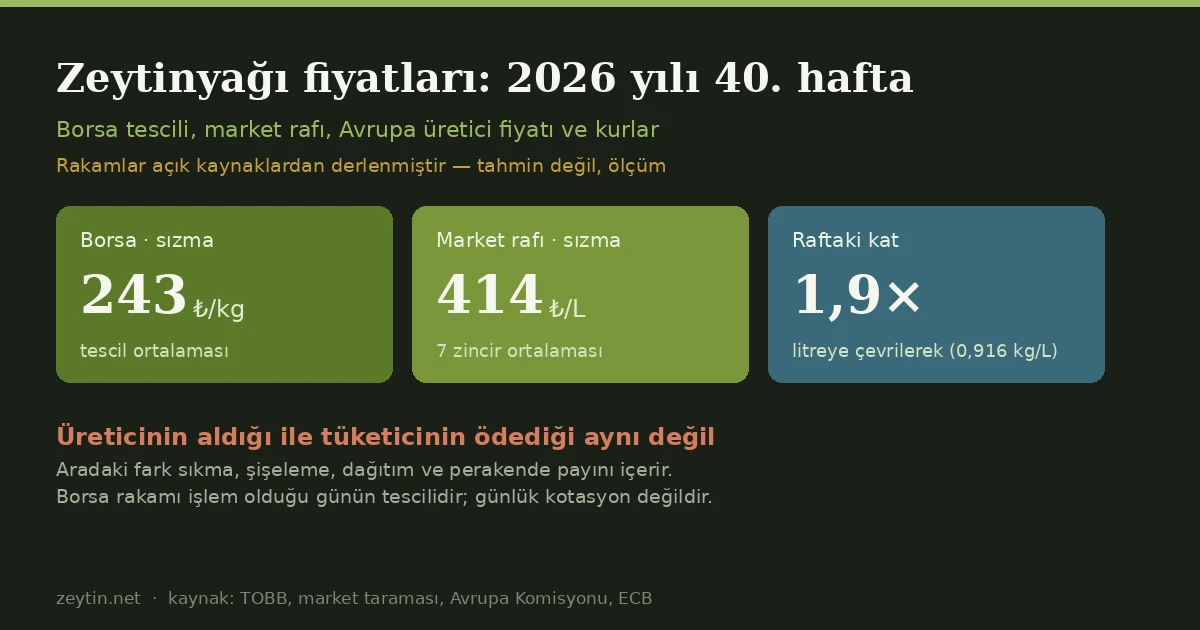
Olive Oil Prices: Week 40 of 2026
Week 40 of 2026: Turkish exchange prices, European producer prices and exchange rates side by side.
Article
Olive Oil Prices: Week 40 of 2026
Week 40 of 2026: Turkish exchange prices, European producer prices and exchange rates side by side.
 Article
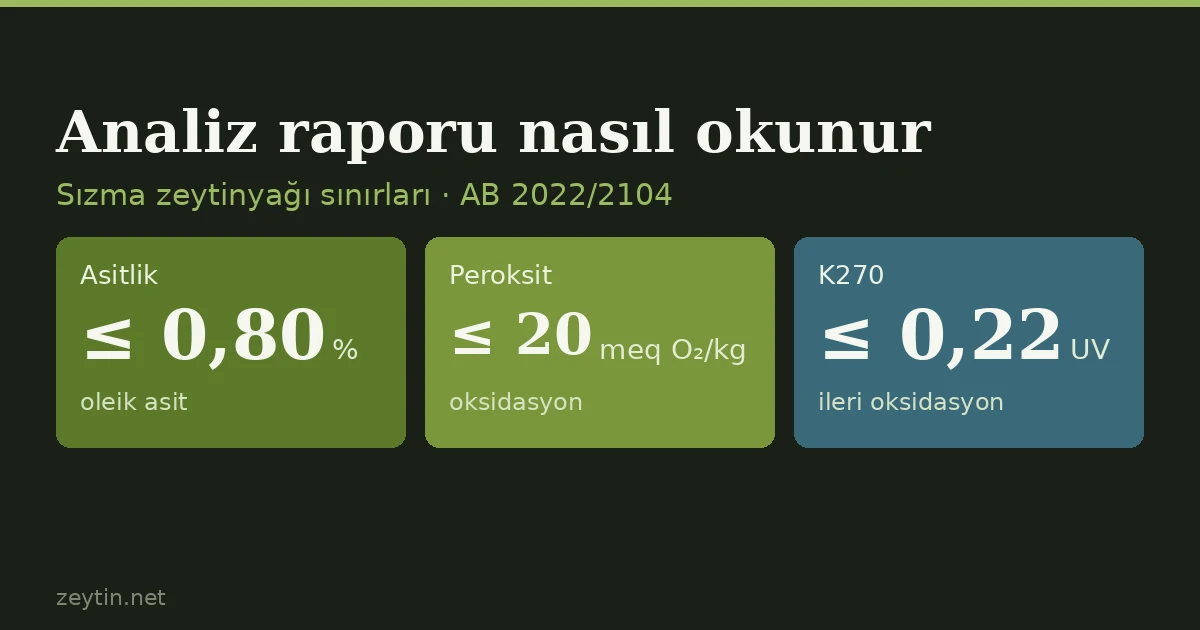
How to read an olive oil lab report: acidity, peroxide, K232, K270 and ΔK
The rows of figures on an olive oil lab report look cryptic at first. What do free acidity, peroxide value, K232, K270, ΔK, ethyl esters and sensory analysis measure, what are the limits for extra virgin and virgin grades, and how do you interpret a report using a worked example?
Article
How to read an olive oil lab report: acidity, peroxide, K232, K270 and ΔK
The rows of figures on an olive oil lab report look cryptic at first. What do free acidity, peroxide value, K232, K270, ΔK, ethyl esters and sensory analysis measure, what are the limits for extra virgin and virgin grades, and how do you interpret a report using a worked example?
 Article
Nizip Olive Oil: a registration that sets a floor for its raw material
Registered in 2011. The certificate sets conditions on the fruit, not just the oil: 15-17 mm wide, 19-20 mm long, at least 25% oil. Fruit outside that cannot be used.
Article
Nizip Olive Oil: a registration that sets a floor for its raw material
Registered in 2011. The certificate sets conditions on the fruit, not just the oil: 15-17 mm wide, 19-20 mm long, at least 25% oil. Fruit outside that cannot be used.