What is lampante olive oil, and why can't it be eaten as it is?
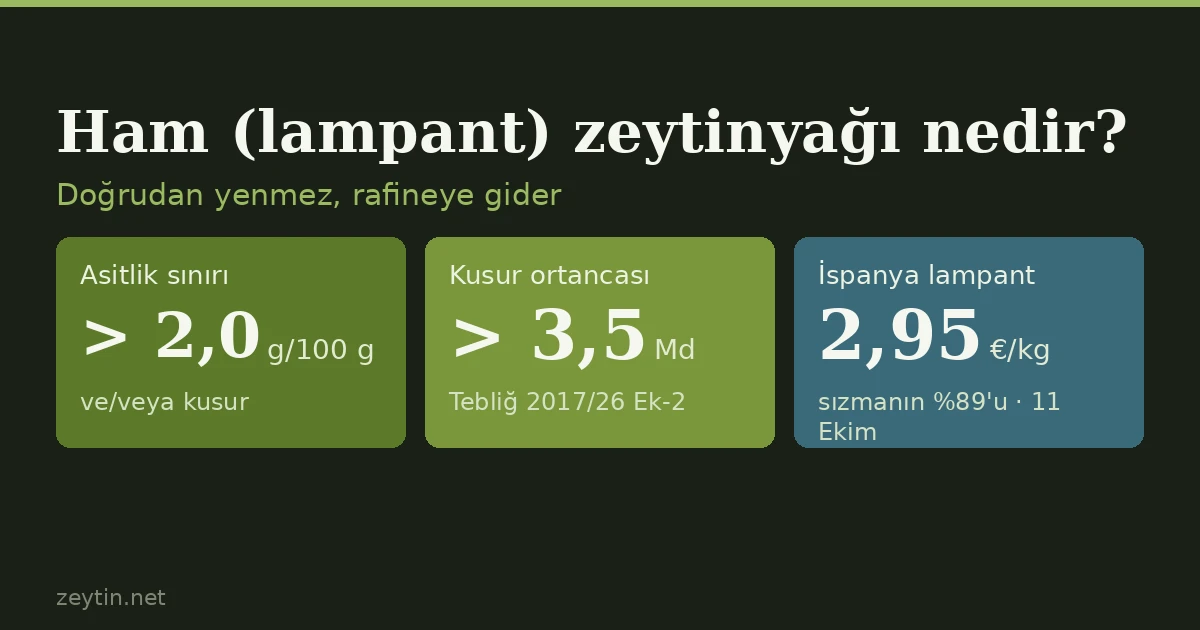
Crude olive oil — lampante, internationally — is oil obtained from olives by mechanical means alone but not considered fit for direct consumption, because its acidity exceeds 2.0 or the tasting panel's median of defects is above 3.5. At the refinery it becomes refined olive oil, and blended with virgin oil it becomes riviera. In the European Commission series for the week of 11 October, Spanish lampante stood at 2.95 €/kg, 89% of the extra virgin price; in Italy at 2.77 €, 63%.
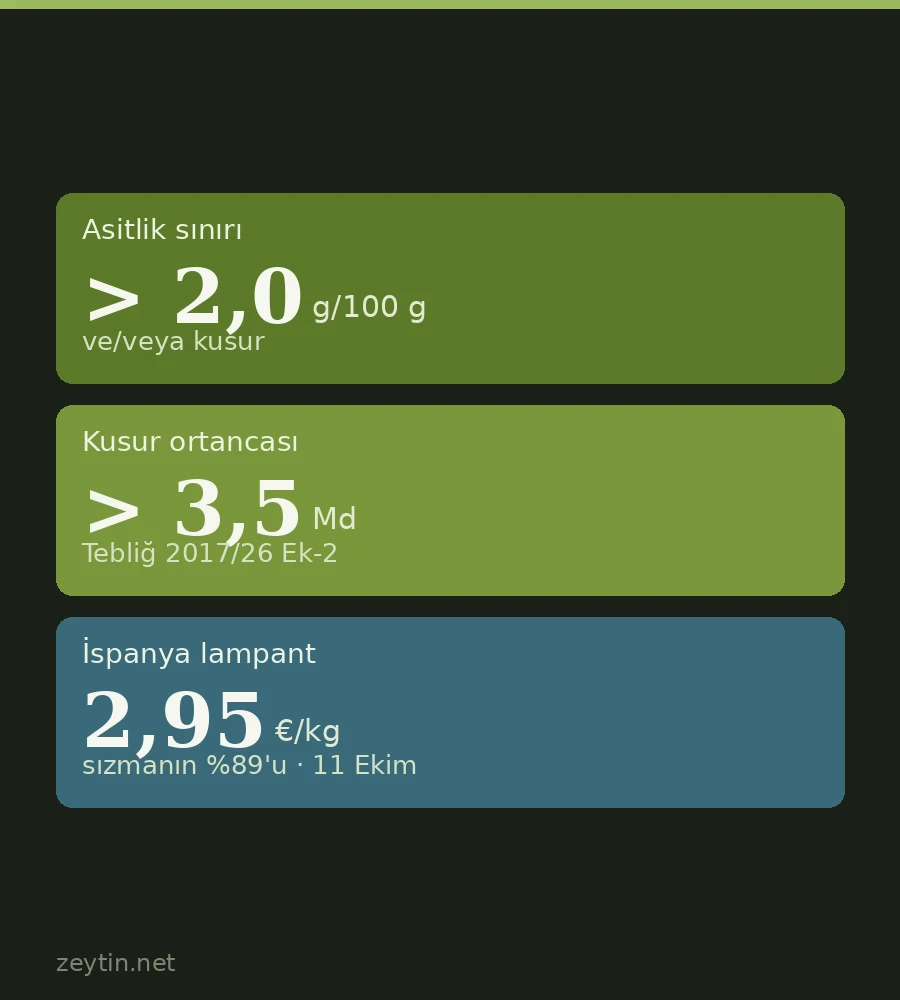
The short answer: lampante olive oil — called ham zeytinyağı ("crude olive oil") in Turkish regulations — is oil obtained from olives by mechanical means only, but which cannot go straight to the table because of its acidity or its taste and smell. The rules define it as oil "suitable for refining or for technical use". It is olive oil; but before anyone eats it, it has to pass through a refinery.
The name comes up often at the start of the season. Oil pressed from olives that were picked up off the ground, left standing in sacks or badly damaged by the olive fly is traded in this category, both on commodity exchanges and in bulk purchases. Below are the definition, the limits, where this oil comes from and what it is worth today.
What the rules say
In Türkiye the categories are defined in the Turkish Food Codex Communiqué on Olive Oil and Olive-Pomace Oil (No. 2017/26, Official Gazette of 17 September 2017, issue 30183). The communiqué divides virgin olive oils into three classes; the third is the subject of this article:
| Category | Free acidity (as oleic acid, g/100 g) | Fit for direct consumption |
|---|---|---|
| Extra virgin | 0.8 or less | Yes |
| Virgin | 2.0 or less | Yes |
| Crude olive oil / lampante | above 2.0 and/or sensory defects | No |
| Refined olive oil | 0.3 or less | Intermediate product of the refinery |
| Riviera (olive oil) | 1.0 or less | Yes (blend of refined and virgin) |
Source: Turkish Food Codex Communiqué on Olive Oil and Olive-Pomace Oil (2017/26), Article 4.
The words "and/or" in the definition matter. An oil does not need high acidity to fall into this class: if the tasting panel finds defects, an oil with 0.3% acidity can still be classed as lampante.
The tasting limit: 3.5
Annex 2 of the communiqué sets the sensory limits. For each oil the tasting panel produces two medians: the median of defects (Md) and the median of fruitiness (Mf).
- Extra virgin: Md = 0, Mf > 0
- Virgin: 0 < Md ≤ 3.5, Mf > 0
- Crude (lampante): Md > 3.5
A footnote to Annex 2 adds one more case: if the median of fruitiness is 0, the oil is classed as crude even when the median of defects is 3.5 or below. An oil with no olive aroma at all is not considered fit for the table, even without a pronounced defect. We explain how panel tasting works, and what the defects are called, in a separate article.
The communiqué was drafted with EU olive oil legislation as its reference (Article 18). In the EU the category is called lampante, from the Italian for an oil lamp: this was oil that was once burned for light rather than eaten.
Where lampante oil comes from
Lampante oil almost always has one cause: the olives went bad before they were pressed. The commonest routes are these:
- Waiting. Olives left in sacks or heaps for days heat up and ferment. The resulting "fusty/muddy sediment" and "winey-vinegary" defects cannot be reversed. We discuss how long olives can safely wait in how soon must harvested olives be pressed.
- Picking from the ground. Fruit that has lain on wet soil for a long time carries mould and earthy defects, and its acidity climbs quickly.
- Fly damage. A high share of stung fruit raises both the acidity and the oxidation of the oil. Details in what happens when fly-damaged olives go into the oil.
- Frost. Oil from fruit frozen on the tree shows the "frostbitten olives" (wet wood) defect.
Once acidity has risen, blending or filtering does not bring it down. As we explain in what acidity means in olive oil, the only step that truly lowers it is neutralisation, which is part of refining.
What happens in the refinery
At the refinery, lampante oil is neutralised (the free fatty acids are removed), bleached and deodorised. The result is refined olive oil: its acidity falls below 0.3, but the defects leave together with most of the olive's aroma, flavour and polyphenols.
Refined olive oil is not sold on its own at retail. Blended with virgin oil fit for direct consumption, it becomes what Turkish shelves call riviera and EU labels call simply "olive oil – composed of refined olive oils and virgin olive oils". Part of the oil in such a bottle has come this way. We set out the differences between the categories in extra virgin, virgin and riviera explained.
Is it the same as crude pomace oil?
No, although the two are often confused. The communiqué defines them separately. Crude olive oil is extracted from the olive paste by mechanical means alone — washing, decanting, centrifuging, filtering — so it is a virgin oil, merely a defective one. Crude olive-pomace oil is extracted from pomace, the olive residue left after pressing, using solvents or other physical treatments. Both go to the refinery, but they become different products: one yields refined olive oil and riviera, the other refined pomace oil and olive-pomace oil. The communiqué also rules that pomace oil "may under no circumstances be called olive oil" (Article 14). Prices reflect the gap: in Spain, crude olive-pomace oil stood at 1.24 €/kg in the week of 11 October, less than half the price of lampante.
What it is worth
The European Commission publishes producer prices by category for member states every week. In the series this site follows, the table for the week of 11 October 2026 looks like this:
| Category | Spain | Italy |
|---|---|---|
| Extra virgin | 3.32 | 4.37 |
| Virgin | 3.07 | 3.20 |
| Refined olive oil | 3.21 | 3.33 |
| Lampante | 2.95 | 2.77 |
Source: European Commission Agri-food Data Portal, weekly national average producer prices; series compiled by this site.
Two things stand out. First, in Spain the gap between lampante and extra virgin has become very narrow: lampante is 89% of the extra virgin price. In the same week a year earlier (12 October 2025), extra virgin stood at 4.25 € and lampante at 3.41 €, a ratio of 80% and a gap of 0.84 € per kilogram. Today the gap is 0.37 €. Second, in Italy the picture is reversed: lampante is only 63% of the extra virgin price. The origin premium carried by Italian extra virgin does not pass through to lampante, which trades as a raw material for refining wherever it comes from.
The gap between refined oil and lampante shows the refiner's margin: in Spain, 0.26 € per kilogram in the week of 11 October.
In Türkiye, commodity exchanges register this category as "crude olive oil". On the Aydın Commodity Exchange on 7 September 2026, a 165,110-kilogram registration of crude olive oil cleared at 183.48 TL per kilogram, while extra virgin stood at 216.71 TL the same day; crude was 84.7% of extra virgin. We explain what to watch for when reading exchange prices separately.
What it means for consumers
Lampante oil cannot reach the shelf in a bottle: the rules do not regard it as fit for direct consumption. The risk consumers face lies elsewhere — defective oil sold as extra virgin, or blended into it. One of the five olive oil entries on the ministry's adulteration list dated 12 October was exactly that: "blending with lower-quality olive oil" in an oil sold as extra virgin.
Such a blend is hard to detect at home; acidity and defects can only be measured by a laboratory and a tasting panel. Look at the category name on the label and, where an analysis has been done, at the values in the report.
What it means for growers
Lampante oil can be sold, but not at the extra virgin price. In Spain the difference today is 0.37 € per kilogram; in Italy 1.60 €. In Türkiye, in the Aydın example, it was around 33 lira per kilogram. That difference is the reward for pressing olives without delay, for having fruit picked up off the ground pressed separately from fruit picked from the tree, and for keeping heavily stung lots apart.
Read with care
⚠ The European Commission figures are weekly national averages; individual purchase prices may differ.
⚠ In Türkiye, registrations of crude olive oil can be infrequent and small. In Nazilli in September, a few small lots of crude oil were registered above the extra virgin price, so no gap between categories should be calculated from a single registration.
⚠ This article is based on the published text of Communiqué 2017/26; if later amendments have updated the limits, the current text prevails.
One rating per visitor; you can change yours at any time. Ratings are real reader votes — no seeded or default scores.
Related
 Article
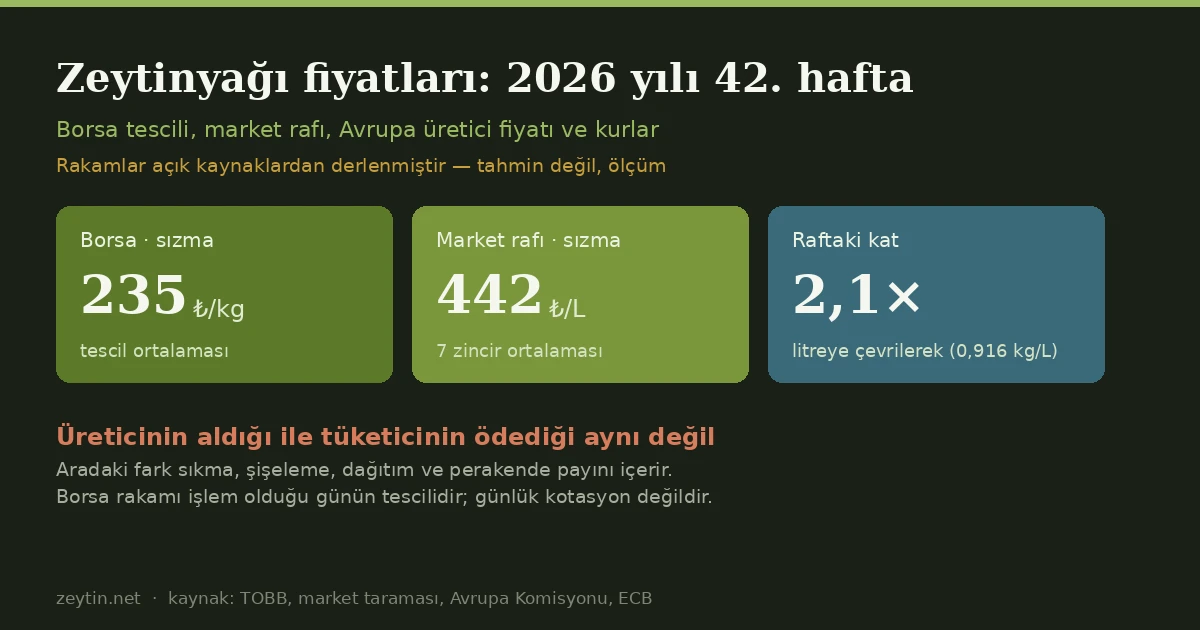
Olive Oil Prices: Week 42 of 2026
Week 42 of 2026: Turkish exchange prices, European producer prices and exchange rates side by side.
 Article
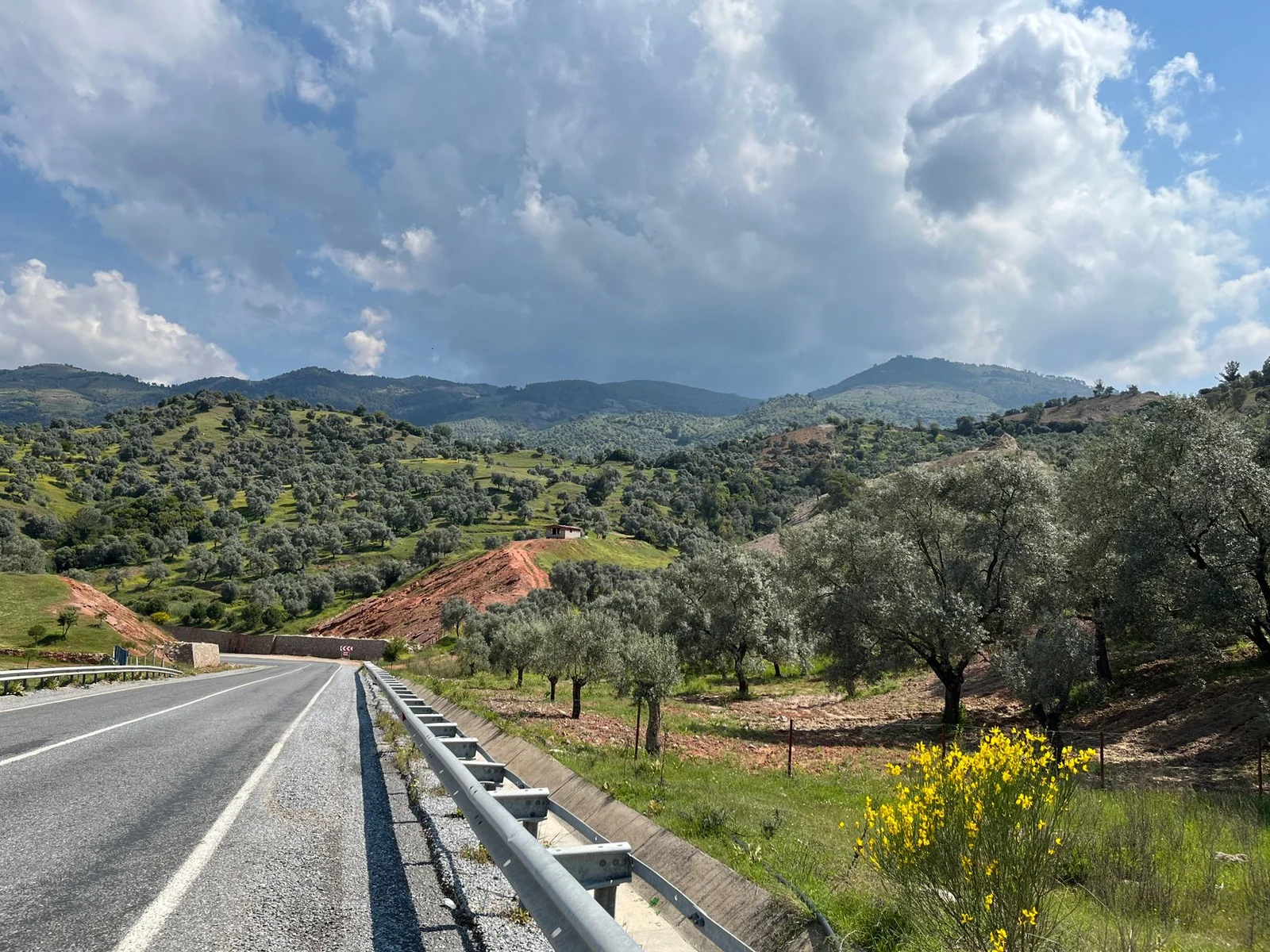
Güney Ege Olive Oils: a designation of origin across three provinces
Registration no 79, published in the Official Gazette in 2004, covers more than thirty-three districts across İzmir, Aydın and Muğla. The reasoning is not administrative but varietal: the region holds almost all of Türkiye's Memecik trees.
 Article
How Cold-Pressed Olive Oil Is Made
From tree to bottle: washing, crushing, malaxation and separation. Why the temperature must stay below 27°C.
 Article
How to Read an Olive Oil Label
Grade, harvest year, acidity, origin and bottling place: which statements on a label are binding and which are just marketing — with a quick checklist.