12 October adulteration list: five of 29 records are olive oil, four with seed oil
The ministry's 12 October 2026 notice added 29 records to Türkiye's counterfeit-and-adulteration list, five of them olive oil: four with seed oil blended in, one with lower-grade olive oil. Of the 320 records currently published, 59 are olive oil, and Manisa's count rose from one to three.
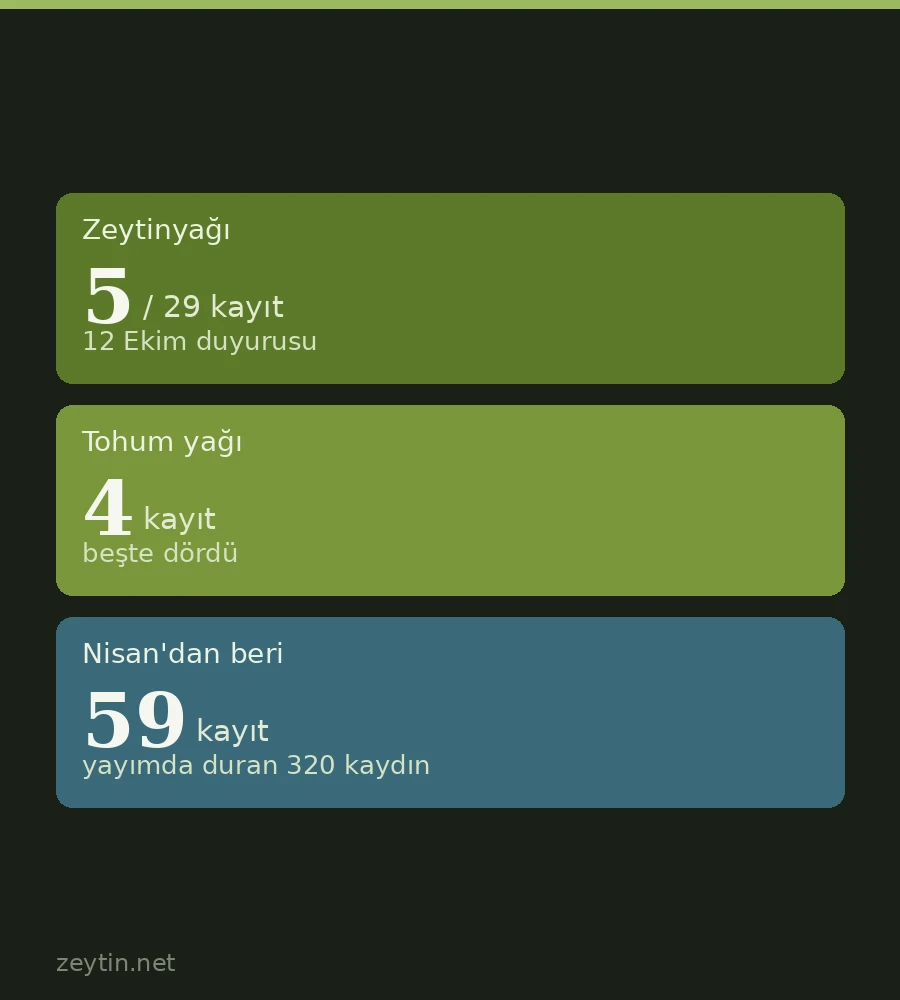
The Ministry of Agriculture and Forestry added 29 records to its counterfeit-and-adulteration list dated 12 October 2026. Five of them are olive oil. A separate list, covering products that endanger health, received nine records on the same date; none of those involve olive oil.
The disclosure is published under the Food Public Notice programme run by the ministry's General Directorate of Food and Control. Its legal basis is Article 31 of Law No. 5996 on Veterinary Services, Plant Health, Food and Feed, together with Article 8 of the Regulation on Official Controls of Food and Feed dated 17 December 2011. Every line on the list rests on a completed laboratory analysis, which is why the list is not a collection of allegations but a register of findings that have become final.
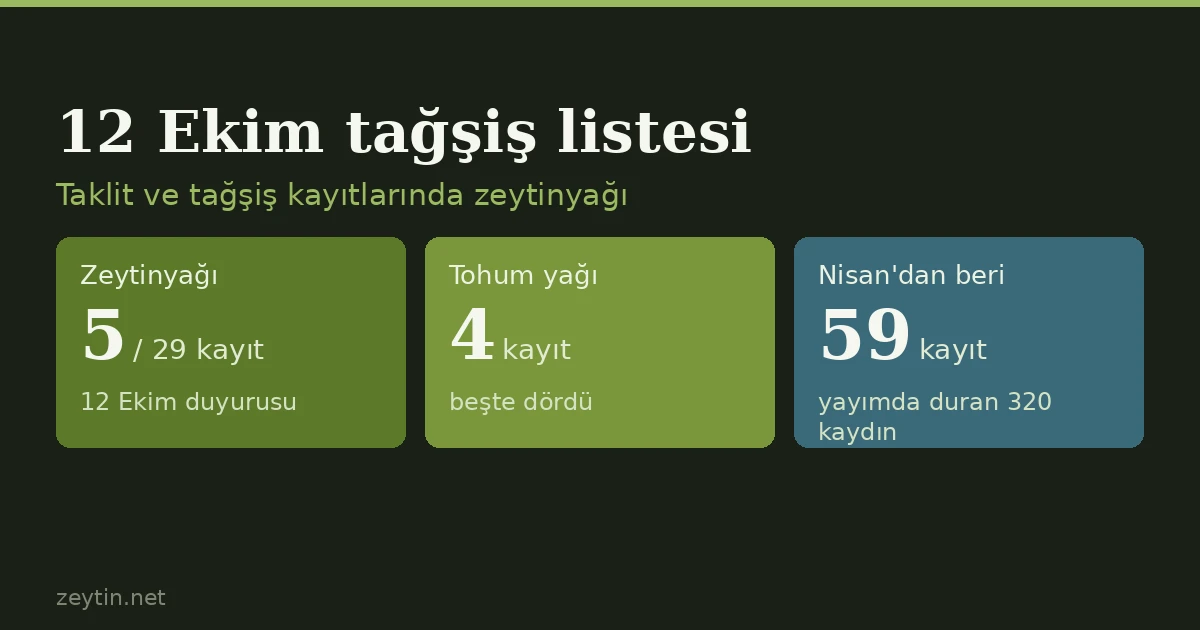
What the whole notice looks like
| Product group | Records |
|---|---|
| Meat and meat products | 17 |
| Vegetable oils | 5 |
| Pastry and desserts | 2 |
| Spices, seasonings and sauces | 2 |
| Milk and dairy | 1 |
| Fruit and vegetable processing | 1 |
| Beekeeping products | 1 |
| Total | 29 |
The bulk of this notice sits in meat: most of the seventeen records concern mechanically separated poultry meat found in heat-treated sausages. All five entries in the vegetable-oil group, meanwhile, are olive oil. No other kind of oil appears, which is in itself the point — in the product group most exposed to adulteration, only one product shows up.
Four of the five involve seed oil
| Finding | Location of the business | Product |
|---|---|---|
| Seed oils mixed in | Manisa / Akhisar | extra virgin olive oil |
| Seed oils mixed in | Manisa / Yunusemre | olive oil |
| Seed oils mixed in | İstanbul / Esenler | extra virgin olive oil |
| Seed oils mixed in | Bursa / Nilüfer | extra virgin olive oil, 5 litres |
| Lower-grade olive oil mixed in | Hatay / Antakya | extra virgin olive oil, 4 litres |
Four records describe the classic form of adulteration: seed oil blended into a product sold as extra virgin. The fifth is a quieter kind of fraud, because the liquid in the container is still olive oil — only the grade is not what the label claims. We have explained what separates extra virgin, virgin and riviera in a separate article.
Note that four of the five were being sold under the extra virgin name. Adulteration does not register at the cheapest end of the shelf; it registers under the name of the most expensive grade. The arithmetic is simple: the lower the cost of what goes in and the higher the price of the grade on the label, the wider the gap that becomes profit. That is why the same grade name keeps recurring on this list year after year.
The geography of the five is not a harvest-season pattern either. Both Manisa records come from district centres, while the İstanbul and Bursa entries sit outside the production basin altogether, on the distribution and consumption side. Olive oil adulteration is recorded not only next to the raw material but also where bottling and distribution happen.
The season as a whole: 59 records
Of the 320 records currently published on the list, 59 are olive oil. The oldest notice still on display is dated 16 April 2026, so all 59 belong to this year. The breakdown of findings points in one direction only.
| Finding | Records |
|---|---|
| Seed oils mixed in | 54 |
| Lower-grade olive oil mixed in | 4 |
| Both together | 1 |
Fifty-four records carry the same finding: seed oil. Olive oil adulteration is not a diversifying field; it is the repetition of a single method.
The packaging pattern is just as one-sided. Of the 39 records that state a volume in the product name, 30 are five-litre containers, one is eighteen litres and one is four litres; only five are one-litre. In other words, what gets recorded is not the glass bottle on the supermarket shelf but the tin sold "straight from the producer". Five records describe the product as unlabelled outright.
The traceability column completes the picture: in 19 of the 59 records the brand field is empty or a dash, and 13 carry no batch or serial number. Among those that do, several hold nothing more than a two-digit figure such as "02" or "012". The latest Antakya record is the exception in this table — its batch number is an eleven-digit decimal code, the kind of reference that allows a product to be traced backwards.
One entry in the 12 October notice deserves separate attention. The product is listed simply as "olive oil", there is no batch number, and the trade name of the business behind it belongs not to an oil producer but to a bakery and catering operation. This is where bulk selling leaks into the record: a product leaving the counter of a business that does not press oil, with no paperwork behind it. If something goes wrong, there is no batch to recall, no bottling plant to hold responsible and no analysis history to consult.
The map shifts towards Manisa
| Province | Records |
|---|---|
| Aydın | 21 |
| Hatay | 12 |
| İstanbul | 5 |
| İzmir | 5 |
| Manisa | 3 |
| Konya | 3 |
| Uşak | 3 |
| Other provinces | 7 |
Two of Manisa's three records arrived with this notice; before 12 October the province had a single entry. One of them comes from Akhisar, the centre of Türkiye's table olive production and the basin of the geographically protected Domat olive. Aydın leads the table, which its position as the country's largest olive producer and the concentration of bulk oil trade there largely explains. Most of Hatay's twelve records, meanwhile, came from a single business in September.
The olive oil share from notice to notice
| Notice | Olive oil | Total |
|---|---|---|
| 23 September 2026 | 21 | 40 |
| 30 September 2026 | 8 | 37 |
| 12 October 2026 | 5 | 29 |
The count has fallen across three notices, but that does not support the conclusion that adulteration is receding. More than half of the 21 records on 23 September belonged to one business; a single enforcement file inflated that notice on its own. And of the thirteen notices published since April, two contain no olive oil record at all.
What this list tracks is the calendar of completed analyses, not the prevalence of fraud in the market. Between an inspection and a record appearing on the list there is a laboratory process, so a cluster in one notice may reflect samples taken months earlier rather than anything that happened that week. The same mechanism explains why one name can appear across four separate notices.
Timing
12 October falls in the week the season's first pressings begin leaving the mills. This is the period when the phrase "new pressing" carries a premium in bulk trade and when buying by the tin or the drum peaks. In a stretch where unlabelled selling looks ordinary, telling an untraceable product apart becomes harder — and this season, with field purchase prices collapsing, access to cheap raw material also becomes easier.
For the buyer the test stays short: avoid bulk oil that carries no label, batch number or filling date, and check whether the brand being bought appears on this list. We set out the methods and what can be examined at home in olive oil fraud and adulteration; and the case where adulterated oil sold above the price of the real thing showed that price alone is no guarantee.
One rating per visitor; you can change yours at any time. Ratings are real reader votes — no seeded or default scores.
Related
 Article
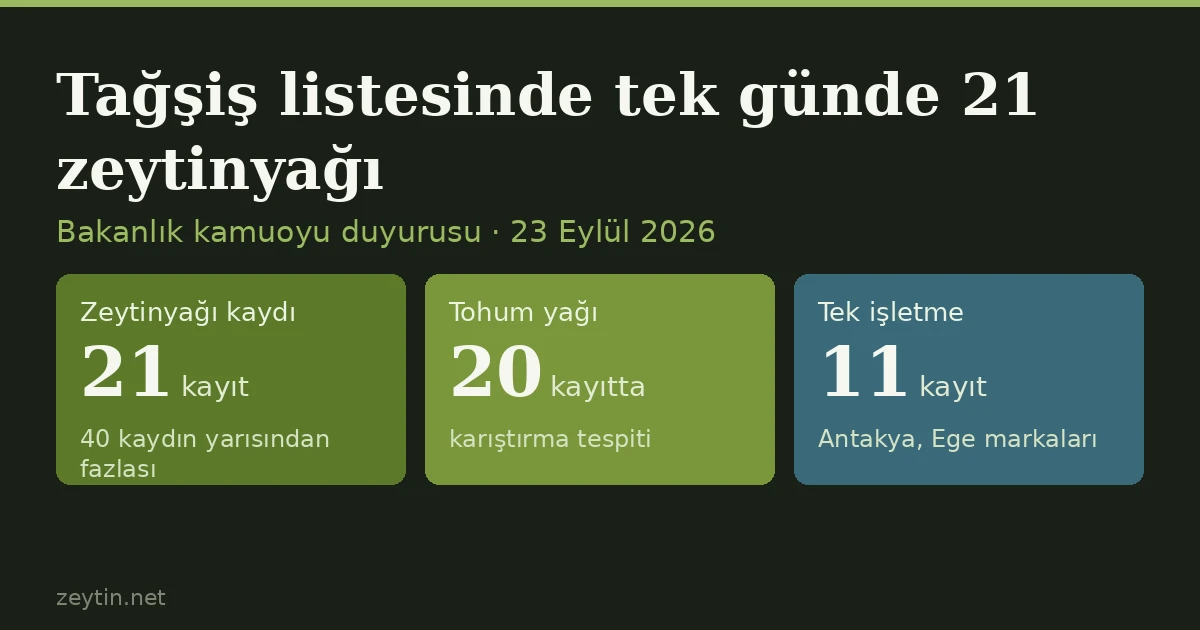
Twenty-one olive oils on the ministry's adulteration list in one day, eleven from a single Antakya business
Of the 40 records added to Turkey's counterfeit-and-adulteration list on 23 September 2026, 21 are olive oil, and 20 of those were found to contain seed oil. Eleven records belong to a single business registered in Antakya, marketing under Aegean origin names such as Ayvalık, Akçay-Altınoluk and Kazdağları. Sixteen of the containers were five litres.
Article
Twenty-one olive oils on the ministry's adulteration list in one day, eleven from a single Antakya business
Of the 40 records added to Turkey's counterfeit-and-adulteration list on 23 September 2026, 21 are olive oil, and 20 of those were found to contain seed oil. Eleven records belong to a single business registered in Antakya, marketing under Aegean origin names such as Ayvalık, Akçay-Altınoluk and Kazdağları. Sixteen of the containers were five litres.
 Article
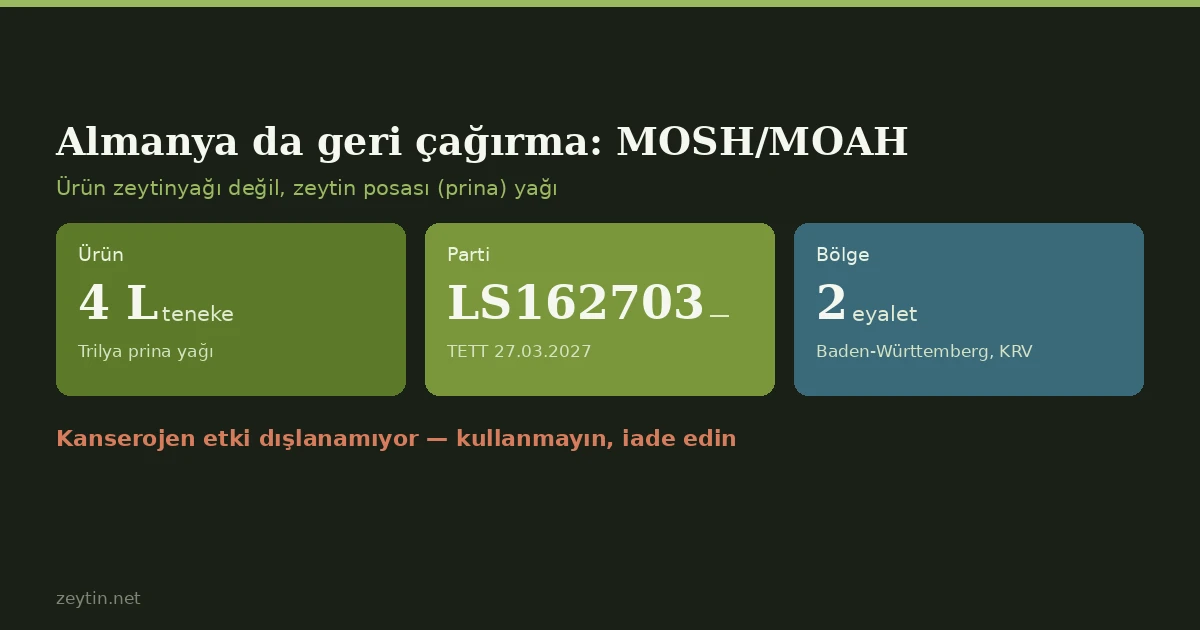
Recall in Germany: MOSH/MOAH in pomace oil — not olive oil
Germany's official food safety portal has recalled a 4-litre pomace oil sold in Turkish shops. The product is not olive oil but olive pomace oil; we explain the difference and what MOSH/MOAH are.
Article
Recall in Germany: MOSH/MOAH in pomace oil — not olive oil
Germany's official food safety portal has recalled a 4-litre pomace oil sold in Turkish shops. The product is not olive oil but olive pomace oil; we explain the difference and what MOSH/MOAH are.
 Article
Italy is back at 325,000 tonnes yet is handing cash to its mills: a 40-million-euro zero-interest loan
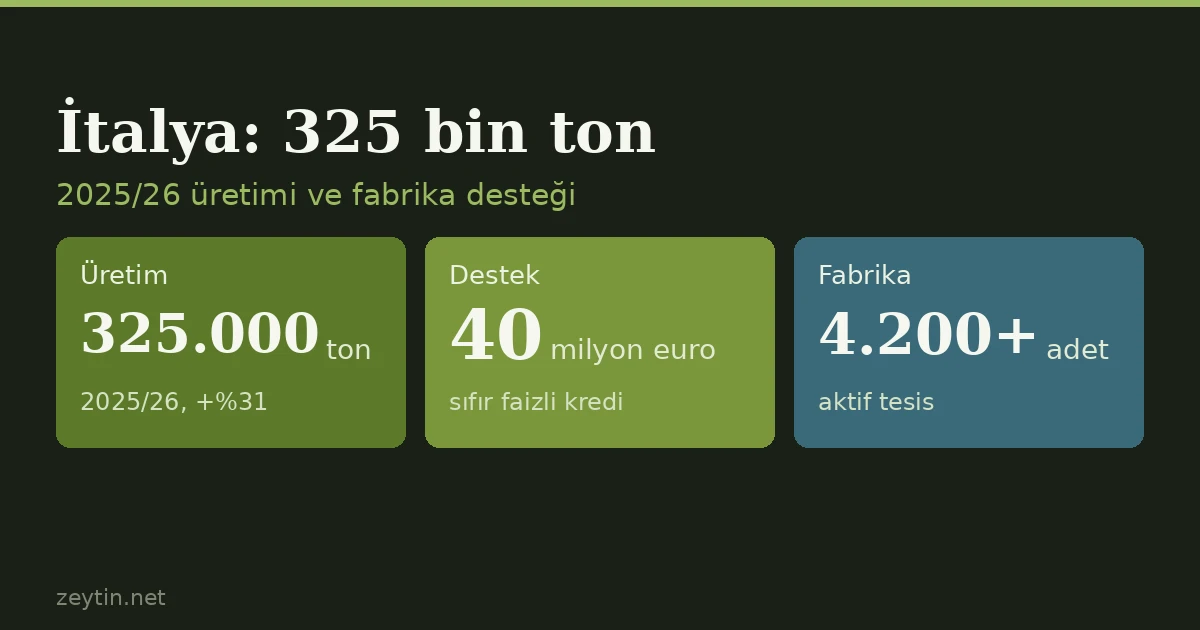
Italy produced 325,000 tonnes of olive oil in the 2025/26 campaign, up 31%, according to Ismea's sector report. Yet even as output recovers, the state is pumping liquidity into mills: the 40-million-euro "Cambiale Frantoi Oleari" offers zero-interest loans of 3,500 to 50,000 euros. The five-year national olive plan aims to lift production by 25%.
Article
Italy is back at 325,000 tonnes yet is handing cash to its mills: a 40-million-euro zero-interest loan
Italy produced 325,000 tonnes of olive oil in the 2025/26 campaign, up 31%, according to Ismea's sector report. Yet even as output recovers, the state is pumping liquidity into mills: the 40-million-euro "Cambiale Frantoi Oleari" offers zero-interest loans of 3,500 to 50,000 euros. The five-year national olive plan aims to lift production by 25%.
 Article
Antalya's crop is up 30%: of 70,000 tonnes of olives, 55,000-60,000 head for the mill
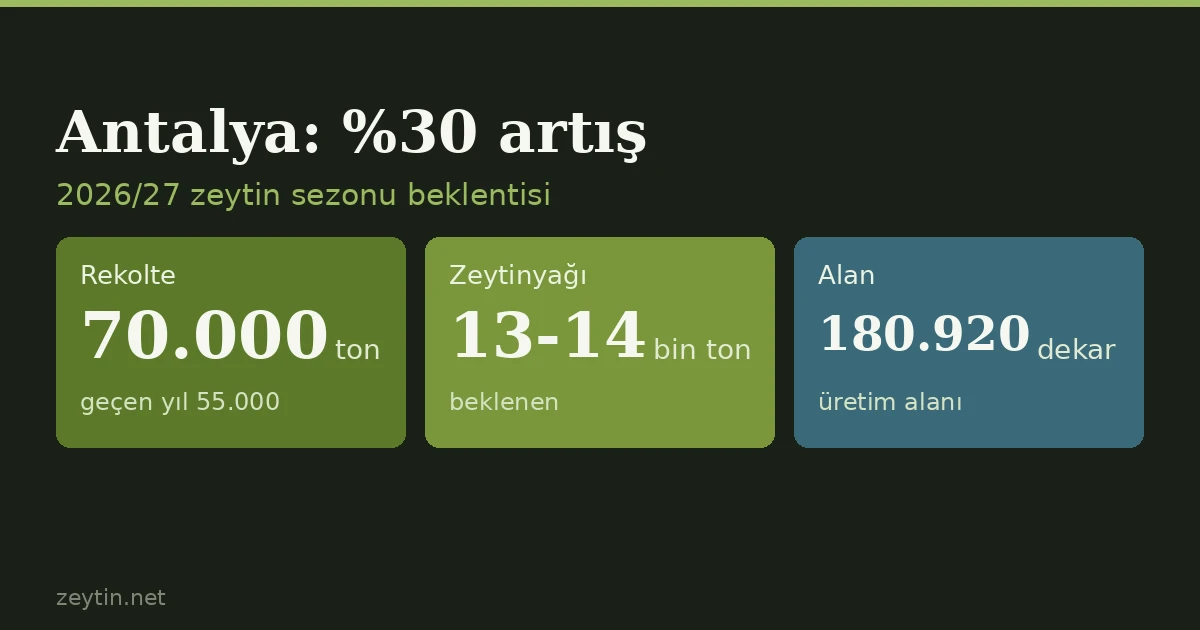
According to the Antalya Commodity Exchange, the province's olive crop is rising about 30% from some 55,000 tonnes last season to around 70,000 tonnes, with 13,000-14,000 tonnes of olive oil and 10,000-15,000 tonnes of brined fruit expected. Harvest opened on 15 September. There is movement on the registration front too: an EU application has been filed for the Tavşan Yüreği olive, and a geographical indication file is under way for the Beylik variety.
Article
Antalya's crop is up 30%: of 70,000 tonnes of olives, 55,000-60,000 head for the mill
According to the Antalya Commodity Exchange, the province's olive crop is rising about 30% from some 55,000 tonnes last season to around 70,000 tonnes, with 13,000-14,000 tonnes of olive oil and 10,000-15,000 tonnes of brined fruit expected. Harvest opened on 15 September. There is movement on the registration front too: an EU application has been filed for the Tavşan Yüreği olive, and a geographical indication file is under way for the Beylik variety.