Twenty-one olive oils on the ministry's adulteration list in one day, eleven from a single Antakya business
Of the 40 records added to Turkey's counterfeit-and-adulteration list on 23 September 2026, 21 are olive oil, and 20 of those were found to contain seed oil. Eleven records belong to a single business registered in Antakya, marketing under Aegean origin names such as Ayvalık, Akçay-Altınoluk and Kazdağları. Sixteen of the containers were five litres.

Turkey's Ministry of Agriculture and Forestry added 40 records to its counterfeit-and-adulteration list on 23 September 2026. Twenty-one of them are olive oil — more than half of a single announcement belongs to one product group.
The list, published by the Ministry's Directorate General of Food and Control as a Food Public Announcement, names products for which adulteration has been confirmed by laboratory analysis, together with the company name, brand, batch number, province and the specific non-conformity found. Its legal basis is Article 31 of Law No. 5996 on Veterinary Services, Plant Health, Food and Feed, together with Article 8 of the Regulation on Official Controls of Food and Feed dated 17 December 2011. That distinction matters: this is not a collection of allegations, but a register of closed laboratory findings.
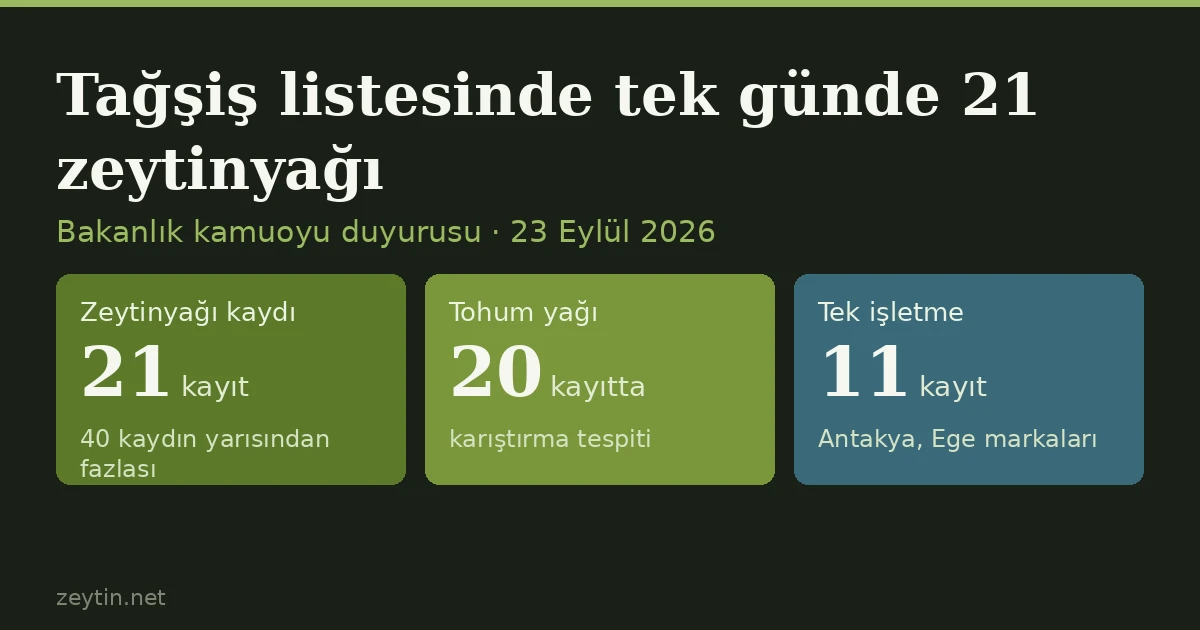
Twenty records, one finding
| Non-conformity found | Records |
|---|---|
| Seed oils mixed in | 20 |
| Lower-grade olive oil mixed in | 1 |
| Total | 21 |
In twenty of the products, laboratories found seed oil blended into oil sold as olive oil. In one case the finding is different: a lower-grade olive oil blended into a higher grade. The second kind of fraud is quieter, because what is in the bottle is still olive oil — only the grade on the label is false. We explained what separates extra virgin, virgin and refined grades in a separate article.
The packaging pattern points in one direction. Sixteen of the 21 records are five-litre containers, one is an 18-litre tin. In other words, the adulteration that reaches this register is not caught in the glass bottle on a supermarket shelf but in the "straight from the producer" tin. One record describes the product as unlabelled; three have an empty brand field. Batch numbers include values as thin as "1", "12" and "004" — where traceability is that weak, tracing a blend back to its source becomes correspondingly difficult.
Eleven records, one business, Aegean place names
The distribution by province is the surprise.
| Province | Records |
|---|---|
| Hatay | 11 |
| Aydın | 4 |
| İzmir | 3 |
| Balıkesir | 2 |
| Artvin | 1 |
Hatay sits at the top of a table about olive oil fraud, and all eleven of its records belong to a single business registered in Antakya. The place names in that business's brand wording explain why the number matters: Balıkesir, North Aegean Region, Akçay, Altınoluk, Kazdağları, Zeytinbağı Trilye. None of them is in Hatay. All of them are among the highest-value origin names in Turkish olive oil.
Some of that wording runs straight into registered territory. North Aegean Olive Oils and Ayvalık Olive Oil are registered geographical indications: registration defines the boundaries within which oil may carry the name, and it names an inspection authority. Printing "North Aegean Region Akçay Altınoluk" on a tin filled in Antakya therefore adds a second problem on top of the adulteration itself — the origin is counterfeit too.
The remaining records come from the districts that actually produce: Efeler, Koçarlı and Köşk in Aydın; Havran in Balıkesir; Buca in İzmir; and one retail record from Kemalpaşa in Artvin.
How the year has run
| Announcement date | Olive oil records |
|---|---|
| 2 April | 6 |
| 16 April | 4 |
| 1 June | 6 |
| 18 June | 1 |
| 2 July | 5 |
| 10 July | 2 |
| 22 July | 3 |
| 30 July | 3 |
| 20 August | 1 |
| 23 September | 21 |
This table reflects the records currently published on the list. Entries whose announcement period has expired are moved to a separate "concluded announcements" service, so earlier months may be incomplete. Even with that caveat, the shape holds: of the 52 olive oil records standing on the live list, 21 carry a single date.
The timing is not accidental either. Late September is the narrowest window of the year — last season's stock is running out and the new oil has not yet reached the market. Supply tightens while demand continues, prices rise, and a high price gets read as a sign of authenticity in its own right. We examined why that reading fails, using price data, earlier this month.
What a buyer can do
- The list is public and searchable. The Ministry's Food Public Announcement service can be queried by product, brand and company name, and each record carries province and district.
- If the label carries a place name, check where the oil was produced. A registered geographical indication has defined boundaries; a mismatch between the name and the producer's province is the first warning sign. We set out how to read a label separately.
- On a five-litre tin, look for a label and a batch number. The packaging pattern in these records points precisely at that channel.
- A claim of extra virgin should come with documentation. We covered what acidity actually tells you and how blending is detected in the laboratory in separate articles; the sterol profile makes a seed-oil blend directly visible.
Sources
- Ministry of Agriculture and Forestry, Directorate General of Food and Control, Food Public Announcement — "Counterfeit or Adulterated Foods (Addition of a Substance Not Carrying the Same Value)" list; records dated 23 September 2026, retrieved 29 September 2026.
- Legal basis: Law No. 5996, Article 31, and the Regulation on Official Controls of Food and Feed, Article 8.
One rating per visitor; you can change yours at any time. Ratings are real reader votes — no seeded or default scores.
Related
 Article
Palestinian olive oil: output down from 33,000 to 7,000 tonnes — the cause is access, not the crop
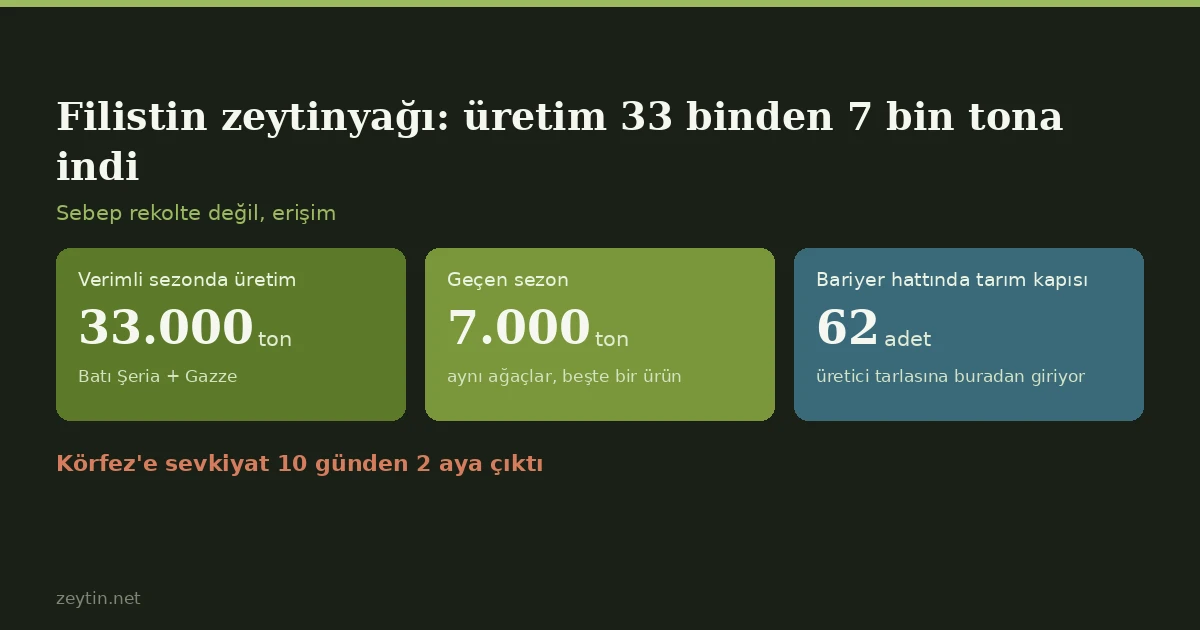
In a productive season Palestine yields 33,000 tonnes of olive oil; last season it produced 7,000. Seventy per cent of the groves sit in the northern West Bank, reached through 62 agricultural gates, and shipping times have gone from ten days to two months.
Article
Palestinian olive oil: output down from 33,000 to 7,000 tonnes — the cause is access, not the crop
In a productive season Palestine yields 33,000 tonnes of olive oil; last season it produced 7,000. Seventy per cent of the groves sit in the northern West Bank, reached through 62 agricultural gates, and shipping times have gone from ten days to two months.
 Article
Italy from production giant to trade hub: it exports more olive oil than it produces
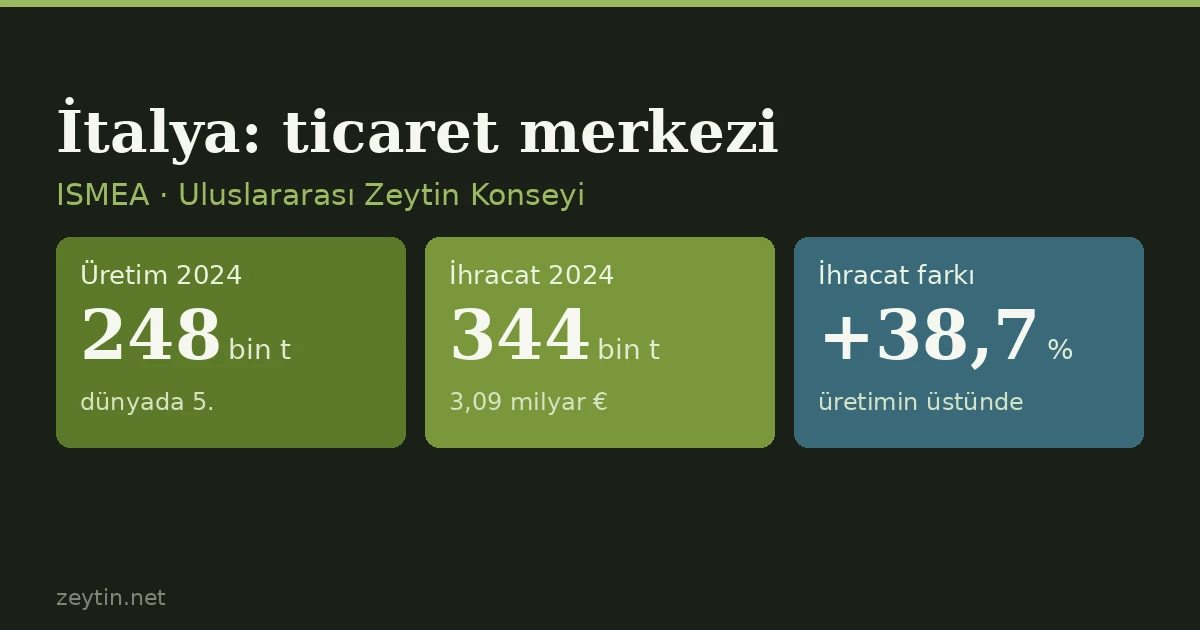
Italy produced 248,000 tonnes of olive oil in 2024 and slipped to fifth place worldwide, yet in the same year it exported 344,000 tonnes worth 3.09 billion euros. The country is now less a production giant than a trade hub that buys oil around the Mediterranean, blends it and sells it to the world.
Article
Italy from production giant to trade hub: it exports more olive oil than it produces
Italy produced 248,000 tonnes of olive oil in 2024 and slipped to fifth place worldwide, yet in the same year it exported 344,000 tonnes worth 3.09 billion euros. The country is now less a production giant than a trade hub that buys oil around the Mediterranean, blends it and sells it to the world.
 Article
Greece finally puts a number on its cost: €3-3.5 a kilo, up to €5 with labour
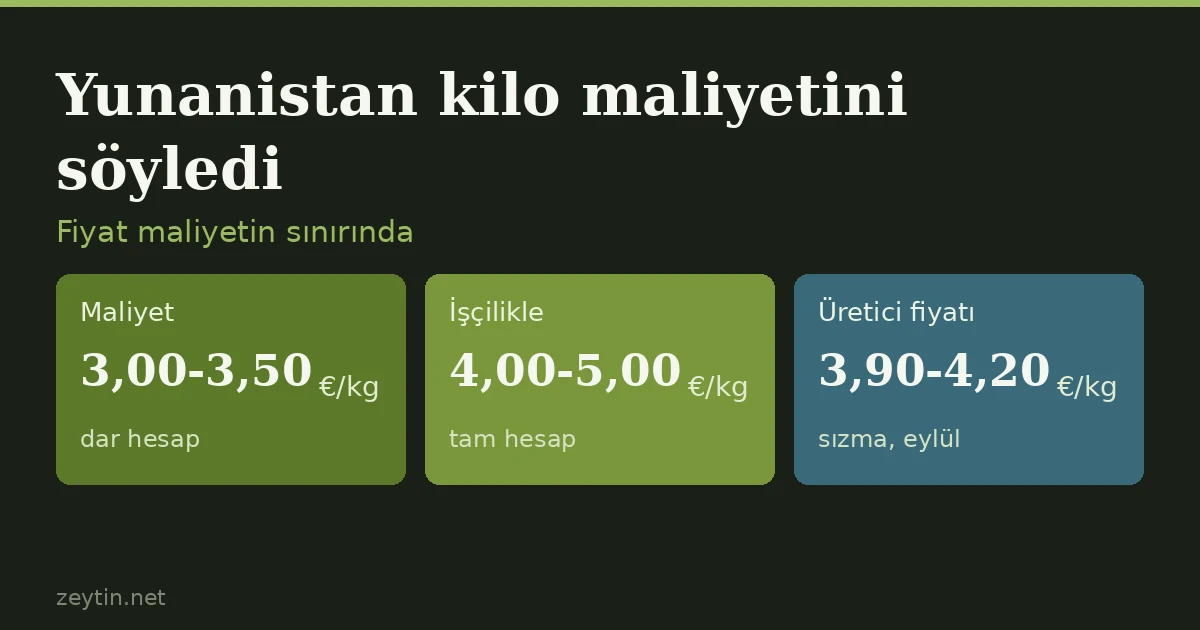
For the first time Greece has put a per-kilo figure on its olive oil production cost: €3.00-3.50, rising to €4.00-5.00 once labour is fully counted. The producer price stands at €3.90-4.20, at or below that cost. Spain's €1.70-2.00 for the same item shows where the competitive gap actually sits. Greek output for 2026/27 is estimated at 280,000-330,000 tonnes.
Article
Greece finally puts a number on its cost: €3-3.5 a kilo, up to €5 with labour
For the first time Greece has put a per-kilo figure on its olive oil production cost: €3.00-3.50, rising to €4.00-5.00 once labour is fully counted. The producer price stands at €3.90-4.20, at or below that cost. Spain's €1.70-2.00 for the same item shows where the competitive gap actually sits. Greek output for 2026/27 is estimated at 280,000-330,000 tonnes.
 Article
Algeria expects a record 150,000 tonnes: the Mediterranean supply map is shifting
Algeria's 2025/26 olive oil output is expected to exceed 150,000 tonnes — up 76% on the previous season and a third consecutive rise. With domestic consumption near 81,000 tonnes, an exportable surplus appears. In a season when Turkish exports fell 62% by value, that means new competition in the bulk market.
Article
Algeria expects a record 150,000 tonnes: the Mediterranean supply map is shifting
Algeria's 2025/26 olive oil output is expected to exceed 150,000 tonnes — up 76% on the previous season and a third consecutive rise. With domestic consumption near 81,000 tonnes, an exportable surplus appears. In a season when Turkish exports fell 62% by value, that means new competition in the bulk market.