The Difference Between Black and Green Olives
Not two different trees but the same fruit at two different moments. So why do they differ in taste, texture and nutrition?
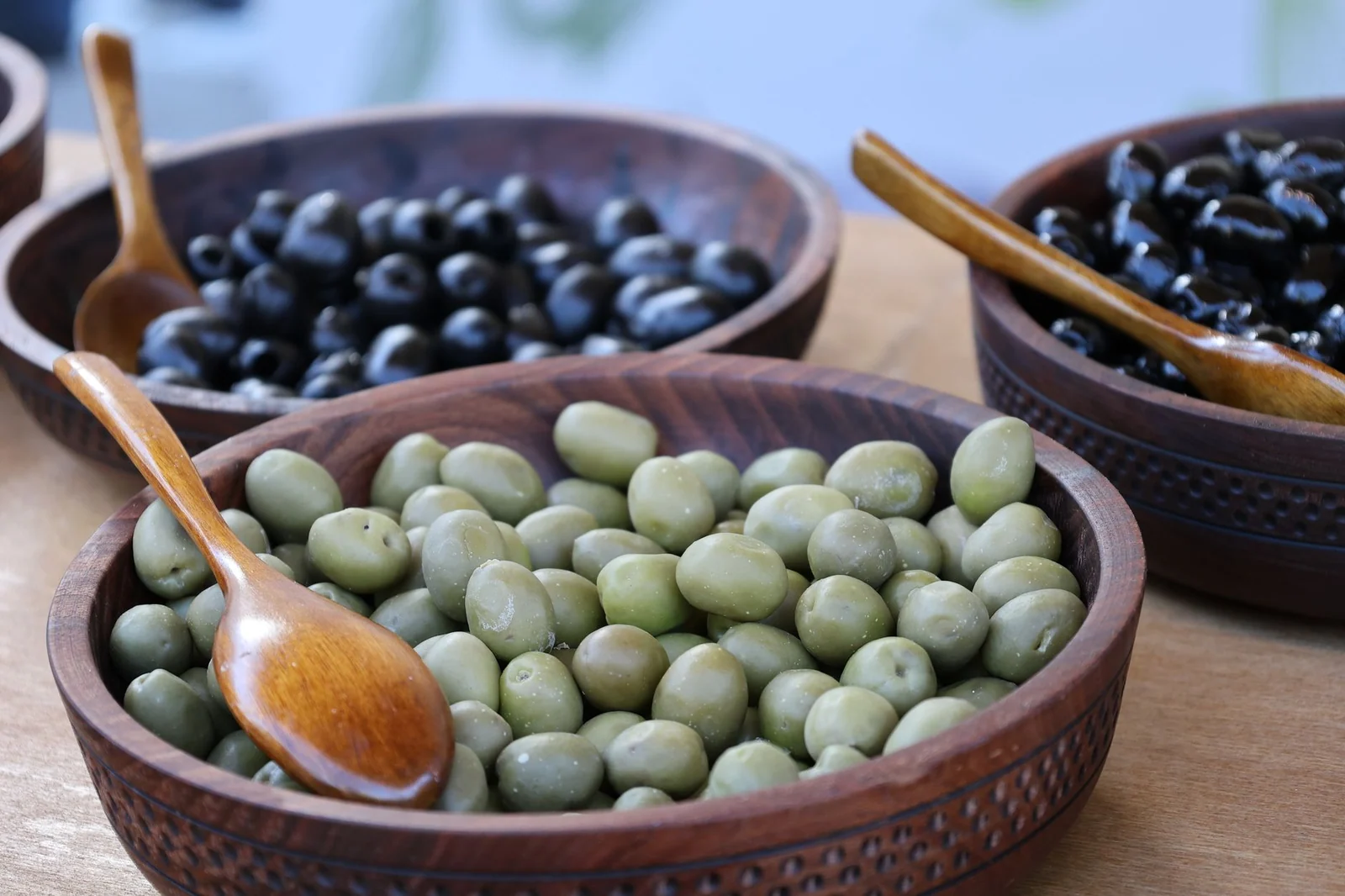
One of the most common questions: do black olives and green olives come from different trees? No. They are the same fruit; the difference lies in harvest time and production method. The same tree can give green olives in October and black olives in December.
The short answer
| Green olives | Black olives | |
|---|---|---|
| When picked | Full size, before colour change | Fully ripe on the tree |
| Texture | Firm, crisp | Soft |
| Taste | Sharp, noticeably bitter | Rounder, sweeter |
| Oil | Lower | Higher |
| Polyphenols | Higher | Decline with ripeness |
| Calories (100 g, average) | ≈145 kcal | ≈115 kcal |
Although oil content in the fruit rises with ripeness, calories at the table depend on the curing method; in databases brined green olives come out higher. Details are in the nutritional profile of olives.
The only difference: ripeness
Green olives are picked when the fruit has reached full size but has not yet changed colour. Black olives are left on the tree and picked once fully ripe. In between there is a purplish, mottled stage; olives picked then are called "pink" or "turning" olives.
The colour change moves from the skin inwards. First the skin turns yellowish green, then pink-purple, and finally black; after that the flesh darkens from under the skin towards the stone. Growers track this progress on a scale from 0 to 7. How the scale is used is explained in the maturity index.
Are green and black olive trees different?
No, but varieties suit the two uses to different degrees. Some varieties are large and firm-fleshed and go to green table olives; others stay firm when ripe and go to black table olives. Examples recorded in our variety data:
- Mainly green table olives: Domat, Çelebi, Samanlı, Manzanilla
- Mainly black table olives: Gemlik, Uslu, Edincik Su, Kalamata
- Multi-purpose: Ayvalık (oil, cracked green and black table olives), Memecik (oil, green and black table olives)
So there is no separate "black olive tree"; green olives can be picked in October even from Gemlik, the variety Turks think of first for black table olives. For the full list, see table olive varieties.
Taste and texture
Green olives have a firmer, crisper texture and a sharper, more noticeably bitter taste. They resist the bite.
Black olives are softer, oilier and sweeter. Their aroma is rounder and they are less bitter.
Production differs too
A freshly picked olive is bitter whatever its colour. How the bitterness is removed depends on the colour:
- Green olives are usually slit or cracked, then soaked in water and brine. In industry the bitterness can be removed quickly with a dilute alkaline solution, followed by fermentation. Details are in how green table olives are made.
- Black olives are kept in natural brine for months or cured in dry salt. Both routes are described in how black table olives are made.
Nutritionally
The two are close, but there are two tendencies:
- Oil content in the fruit rises as it ripens.
- Polyphenols are higher in green olives and decline with ripeness.
- Iron stands out in black olives, but part of that value comes from the darkening process (see below).
Salt content depends more on the brining method than on colour.
⚠ Darkened black olives
There is a practice worth knowing about. Some cheap black olives on the market were not ripened on the tree: they are picked green, darkened by oxidation, and their colour is fixed with ferrous gluconate (E579). It is a quick, cheap method that turns olives black in days instead of waiting on the tree.
How to tell:
- Check the ingredients. If ferrous gluconate or E579 is listed, the olives have been darkened; the additive must be declared on the label.
- Be suspicious of perfectly even colour. Naturally ripened black olives vary in tone from fruit to fruit; darkened ones are uniformly glossy or matt black.
- Look at the flesh near the stone. In an olive fully ripened on the tree, the flesh darkens inwards from the skin. In an olive darkened by oxidation, the colour stays on the surface and the flesh near the stone is light.
- If the stone itself is dyed, that cannot be explained by natural ripening or by permitted darkening; it points to unauthorised dyeing.
Darkened olives are not harmful and are a legal product, but they do not carry the aroma of ripe olives or the nutritional profile of naturally black ones. Knowing what you are paying for is enough. For unauthorised methods, see fraud in table olives.
Is olive oil made from green or black olives?
Both. Oil from olives picked early, at the green-to-turning stage, is more bitter, more peppery and rich in polyphenols, but there is less of it. Ripe black olives give more oil; its taste is milder and its shelf life shorter. We worked out the economics of that choice in is early harvest expensive or valuable.
Which is healthier?
There is no clear winner. Green olives stand out for polyphenols, but because of the brining method their sodium is often higher. Naturally ripened black olives are less bitter and oilier, and usually slightly lower in salt. Darkened black olives, however, do not carry the advantages of naturally black ones. A practical rule: look less at the colour itself and more at the amount of salt, additives and production method. We covered the benefits of each colour in what are green olives and what are their benefits and what are black olives and what are their benefits, and compared them in which olive is healthiest.
Do they store differently?
Yes. Thanks to their firm texture, green olives stay crisp in brine for longer. Black olives are softer and therefore more delicate in brine; in an opened jar it matters that the olives stay under the liquid and are kept in the fridge. Dry-salt cured black olives, by contrast, are stored without brine, somewhere dry and cool or covered with olive oil. Details are in how to store olives.
Which to use for what?
- Breakfast: both; black olives are the more common choice because they are softer.
- Salads (Greek style): naturally black olives such as Kalamata.
- Cooking (stews, pasta sauce): black olives hold together under heat and lend their flavour.
- Meze and marinades: green olives, with their firmer texture, are better suited.
- Martinis and stuffed olives: green, especially Manzanilla.
You can find which variety suits which use in detail in olive varieties.
One rating per visitor; you can change yours at any time. Ratings are real reader votes — no seeded or default scores.
Related
 Article
How do you reduce the salt in olives?
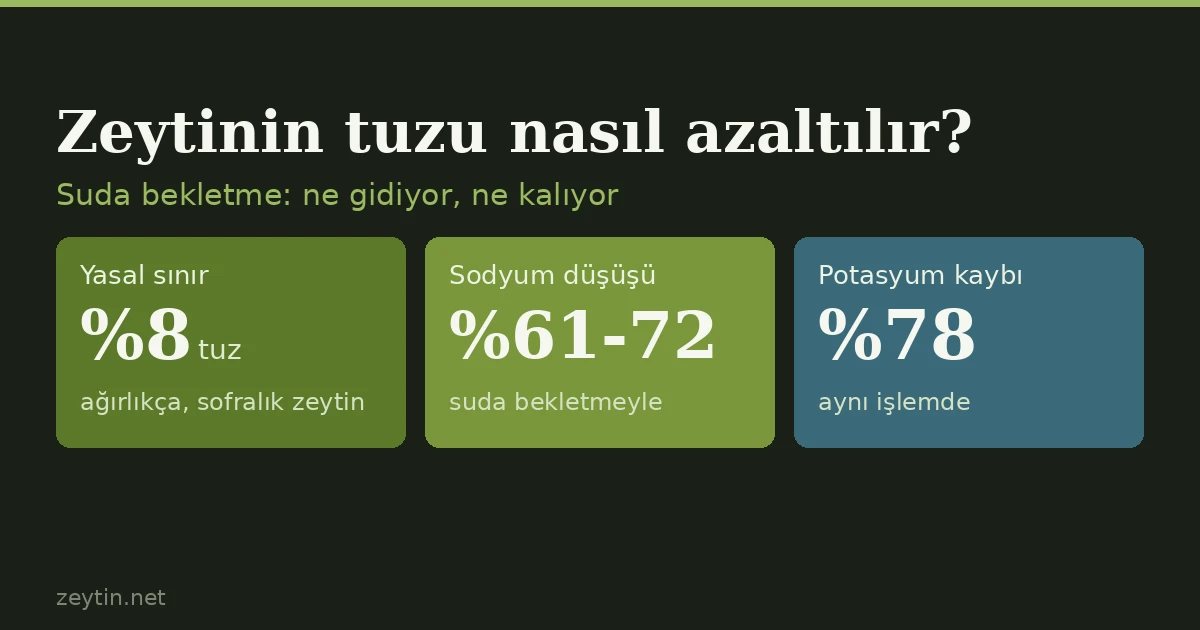
Draining the brine does not remove the salt — it has worked its way into the flesh. A Spanish study measured that soaking in water cuts sodium by 61-72%, but the same process also carries away up to 78% of the potassium and softens the fruit. The legal salt ceiling for table olives is 8% by weight, and the "low salt" claim requires no more than 4 grams per 100. Which method works how well, and what does each one give up?
Article
How do you reduce the salt in olives?
Draining the brine does not remove the salt — it has worked its way into the flesh. A Spanish study measured that soaking in water cuts sodium by 61-72%, but the same process also carries away up to 78% of the potassium and softens the fruit. The legal salt ceiling for table olives is 8% by weight, and the "low salt" claim requires no more than 4 grams per 100. Which method works how well, and what does each one give up?
 Article
Gölvala olive
Gölvala is a recorded variety of the Black Sea. No measured pomological data published.
Article
Gölvala olive
Gölvala is a recorded variety of the Black Sea. No measured pomological data published.
 Article
Leccino olive: Italy's oil variety
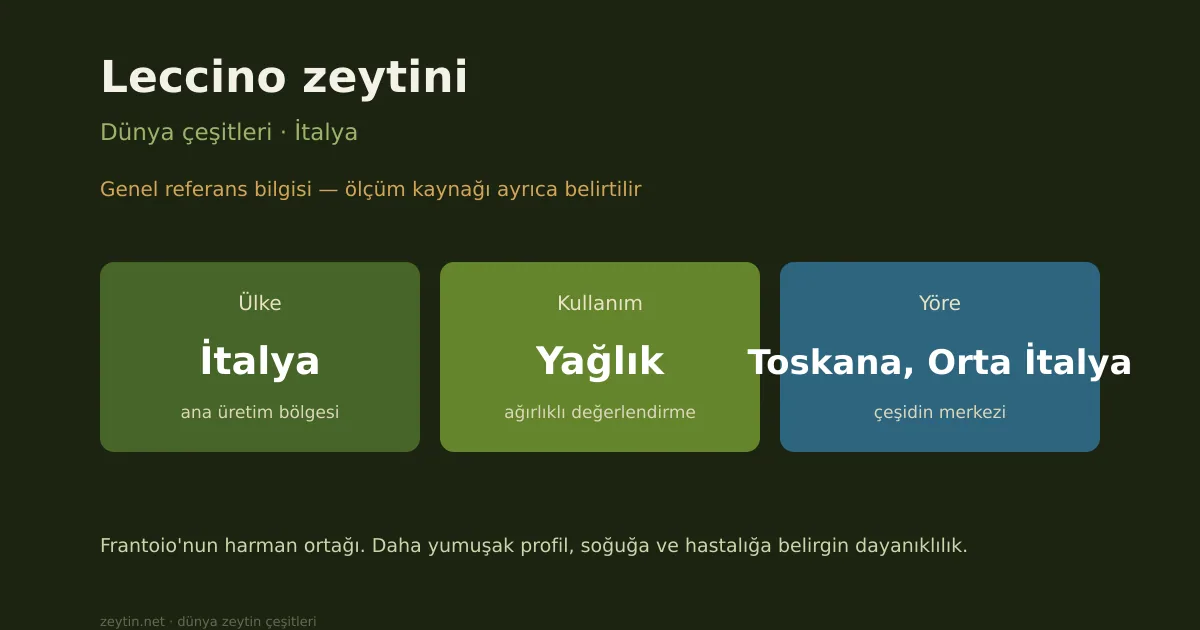
Frantoio's blending partner. A softer profile with notable cold and disease tolerance.
Article
Leccino olive: Italy's oil variety
Frantoio's blending partner. A softer profile with notable cold and disease tolerance.
 Article
Aydın Memecik Olive: grafted on wild rootstock, a tree that yields for a century
Registered in 2021. The certificate ties the cultivar's key trait to longevity: grafted on wild rootstock, Memecik yields economically for 80-100 years and can then be rejuvenated.
Article
Aydın Memecik Olive: grafted on wild rootstock, a tree that yields for a century
Registered in 2021. The certificate ties the cultivar's key trait to longevity: grafted on wild rootstock, Memecik yields economically for 80-100 years and can then be rejuvenated.