When does new-harvest olive oil come out, and when should you buy it?
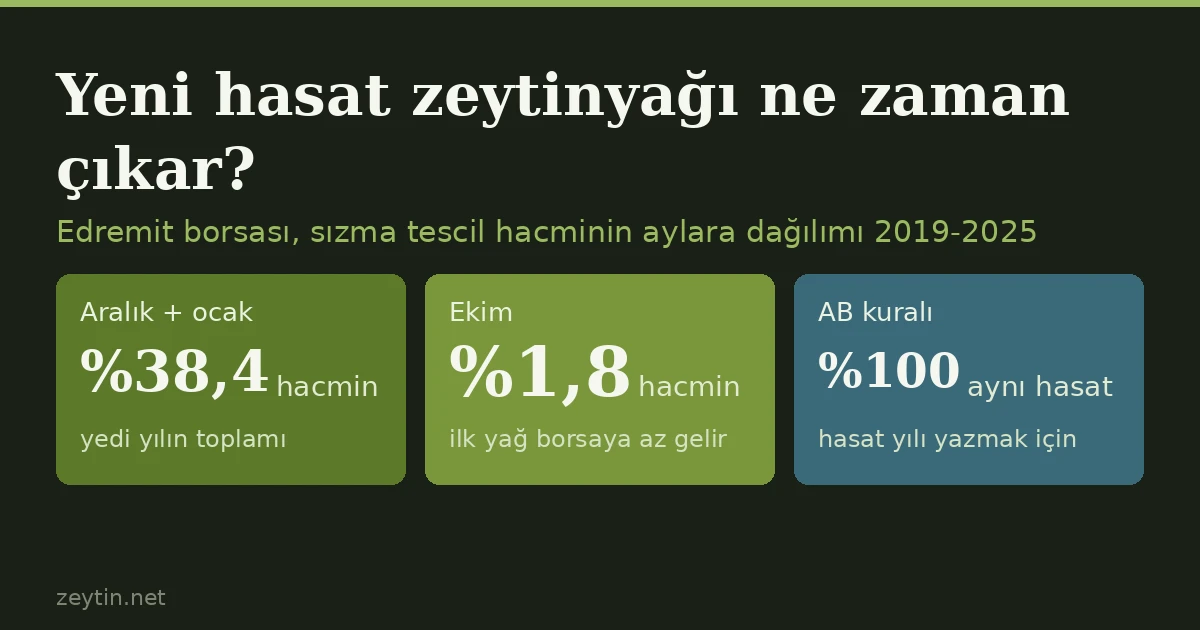
In Turkey the first new-season oil appears in October, mostly early harvest; the bulk arrives between November and January depending on region. At the Edremit exchange 38.4% of seven years' extra virgin volume was registered in December–January, only 1.8% in October. Turkish rules say nothing on harvest year; the EU allows it only if 100% comes from one harvest.
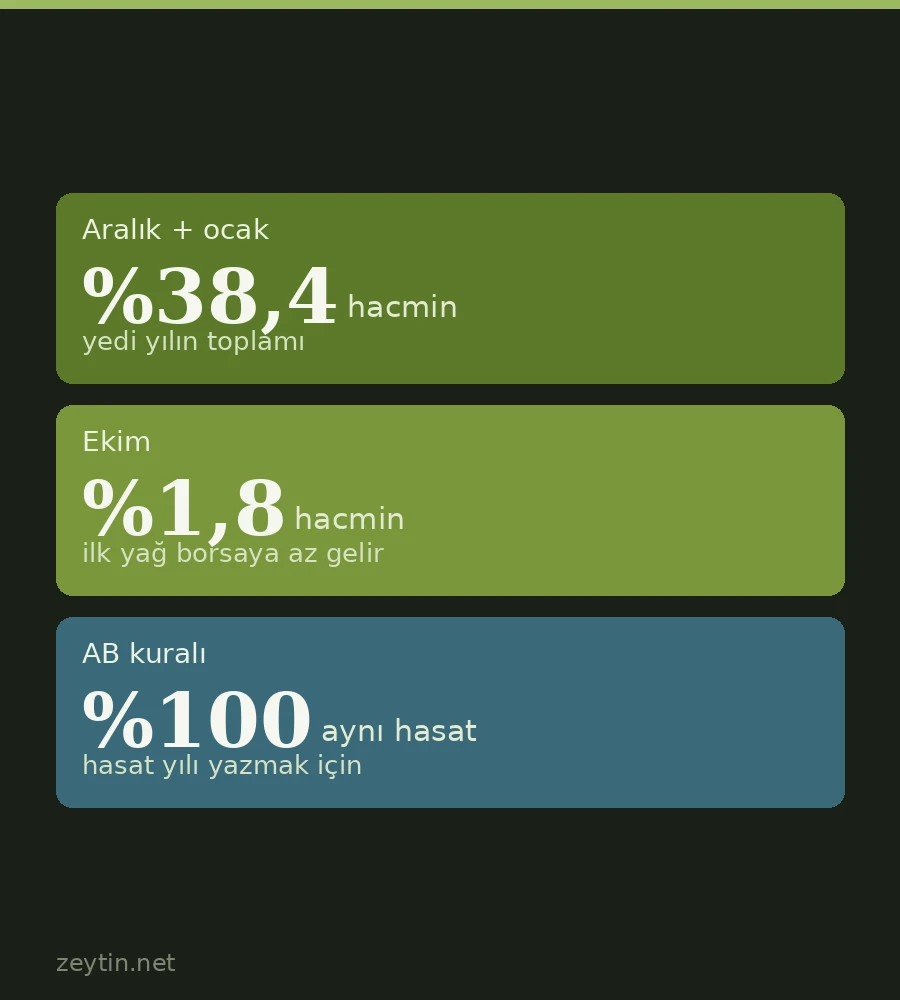
The short answer: in Turkey the first oil of the season appears in October, mostly as early-harvest oil, while the bulk of new oil arrives between November and January, stretching into February in some regions. The International Olive Council's olive oil year likewise runs from 1 October to 30 September. When to buy, though, depends less on the calendar than on the oil you want and what the label tells you.
The harvest calendar shifts by region and variety
September's "first harvest" festivals are ceremonial; commercial milling starts later. The best written record of regional timing is Turkey's geographical indication registrations:
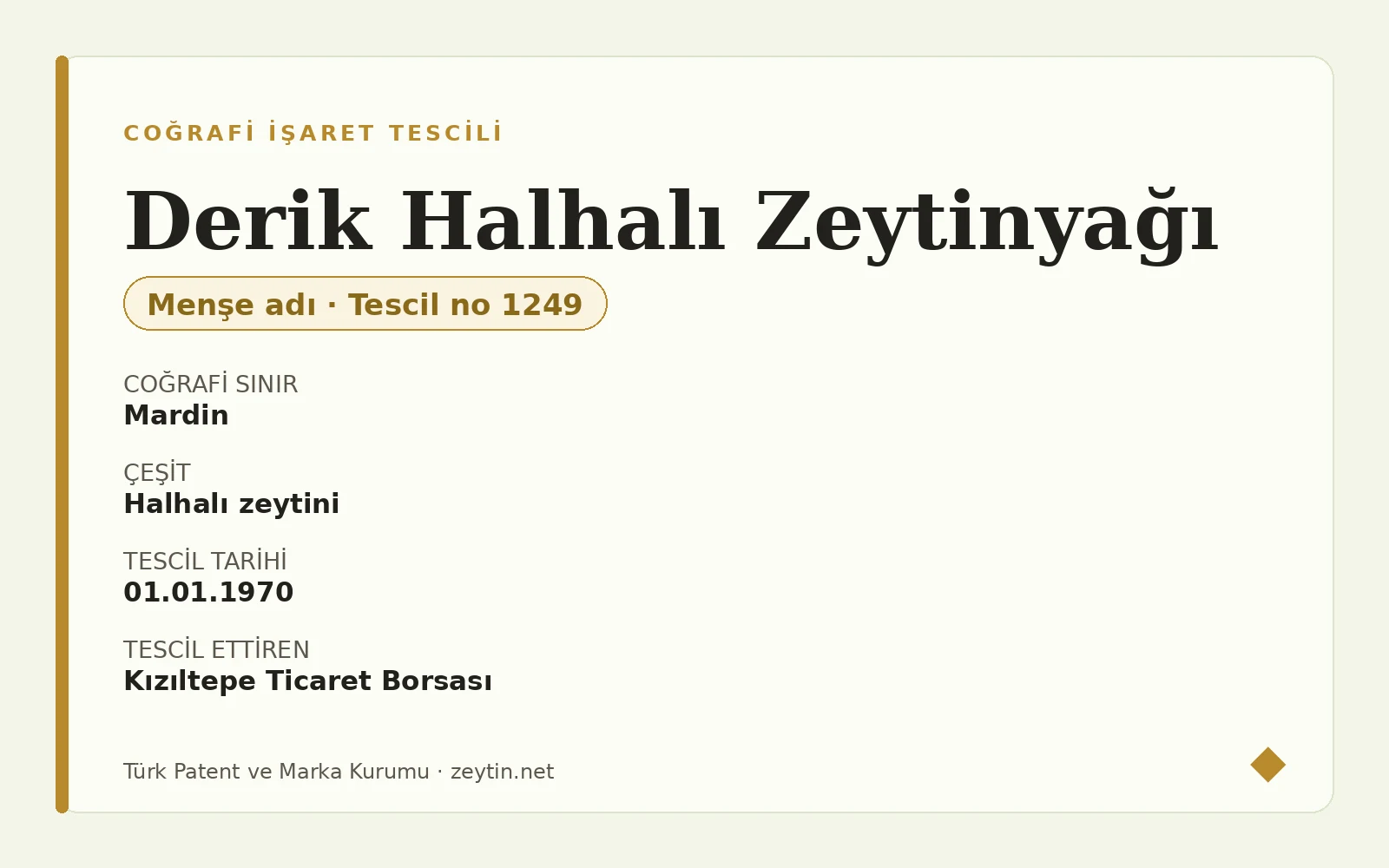
- Derik Halhalı (Mardin, southeast): October, while the fruit is green, to mid-November.
- Altınözü (Hatay): from early November to the end of December.
- Nizip (Gaziantep): usually November to the first week of February.
- North Aegean oils (Ayvalık–Edremit–Dikili belt): mid-October, possibly until the end of February.
- Ödemiş Çekişte (İzmir): early harvest in November–December; the "çakır" harvest, as fruit turns pink, mid-December to mid-January.
- Erdek Kapıdağ (Balıkesir, Marmara): from mid-September to the end of January.
- Edincik Su (Balıkesir, Marmara): early harvest from the first week of October to the end of January.
So "south early, north late" does not hold on its own: a Marmara registration mentions September, the Hatay one starts in November. Variety, weather and the grower's choice between early and ripe harvest matter more than latitude.
What the commodity exchanges show
The wholesale market tells a different story. We split the extra virgin olive oil trades registered at the Edremit and Aydın commodity exchanges between 2019 and 2025 by month:
| Month | Edremit | Aydın |
|---|---|---|
| January | 19.5 | 3.9 |
| February | 3.6 | 14.3 |
| March | 6.7 | 14.7 |
| April | 5.0 | 4.8 |
| May | 3.6 | 10.4 |
| June | 4.0 | 9.0 |
| July | 5.6 | 7.8 |
| August | 6.4 | 4.9 |
| September | 19.6 | 14.8 |
| October | 1.8 | 8.2 |
| November | 5.4 | 4.9 |
| December | 18.9 | 2.3 |
| Total volume, seven years | 13.8 million kg | 21.2 million kg |
Calculated by zeytin.net. Data: "Zeytinyağı sızma" (extra virgin olive oil) trades registered at the Edremit and Aydın commodity exchanges, members of TOBB (the Union of Chambers and Commodity Exchanges of Turkey), 2019–2025. Each month's share is calculated against that exchange's total registered volume over the seven years. Exchange registrations are wholesale (bulk) trades; retail sales and direct purchases from mills are not included.
At Edremit, October is the quietest month of the year, with only 1.8% of seven-year volume. In six of the seven years October's share stayed below 3%, and even the highest year reached only 5%. One possible reason is that early volumes are small and much of that oil goes straight to buyers. Volume gathers in December (18.9%) and January (19.5%): together, 38.4%. That suggests new-season oil from the North Aegean reaches the wholesale market mainly in midwinter.
September's 19.6%, on a par with December and January, stands out. These trades come before the harvest, so they may be sales of the previous season's remaining stock; an exchange record does not say which harvest the oil came from.
Aydın looks different. December and January together account for only 6.2%; activity peaks in February–March (29% combined) and in September (14.8%). The registration for Aydın Memecik olive oil states that inspections are carried out during the harvest period, in October and November. Trading peaking a few months later may mean oil is held by producers or in storage before it is sold. With calendars this different, a single "new oil month" would be misleading.
Two further caveats. First, these are seven-year totals and a single year can weigh heavily: about 42% of Edremit's December–January volume, and about 42% of Aydın's February–March volume, comes from one calendar year (2021 and 2023 respectively). Second, the series does not show prices falling in any particular month; there is no consistent monthly price pattern.
What does "new harvest" on a label guarantee?
In Turkey, olive oil is governed by the Turkish Food Codex Communiqué on Olive Oil and Olive Pomace Oil (Official Gazette no. 30183 of 17 September 2017, Communiqué No. 2017/26, amended twice in 2023). It contains no provision on stating a harvest year or harvest date, and neither "early harvest" nor "new harvest" is defined in it. On Turkish labels these phrases are voluntary and rest on the producer's own claim. A "new harvest" label that does not say which harvest could sit on a shelf a year later with exactly the same words.
The EU is more specific. Under Article 11 of Delegated Regulation (EU) 2022/2104, only extra virgin and virgin olive oil may show a harvest year, and only if 100% of the contents of the container come from that harvest. It must be given either as the marketing year or as the month and year of the harvest, in that order, and the month must be the month in which the oil was extracted from the olives. Member states may also make the harvest year compulsory for oil produced from olives grown on their territory and sold on their own national market.
So under EU rules a bottle blending two seasons cannot carry a harvest year. Turkey has no such rule; a Turkish producer who prints the month and year of milling is telling you more than the law requires.
Look for the harvest date, not the best-before date
The International Olive Council defines shelf life as the time an oil keeps its composition and sensory characteristics and stays fit for consumption, depending on its category; it gives no fixed number of months, and neither does the EU olive oil regulation. In Turkey the best-before date is set by the producer, as we explained in does olive oil have a use-by date. Two bottles with the same best-before date may therefore have been pressed a month apart or a year apart.
A 2013 report from the University of California, Davis Olive Center advises consumers to choose an oil within 15 months of its harvest date, not its best-before date. For oil pressed in November 2026, that limit falls in February 2028, so a year's supply bought in winter is still inside that window when the next harvest arrives.
When should you buy?
- October: the first early-harvest oils of the season. They are bitter and pungent, scarce and expensive; we worked out why, from yields, in is early harvest expensive or valuable.
- November–January: the period of greatest supply. Oil fresh from the mill is cloudy and has not yet settled. Cloudiness is not spoilage, but sediment left at the bottom for weeks can create defects; see why is freshly pressed olive oil cloudy.
- January–February: oil bought now has likely settled through its first weeks; just ask the seller whether it has been racked off its sediment.
- Summer and September: shelf oil is most likely from the previous season. That is fine in itself, but without a harvest month and year you cannot tell its age.
If you buy a year's supply at once, size it to run out by the next harvest, separate it from its sediment and keep it cool and dark; see our guide on how to store freshly pressed olive oil.
One rating per visitor; you can change yours at any time. Ratings are real reader votes — no seeded or default scores.
Related
 Article
Derik Halhalı Olive Oil: a burn reminiscent of red pepper
Registered in 2022. Low acidity (0.29-0.60%) and high phenols; the certificate describes the pungency directly — a lasting burn spreading over tongue and lips.
 Article
Olive Oil Prices: Week 38 of 2026
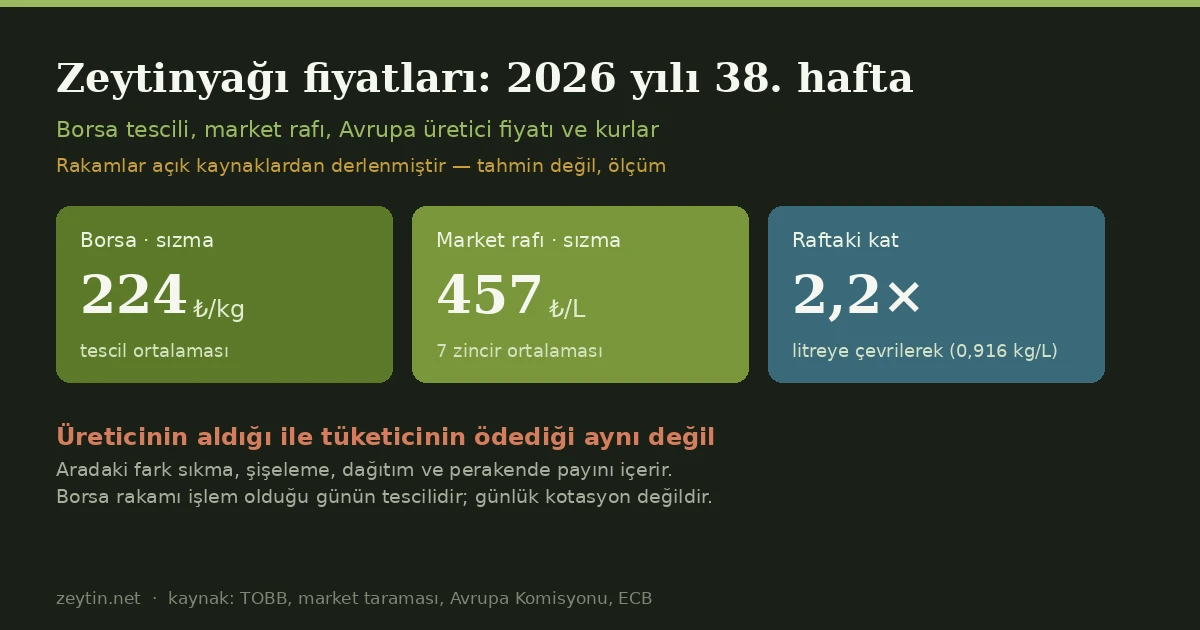
Week 38 of 2026: Turkish exchange prices, European producer prices and exchange rates side by side.
 Article
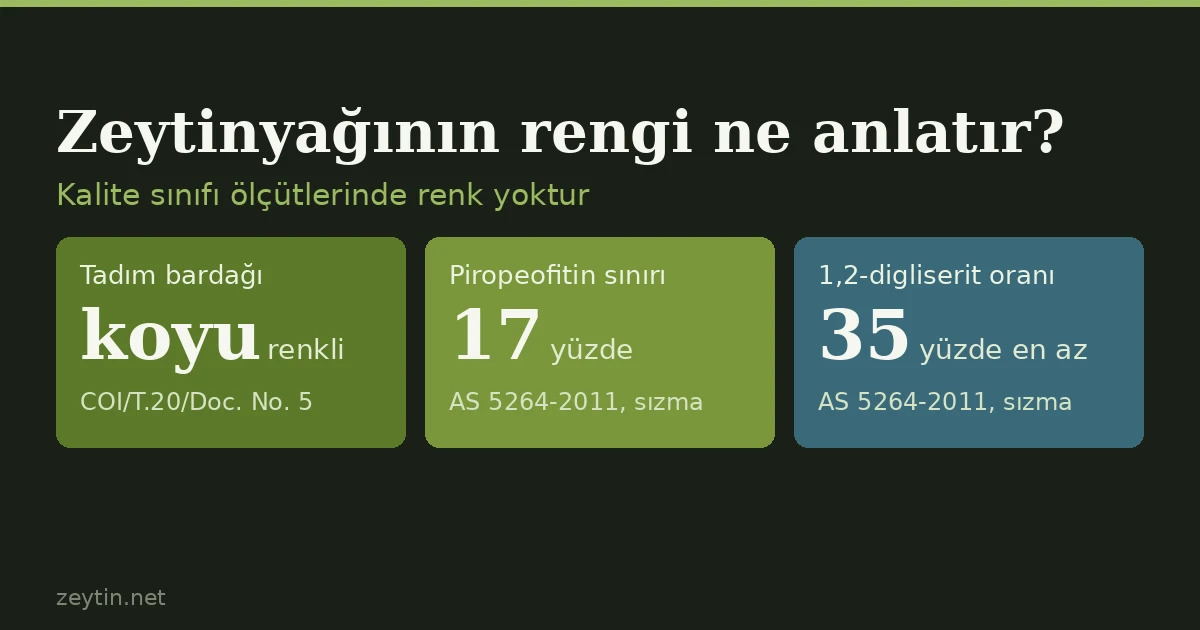
What does the colour of olive oil mean?
Dark green olive oil is widely assumed to be better, yet colour is not a criterion in any quality grade. The International Olive Council's official tasting glass must be dark enough that the colour of its contents cannot be seen — precisely so that the taster is not influenced by it. The chlorophylls and carotenoids that make the colour vary with cultivar, ripeness, leaf ratio and settling. Pigments do carry information in the laboratory as markers of freshness and heat treatment, but they cannot be read by looking at the bottle.
 Article
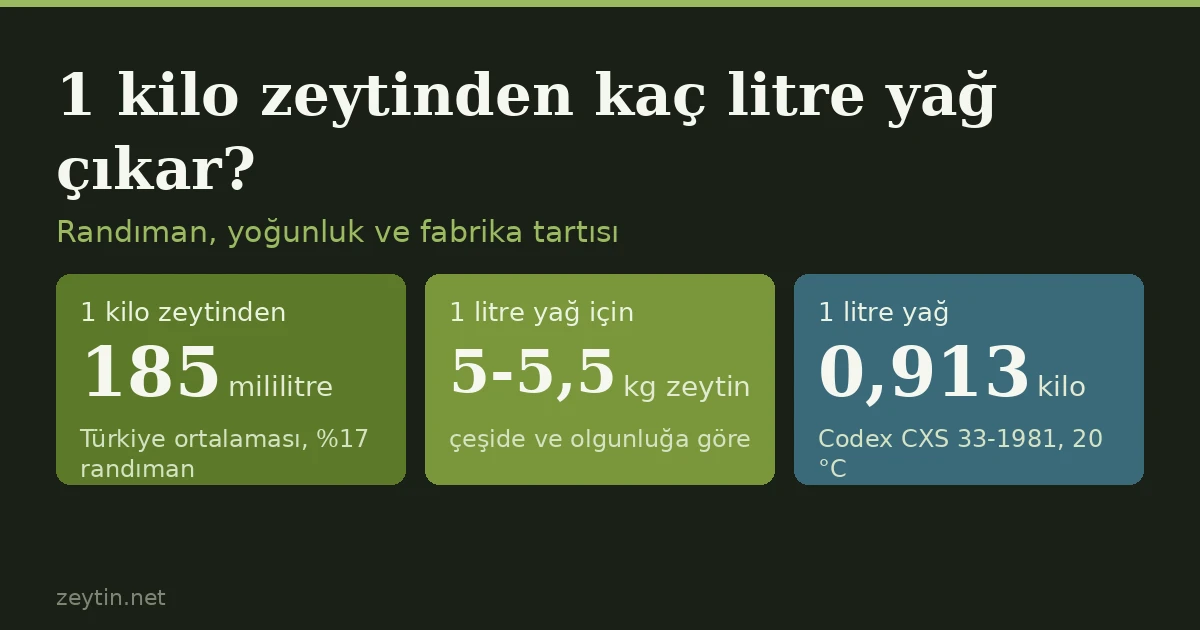
How many kilos of olives make 1 litre of oil? How many litres is 1 kg?
One kilo of olives gives about 185 ml of oil; a litre needs 5-5.5 kilos of olives. 1 kg of olive oil is 1.095 litres, so a 16 kg tin holds 17.5 litres.