Why does olive oil foam? Is foaming oil spoiled?
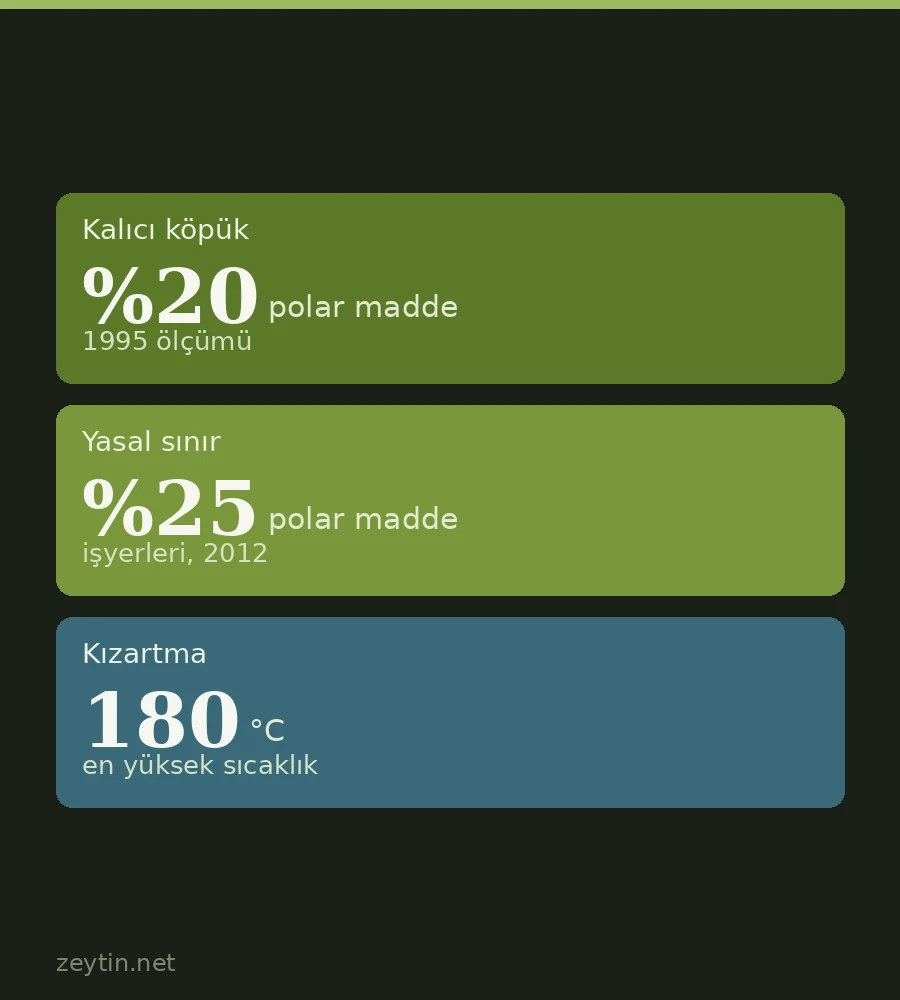
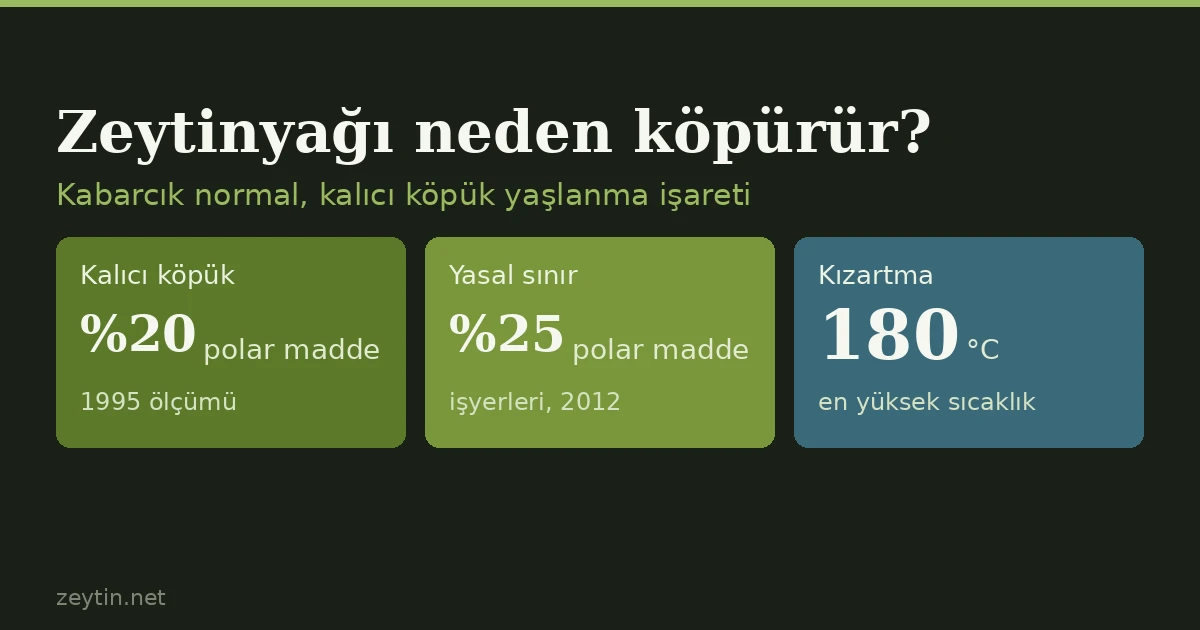
Bubbles when food goes in are steam and perfectly normal. Foam that stays after the food is out shows the oil is ageing: durable foaming starts once polar compounds pass 20%. In Turkey the limit for food businesses is 25% polar compounds and 180 °C.
Olive oil in a pan sometimes heats up quietly and sometimes covers itself in foam. In the kitchen the question comes up in three different situations: when freshly pressed, unfiltered oil sizzles and foams in the pan; when a layer of foam that will not go away appears after the same oil has been used for frying several times; and when bubbles linger at the neck of a bottle after it has been shaken. The causes are not the same. One is a sign of deterioration, the others are not. This article separates them using measured data.
Bubbles or foam?
First, what is normal. When potatoes or meatballs go into hot oil, the water on their surface turns to steam as soon as it passes 100 °C and rises through the oil as bubbles. Studies of frying divide the process into stages: initial heating, surface boiling, a stage in which boiling slows down, and an end point at which bubbling stops. As the food cooks it loses water and the bubbling eases; in the last stage no more bubbles are released.
Those bubbles are the sound of the food, not of the oil. What deserves attention is dense, persistent foam that stays on the surface after the food has been taken out and comes back after it is skimmed off.
The cause of persistent foam: an ageing oil
Hot oil deteriorates in three ways each time it is used: hydrolysis caused by water from the food, oxidation caused by air and polymerisation caused by high heat. These reactions build up polar compounds and polymers in the oil, and free fatty acids and mono- and diglycerides also increase. What these substances have in common is that they lower surface tension; they act a little like soap and slow down the bursting of bubbles.
A 2018 review by researchers at the Spanish National Research Council lists darkening, increased viscosity, foaming and a falling smoke point among the changes that frying oil undergoes as water is released from the food. The food safety authority of Bavaria likewise states that polymer products cause foaming and make the fat more viscous.
The study that measured the link between foam and deterioration most directly was published in Japan in 1995. The researchers found that foam height was clearly related to the amount of polar compounds and polymerised oil, and that durable foaming set in once polar compounds exceeded 20% and polymerised oil exceeded 10%.
The limit in Turkey: 25% polar compounds, 180 °C
In Turkey this limit is set by regulation for food businesses. The table annexed to the Regulation on Special Hygiene Rules for Solid and Liquid Fats Used in Frying, dated 12 May 2012, reads as follows:
| Parameter | Limit |
|---|---|
| Frying oil temperature | ≤ 180 °C |
| Polar compounds | ≤ 25% |
| Acid value | ≤ 2.5 mg KOH/g |
Under the regulation, oil that exceeds the polar compound or acid value limit may not be used as food in any way. The rule applies to restaurants, snack bars and food production sites, not to home kitchens, but it is a useful yardstick. In Europe, a 1998 comparison gave similar limits of 24% in Germany, 25% in Spain, Italy, France and Belgium and 27% in Austria.
There is a caveat. The frying recommendations of the German Society for Fat Science list the onset of smoke and increased foaming among the signs that oil should be changed, but they add that darkening colour is not a measure of deterioration. Spanish researchers, for their part, note that the criteria used in restaurants, such as colour, foaming, smoking and odour, correlate poorly with the percentage of polar compounds, which is why oil is often overused without anyone noticing. Visible foam is a late warning: not seeing foam does not prove the oil is still fresh.
Does olive oil break down faster?
No; the measurements show the opposite. In a Spanish experiment published in 1998, potatoes were fried 75 times at 180 °C and the oil that was used up was regularly topped up with fresh oil. In virgin olive oil, polar compounds started at 2.76%, rose to 6.60% by the 30th frying and to 8.01% by the 75th. Under the same conditions, high-oleic sunflower oil went from 3.6% to 9.2%. When fryings were carried out without topping up, polar compounds rose in a straight line with the number of uses.
In a 2018 heating experiment in Australia, carried out without food, oils were held at 180 °C for six hours. At the end, polar compounds stood at 21.75% in sunflower oil, 17.32% in canola oil and 10.5% in extra virgin olive oil. The study was run by an olive oil laboratory, and the authors themselves point out that no food was cooked during the test; the result nonetheless points the same way as the other measurements.
We discuss olive oil's resistance to breakdown, how many times it can be reused and its smoke point in a separate article: is olive oil suitable for frying.
Why does freshly pressed oil foam and spit?
Cloudy oil fresh from the mill carries suspended water droplets and fine particles of olive flesh. In cloudy extra virgin oils measured in Italy, water ranged from 0.15% to 0.40% and solids from 0.10% to 0.45%; in filtered samples water dropped to 0.04-0.05% and solids to zero. The international food standard, Codex, sets an upper limit of 0.2% for moisture and volatile matter in virgin oils. The upper end of cloudy oil can reach twice that limit.
When this oil heats up in a pan, the water in it turns to steam at 100 °C; that is where the sizzling, spitting and bubbling come from. Cloudy oil also contains surface-active substances such as phospholipids, but the measured amounts lie between 21 and 200 milligrams per kilogram. In frying experiments in which phospholipids were added, no significant foaming was seen below 2,000 milligrams per kilogram. The water is therefore the most likely reason why new oil is so lively in the pan.
The remedy is to let the oil rest for a few weeks and separate it from its sediment, or to filter it. We explain what cloudiness means for quality in why freshly pressed olive oil is cloudy and how to separate it from the sediment in our storage guide.
Bubbles after shaking the bottle
Shaking a bottle or pouring quickly from a tin mixes air into the oil. Because olive oil is much thicker than water, the bubbles rise slowly and stay at the neck for a while. This is different from foam formed by heating and is not, by itself, a sign of deterioration. It is smell and taste that tell you about quality, not bubbles: a musty, winey or rancid smell points to a different problem.
Anti-foaming agents: not allowed in olive oil
Commercial frying oils may contain a silicone-based additive to suppress foam: dimethylpolysiloxane, or E 900. EU additive legislation allows it only in oils and fats for frying, up to 10 milligrams per litre. Turkey's Olive Oil and Pomace Oil Communiqué is clear: no food additive of any kind may be added to virgin olive oils, and the international Codex standard says the same. Comparing a frying oil with additives to olive oil on the basis of "which one foams less" can therefore be misleading: one may contain an additive that suppresses foam, while the other cannot.
When to throw it away
- Bubbles when food goes in are normal. They are steam and ease as the food cooks.
- Foam that stays after the food is taken out shows the oil is ageing. If it comes with darkening, stickiness, smoke or a sharp smell, discard the oil.
- Keep the temperature below 180 °C. German recommendations prefer 150-175 °C; the EU acrylamide regulation recommends 160-175 °C when frying potatoes.
- Topping up with fresh oil slows deterioration, but it is no substitute for not cycling the same oil for too long.
- Let new oil rest before it goes in the pan. The water and sediment at the bottom are the source of the spitting.
Foaming is not a definitive test on its own; it is just one of the signs of how far the oil has aged. How long frying oil lasts depends mainly on how many times, at what temperature and for how long it has been used.
One rating per visitor; you can change yours at any time. Ratings are real reader votes — no seeded or default scores.
Related
 Article
Burhaniye Olive Oil: two thousand years attested by the Adramytteion excavations
Registered in 2021. The certificate grounds two thousand years of olive growing in the excavation of an ancient city, and sets separate sensory thresholds for early and ripe harvest.
 Article
Olive Oil Prices: Week 35 of 2026
Turkish exchange prices, European producer prices and exchange rates side by side: extra virgin at 300 TL/kg in Edremit, Spain's national average €3.52/kg.
 Article
North Aegean Olive Oils: a registration stricter than the food codex
The mark of ten localities rather than one district — and unusually, it sets tighter limits than the national standard on peroxide, FAEE, waxes and K270.
 Article
Güney Ege Olive Oils: a designation of origin across three provinces
Registration no 79, published in the Official Gazette in 2004, covers more than thirty-three districts across İzmir, Aydın and Muğla. The reasoning is not administrative but varietal: the region holds almost all of Türkiye's Memecik trees.