What permits do you need to build an olive oil mill in Turkey? Is there state support?
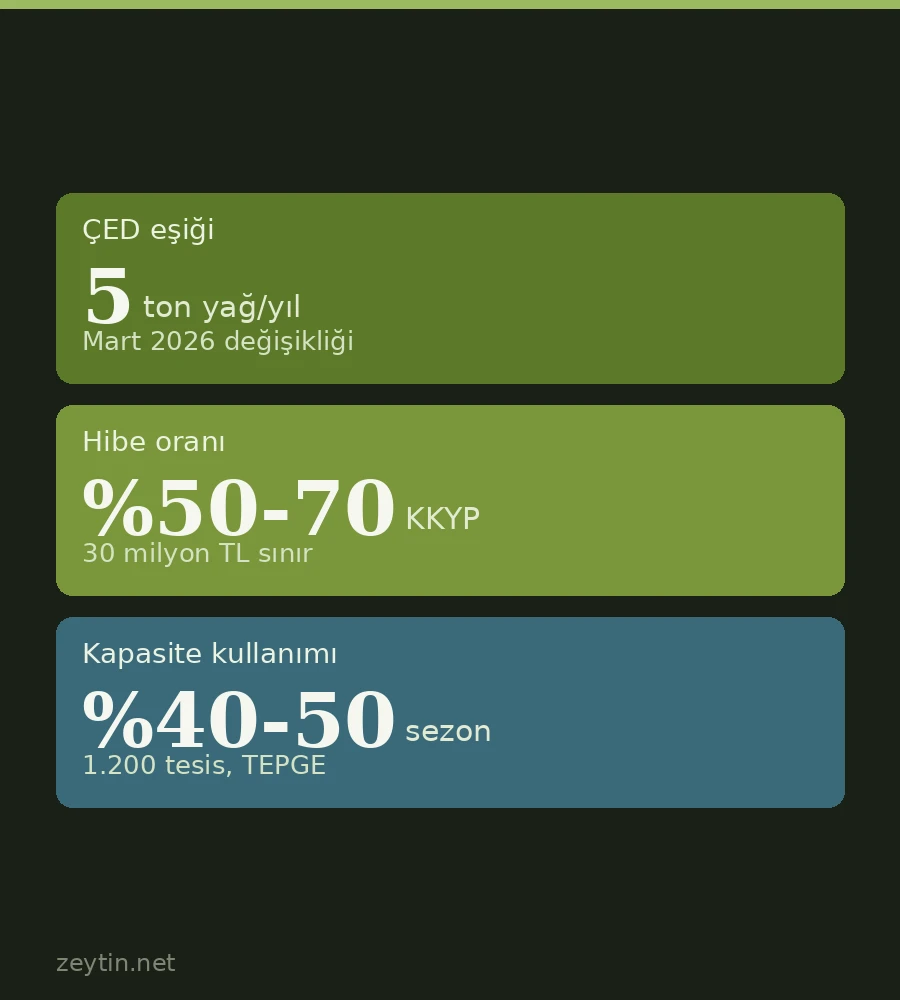
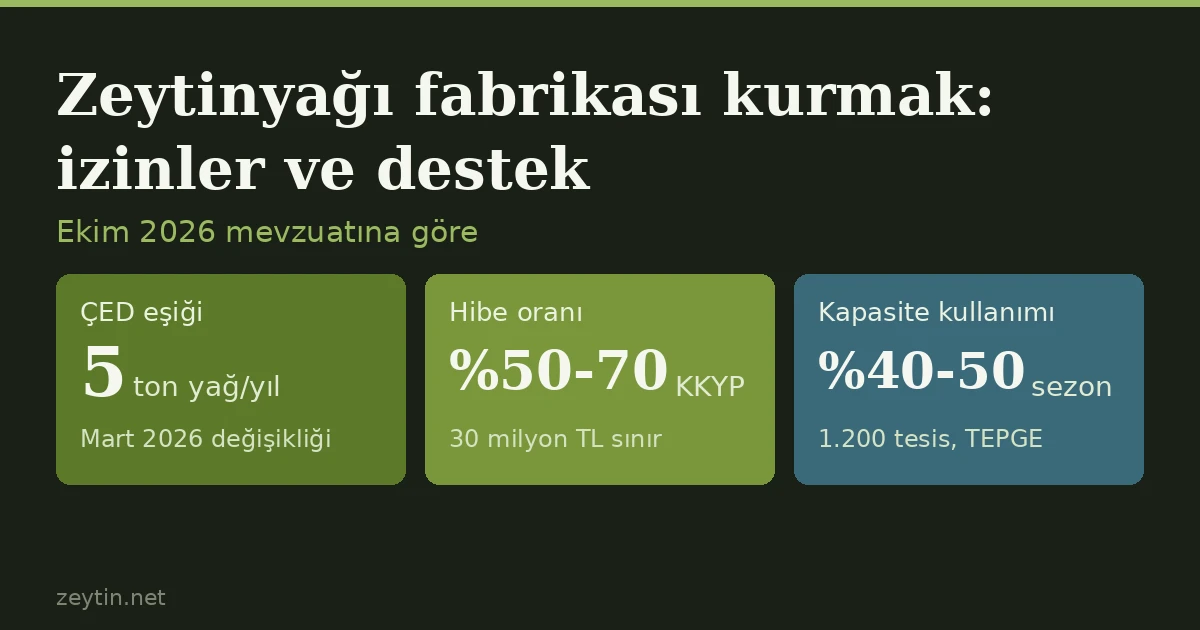
Since March 2026 every plant producing 5 tonnes of oil a year or more enters EIA screening; three-phase mills are no longer allowed and building within 3 km of olive groves needs Ministry permission. Grants cover 50-70%, but the sector uses only half its capacity.
Every harvest season reopens the same question in Turkey's olive districts: with this much fruit on the trees, why not build our own mill? The last week of October 2026 offered two examples at once. In Datça, a grant contract was signed to modernise the olive oil plant of a village cooperative; in Kemalpaşa, near İzmir, an Environmental Impact Assessment application was filed for a mill that is already operating. One is the support side, the other the permit side. This article walks through the gates an olive oil mill has to pass before it presses its first olive, in order, under the Turkish legislation in force as of October 2026.
First, the site: olive groves and farmland
The first question is land, not machinery. Article 20 of Law No. 3573 on the Improvement of Olive Growing bans facilities that emit dust, smoke or chemical waste inside olive grove areas and within 3 kilometres of them, and it explicitly exempts olive oil mills from that ban. The exemption comes with a condition. The article goes on to say that the construction and operation of olive oil mills and small agricultural processing plants in these areas is subject to the permission of the Ministry of Agriculture. In other words, a mill can be built next to the groves, but only with a permit. Olive grove areas are also listed as "sensitive zones" in the EIA Regulation.
If the plot is agricultural land, the second gate is Law No. 5403 on Soil Conservation and Land Use. Under its Article 13, agricultural land of any class may be used for agricultural structures with the permission of the provincial governor. The details are set by a new regulation on the protection and use of agricultural land published on 4 April 2026. The regulation does not name olive mills, so which definition a pressing plant falls under is left to the provincial directorate of agriculture.
EIA: the threshold is 5 tonnes of oil
This is where most people are surprised. Item 26 of Annex 2 of the Environmental Impact Assessment Regulation was amended on 5 March 2026 to read: "facilities producing 5 tonnes/year or more of crude or refined vegetable oil". A small mill pressing 1,000 tonnes of olives a year produces about 170 tonnes of oil at the average yield of around 17%, which is 34 times the threshold. In practice every commercial-scale mill enters the screening procedure and prepares a project information file. Plants producing 200 tonnes or more of crude oil per day are in Annex 1 and need a full EIA report straight away.
The Kemalpaşa application shows how the process works. According to the project information file as reported in the local press, the plant runs two decanters on a two-phase system; it processes 120 tonnes of olives a day and produces 24 tonnes of oil and 96 tonnes of pomace. According to the same file, the operator's previous application had been cancelled and an administrative sanction was served in March 2026. A missing permit does not close itself just because the plant is running.
Vegetation water: the three-phase era is over
The main environmental burden of a mill is its wastewater, known in Turkish as karasu ("black water"). According to the Environment Ministry's circular No. 2015/10, its chemical oxygen demand is between 50,000 and 220,000 milligrams per litre. The Water Pollution Control Regulation sets the discharge limit for olive oil production at 160 milligrams per litre; raw vegetation water is 300 to 1,400 times that limit. The ministry's technical brochure gives the difference in scale: a three-phase mill pressing 1,000 tonnes of olives a year generates about 1,200 m³ of wastewater, 900 m³ of which is vegetation water. In a two-phase system the same tonnage produces 250-280 m³; most of the water stays in the pomace.
That is why circular No. 2023/2 of 23 January 2023 required three-phase mills to switch to two-phase systems by 15 September 2023 and stated that those continuing would face sanctions under Environmental Law No. 2872. For a new mill the question is no longer two-phase or three-phase. Where evaporation ponds are used, the technical annex of the 2015 circular is detailed: at least 300 mm of compacted clay, a level difference of at least 2 metres from groundwater, and an impermeable liner at least 1 mm thick. Pomace, which is 50-70% water, is stored on site in ponds or closed silos and carried in sealed tankers. We have covered where the wastewater goes and the waste problem as a whole separately.
Municipal licence and capacity report
An olive oil mill is not a sanitary establishment but a non-sanitary establishment under Turkish licensing rules. The Regulation on Workplace Opening and Operating Licences ties the class to capacity:
| Definition in the regulation | Class | Licensing authority |
|---|---|---|
| Continuous-system olive oil production of 30 t/day or more | Class 1 | Metropolitan municipality where there is one |
| Continuous system below 30 t/day with olive processing of 100 t/day or more | Class 1 | Metropolitan municipality where there is one |
| Continuous-system olive oil production below 30 t/day | Class 2 | District municipality |
Outside municipal boundaries the licence comes from the special provincial administration, and inside an organised industrial zone from the zone's management. The capacity report required for the licence is issued, under the rules of the Union of Chambers (TOBB), by the chamber of industry, or by the chamber of commerce for businesses not required to register with a chamber of industry.
The food side: registration
Under the regulation on registration and approval of food businesses, olive oil production requires registration, not approval. The business must apply to the provincial directorate of agriculture within 30 days of receiving its operating licence and complete registration within three months. The rules that apply once production starts are in the Turkish Olive Oil and Pomace Oil Communiqué: no additive of any kind may be added to virgin olive oil, the term "cold pressed" may only be used for oil obtained below 27 °C, and oil sold to the final consumer must be pre-packaged. A grower who only wants to sell their own oil needs much less; we covered that in a separate article.
State support: three doors
| Programme | What it supports | Rate / ceiling | Status in 2026 |
|---|---|---|---|
| Rural Development Investment Programme (Communiqué 2026/9) | New plants, conversion from three-phase to two-phase | 50-70% grant, project up to TRY 30 million | Applications 29 April - 12 June, closed |
| TKDK IPARD III, Measure 3 | Machinery and equipment, processing and bottling lines | 50%, 70% for producer organisations; €30,000 - €1.25 million | 11th call closed on 20 July |
| Investment incentive certificate (2025 decree) | VAT exemption, customs duty exemption, tax reduction | Minimum investment TRY 6-12 million | Applications open until end-2030 |
The 2026 implementation rules of the rural development programme set a clear precondition for olive oil: an application for a new plant must include a two-phase process and comply with the 2015 wastewater circular. The grant rate rises to 60% for investments in villages and for young or women entrepreneurs, and to 70% for agricultural producer organisations. The Datça contract, according to press reports, comes from this programme. TKDK's IPARD support is open in all 81 provinces but does not cover construction: it finances machines, not buildings.
The real calculation: overcapacity
Legislation aside, the 2023 olive oil report of TEPGE, the Agriculture Ministry's policy research unit, gives the sector's capacity using National Olive and Olive Oil Council data: about 1,200 olive mills in Turkey, a combined capacity of roughly 70,000 tonnes a day and capacity utilisation of 40-50%. A rough check lands in the same place: over a 100-day pressing season that capacity equals 7 million tonnes of olives, while the olives pressed in the record 2024/25 season totalled 2.85 million tonnes, or 41%.
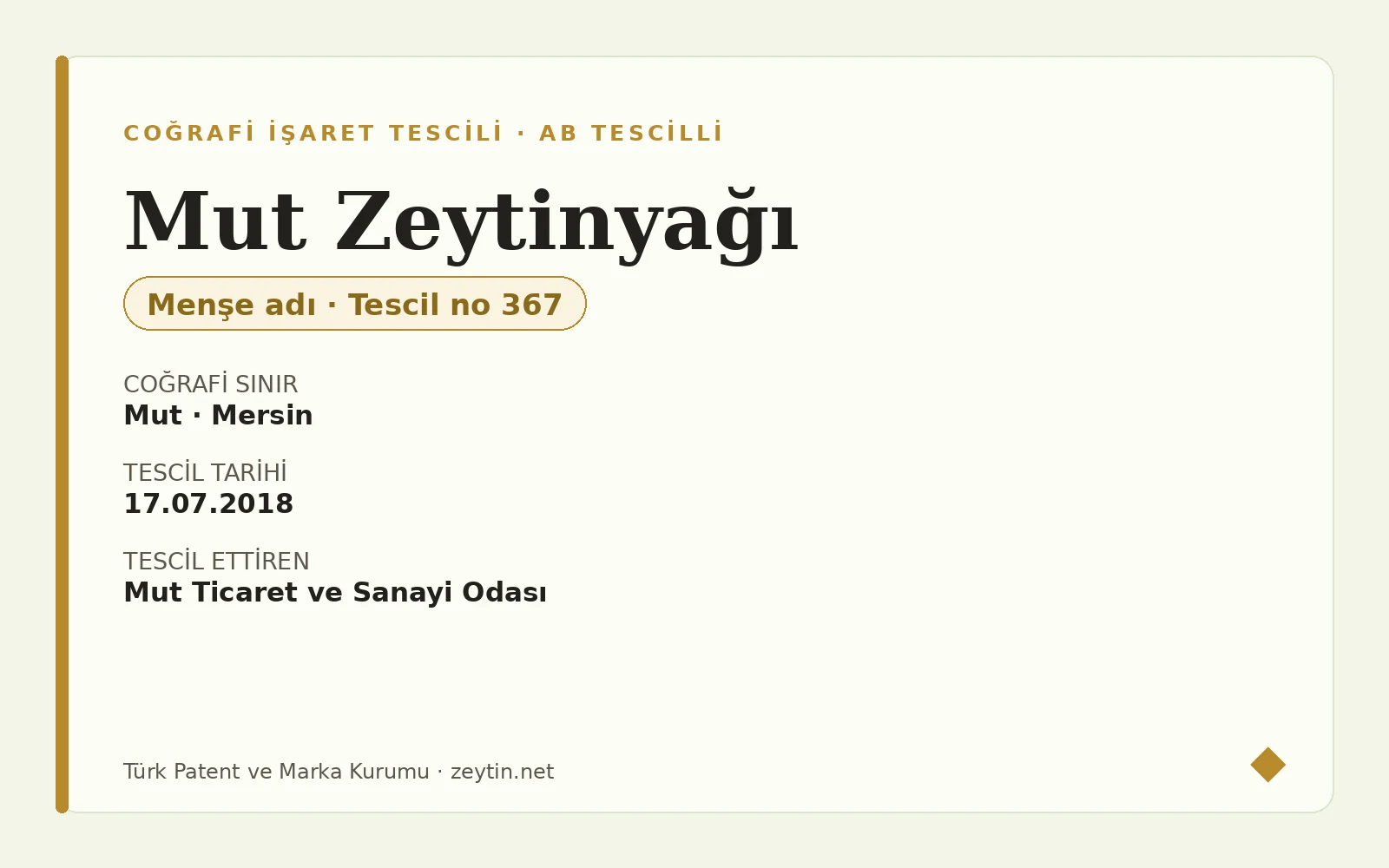
A new mill therefore does not enter an empty market; it competes with half-used mills. A field study of mills in Mut shows what that competition looks like on the ground. Sometimes the better option for growers is not building a plant but sharing an existing one: joining a cooperative is the oldest form of that.
The short order
1. Site: Ministry permission for proximity to olive groves, governor's permission if the plot is farmland, zoning status.
2. EIA: a project information file, or an out-of-scope decision.
3. Environment: a two-phase process, a pomace storage and transport plan, technical specifications if there is a pond.
4. Municipality: building permit, non-sanitary establishment licence, capacity report.
5. Food: registration application within 30 days.
6. Support: the next call calendar; check in the call guide whether spending made before the grant contract is eligible.
The rules change often: the EIA threshold was revised in March 2026, the farmland regulation in April 2026 and the grant communiqué also in April 2026. It is worth confirming the current text with the provincial directorates before applying.
One rating per visitor; you can change yours at any time. Ratings are real reader votes — no seeded or default scores.
Related
 Article
How to Store Olive Oil
Light, heat, air and time — the four enemies of olive oil. Why the bottle next to your stove is in the worst possible place.
 Article
What is lampante olive oil, and why can't it be eaten as it is?
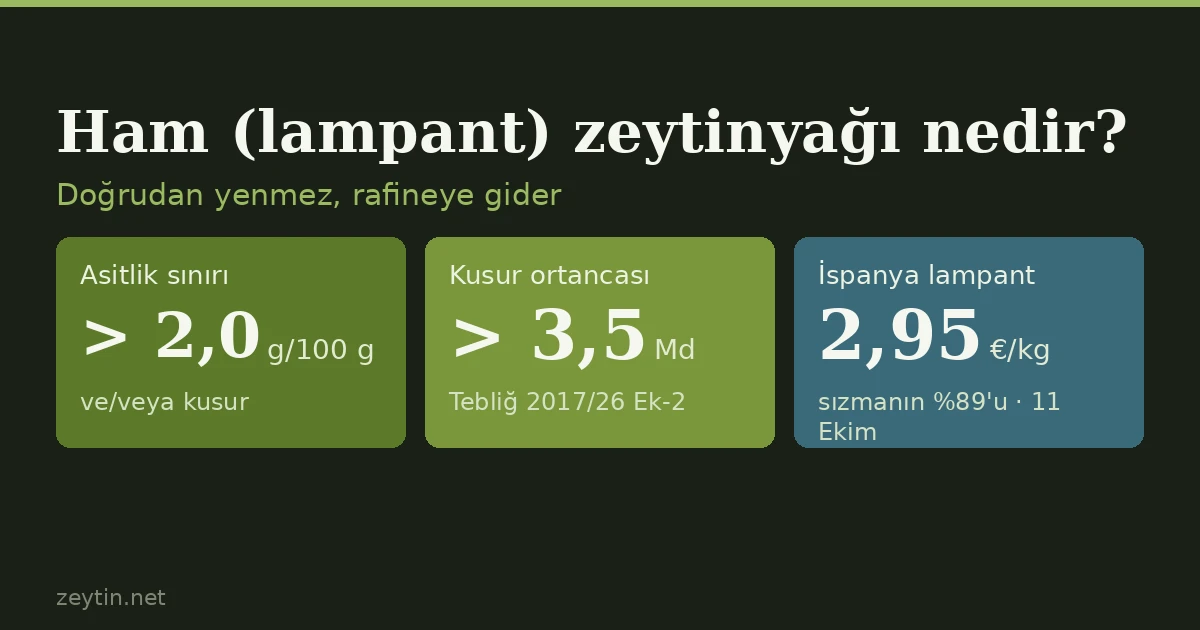
Crude olive oil — lampante, internationally — is oil obtained from olives by mechanical means alone but not considered fit for direct consumption, because its acidity exceeds 2.0 or the tasting panel's median of defects is above 3.5. At the refinery it becomes refined olive oil, and blended with virgin oil it becomes riviera. In the European Commission series for the week of 11 October, Spanish lampante stood at 2.95 €/kg, 89% of the extra virgin price; in Italy at 2.77 €, 63%.
 Article
How is olive oil acidity measured? Titration, the formula and taking a sample
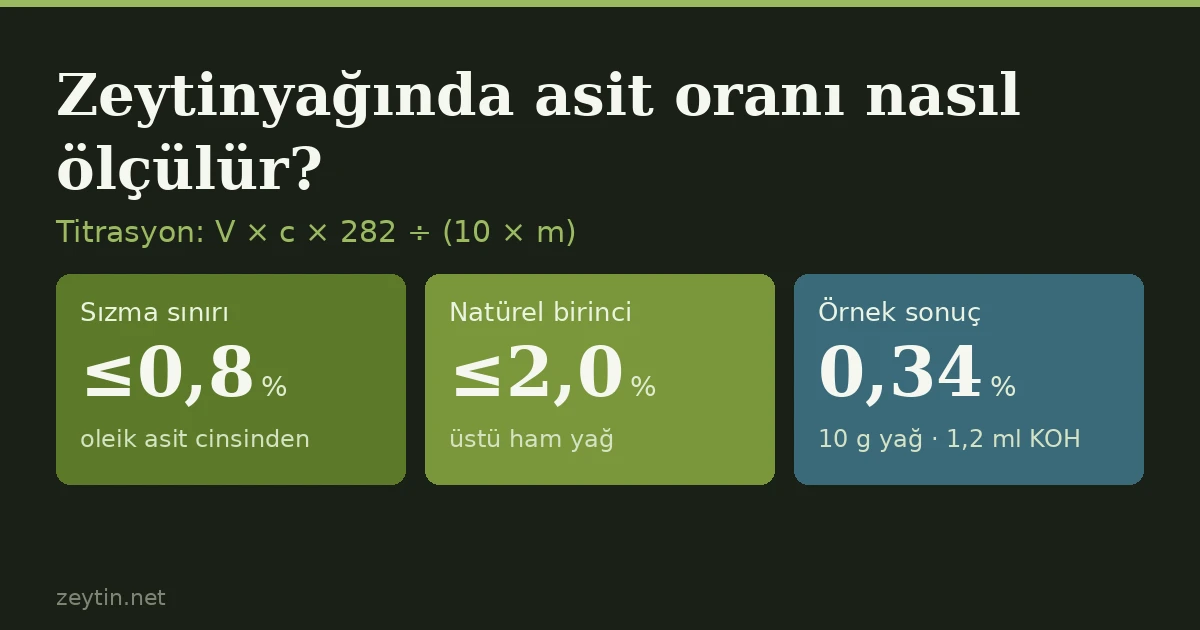
Olive oil acidity is measured in a laboratory by titration: the oil is dissolved in a solvent, free fatty acids are neutralised with potassium hydroxide, and the percentage is calculated as oleic acid from the amount used. The formula, a worked example, sampling and the limits of home test kits.
 Article
Mut Olive Oil: a landscape that needs no pesticide
The certificate's real claim rests on altitude and humidity: 10-40% relative humidity keeps out both the olive fly and peacock spot. That is why organic production is straightforward here.