Olive Oil
The difference between extra virgin, virgin, refined and riviera; what acidity means, how cold pressing works and how to store oil.
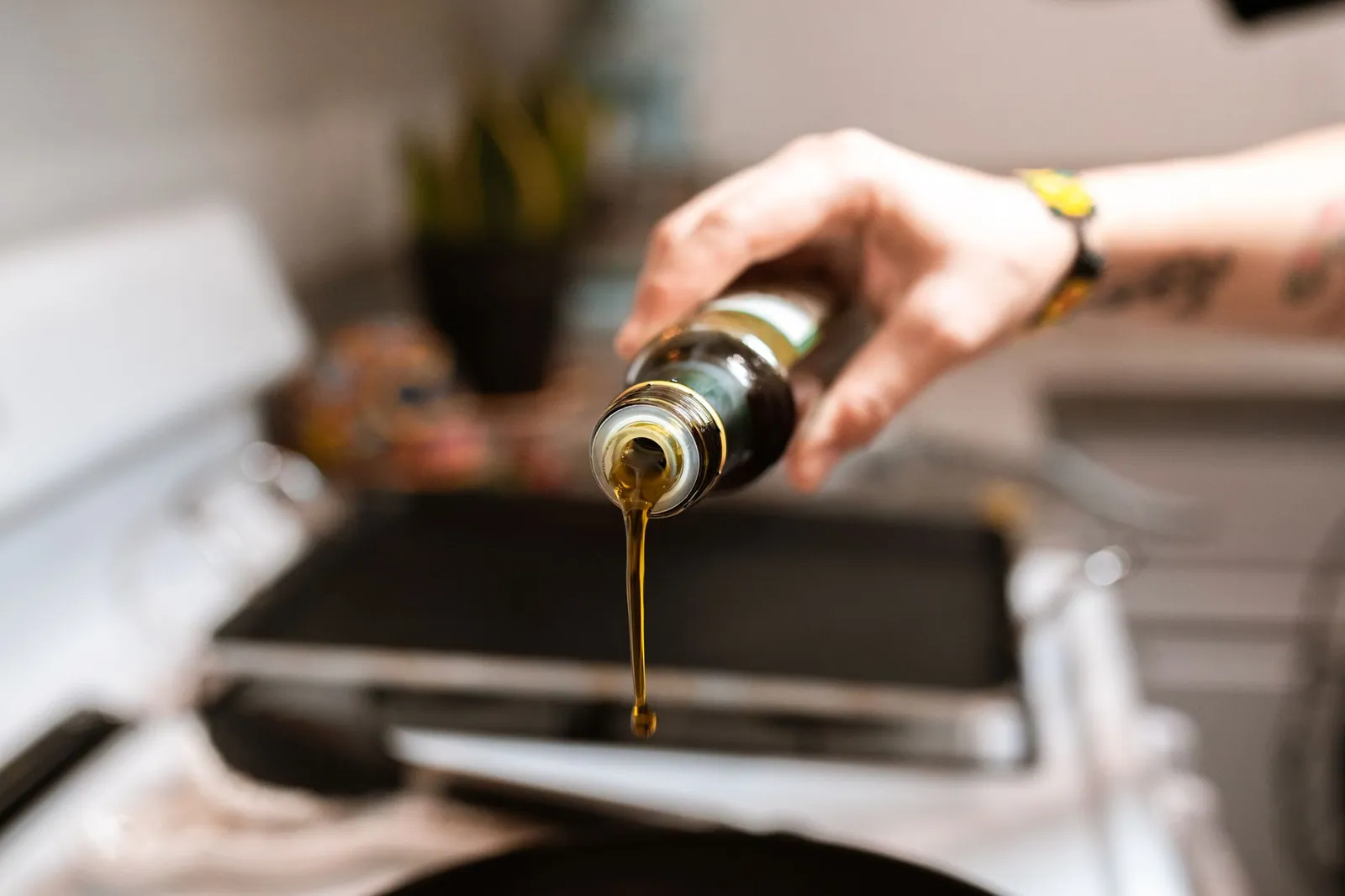
Olive oil is one of humanity's oldest and most valued foods. This "liquid gold" — once used as currency and sacred object — has become the darling of both the kitchen and health science.
How Is Olive Oil Produced?
- Harvest: Olives are gathered by hand or mechanically. Early harvest (green) gives sharper, more health-protective oil; late harvest (ripe black) gives higher yield.
- Washing and sorting: Foreign matter is removed.
- Crushing: Traditional millstones or modern steel discs grind the olives.
- Malaxation: The paste is slowly mixed to allow oil droplets to combine.
- Centrifugation: Oil, water and solids are separated.
🫙 Key Fact
True Extra Virgin Olive Oil is obtained by processing harvested olives within 24 hours and maintaining an acidity level below 0.8%. All chemical treatments are strictly prohibited.
Olive Oil Classification
| Grade | Acidity | Production | Use |
|---|---|---|---|
| Extra Virgin | ≤ 0.8% | Mechanical only | Raw, salads, finishing |
| Virgin | ≤ 2.0% | Mechanical only | Cooking, salads |
| Pure / Light | ≤ 1.0% | Refined + virgin blend | High-heat cooking |
| Refined | ≤ 0.3% | Chemical/heat process | Industrial |
How to Choose a Quality Olive Oil
- Smell: Fresh grass, tomato, green almond or fruit aromas signal quality.
- Taste: Good olive oil leaves a slightly bitter, pungent finish — this is the polyphenols at work.
- Packaging: Dark glass bottle or tin protects from light. Avoid PET bottles.
- Harvest date: Avoid oils with no vintage stated. Freshest is always best.
World Olive Oil Production
Around 3–3.5 million tonnes of olive oil are produced globally each year. Spain leads with roughly 45%, followed by Turkey, Italy, Greece and Morocco.
Cooking with Olive Oil
Olive oil's smoke point (around 190–207°C) is perfectly adequate for everyday home cooking. Extra virgin is ideal for salads and finishing; refined or pure olive oil suits very high-heat frying. Research shows extra virgin olive oil is far more heat-stable than most other vegetable oils.
One rating per visitor; you can change yours at any time. Ratings are real reader votes — no seeded or default scores.
Related
 Article
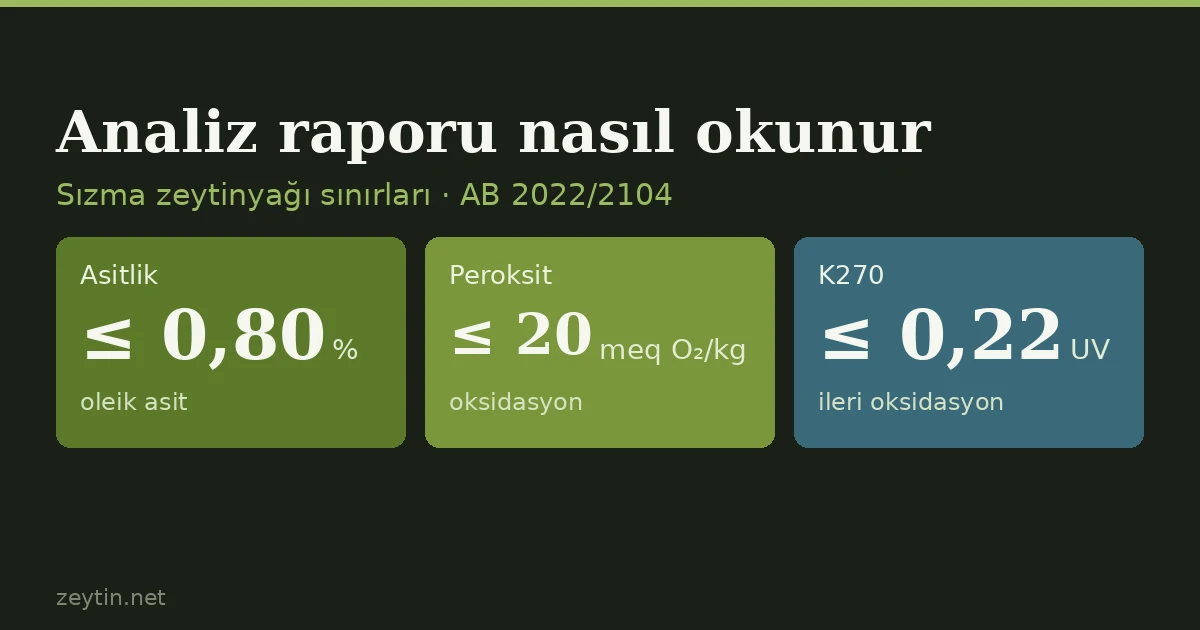
How to read an olive oil lab report: acidity, peroxide, K232, K270 and ΔK
The rows of figures on an olive oil lab report look cryptic at first. What do free acidity, peroxide value, K232, K270, ΔK, ethyl esters and sensory analysis measure, what are the limits for extra virgin and virgin grades, and how do you interpret a report using a worked example?
Article
How to read an olive oil lab report: acidity, peroxide, K232, K270 and ΔK
The rows of figures on an olive oil lab report look cryptic at first. What do free acidity, peroxide value, K232, K270, ΔK, ethyl esters and sensory analysis measure, what are the limits for extra virgin and virgin grades, and how do you interpret a report using a worked example?
 Article
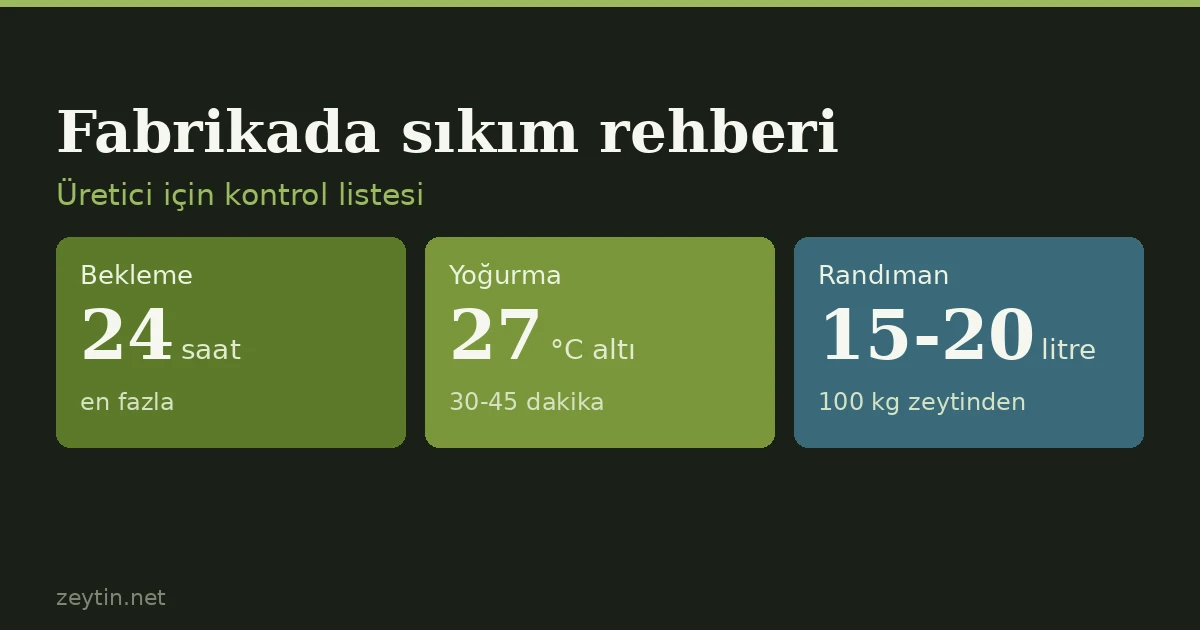
What to check when having your olives pressed at a mill: a grower's checklist
The same olives can give a very different oil when pressed at a different mill under different conditions. From what to do before bringing olives in to two-phase versus three-phase systems, kneading temperature, yield, milling fees and the questions to ask when collecting the oil, here is what a grower having olives pressed needs to know.
Article
What to check when having your olives pressed at a mill: a grower's checklist
The same olives can give a very different oil when pressed at a different mill under different conditions. From what to do before bringing olives in to two-phase versus three-phase systems, kneading temperature, yield, milling fees and the questions to ask when collecting the oil, here is what a grower having olives pressed needs to know.
 Article
Ödemiş Çekişte Olive Oil: a separate harvest window called “çakır”
Registered in 2020. The certificate names two harvest windows: early (green, November-December) and “çakır” (green turning pink, mid-December to mid-January).
Article
Ödemiş Çekişte Olive Oil: a separate harvest window called “çakır”
Registered in 2020. The certificate names two harvest windows: early (green, November-December) and “çakır” (green turning pink, mid-December to mid-January).
 Article
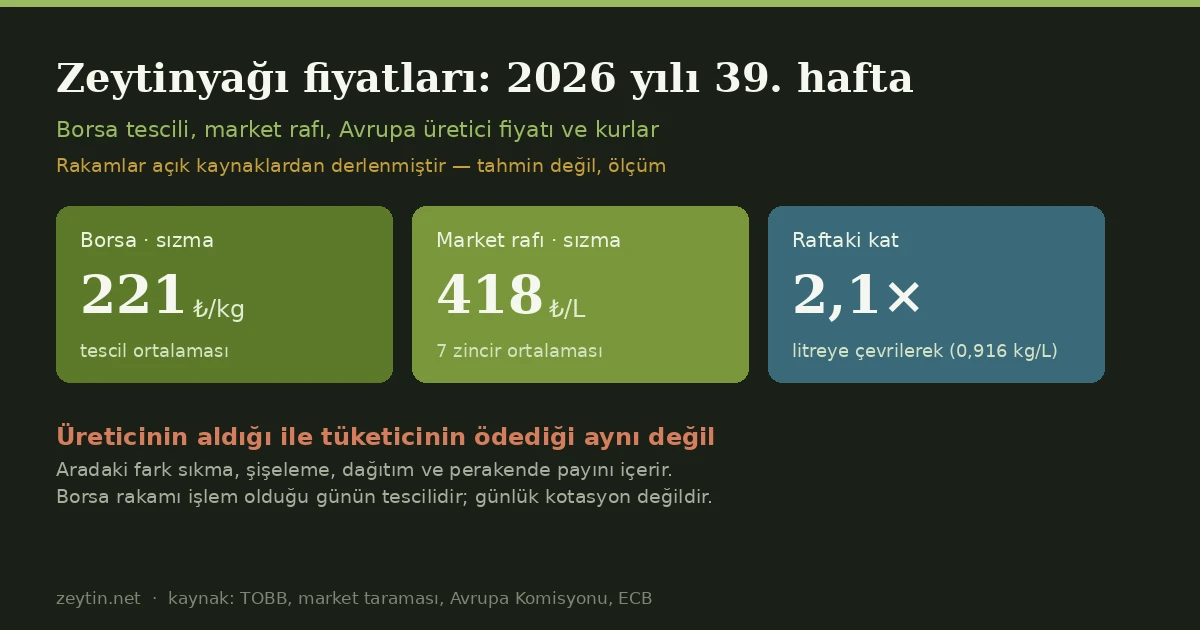
Olive Oil Prices: Week 39 of 2026
Week 39 of 2026: Turkish exchange prices, European producer prices and exchange rates side by side.
Article
Olive Oil Prices: Week 39 of 2026
Week 39 of 2026: Turkish exchange prices, European producer prices and exchange rates side by side.