How to Tell Good Olive Oil
Bitterness is a mark of quality, not a defect. Colour tells you nothing. The three attributes tasting panels look for, and a simple test at home.
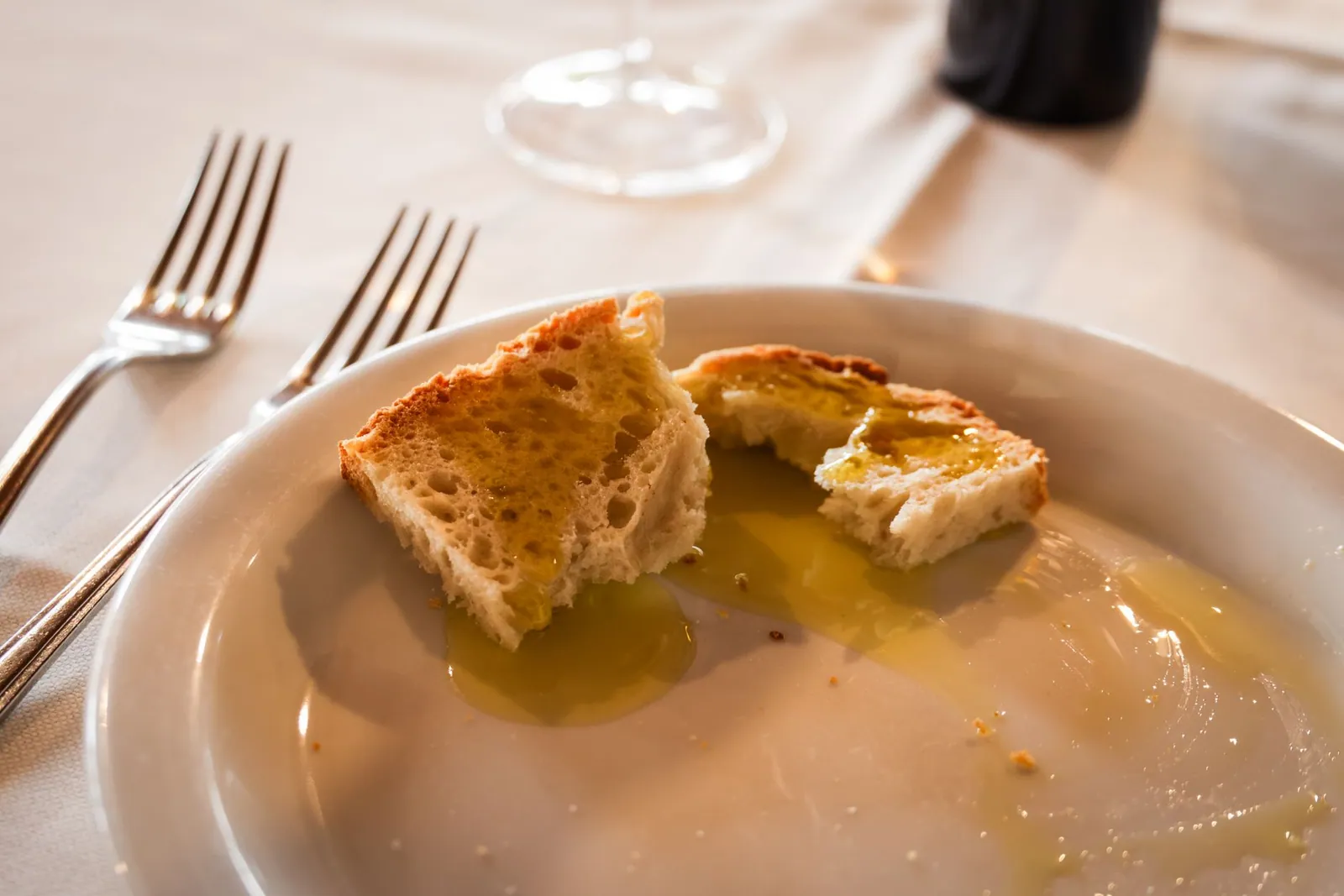
Most people judge olive oil by colour, assuming dark green means good. Colour in fact tells you nothing about quality. That is why professional tastings use dark blue glasses — the taster is not allowed to see the colour.
The three attributes panels look for
Fruitiness (fruttato). The aroma and flavour of sound fruit. Described as fresh grass, green apple, artichoke, tomato leaf, almond. Without it, the oil is either old or made from defective fruit.
Bitterness (amaro). A bitter note felt at the back of the tongue. Not a defect — it marks early-harvest oil rich in polyphenols. It fades over time.
Pungency (piccante). A tingling at the back of the throat, sometimes strong enough to make you cough. The compound behind it is oleocanthal, one of the oil's most valuable antioxidants. A good extra virgin makes you cough slightly on the first spoonful.
So an oil praised as "so smooth, not bitter at all" is usually low in polyphenols or simply old.
Defects
- Musty: olives kept in damp storage
- Muddy sediment: pulp left sitting in the oil too long
- Winey-vinegary: fruit that began to ferment
- Rancid: oxidised oil — smells of old paint or stale walnuts
If any of these are present, the oil cannot be classified as extra virgin.
A simple tasting at home
1. Pour a tablespoon into a small glass and warm it in your palm (30-35°C).
2. Cover the glass, swirl, then smell: fresh, or paint and mould?
3. Take a small sip, spread it over your tongue and draw air through your teeth — this is the only way the aroma opens up.
4. Swallow and pay attention to your throat: tingling or a slight cough is a good sign.
What to check on the label
- Grade: it must say "extra virgin"; a bottle labelled only "olive oil" is riviera
- Harvest year: rarely printed, yet the most important detail. Olive oil does not improve with age.
- Origin: which region
- Packaging: dark glass or tin. Oil in a clear bottle has been exposed to light.
- Acidity: low is good but not sufficient on its own
How does variety shape flavour?
Turkey's main oil varieties each give a different character:
- Ayvalık (Edremit): balanced, notes of almond and green apple, medium bitterness. The Aegean classic.
- Memecik: the Muğla-Aydın belt. More pronounced bitterness and pungency, grassy character.
- Gemlik: mainly a table variety; its oil is soft with little bitterness.
- Nizip Yağlık: the southeast. Full-bodied, spicy.
- Domat, Uslu: generally table olives; low oil yield.
Among foreign varieties, Picual (Spain) is robust and stable, Koroneiki (Greece) intensely aromatic, Arbequina (Spain) mild and fruity.
Even the same variety tastes different from year to year; climate, rainfall and harvest timing all matter.
New oil, old oil
The fresh oil that appears in November and December is cloudy, bitter and pungent. Some people dislike this sharpness. Over a few months the edge softens and the aroma settles.
But softening is only good up to a point: in oil over a year old, bitterness and pungency fade because the polyphenols are spent. So "smooth" can mean two different things — rested fresh oil, or tired old oil. Fruitiness tells them apart: fresh oil smells alive, old oil smells flat.
How is olive oil adulterated?
Olive oil is among the most frequently adulterated foods in the world. Common methods:
- Blending refined oil into extra virgin
- Adding sunflower, canola or soy oil
- Selling pomace oil as olive oil
- Colouring low-grade oil with chlorophyll
Consumers usually cannot detect these by taste. Practical protection: buy from known producers, be suspicious of very cheap bottles (if the cost maths does not work, something is missing), and prefer brands that publish analysis reports.
Reading how it was stored
What you can check while holding the bottle in the shop:
- Is the bottle clear glass? Then it has been exposed to light.
- Is the shelf under display lighting?
- Is there a harvest date, and how long ago was it?
- Is there excessive sediment and cloudiness at the bottom?
These four tell you more than the acidity figure on the label.
One rating per visitor; you can change yours at any time. Ratings are real reader votes — no seeded or default scores.
Related
 Article
Does olive oil solidify in the fridge?
Olive oil solidifies in the fridge, but this is not a purity test: sunflower and canola oil do the same. The rate depends on variety and fatty acid composition.
Article
Does olive oil solidify in the fridge?
Olive oil solidifies in the fridge, but this is not a purity test: sunflower and canola oil do the same. The rate depends on variety and fatty acid composition.
 Article
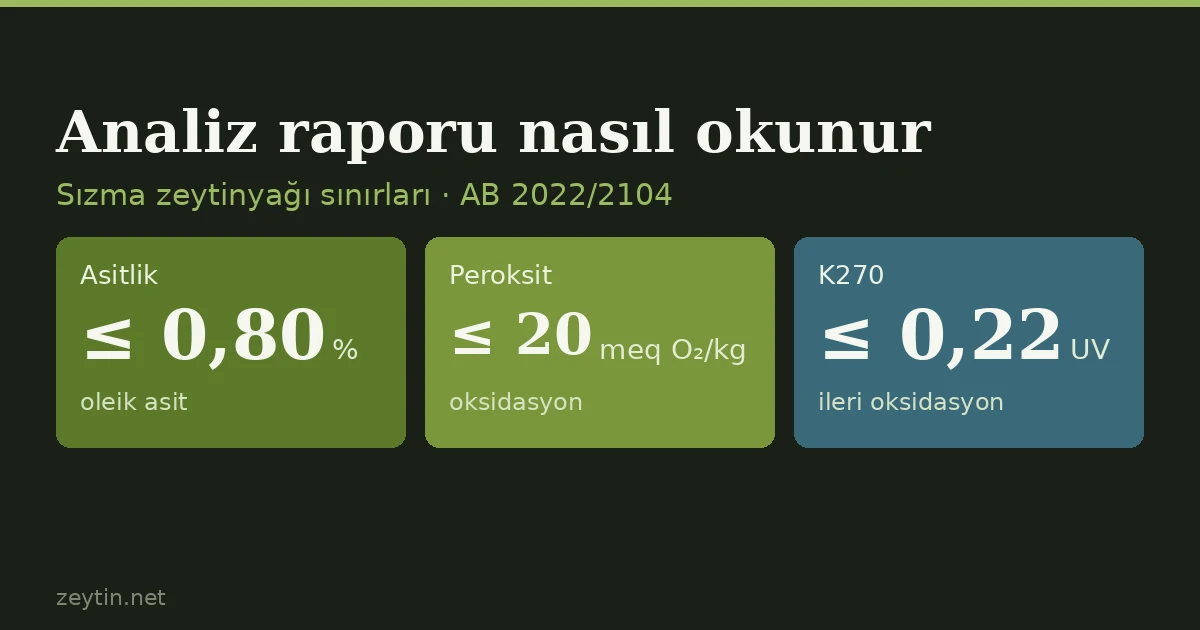
How to read an olive oil lab report: acidity, peroxide, K232, K270 and ΔK
The rows of figures on an olive oil lab report look cryptic at first. What do free acidity, peroxide value, K232, K270, ΔK, ethyl esters and sensory analysis measure, what are the limits for extra virgin and virgin grades, and how do you interpret a report using a worked example?
Article
How to read an olive oil lab report: acidity, peroxide, K232, K270 and ΔK
The rows of figures on an olive oil lab report look cryptic at first. What do free acidity, peroxide value, K232, K270, ΔK, ethyl esters and sensory analysis measure, what are the limits for extra virgin and virgin grades, and how do you interpret a report using a worked example?
 Article
Ödemiş Çekişte Olive Oil: a separate harvest window called “çakır”
Registered in 2020. The certificate names two harvest windows: early (green, November-December) and “çakır” (green turning pink, mid-December to mid-January).
Article
Ödemiş Çekişte Olive Oil: a separate harvest window called “çakır”
Registered in 2020. The certificate names two harvest windows: early (green, November-December) and “çakır” (green turning pink, mid-December to mid-January).
 Article
Extra Virgin, Virgin, Riviera: Olive Oil Grades Explained
What do 'extra virgin', 'riviera' and 'refined' mean on the label? The difference lies in the production method and acidity.
Article
Extra Virgin, Virgin, Riviera: Olive Oil Grades Explained
What do 'extra virgin', 'riviera' and 'refined' mean on the label? The difference lies in the production method and acidity.