The Edincik Su olive: the third black-table cultivar
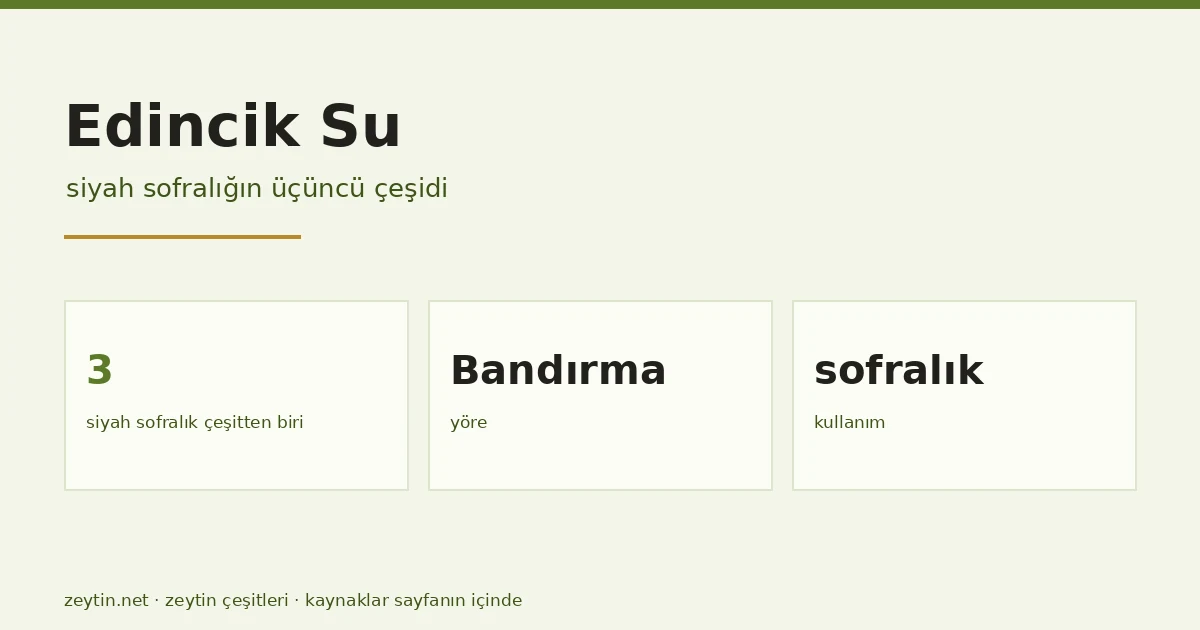
One of the three cultivars widely processed as black table olives in Turkey, alongside Gemlik and Uslu. The cultivar of the Bandırma area.
Three varieties are widely processed as black table olives in Turkey: Gemlik, Uslu and Edincik Su. Edincik Su belongs to the Bandırma area of Balıkesir and takes its name from the town of Edincik.
Edincik Su in numbers
| Property | Value | Note |
|---|---|---|
| Main use | black table olive | same group as Gemlik and Uslu |
| Place in the table-olive ranking | top nine | Canözer classification |
| Region | Balıkesir · Bandırma · Edincik | southern Marmara |
Holding together when ripe
Being processed black means the fruit is picked fully ripe — and not every variety can take that: as the fruit ripens it softens, it can break up in brine, and the skin can wrinkle.
That Edincik Su is named alongside Gemlik and Uslu shows it holds its structure at black ripeness. It also appears on the list of Turkey's most important table varieties: Gemlik, Ayvalık, Domat, Memecik, Erkence, Uslu, Eşek Zeytini, Yamalak Sarısı and Edincik Su.
The variety spread of Marmara
Because Marmara olive growing stands in Gemlik's shadow, the region's other varieties are little known. Yet there are several local ones: Karamürsel Su, Şamanlı, Eğriburun and Edincik Su.
The Bandırma area also shows up in exchange records — Turkey's olive registration data holds a limited number of entries from the Bandırma Commodity Exchange.
Missing data
No verified published source was found giving fruit weight, oil content, flesh-to-stone ratio or chilling requirement for Edincik Su. This page does not fill those values in by estimation.
In short
Edincik Su is one of the three main varieties processed as black table olives in Turkey, and the local variety of southern Marmara. Its ability to hold together at black ripeness is what places it in that group. Pomological measurement data is limited.
Note on sources
The pomological and chilling values on this page come from a comparative trial of Turkish and foreign olive varieties conducted under Adana conditions. Properties without a measurement have not been filled in by estimation; they are left blank.
Turkey's full variety distribution and comparative tables: olive varieties.
Registered names built on this variety
The registration covers the product of a defined area — not this variety wherever it is grown.
- Edincik Zeytini designation of origin · reg. no 1556
- Edincik Su Zeytinyağı designation of origin · reg. no 1595
Where it stands among measured varieties
Zeytin Kitabı — Efe, Soykan, Cürebal, Sönmez (2016) s.37-80
Zeytin Kitabı — Efe, Soykan, Cürebal, Sönmez (2016) s.37-80 — bu çeşidin ölçüm takımı bu çalışmadan (2 kaynak arasından)
Zeytin Kitabı — Efe, Soykan, Cürebal, Sönmez (2016) s.37-80 — bu çeşidin ölçüm takımı bu çalışmadan (2 kaynak arasından)
Zeytin Kitabı — Efe, Soykan, Cürebal, Sönmez (2016) s.37-80 — bu çeşidin ölçüm takımı bu çalışmadan (2 kaynak arasından)
Türkpatent Coğrafi İşaret Tescil Belgesi — Edincik Zeytini, 100 meyve 250-600 g
Values are those published on each variety's own page; the comparison covers only varieties with a measured figure, so it is a comparison of what is known — not of every Turkish variety. See the full ranking and how it is built →
One rating per visitor; you can change yours at any time. Ratings are real reader votes — no seeded or default scores.
Related
 Article
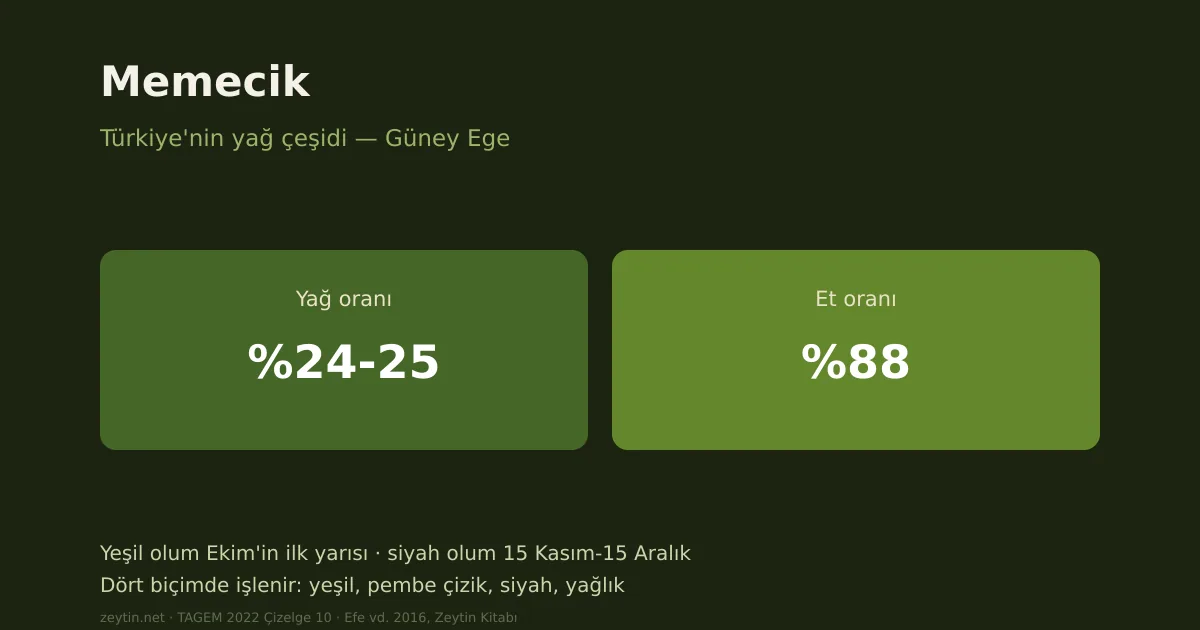
The Memecik olive: Türkiye's oil variety
Between 19% and 45% of the tree stock. 24-25% oil, 88% flesh. Green maturity in early October, two months after Gemlik.
Article
The Memecik olive: Türkiye's oil variety
Between 19% and 45% of the tree stock. 24-25% oil, 88% flesh. Green maturity in early October, two months after Gemlik.
 Article
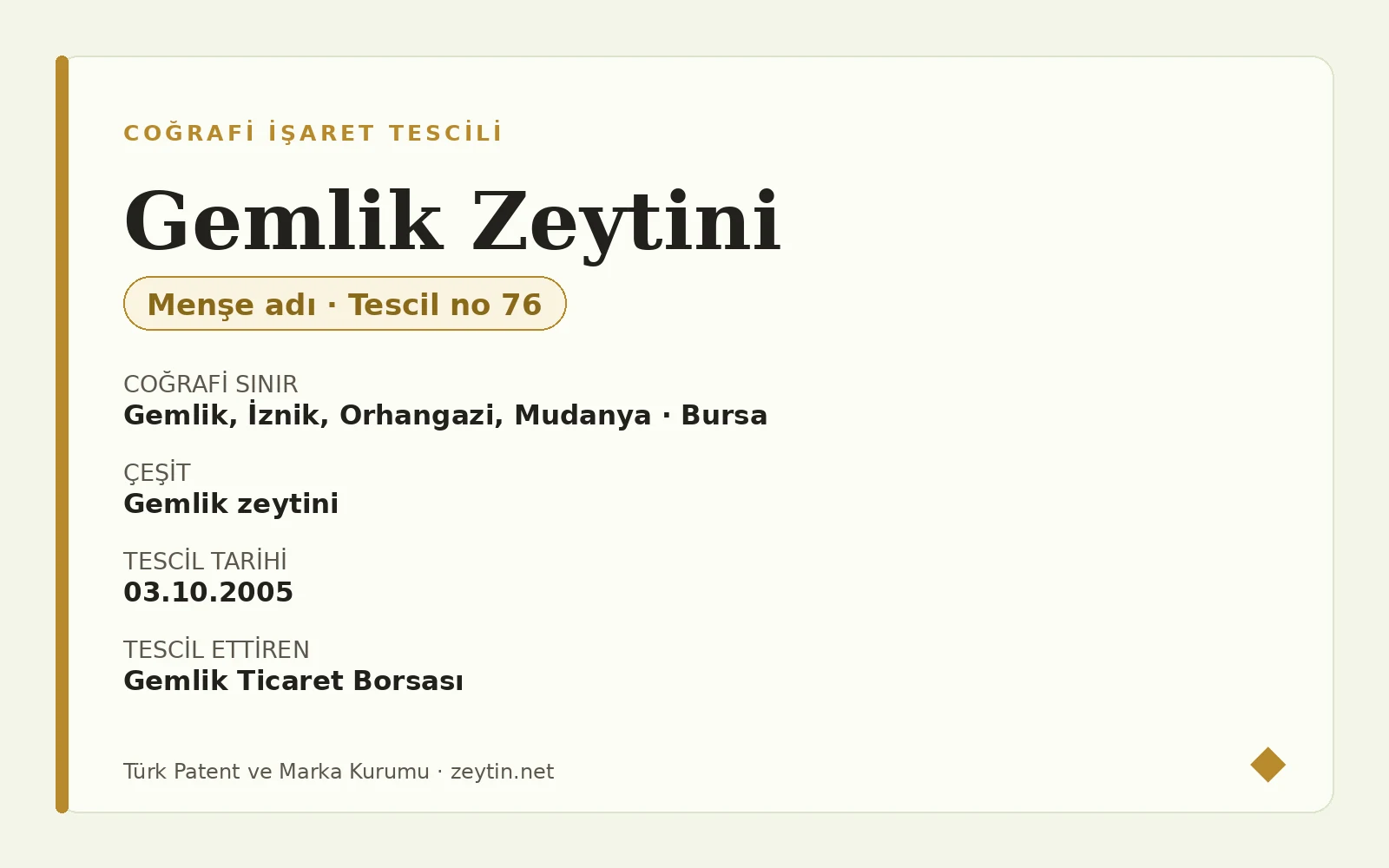
The Gemlik Olive designation of origin: what the certificate says
Turkey's first registered olive (2005, no 76). The certificate defines four districts, three cultivars, four curing methods and seven size grades — all of them binding.
Article
The Gemlik Olive designation of origin: what the certificate says
Turkey's first registered olive (2005, no 76). The certificate defines four districts, three cultivars, four curing methods and seven size grades — all of them binding.
 Article
Tavşanyüreği olive
Tavşanyüreği is a recorded variety of the Mediterranean. Described in the source.
Article
Tavşanyüreği olive
Tavşanyüreği is a recorded variety of the Mediterranean. Described in the source.
 Article
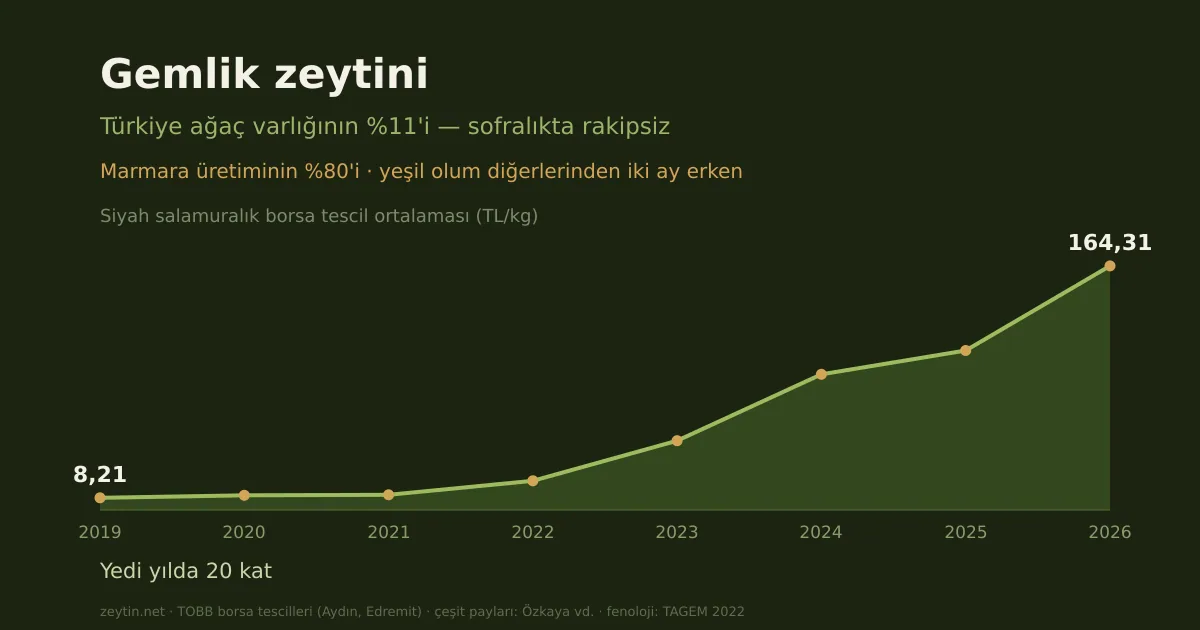
The Gemlik olive: small fruit, six times the flesh
Turkey s only olive cultivar with a geographical indication: 3.7 g fruit, a 6.4 flesh-to-pit ratio, 29-30% oil. Self-fertility measurements, chilling requirement, and why it is still picked by hand.
Article
The Gemlik olive: small fruit, six times the flesh
Turkey s only olive cultivar with a geographical indication: 3.7 g fruit, a 6.4 flesh-to-pit ratio, 29-30% oil. Self-fertility measurements, chilling requirement, and why it is still picked by hand.